Samson’s A Theatre for Dreamers

Set on the Greek island of Hydra in the 1960s when it was a writers and artists’ colony, Polly Samson’s A Theatre for Dreamers has been my lockdown escapist’s treat.  The writing is delicious, a full-sensory experience of seeing the purple bougainvillea, inhaling the fragrance of the sea air and tasting the icy liquorice of the raki.

Borrowing from the true life stories of Hydra’s bohemian inhabits, the main story revolves around the narrator Erica, a new arrival to the island. Following the death of her mother, Erica, who’s in her late teens, and her slightly older brother have escaped England and their brutal dictatorial father. While her brother pursues the artist’s life, along with plenty of sun, sex and sand, Erica dabbles in writing and in her boyfriend. But she’s really on the island to talk to Australian writer Charmian Clift, who knew Erica’s mother. Charmian becomes something of a reluctant mentor to young Erica, scolding her for supporting her boyfriend’s creative aspirations over her own. In time Charmian recognises herself in this as she plays muse and literary coach to her husband George Johnson. Their real-life turbulent literary partnership is well documented.

A titillating subplot weaves its way through the narrative, involving a young Leonard Cohen at a point when he falls in love with Marianne Ihlen, who was on again and off again, though eventually separated from the artist Axel Jensen. Cohen and Ihlen’s relationship lasted many years, unlike most on this island of free-love, and has been immortalised by some of Cohen’s own poems and more recently by the Netflix documentary Marianne and Leonard: Words of Love.

Sidebar: I’m not a Leonard Cohen fan. Can I say that without getting trolled? I like some of his songs and his poems even more, but I simply do not understand the cult-like adoration.

Back to Samson’s exhilarating and beautiful book. Ultimately, it is a meditation on creativity and relationships, showing how together they can take form, crack and break.

For writers interested in biography or fictions based on true lives, the acknowledgements at the end are worth reading. The author gathered materials from interviews, some on radio and TV, some of her own, pieced together with memoirs and other artefacts. Some of the characters’ dialogue comes from their actual words.

For you Cohen fans, I close on Cohen’s description of life in Hydra: ‘There is nowhere in the world where you can live like you can in Hydra, and that includes Hydra.’

Leonard Cohen with Marianne et al
Leonard Cohen, Marianne Ehlen (and her son), George Johnson and Charmian Clift. Photo by James Burke


Rethinking Nature

With the lockdown, many us of have had the pleasure of observing more creatures, breathing in palatably cleaner air and hearing birdsong on a scale never heard before. In some online circles, this has produced a ‘back to nature’ movement that goes far beyond the obvious need to reduce greenhouse gases to save our planet from becoming an over-heated death trap. Sorry to be so grim.

The Observer columnist Kenan Malik rightly criticised this wave of naïveté, its meme ‘The Earth is healing, we are the virus’ and much of the pro-nature public discourse around it (10 May 2020). It’s not that climate change or the toxic environment we live in are desirable. Far from it. But should we let nature take complete control?

For the first time ever I have seen goldfinches in a park and a private front garden in our town of Ely.

Nature is not entirely benign. I’m reminded of Tennyson’s image of nature as ‘red in tooth and claw.’ There is a litany of natural disasters that have destroyed homes and livelihoods and have brought about disease and taken lives for centuries. Humans have reduced some of the impact of these disasters by engaging in some nature-defying sciences and technologies for which any sentient being is grateful.

I inhale the cleaner air and notice the quieter streets as I jog through town.

Malik argues that romanticising nature is the preserve of those who live in rich countries with electricity, transport systems and access to medicine. I see the truth in this and saw this idea crop up a few days later when I was watching a lockdown YouTube video from the Royal Academy of Arts (Painting the Modern Garden: from Monet to Matisse). One of the expert horticulturalists pointed out that with modernity came the growth of the middle classes and the idea of creating gardens for pleasure.  That is, gardening was no longer just about growing the potatoes and other veg to sustain lives. At least not in richer countries and this is still true today.

I have never seen an orange-tip butterfly until two weeks ago.

I’m left both enlightened and uneasy with Malik’s conclusion: ‘It is the poor, whether in rich countries or the global south, who must suffer from industrial pollution, are most imperilled by climate change and most threatened by the consequences of coronavirus. This is not because humans are violating nature, but because societies are structured in ways that ensure that innovation and development remain the privilege of the few, while deprivation and ill health are the lot of the many.’

This could be misread as a denial of humans violating nature. I trust that Malik knows that humans have violated nature, but they have also fought it in order to save lives, as Malik notes in his examples. It is also true that social inequalities have played a huge role in the climate crisis we are now confronted with. I think we can acknowledge these points, stay clear of romanticising nature, while still appreciating the ways nature has been showing off while much of the industrial world is in lockdown.

ely jog

A Dip into Biographies

Like many of you during lockdown, I’ve invaded my bookshelves to reread or finish reading books that have accumulated dust. Among these I uncovered a couple biographies. I had started reading Deidre Bair’s highly acclaimed biography of Simone de Beauvoir some twenty-five years ago when it first came out, but for some reason, I had abandoned it before the part where Simone meets Jean Paul Sartre. I’m past that part now and realise that this is a worthwhile read, especially since the author interviewed her subject on several occasions, something historical biographers can only dream of. Some of the best books I’ve read on the life of Shakespeare have been more about the socio-cultural and political context of the time than on the bard himself (such as works by  Anthony Holden and James Shapiro).

For me, the gems of these lockdown biographies can be found in biographical essays. I’ve recently read, from one of the musty half-read books on my shelves, an essay by Clive James on Mark Twain’s life as a journalist. Here you have the highly quotable James writing about the highly quotable Twain. Example:

‘Every subsequent American humour writer writes in the range of tones established by Twain. When Thurber says of his fellow economics student the football player Bolenciecwcz that ‘while he was not dumber than an ox he was not any smarter,’ he is in touch with Twain.’Biographies 2

Another biographical essay that’s come my way during the lockdown is from the New Yorker. Vinson Cunningham’s essay on playwright Lorraine Hansberry, best-known for writing ‘A Raisin in the Sun,’ reflects on Hansberry’s life as a writer and political thinker, mixing biographical details with her writing output. Cunningham explains that when Hansberry discovered playwriting, ‘The theatre, with its urge to make the interior visible, and to force contradictions through the refiner’s fire of confrontation, was a perfect vehicle for her to develop both her politics and her art.’

Perhaps in their brevity, these essays have benefitted from needing to focus on one aspect or a certain time period of a person’s life. An issue I have with book-length biography and many a bio-pic is that they can suffer on trying to cover the full life, even the dull patches of childhood, in desperate attempts to explain how the notable person became notable. Clunky writing ensues.

When it comes to biographies, I’ve only dabbled in the essay form myself, including ‘Virginia Wolfe’s Teeth’ and an essay-type piece on C.S. Peirce for the Literary Encyclopedia. Even if the end product was small, writing such pieces was enlightening and gratifying. Despite having garnered no inspiration whatsoever from the lockdown itself, at least the circumstances have led to these stimulating pieces that make me want to pursue the biographical essay again.

Dear Reader, keep reading and stay safe.

Biographies 3
Lorraine Hansberry

The Semiotics of Lockdown Signage

This blog’s title is grander than this blog could possibly be. As a blogger, my linguist’s hat is being worn slightly askew as I write this – I’m sparing you, dear reader, a heady mix of semiotics and multimodal analysis that a more academically competitive linguist might offer. This is just a small sharing of the signage I’ve noticed in recent weeks as David and I have covered every corner and every walking path in Ely, usually with shopping bags in tow in order to distinguish the outing from our daily exercise outing of running/jogging.

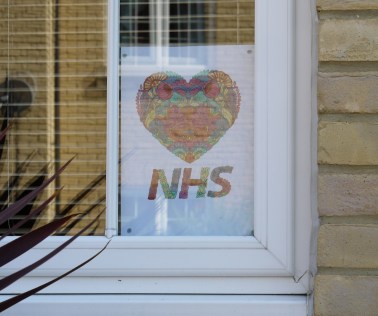
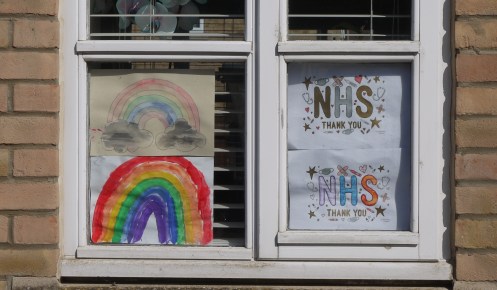
While many of us are communicating with the world outside our homes via social media, Zoom, Skype and phone calls, others have taken to their window panes. The rainbow campaign to involve children in a productive and positive way during their confinement at home has grown into an art from for some and a means of protest for others of all ages.

P1010811
This one is more specific than most, referring to our local hospital, Addenbrookes. The images of stethoscopes and plasters etc are emoji-like.


P1010815
Sticking with a rainbow palette, the heart symbol, perhaps overused in our culture, sends the message.

Saying thank you to strangers who are not present in front of us is an interesting act in itself. But that is essentially what we’re doing. The intended recipient – the NHS worker – is likely not to see the sign, ever. The intended audience then are the passers-by, our neighbours, our fellow town residents – who else could it possibly be given the restrictions of the lockdown? Despite the limited audience in this public discourse, at least with window panes, one is less likely to be trolled by a stranger or feel obliged to answer or click ‘like’ to any comments.


The use of semiotic resources of colour and shape along with recognisable texts of our times, phrased as imperatives (stay safe, stay at home etc.), communicate emotions more than orders.  On some streets, the rows of townhouses with children’s rainbows create a wallpaper effect, turning houses inside out.

P1010816
This window presents a mini-narrative, suggesting before (grey clouds and letters) and after (rainbow colours).
P1010797
The text is not just a thank you, but a socio-political protest cheekily written in the rainbow colours.

I feel I have to say something about the signage of businesses around our little town. Most are the rather prosaic black ink on white paper, usually type print, occasionally handwritten, saying simply ‘Coronavirus – Closed until further notice.’ One of our local pubs  added political commentary, well wishes and indirect advertising into the mix:

P1010799

I close, as these walks often do, with a trip to the supermarket and the signage on the ground of the carparks. These signs that have forced our behaviours to change will likely be one of the more poignant memories I’ll have when I look back on this time.

P1010808

Stay safe, everyone.


Hannah Kent’s Burial Rites

It’s a sad story that doesn’t make you miserable. Quite the contrary. I would even add it to the list of sad things that bring pleasure, up there with paintings by Edward Hopper and Ravel’s Pavane pour une infante défunte.

Hannah Kent’s debut novel Burial Rites uncovers the life of Agnes, a murderess, sentenced to death in Iceland in the early 19th century. The illegitimate daughter of a poor servant, who abandoned her when she was a child, Agnes also enters a precarious life of service. The reader learns of Agnes’s early years in retrospect and interspersed with the novel’s present day, where the lack of prison facilities in sparsely populated Iceland means Agnes is sent to live with a local official and his family until her execution. The wife, Margrét, and two daughters, Lauga and Steina, take Agnes in as a matter of duty but grapple with their emotions, ranging from fear to fascination. During this time, Agnes is required to have her soul cleansed by the apprentice Reverend Tóti in preparation for her death, hence the title.

Despite the bleak setting, taking the reader from the short days of autumn to the even shorter days of winter, in a world where life is hard and death often brutal, this is a heartening tale, full of richly drawn characters and their inner journeys. The family and the reverend grow from their interactions with Agnes. As they share the harsh quotidian of rural life, Margrét and Agnes develop a sisterly bond. Reverend Tóti  soon realises that the fire and brimstone approach would never work with Agnes, who knows her scriptures as well as he does, and learns the power of listening and that much of what he thought was true was riddled with misjudgements and superstition.

While this book was first promoted as a kind of Scandinavian crime novel, the genre of historical fiction might be more accurate. This is based on the true story of the Illugastđir murders, with attention paid to the documents of record at the time and the detail of life among the Icelanders of that region. This includes the interesting fact that Iceland had high levels of literacy even in the early 19th century.

Some readers have compared this to Margaret Attwood’s Alias Grace, whose fictional account of a true life murderess is set in Victorian Canada. In addition to the shared subject matter, both writers employ multiple narrators, where the first person account from the murderess stands in contrast to an omniscient third-person narrator, alongside other voices, such as those of poets and authors of official documents. Attwood’s use of this technique appears more forced and aesthetic, arguably pretentious in places with some of its textual choices. Kent’s retelling of an historical crime is more substance over style, a naturalism fitting the events and their time. Common to both novels is an awareness of the suffering of women for their intelligence. Attwood’s Grace conceals her intelligence to help her gain a pardon, while Kent’s Agnes is judged by officials as a clever woman thus capable of evil. I accept these depictions as true of their time (and to a lesser extent true today) – a sad truth, the type of sadness that is not pleasurable. As this point serves as a minor theme, the Kent book is nevertheless worth losing oneself in.

Burial rites 2
Painting by Icelandic artist Júlíana Sveinsdóttir – the type of image that came to mind while reading Burial Rites.

Corona Writing Corona

One of the downsides of being a writer at the moment comes from receiving emails for writers. Since the Covid-19 lockdown, literary magazines, writers’ competitions and writers’ organisations have taken it upon themselves to provide a service by coaxing us into writing during the lockdown.  Whether it’s corona-themed issues, creative writing competitions for our suddenly increased output or sharing our dryly humorous lockdown stories, we writers should all be writing right now.

This unearths several problems.

First of all, lockdown does not equal free time. My academic and professional writing life, which involves mostly confinement with my laptop, has not changed at all. Student assignments are still coming in and writing deadlines are still looming. My non-work time has been filled, in addition to the usual jogging/walking, news and fiction reading and language studying, with Zoom calls to friends and colleagues and with standing in long queues outside of supermarkets. Finding the time for creative writing involves breaking some laws of physics.

Second, thinking is a big part of creative writing. The thinking part of my brain (I believe my brain also emotes and reacts without thinking) has been rather pre-occupied. If I were to etch out some time, probably from the one-subject-only newspaper reading, my thought space would be filled with the enormity of this all. Sometimes my head wheels are turning over the different approaches to the spread of the virus across different countries, and I suspect Britain is not doing the right thing, but I don’t know what the right thing is. Other times, my thoughts are wallowing in the sadness of what is happening, the loss of so many lives and the stories of some of those lives. I do express these thoughts, as I am now, but mostly in my journal, where I have the privacy to convey ideas in their raw form without having to find the bon mot.

This brings me to the third problem. You can’t turn creativity off and on like a tap. I find that my fountain of creativity is not only unpredictable at the best of times, but runs dry when I’m sad about something (which is different from being inexplicably depressed, where writing can be therapeutic – another time, another blog). I admire the war poets who could compose the most beautiful verses in the face of such fear and sorrow. Does the sadness I’m experiencing need to be explained or explored? We’re all experiencing it. When I experience it, I recoil from creative writing. In recent weeks, I’ve spoken to other writers about this and I know I’m not alone.

Fourth, other writers, mainly journalist, are writing about the virus. Whether it’s reportage on the science, analysis of what governments are doing or not doing, or those who tell us how the lockdown is affecting our lives, there are plenty of writers kept in work by Covid-19. I ask myself, what could I possibly add to the public discourse on this virus that hasn’t already been said? The real challenge for writers – journalists, non-fiction and fiction writers – is to not write about Covid-19 and get published.

That brings me to a solution to these problems, at least for now.  As an avid diarist, I’ve been writing most days in my journals. Only the subject matter has changed to the topic of the day – as it’s stuck in my head – details of the ways our town has changed, the joys of more birdlife around us and feelings about my existence/mortality and that of those around me (spiritually if not physically these days). Someday, as with a lot of my journal writing, these thoughts will find their way to a public readership, but in some other form – a story, a novel, an essay. Something will be created out of these recorded memories, but with the assistance of hindsight and reflection.


A Serial Killer Sister and Nigerian Fiction

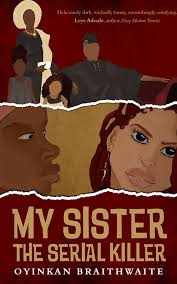
In need of some dark comedy? Oynikan Braithwaite’s My Sister, The Serial Killer is, as implied in the title, comic, darkly comic at times. Yet, it’s not just comedy. I see it as dramedy, a character study that explores a sister relationship in a sexist and superficial world.

The narrator, Korede works as a nurse in a hospital in Lagos. She tells us from the start that her stunningly beautiful sister Ayoola is a serial killer. The reader might at first suspect an unreliable narrator faced with Korede’s nonchalance as she sponges up the blood, helping her sister to cover-up her third murder of a boyfriend in ‘self-defence.’ As the story develops, we see the plain but likeable Korede harbouring a crush on Tade, a doctor at the hospital, while Alooya enjoys the attention from social media once her latest boyfriend-victim is assumed to be ‘missing.’ Memories of the other victims mix in with a family saga involving the sisters’ recently deceased father, a brutish man and unfaithful husband. Korede’s dreams of being with Tade are scuppered when Ayoola drops by the hospital, turns heads and effortlessly charms Tade. This love triangle can only go one direction, and the reader fears that once again the gorgeous Ayoola will get away with murder.

Even though the story is set in Nigeria and is authored by a Nigerian writer, for much of my reading I didn’t see it as ‘Nigerian Fiction.’ The story could have taken place in any urban setting in any country. Its themes of sisterhood and womanhood are universal. The characters’ names and references to national food and clothing serve as subtle reminders that we are in Nigeria. One minor exception to this comes from the narrator’s memory of the time a wealthy tribal chief came to the family home with an interest in the beauty named Ayoola. Korede protects her sister and prohibits any possible union between Ayoola and the chief from ever taking place. This mini-story is more of a reflection than a subplot, but does serve as a reminder of the treatment of women in countries like Nigeria.Braithwaite

Braithwaite’s novel might not fit into categories used by literary critics to describe Nigerian fiction. It’s not Colonial, Post-Colonial, Liberation or Nationalism, thematic categories filled by Nigerian male writers and known mostly outside of Africa through the works of Chinua Achebe. I’d like to think Braithwaite’s modern story is not so much about being Nigerian as it is about being human, about familial relations and the objectification of women. Such themes have long been accepted in the blindingly white Western canon without the need to label a work by its nationality.

Travels in the Time of Corona

We did consider whether we should go at all. Covid-19 had struck Italy hard, but at that time only the region of Lombardy was in lockdown. Still, northern Italy is just a 45-minute train journey from Nice, and how long would it be before France was in lockdown? Thanks to the European bus service of the sky, Ryan Air, we had rationalised that we could always come back sooner, only losing the money spent on cheap tickets. As we were going to our second home, we didn’t have to worry about the costs of cancelled hotel bookings. Everything would be fine.

We agreed before boarding our flight from Stansted that if anyone was sitting next to us and there were other seats available, we would move, spread ourselves out and play it safe. Sure enough, in our row of three, sitting next to me was a young man with the physical appearance of someone from the Wuhan. David and I moved, guiltily imagining the young man thinking we were paranoid, racists or both. Things were not off to a good start.

As we arrived in Nice, the final weekend of the centuries-old carnaval had been cancelled. Nice didn’t feel like Nice without coach loads of tourists or the buskers and pickpockets taking advantage of the increased trade. Concerts we had planned to attend were cancelled. The city didn’t have its usual buzz of people or vehicle traffic. Fortunately, cafes, restaurants, cinemas and clubs were still open with no talk of closures. Yet, we weren’t going to be foolhardy. We didn’t go to restaurants or our usual jazz clubs and mostly got our croissants at outdoor cafes – if you’re wondering, average daytime temperature was 16C.

corona2

While it was important to be cautious, we didn’t want to be sucked into the media hysteria. The information available from British and French health sources made the risks of contracting Corvid-19 appear small. Not wanting to be cooped up in our one-bedroom apartment every evening, we decided to go to the cinema – twice in one week. Before you think we were being foolish, English films with French subtitles (as opposed to dubbing) shown in the early evenings are not typically well-attended. At both films, the dozen or so in the audience spread themselves out while the fragrance of disinfectant hand gel hung in the air.

As the death toll in Italy was skyrocketing, the cases of Covid-19 and deaths were steadily going up in France. This was the unavoidable main topic at my French drop-in class, which I opted to attend because it was at the teacher’s home, usually with only a few students. Again, I was rationalising and trying not to be hypnotised by the wall-to-wall media coverage we were getting in two languages. As it turned out, there were only two students that day, and we both rubbed our hands with disinfectant hand gel at the start of class.

Living close to the Promenade, pleasant seaside strolls and jogs are de rigueur, but we also like our other walks. Problem – getting from our apartment to these picturesque walking paths in Villefranche-sur-mer and Cap Ferrat involves trams and/or buses. In that first week, we braved several tram journeys, keeping a safe distance from people when we could, and two bus trips with near-empty buses. Of course, we realised that others thought crowded buses would be too risky, especially the elderly, who were heeding the advice to stay chez vous.

The week ended with Italy entering total lockdown. We went from slightly concerned to PANIC. My main worry was getting out of France before it would no longer be possible. I had to get back to the UK for meetings and to chair a doctoral exam. My second worry was not being able to get out with David, who was going to stay in Nice for an extra week to paint doors and window frames.

Fear comes in waves. We went from ‘let’s leave Wednesday’ – three days away – to ‘let’s stay here as planned but leave together on my flight in 10 days’ – then back to Wednesday or Friday – or maybe Sunday. Realising that we couldn’t really make up our minds, and that the news about the spread of the virus and the actions of governments were even less predictable than our brains, we held off on booking any new plane tickets. We agreed that whatever we did, we would go back together.

I soon learned from two of my friends back in the UK that people were panicking there as well. Both messaged me to let me know that supermarket shelves had been emptied of toilet roll. I could only chuckle, wondering why food and medicine seemed less essential.

For those last days in Nice, however many they were going to be, we focused on just enjoying the sunshine by day with walks around the city and staying in at night watching Netflix, doing crossword puzzles or me working on a writing assignment. We limited our socialising. We didn’t see our elderly or recently ill friends, but reasoned that it wasn’t unsafe to go to the home of two of our friends who had just arrived from Colorado, which at that point had only recorded two cases of the virus. We greeted our friends with Namaste and at the end of the evening tipsily waved goodbye. Strange not hugging or kissing friends.

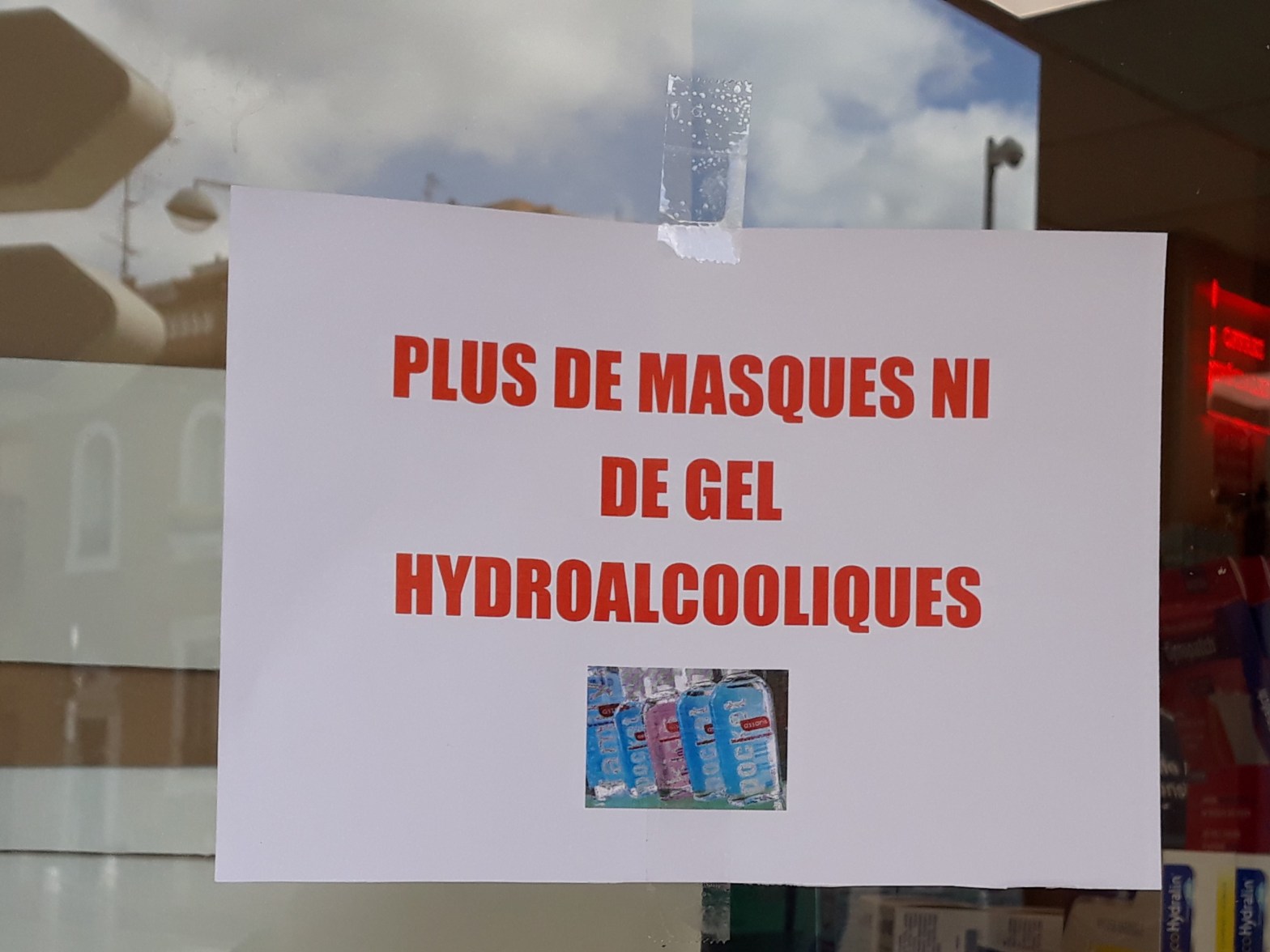
A couple of days later, the death toll in France rose sharply, but mostly to the north of us, while the number of cases in our region doubled overnight. Tr*mp stopped all flights from Europe to America, except for those carrying US citizens returning home. As fewer and fewer people were flying between European countries, airlines were cancelling more and more flights. Ryan Air had still not cancelled our flights, but we knew that we couldn’t stay much longer. Fear was in the air. Half-empty trams echoed with announcements to cover your mouth with a cloth when you sneeze or cough and to keep a social distance – at this point defined as a one-meter space. Disinfectant hand gel and surgical masks had sold out.

The time had come to book a new flight back for both of us. A few days were cut off my working-holiday and 10 days were taken away from David, along with his painting duties.

In the days remaining, I fought off the sense of panic by meeting with girlfriends for an apero in a hotel bar. No hugs, no kisses, but plenty of hand gel and a distance of roughly a meter between us. The following day, I attended my French class – the only student this time. Of course, all we talked about was the virus and people’s strange and sometimes silly behaviours, ranging from Tr*mp’s flippancy to people hoarding toilet paper. I’m one of these people who often uses humour to hide my anxieties – from others as well as myself.

I was indeed anxious. One of us could get ill before our flight, and even though we could manage healthcare in French, it would be easier in English and in a health system that we know. In all of the times I’ve gone to Nice over these past ten years, it was the first time I was looking forward to leaving.

On the day before we flew out schools, universities, restaurants, cafes, bars, non-essential shops and cinemas across France had been ordered to shut. I joked on Facebook about leaving now that the cafes were closed.

As I packed my carry-on bag, I realised I wasn’t taking much back. In fact there was loads of space. Full of embarrassment at myself, I packed two rolls of toilet paper.

At Nice Airport Departures all the shops were closed except for a newsagent. No restaurants or cafes, except for one take-away coffee shop. At the gate, people were keeping a social distance, some of us standing or sitting on the floor in order to have a meter between us. That is until the gate opened and an undignified queue formed – suddenly safe spaces seemed unnecessary. I did wonder if everyone else was as anxious as me to get home.

We’ve been back in the UK for nearly two weeks now, and I still feel as if I’m travelling. I’m a tourist in a country where people only go outside for exercise or to the supermarkets that only allow 25 people in at one time and where customers are ordered to stand 2 meters from each other at the checkout.

Afterward: David’s original flight was cancelled by the airline and he is awaiting his refund. My original flight was also cancelled, but it was later ‘reinstated.’ I was informed of this reinstatement by a text message sent out two hours after my flight landed in Stansted. Like me, Ryan Air makes jokes when they’re nervous.

Schjerfbeck, really

Since the last International Women’s Day, I’ve blogged about, among other things, the historical violence against suffragettes, the exclusion of women from medical studies and the alarming rise in femicide. At the risk of appearing to downplay the plight of women, I’m taking a more positive approach to this year’s holiday, for which no one anywhere gets the day off work.

Last autumn I went to the Royal Academy of Arts in London to see their exhibition on the works of painter Helene Schjerfbeck (1862-1946). Who? Exactly – unless you’re from Finland. Not being from Finland, I hadn’t heard of her until the exhibition came along and received thunderous reviews in the press. The Guardian referred to Schjerfbeck as ‘Finland’s Munch.’ Other papers described her techniques in terms of Frans Hals and Velazquez and mentioned her being influenced by her contemporaries Cezanne and Picasso. All a rather blokey affair.

Yet, Schjerfbeck’s works have also been described as realism and expressionism, as haunting and melancholic and as pensive and intelligent. I went to the exhibition with these gender-neutral descriptors in mind, determined to judge the works devoid of comparisons to the male masters. Here are some examples of the paintings that moved me and made me feel that I had made a worthwhile discovery:

I especially liked the self-portraits made over time, drawing attention to the inevitable changes nature puts us through.

I suppose I could have written about this exhibition closer to the time, but as the weeks and months passed what seemed novel and intriguing simply become less so.  I wonder now if my mind had subconsciously compartmentalize Schjerfbeck’s paintings as being like this man’s and that man’s, and that I was no better than the arts reviewers in the newspapers. Asking myself to unlearn years of exposure to the male masters may have been a tall order. Yet, I’m glad I’m reacquainting myself with Schjerfbeck’s works and for having discovered many more of them online – she lived a long life and was highly prolific.

For those who say International Women’s Day serves little purpose and that men have the other 364 days of the year, without it, I probably wouldn’t have given Schjerfbeck a second chance. Happy International Women’s Day 2020!

It’s Killing Her

There’s been a lot of talk in recent weeks about pandemics and epidemics. Let’s consider another epidemic. To quote historian Rebecca Solnit, ‘Violence against women is an epidemic that takes four lives a day in the USA and leaves millions living in terror or facing the torture of rape, beatings, stalkings, and abuse.’  According to the Office for National Statistics (ONS) in the UK, 80 women were killed by a current or ex-partner in the past year – that’s a 27% increase on the previous year.

You’re welcomed to say that the Coronavirus (Covid-19) is a whole different thing altogether.  After all, the Coronavirus is a biological contagion with no known vaccine. Violence against women is a cultural contagion for which there are blindingly obvious cures.

There is another difference which struck me this week. Like many people around the world, I’ve been following the story of the British couple, the Abels, who were ‘quarantined’ on the Diamond Princess and then caught the virus. Before this incident, the Abels were strangers to me. But now, thanks to the Coronavirus, I know them by name – Sally and David Abel.

Aside from a few women celebrities, I cannot think of the name of one woman, previously unknown to me, who has been the victim of violence perpetrated by a man. On occasion these stories appear in the news, especially if a legal case is involved, but not for long before they fade away. Perhaps, it isn’t just the reporting, but the sheer numbers – to quote Stalin, ‘one death is a tragedy; a million is a statistic.’

I recently read Hallie Rubenhold’s The Five: The Untold Lives of the Women Killed by Jack the Ripper, a revisionist’s history of the well-known killings. On the premise that there’s been vast interest over the decades in identifying the ripper, and there’s been little about his victims. Furthermore, what has been said about these women is by and large inaccurate. For example, they were not all prostitutes. Only one of the five women was a prostitute when she was killed and another had been a prostitute briefly in her past. A point also worth mentioning is that, contrary to popular lore, none of these women had been raped by their killer. Based on police records, Rubenhold concludes that these women were all killed in their sleep and only one of them in her own bed – the others were sleeping rough on the streets of Victorian London. I leave it to you, dear reader, to extrapolate the levels of misogyny going on there.Femicide 2

Since I started with Rebecca Solnit, I’ll conclude with her as well: ‘Even those of us who are not direct victims are impacted by living in a world where such gender violence is both common and normalized or trivialized, where any woman may be harmed because she is a woman.’