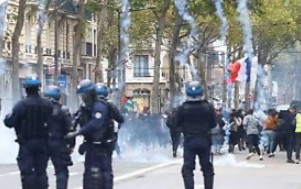
Another weekend, another protest march through the cities of France – and often another riot. When I left Menton two weeks ago, the student demonstrations were a week old and expected to continue throughout October – the traditional month of strikes and protests. The students’ demands seemed both clear and reasonable – school buildings better equipped to cope with heatwaves, smaller class sizes, more teachers and shorter school days.
In Menton, the student protests have been rather subdued. Some lycée students blockaded their school entrance and set alight to a couple of rubbish bins. The Science Po University students demonstrated in small numbers. Yawn, another week passes.
Elsewhere in France, what started as peaceful protests turned violent. The French I spoke to didn’t seem at all bothered. ‘It’s what we do,’ followed by the Gallic shrug. There was a widespread sense that protest, and occasionally disorder, remains one of the few ways ordinary people can force themselves onto the political agenda.
As the days turned into weeks, the movement broadened. University students joined in to support students’ rights, the unions soon followed to protest the costs of fuel, individuals joined in over inflation and the cost of living. Then, the opportunists arrived – criminals and delinquents took advantage of the crowds to break shop windows, loot and set fire to anything combustible that didn’t move.
The one thing this has not been about is immigrants. Yet outside France, some political figures have been quick to present the unrest as an immigration issue. Depending on which source you read, immigrants are either responsible for the disorder, or the protests are a backlash against immigration. Neither is true. Even the French far right party aren’t playing that card – the Rassemblement Nationale is blaming the government as out of control. These immigration accusations don’t need to be true. To quote Mark Twain, writing decades before the Internet was even born, ‘A lie can travel halfway around the world while the truth is putting on its shoes.’
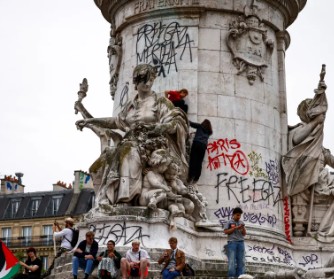
Watching the coverage and commentary on British television, I’m seeing mostly violence in the streets, the fires and destruction. Some commentators have reached for comparisons with 1968, and there are faint echoes in the youth-led demonstrations taking place elsewhere in Europe. French news has included these dramatic images, but the focus has also looked at the role of the riot police and their treatment of the students. My favourite piece of French commentary came from Le Monde, which dryly remarked that the graffiti now covering the nineteenth-century statue in the Place de la République may have undergone an aesthetic upgrade.
What I’ve been reading
Over the last couple of months, between books I’ve been dipping into Yongey Mingyur Rinpoche’s In Love with the World. The Tibetan Buddhist monk recounts his abandonment of the monastery, taking only a few belongings and the clothes on his back, to undertake a four-and-a-half-year journey, encountering the ‘real world’, including a near-death experience, while travelling his own spiritual path. It’s a primer of Tibetan Buddhist principles, full of traditional stories and relevant anecdotes. What I’ve taken away from this book are the practical insights into meditation and awareness, particularly how to deal with our ‘monkey minds’ – that cascading rush of thoughts that rarely pauses for breath. It’s also been a useful companion while watching events unfold in France. Amid the noise of protests, political point-scoring and competing narratives, the book is a reminder that uncertainty is not an aberration but the normal state of things. As Mingyur Rinpoche writes:
‘Everything is always in flux; by letting it be we simply allow for inherent movement. We can notice preference and desire, but chasing after them blocks the flow of change. Awareness contains impermanence.’