Dipping into British Herstory

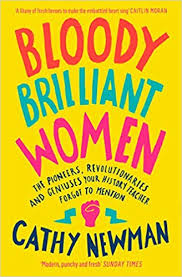
In Bloody Brilliant Women Cathy Newman writes about one of my heroines, Gertrude Bell, with a couple of lively examples exposing male perspectives that has kept Bell out of the history books. In the film version of Michael Ondaatje’s fabulous The English Patient, there is a scene where British soldiers are examining a map, trying to find a way through the mountains. One says, ‘The Bell map shows the way,’ and the other replies, ‘Let’s hope he’s right.’ Newman remarks on this unconscious bias, the assumption that a map maker must be male, behind this scriptwriting. For me, the more astounding point is that this error went unnoticed and unchecked by the script editor and the director’s assistant as well and made it to the screen.

Having read some of Gertrude Bell’s travelogues and letters and having seen an excellent documentary-cum-docudrama about her, Letters from Baghdad , I was pleased by Newman’s find of a letter from Sir Mark Sykes (he of the Sykes-Picot Agreement that carved up parts of the former Ottoman Empire for the likes of Britain, France and Russia). Sykes wrote to his wife describing Bell as ‘a silly chattering windbag of a conceited, gushing, flat-chested, man-woman, globe-trotting, rump-wagging, blithering ass.’ No need to deconstruct the misogyny here. Newman follows this quote with a simple ‘Wow!’ An example of the laid back journalistic style used throughout the book.

Newman’s version of herstory covers some familiar territory with Emmeline Parkhurst, Millicent Fawcett and accounts of women impersonating men in order to fight in wars. But it is well worth a read as the book explains the significance of these pioneering women in their pursuit for justice and equality given the socio-political and legal contexts of their time.

As much of my understanding of herstory is of a more international variety, I’m grateful to Newman for introducing me to a few personages that I would have otherwise missed, and who I now feel compelled to read or read about. There’s Dora Russell who championed contraception, recognising that childbearing wasn’t only controlling women’s lives, but also shortening them. Dora is otherwise known as the second wife of Bertrand Russell. And there is Claudia Jones, a journalist and activist, who founded the Notting Hill Carnival. I close with one of Jones’s most quoted remarks: ‘A people’s art is the genesis of their freedom.’

Defeated

It’s been a week since the UK General Election. I’m not going to blame Corbyn, the People’s Vote, the electoral system or the LibDems for what happened. Instead of seeing this as their loss or folly, I have been struck down by the realisation of the Brexit movement’s victory. I must acknowledge it. The falsehoods and misinformation are immaterial. They out-campaigned us and out-manoeuvred us.

As I try to untangle this, I take little solace in the knowledge that my side may have lost the vote, but we still have won the argument. That kind of thinking helped me through the aftermath of the referendum, but it’s not working now. I say this in all sincerity. I’m not looking to be right. I’m too busy wallowing in my own defeat for that.

Defeat is a monstrous burden to bear. Maybe it’s because the three and a half years of my life engaged in Brexit conversations, delivering leaflets, attending rallies and marches and above all else, wishing it away. I turn once again to Buddhism, the Zen variety this time. In this tradition, and I paraphrase Thomas Merton, when a person feels kicked, crushed and defeated , a spiritual path is the best place to be. I meditate and breath.

But that’s only part of it, since the GE, I live in a world that feels alien to me and this is not an exaggeration. I recall the Reagan/Thatcher years, where I strongly disagreed with the policies of both and had to live with them as a US resident and then a British one. But I could understand then, and especially now, why people voted for them. Both politicians benefitted from the economic boom at the time while the left on both sides of the Atlantic experienced a paucity of leadership. I feel on safe ground saying that if Reagan or Thatcher had behaved in the ways of Trump and Johnson – the bare-faced lies, the racist and sexist remarks, the stirring up of hatred – they would not have been re-elected. This is where it hurts, I’m having to acknowledge that I live in a new world order, where cult-like charlatans rule the most powerful countries on our planet. Historians will be quick to point out that this is not a new world. This is an old world that was around before my lifetime, the interwar years in Germany comes to mind.

So I take inspiration from Michael Tippett, who composed A Child of Our Time in response to the disunity in Europe just before WWII. ‘The world turns on its dark side — it is winter,’ the chorus sings. But we know that after winter the flowers will start to bloom again.m tippett

Apophenia and Zombie Statistics

It’s polling day in the UK. If you’ve come to this blog seeking my election predictions, think again dear reader. My political crystal ball shattered into a million pieces in 2016 – first the Brexit Referendum, then Trump.

This election day is certainly the most important in my lifetime as a British citizen up against losing my rights as an EU citizen and as a citizen of a world that is facing a climate emergency. With all of this, what am I thinking about today – the spurious nature of truths.

There’s apophenia. That’s the tendency to mistakenly see connections between unrelated things. The term was first used back in the 50s to describe types of mental disorders like schizophrenia. Examples include gamblers who think they see meaning patterns in numbers or people who see images of the Virgin Mary in their cappuccino froth.

Zombie statistics are numbers that are bogus but are repeated so often they are assumed to be true. There are loads of these out there. My personal favourite is that only 10% of Americans hold passports. Interesting, given that some 20% of Americans were not born in the US – how did they get there? The actual figure, according to the US State Department, is that 42% of Americans have passports. (Okay, I know, it’s 66% for Canadians and 76% for Brits). Zombie statistics are believable because they feed into popular myths or make for good headlines.

In both apophenia and zombie statistics, the mind plays tricks with people, even otherwise intelligent people. As this election campaign comes to an ignominious end – it’s been plagued by concocted ‘news’ stories against rivals and blatant, easily disprovable  lies from a sitting Prime Minister – I can’t help but to think about the way our minds play with us and how we convince ourselves and create our own truths.

apophenia

Black Friday

Black Friday didn’t start with Amazon, gift wrapping or 30% off this or that. It didn’t even start, as the story goes, with shopkeepers coming out of the red and into the black due to the hordes of Christmas shoppers on the day after Thanksgiving.

The first Black Friday was on 18 November 1910, and it was in England. This was the day that some 300 women marched on Parliament, furious that Prime Minister Asquith called an election, meaning that Parliament would soon be dissolved and that the Conciliation Bill, giving some women the right to vote, was going to be scuppered. The Conciliation Bill was far from ideal, allowing only women property owners to vote, but it had already passed its first and second readings and was likely to pass into law. This was going to be momentous, a start of things to come on the road to full suffrage for women.

The women who converged on Parliament were angry and loud, but not violent. The violence came from police officers and men in the crowd. Some 30 women were seriously injured and a few days later two women died from what some sources believe d were conditions brought on by the police beatings.

Equally disturbing was the level of sexual violence perpetrated on these women. One suffragette noted: ‘Several times constables and plain-clothes men who were in the crowds passed their arms round me from the back and clutched hold of my breasts in as public a manner as possible, and men in the crowd followed their example… My skirt was lifted up as high as possible, and the constable attempted to lift me off the ground by raising his knee. This he could not do, so he threw me into the crowd and incited the men to treat me as they wished.’ (Source: British Museum)

Black Friday has come to mean an orgy of consumerism, the start of the Christmas shopping season. On the internet it takes place all weekend and in France it’s a week of ‘Black Fridays’. (Obviously, something got misplaced in translation.) So far removed from its original use and so little known to the average English-speaking person, Black Friday serves as a reminder of what we have come to value and what we choose to forget.

black friday

Not Writing About Brexit

You’ve probably noticed that I haven’t been writing about Brexit of late. My last Brexit tagged blog was in early May, and you have to go back to March to find Brexit in the title. Unlike a lot of people in the UK, I can’t with hand on heart say that I’m tired of Brexit. The topic is complex and multi-layered. It can be looked at from the standpoints of trade and economics, climate change and the environment, human rights, shared research or cultural exchange. Brexit can be seen as a phenomenon of voter and media manipulation or as the catalyst to end party politics as we’ve know it in Britain. That is, for someone like me who enjoys reading and problem-solving through deconstruction, Brexit has been the gift that keeps on giving.

Writing about it has become another matter altogether. As soon as I get an idea for another Brexit blog, I read about it in a newspaper or magazine or hear that a book has come out with the same thesis. Among my favourite Brexit writers – I think this is a start of a genre – are Andrew Rawnsley, Nick Cohen and Will Hutton from The Observer, Polly Toynbee from The Guardian, Stephanie Baker from Bloomberg News and Steve Richards of The Independent and The New European.

Only a few days ago, I stumbled across the perfect quote for what I was going to write about in this blog – another failed attempt. Roger Cohen of the New York Times wrote: ‘The fantasy voted for in 2016 is not the reality of 2019… Democracies are exercises in constant reassessment. The core reason nobody has been able to deliver Brexit is that it makes no sense.’

It’s hard to improve on that.

All I can offer are a few reports gathered from my academic life. I’ve been hearing directly from researchers based at UK universities (many of them not British themselves) who have been excluded from funding applications because Brexit makes them ‘too risky.’ In another case, an academic organisation has changed its plans to have a British university host an international conference over worries that EU27 citizens might need visas to enter the UK. Underlying these examples, as with all changes to our lives brought on by Brexit is a sense of anxiety – sometimes it’s about the unknown, and at other times it’s about losing the good things that we do know have come from our EU membership.

As I struggle to find words to describe this anxiety – a vapid and overused word – I appear to be not writing about Brexit again.

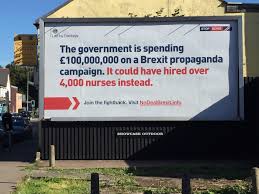
ledby donkeys

‘Man up’ – Johnson’s Sexist Parlance Continues

This time it’s a phrasal verb that demonstrates Prime Minister Johnson’s fluency in sexist language. While Johnson didn’t invent the phrase to man up, he has borrowed it from the underbelly of popular culture. According to the Google dictionary, it means to ‘be brave or tough enough to deal with an unpleasant situation.’ Yet, the definition is more than that. To man up is one of those expressions that carries its etymology with it – that is, its full meaning is to be brave and tough like a man. Many phrases and words in English (and other languages) linguistically operate in this metaphorical way. We have to break the ice and cherry picking, to name a couple. Unlike these examples, to man up gets its meaning from gender stereotyping, from a world where men are brave and tough and women are the antithesis. It’s a fantasy world that has disregarded women’s work and women’s voices for centuries.

Whenever I see what I think is sexist language or behaviour, I check myself by running the reversal test – I first heard of this back in the early 90s from American feminist Gloria Steinem. It goes like this – replace ‘woman’ with ‘man’ or ‘man’ with ‘woman’ and see what you get. I’ve never heard of ‘woman up.’ Pulling yourself together and acting like a woman is not in our public discourse. Further, whereas the underlying sense of ‘to act like a man’ means to be brave, ‘to act like a woman’ is nearly always used as a slur, saying that someone is emotional or bitchy.

It could be argued that Johnson is merely reflecting in his language the sexism that festers in our society. Maybe Johnson is copying a phrase that has a modern ring about it. But this PM has already leapt farther than that. He recently called Jeremy Corbyn a ‘big girl’s blouse’ when the Labour leader argued against a snap election.  Similarly sophomoric, Johnson referred to former PM David Cameron as a ‘girly swot.’ I find these examples of degradation by feminisation even more disturbing than using man up. These boys’-school-sounding phrases are not found in dictionaries. Both expressions are unique to the Johnson idiolect, no mimicry of popular culture or trying to sound cool involved.

What does that say about the man-child living at 10 Downing Street?

Suzy
Suzy Kassem

While Johnson has not turned his sexism into misogynistic legislation in the way Tr**p has (e.g. removing funding for women’s health in developing countries), I don’t think we should take the PM’s language lightly. To quote poet Suzy Kassem, ‘Never underestimate the power of a single word, and never recklessly throw around words. One wrong word, or misinterpreted word, can change the meaning of an entire sentence – and even start a war. And one right word, or one kind word, can grant you the heavens and open doors.’


Two kind men

Former French President Jacques Chirac and my husband’s Uncle Dennis died within a week of each other. Both had lived long, full lives, one in the spotlight, the other not.

Eulogies about Chirac have evoked images of a slick-haired politician who had his share of enemies, whom he also treated as friends, and of a man who was convicted (but never served time) for fraud. He wasn’t the leader of heroic war years, nor did he leave a name synonymous with some grand social movement. Politically, his greatest accomplishments were keeping France out of the second Gulf War and keeping his right-winged party closer to the centre. Bizarrely, within these commentaries and testimonials, the word kind often came up. He was a kind man. Not just ‘underneath it all’ as they say, but outwardly as well. When he met with friends or the public, he was tactile and engaged. Sympa, as they say in France.

Kind was one of the first words that came to mind after hearing of Uncle Dennis’s death. Of course, talk about him we did and continue to do. When someone is no longer there it’s only natural to want to bring them back to life through reminiscences, or to get used to talking about them in the past tense – a training of the mind, fighting against the loss. I didn’t know Dennis during his working life, and the life of a man who ran a fish and chip shop doesn’t fill the headlines in the way presidents of countries do. Dennis, without any higher degrees, was one of my teachers. Nearly everything I know about gardening I learned from Uncle Dennis. What is more important is that he shared this knowledge not to act the role of the expert, but out of genuine kindness, always in a helpful mode.

In Buddhism, kindness is embedded in the four immeasurables and has its place in the meditation practice of the DennisMetta Prayer. These are my ways of tapping into the practice of kindness and trying – with mixed results – to live it. As far as I know, neither President Chirac nor Uncle Dennis practiced Buddhism. Yet, these two starkly different men exemplified one of its leading principles and leave us touched by it.


Climate protests – has the time really come?

When I was a child I wrote a poem about pollution and I rhymed it with solution. My younger self believed that the problems of dirty air and toxic waterways would be remedied by the time I reached adulthood. I had already witnessed a change in the ways our Chicago streets were cleaner once the word litterbug entered our lexicon. For a decade or so, I allowed myself to be seduced by the view that the ecology movement (as we called it then) was finding that solution. We had unleaded fuel, the Clean Air Act and the Clean Water Act. We had taken the CO2 out of our refrigerators and attics were being insulated. It was just a matter of time.

Some forty years later, I find myself supporting Extinction Rebellion and last week, David and I joined in the Climate March in Nice. I was walking down Felix Faure heading towards Place Massena at an aging tortoise’s pace when I realised that this march was strikingly different from other marches. Unlike anti-brexit marches, there weren’t any protesters at the side lines swearing at us or calling us stupid. After all, who’s going to disagree with wanting to save our planet and improve our health and quality of life? That view hadn’t changed since my childhood.

But something else had changed. There are now climate change deniers. I know, I have waxed on about this sub-human form before.  But to date, the only ones I know are far-right politicians and the companies that sponsor them, those who have the most to lose financially by switching to clean energy. These are not the kind of protesters who take their arguments to the streets. Their methods are more insidious.

I also noticed a few gilets jaunes in the crowd in Nice. These are the people in highClimate 2

-viz yellow vests that have been protesting every Saturday across France for nearly a year now. Most of their protests have been aimed at tax reforms and the lack of spending power for low to medium income individuals. Ironically, the origins of the gilets jaunes movement were over the carbon tax on petrol,  a way of reducing France’s carbon footprint. The gilets jaunes were against it. Is it that they now join any protest that comes along? Or has the last year of climate protests and public discourse about our environment changed their minds?

I don’t want to be seduced into positive or complacent thinking again.

I’ll end this blog as I started it with lines from a poem. This from American poet Rita Dove:

Hold your breath: a song of climate change

The water’s rising
but we’re not drowning yet.
When we’re drowning
we’ll do something.
When we’re on our roofs.
When we’re deciding between saving
the cute baby or the smart baby.
When there aren’t enough helicopters
or news crews to circle
over everyone. When sharks
are in the streets. When people
are dying…


Kang’s The Vegetarian and what it means to be different

It’s not just that Koreans are big meat eaters – which, yes, includes dog stew – it’s the extreme reaction to someone who doesn’t eat meat. I was often greeted with a blank stare, followed by a twist of the head and then a steely-eyed glare. Sometimes I would be asked ‘why not?’ ‘do you have an illness?’ By illness, I suspect they meant allergy. Eventually, I would fib and say ‘yeah, it’s like an allergy’ just for peace of mind. As a vegetarian who lived in Seoul between 1995 and 1998, I can relate to Han Kang’s award-winning novel, The Vegetarian, set in Seoul in the early 2000s.Korea vege 2 001 (2)

That’s not to say there aren’t any vegetarian dishes in Korea – the national dish, Kimchi, which can be eaten at breakfast, lunch or dinner is basically pickled cabbage and peppers. But too often at restaurants in Seoul, I would order a vegetarian side dish like kimchi but as a main dish, only to have it served with meat. I lost count of the number of times I’d ask for a vegetable soup, which would be placed in front of me with strips of beef surfacing to the top like pieces of driftwood. It turned out that the chef, seeing the white woman, assumed that I hadn’t realised that I hadn’t ordered any meat and had decided to do me a great favour. On occasion, a colleague would go into Korean on my behalf to explain to the baffled locals that I simply didn’t eat meat. At the time, there was no word in Korean for ‘vegetarian.’

In Kang’s novel, a young Korean married woman is terrified by a dream that causes her to become a vegetarian. Yeong-Hye’s conversion to vegetarianism isn’t depicted in anecdotes about the life of a vegetarian in Korea. This is a much more serious and complex story, where becoming a vegetarian, scandalous to her family, triggers a string of events that are dark, violent, sexual and surreal. The writing beautifully describes these consequences in patterns that develop into motifs and metaphors.

But the problem with Yeong-Hye isn’t so much her vegetarianism as it is her mental illness, even though the two are linked by the other characters. Once she is put into a mental institution, her husband leaves her. The reader is put into a position of wondering if the family’s reactions to Yeong-Hye’s eccentricities are what created her madness. This suspicion is heightened when her brother-in-law, a conceptual artist, also pays for his individuality and a brief extra-marital encounter with an arrest and an attempt to have him institutionalised. The vegetarian

Though it was a couple of decades ago, I do recall (and probably wrote about) a conversation I had with one of my Korean colleagues who spent many years in America. He explained to me that unlike Americans, Koreans do not celebrate the individual, the person who is too different. He said, ‘Same is good for us. Maybe…’ Korean’s use maybe a lot…’Maybe it is safe that way.’ Safe from what exactly was never explained, and after nearly three years there, I never figured it out.

For me these challenges to the individual were intimated in Kang’s novel, though another reader could legitimately see it as a struggle between traditional beliefs and a modern-reaching society.

Reminiscing about my time in Korea and coping with being a vegetarian there, I’m reminded of the ironic fact that one of the best restaurants in Seoul was the vegetarian one – the only one in those days. Run by a group of Buddhist monks, it was technically speaking vegan. The food was served on wooden platters with bamboo utensils to customers seated cross-legged on floor cushions. Writing about it now, I can smell the gentle aromas.  If you find yourself in Seoul, the restaurant is Sanchon in Insa-dong.

Some Advice for Environmental Activists

The psychoanalyst, writer and activist Susie Orbach, writing in This is Not a Drill, the Extinction Rebellion handbook, makes this cogent point: ‘The feminist movement taught us that speaking with one another allows truths to enter in and be held together.’ This is crucial when we are living in a time where evidenced reports are brazenly referred to as fake news, while lies and distortions are foisted on the public as undisputed facts.

Orbach notes the need ‘to create spaces in which we can share how difficult this hurt is and how to deal with our despair and rage.’ This might sound touchy-feely at first, but for those of us who live in Brexit-inflicted Britain, it rings too true. The Leave campaign created a public space for those hit by economic despair at a time when income inequality is writ large. The fact that these domestic problems had little to do with the European Union didn’t matter. The space for feelings of despair and rage had been created. The problem, of course, with this Brexit example, is that truths were not allowed to enter in.

Even though the environmental movement has science on its side, the selection and interpretation of the science can also be manipulated. Just listen to Pat Michaels, a climate scientist with legitimate credentials, who claims, often on Fox News, that human contribution to global warming is minor and that our planet is just going through a natural cycle.

I’m also bothered by the arguments that try to turn the climate crisis on its head. The growing interest in the Arctic by governments such as China, Russia and the US sees the melting ice as opening up sea passages and making undiscovered mineral and fuel resources accessible. I find this annoyingly paradoxical coming from the Trump administration that denies the existence of global warming.

Orbach’s advice to environmental activists is well-meaning, but doesn’t take into account all of these complexities. But she concludes her piece by encouraging us to ‘accept our own feelings of grief and fear and…to provoke conversations that touch the hearts of others.’ I think this is already taking place and can help to explain why the environmental crisis that has been talked about in some circles for decades is now part of our public discourse.

I’ll add to this my own advice to keep these conversations going and to translate them into actions. ExtinctionRebellion1