Ten Days in a Woman’s Life

Ten days ago, the UK Supreme Court made a pronouncement clarifying that in Britian’s Equality Act, ‘woman’ referred only to those assigned female at birth. This in effect says that a transwoman is not legally a woman. Unsurprisingly, the trans community is furious about the decision. Women like me who have fought for women’s sex-based rights welcome the ruling and the fact that the Equality Act still protects transgender people from discrimination while it also protects people from sex-based discrimination. The difference now is that sex and gender are not being conflated. In most of our daily lives this distinction doesn’t matter, and transwomen could be referred to as women by friends and colleagues. But when legal issues or situations arise, such as safe spaces for women and competitive sports, the sex-based biological difference is acknowledged and legally acted upon. Will the debates around this continue? I wish they would, but too many people in the public eye are wary to engage in this topic, especially if they agree with any aspect of the Court’s ruling. It’s unfortunate that no ruling from the Courts or Britain’s Parliament have addressed the conflation of debate with hate speech.

Easter Weekend saw the death of a pope. The obits were lengthy and the discussion panels on his legacy tried to create a polemic over what type of pope Francis was – liberal or conservative, left-leaning, right-leaning. In every discussion and interview I heard across my three languages, this last pope lost only a small fragment of his liberal credentials when it came to the role of women in the church. The experts in religion shook off this topic as if to say, ‘What do you expect?’

Mid-week saw Trump’s team  announce government efforts to increase birth rates in America. This warped government is considering baby bonuses of $5000 to every American mother after her baby is born and classes for women in charting their menstrual cycles to increase their odds of conceiving. This pronatalist strategy is wrapped around conservative ideology about families based on marriage (as opposed to partnerships) between women and men and with the intent of having enough offspring to form a choir (okay, not their exact choice of words – it’s hard not to be sarcastic).

Speaking of controlling women’s bodies, Thursday morning, I found myself in conversation with a French language partner about the historical contradictions in Poland on the issue of legal abortions. In brief, abortions were legal during the days of the USSR when people had fewer individual freedoms. After the dissolution of the Soviet Union, in 1990 Poland’s new president Lech Walesa reestablished the country’s ties with the Catholic Church. By 1993, abortions were only legal in cases of severe abnormalities in the foetus – the woman’s mental and physical health were not taken into consideration. Today in Poland, abortions are only allowed in cases of rape, incest or if the mother’s life is in danger. Incidentally, the Soviets hadn’t been acting out of feminism or concern for women’s health. According to the Arte documentary my language partner and I watched, the Soviet government needed women in the workforce.
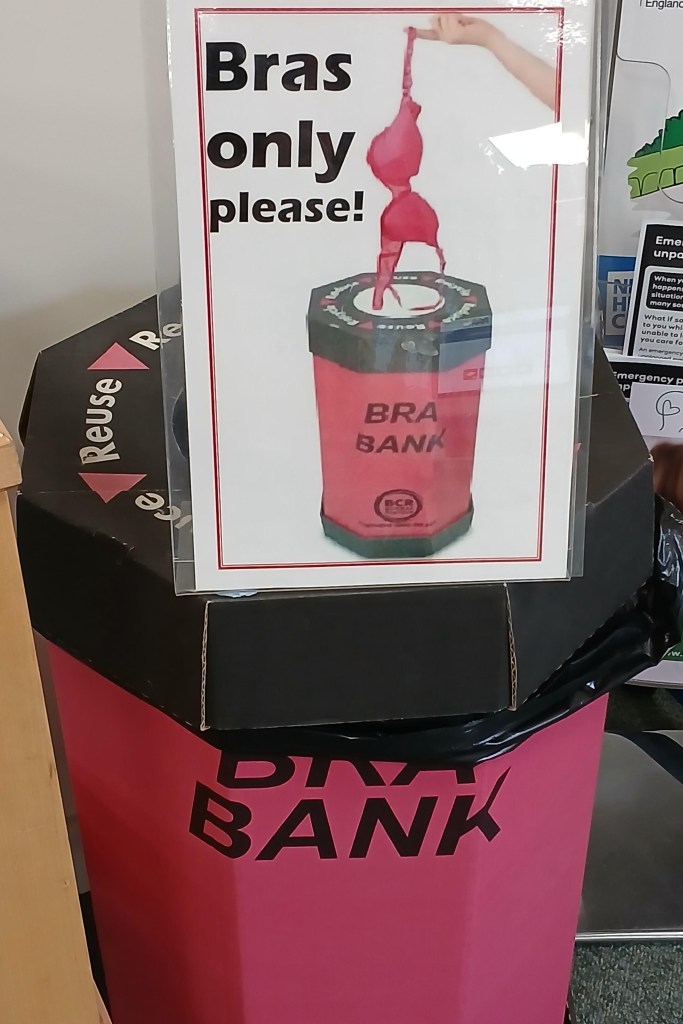
The new weekend started with a trip to the public library, where I notice a small recycle barrel partially tucked into a corner near the self-service checkout machines. Not for paper as one would expect in a library, but for bras (or brassieres as some insist on calling them). And of course, it was pink. Why in the library and why partly hidden? Several recycling bring banks, as we call them locally, are peppered across the tiny town of Ely with receptacles for used paper, glass, clothes, shoes and books. But none of them have a recycle barrel for the uniquely female undergarment. In the twenty-first century clothes associated with sexualised parts of the female body are requiring a gentle sort of censorship. At least this woman could end this 10-day cycle of womanhood with a laugh.

What I’ve been reading

I’m a huge fan of Joyce Carol Oates and have written about three of her books for The Literary Encyclopedia. Babysitter has been lauded as one of her bests, and I must agree. Be prepared – this is not a bedtime read. Like many of Oates’s work, some dark, unsettling topics are at the fore. In this case the abduction, rape and killing of children by a serial assailant make for the backdrop that disrupts the ‘pleasant valley’ white suburb of Detroit in the mid-70s. At the centre is Hannah, the wife of a wealthy businessman and mother to their two children. Bored with her passionless marriage, she is seduced by a strange man, not a part of her social circle, who engages in violent sex. One time, she ends up nearly dead. She is traumatised and cannot hide the injuries. Now clearly a victim of rape, her story exposes the sexism and racism of the time. Her story also develops in thriller style, linking to the serial child killer. Fortunately, breaks from the violence can be found in moments of poignant reflection. These lift the storytelling out of social commentary into something deeper and philosophical. When Hannah is forced to sell her grandmother’s pearls, she goes to a pawnshop and is told by the jeweller: ‘You have neglected these pearls, dear. You need to wear pearls often. You should know, pearls require human warmth, intimacy, to maintain their beauty. Their being. Spinoza said, “All things desire to persist in their being.” Pearls are not diamonds, dear. If left alone, they lose heart. They lose hope. Like all of us, they become brittle and begin to die.” At that point in the narrative, the analogy to Hannah’s life is evident.

It’s been a week and a half of sometimes frustrating but also intriguing and enriching women’s stories.

Difficult Women

Prime Minister Theresa May was once publicly referred to as a ‘bloody difficult woman’ by one of her own MPs, Kenneth Clarke. May revelled in it and used the label to raise her feminist credentials. But the more I read about ‘difficult women,’ the more I think May was undeserving of the accolade. Her brief time at No. 10 Downing Street left many of us wondering about her competence as she fumbled her way through Brexit negotiations that left all sides unhappy.

In Helen Lewis’s book Difficult Women: A History of Feminism in 11 Fights, the author looks at the lives of 19th and 20th century women who were judged as difficult women, but who were clearly breaking barriers, often risking their lives and destroying their and their families’ reputations. These stories make Theresa May look like a lightweight, if not a fraud among difficult women.

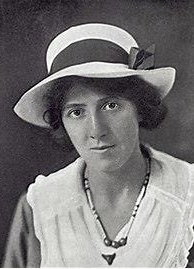
Among Lewis’s choices are the many little-known suffragettes, who spent years in prison for rioting, and women who weren’t allowed in universities, but having been accepted went anyway – with sympathetic male escorts. Lewis also writes about Marie Stopes, who was a palaeobotanist and campaigner for women’s right, perhaps best known for her book on the female body Married Love (1918), and for being the founder of Britain’s first birth control clinic. To Lewis’s credit, she points out that Stopes wasn’t a complete inspirational heroine. Stopes was a gushing admirer of Adolph Hitler, going so far to send him some of her love poems, and she was a strong advocate for eugenics. Lewis writes about her because she was complicated and because women’s histories tend to be selective in our modern search for feel-good role models and pioneers.

Bringing this topic back into the 21st century, I did a search on ‘difficult woman’ in the News on the Web Corpus of some 14 billion plus words, mostly from written language but including news transcripts. The Kenneth Clarke quote loomed large. Other women referred to as ‘difficult’ were Winnie Mandela, Megan Markle and Patti Smith, along with many people’s mothers. I did another search looking for occurrences of ‘difficult man’ in the news corpus. I expected to find fewer occurrences of ‘difficult man’ than ‘difficult woman,’ but the opposite was true. ‘Difficult man’ occurred 20% more frequently than ‘difficult woman.’ Why is this? I suspect, first of all, it’s because men are more likely than women to appear in the news. Examining the contexts of these occurrences more closely, I noticed that ‘difficult’ was often used to label the woman as if she belongs to a type of woman that didn’t need any further explaining. That’s who she is, and our culture understands what that means. Difficult man often appeared in phrases such as ‘a difficult man to pin down’ and ‘a difficult man to track down’ – the busy, important man – and in sports contexts, ‘a difficult man to mark’ and ‘a difficult man to stop’ – the heroes of the male-dominated sports news (oh, don’t get me started on that one – the lack of coverage of women’s sports).

Writing about this topic probably makes me a difficult woman. With this in mind, I’ll close with a quote from Helen Lewis: ‘Being a feminist unavoidably involves being a killjoy, because it involves puncturing the cosy bubble of consensus. That’s difficult, and it can make you seem difficult for doing it.’

Marie Stopes

Daphne and Daphne

My nod to International Women’s Day 2023 comes in the form of noting two women named Daphne.

The first is the original Daphne, a figure from Greek mythology. Not important enough to be a goddess, she was a type of nymph associated with freshwater structures, such as wells, streams and brooks. Her story is certainly a woman’s story. Determined to be independent, Daphne wanted to stay single and untouched by a man for the entirety of her life. Unfortunately, she was beautiful, and even worse, Apollo wanted her. In one version of this tale, Eros, punishing Apollo for his hubris, speared Apollo with a golden arrow, making him desire Daphne. To protect her from Apollo’s clutches, the river god Paneus transformed Daphne into a tree. A linguistic aside: In English, the type of tree that Daphne becomes is called a laurel tree, and in Greek, the word for laurel is the same as Daphne.

Was Daphne happy and fulfilled being a tree? That, we don’t know as Daphne’s storyline ends there. From versions and adaptions written by men, this is Apollo’s tragic story. In Ovid’s Metamorphoses, the moral is the lesson Apollo learns about his haughtiness. Daphne is left in the dust, a conduit for the man’s (or god’s) story. Ovid’s version also has Daphne being pierced by Eros’s lead arrow to make her repel Apollo – that is, she loses her agency and her desire to be independent from men. I’m waiting for a feminist scholar to take up the perils of this Daphne.

The other Daphne is du Maurier. You probably guessed that. The author of modern classics Rebecca, Jamaica Inn and The Scapegoat was only on my radar as a novelist until I read Margaret Forster’s biography. Du Maurier was also a scriptwriter and film producer, eventually owning a production studio, none of which were easy feats for women in post-war Britain or America. She was also the breadwinner, earning a great deal more than her army general husband – who was portrayed by Dirk Bogarde in the film A Bridge Too Far.

Yet, du Maurier was not just another woman of extraordinary accomplishments bucking the social gender-defined trends. For me, she was also an everywoman of sorts. According to Forster, du Maurier battled with depression throughout her life and was at its worst towards the end when it was accompanied by anxiety. Women are more likely than men to experience depression and anxiety. Women are also more likely to speak about these conditions and to be prescribed medication. Between 1977-81, du Maurier suffered from such a severe bout of depression she couldn’t write. She was trapped in a cycle of being too depressed to write while believing that some inspiration to write would take her out of her depression. She was prescribed Halcion (a benzodiazepine). That medication heightened her anxiety, which du Maurier felt was caused by a lack of creativity. For the anxiety she was put on the sleeping pill Mogadon, which triggered a deeper depression, for which she was given Prothiaden (a tricyclic antidepressant). After a severe panic attack accompanied by spells of not eating, she was taken to hospital. She wrote about it in verse:

“They said it was not my body but my brain,

Had ceased to function in its normal way,

So back to hospital I went again, Doctors

Would find out what had gone astray.

A week of tests. Results? I am not told, but

Appetite has gone, has ceased to be. The sight

Of food appals me, hot or cold, the character sitting here

No longer me. I walk around the block, then

Come inside, no reason to exist or to reside upon

This planet here, myself has fled to unknown starts

Far lower than this earth.

Dear God, did you intend this from my birth?”

These Daphnes shared more than a name and an undaunted spirit. They both struggled in ways clearly indicative of their womanhood.

Gifts for Her – Headless Women?

The Observer recently published in its glossy magazine ideas for Christmas gifts, the latest items to buy that you can’t think of yourself. Under the category ‘Gifts for Her’ were candle holders in the shape of a partial female nude. It only had the upper thighs and beautifully fit buttocks, stopping at the waist. That is, it also lacked breasts and legs, one could argue, making the objects less titillating and therefore something appropriate to purchase for ‘her’ this Christmas. But not this ‘her.’ Straight away, I felt uncomfortable with this gift idea.

from The Observer Magazine 5 Dec 2021

As the photo in The Observer only showed the back of these candle holders – a set of three in the female-friendly colours, I suppose, of red, pink and purple for £110 – I visited the seller’s website in the hope of seeing the fronts. I was curious if they had a triangle of pubes or were more like Barbie and bald. This curiosity was not to be satiated. The items weren’t there and I had to assume that they had sold out. Obviously, others weren’t put off by these objects as I had been. On that point, I also noticed that there haven’t been any published Letters to the Editor or comments on the website about these female-buttocks candle holders.

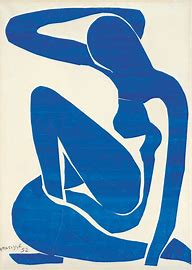
I did, however, find some candlesticks by the same designer, Anissa Kermiche. These were also of women’s bodies, including breasts, but still excluding heads. I found these shapes aesthetically pleasing and reminiscent of Matisse’s famous blue and white paintings of female nudes – only his women had not been decapitated. Perhaps it is the lack of heads in these gift items that bothers me. Headless women objectify the female body and in ways for which you’d be hard pressed to find male equivalents. Nude male bodies without their heads if used for household items, usually come with a wink and a chuckle.

All of this brings to mind Margaret Atwood’s much-quoted essay on the female body, which includes this vignette:

The Female Body has many uses. It’s been used as a door-knocker, a bottle-opener, as a clock with a ticking belly, as something to hold up lampshades, as a nutcracker, just squeeze the brass legs together and out comes your nut. It bears torches, lifts victorious wreaths, grows copper wings and raises aloft a ring of neon stars; whole buildings rest on its marble heads.

Conclusion, if you want to buy me a present this Christmas, skip the headless women, a book is always a safe bet, or perhaps a Matisse 2022 calendar.

Stories About Girls

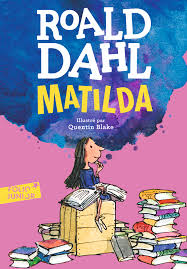
Having recently written about Roald Dahl’s Matilda (the Literary Encyclopedia), I’ve become more aware of stories about girls. By ‘girls’, I mean under the age of eighteen. Paula Hawkins’s The Girl on the Train was not about a girl – it was about a young woman. 

So many stories about girlhood depict heroines battling against adversaries and situations that often stem from simply not being a boy. Matilda is a gifted child who can read and do maths well beyond her years. Yet, she has to fight the negative gender stereotypes  promoted by both of her parents, who blatantly favour Matilda’s little dimwitted brother. When Matilda displays a stronger ability in maths than her father, he calls his daughter a stupid liar. Her mother tries to dissuade her from being smart as it would make it harder for her to get a husband. These characters, referred to by one scholar as ‘.the most thoroughly unpleasant personalities in children’s fiction’ are seen by some as exaggerations for the amusement of children. But I would argue they are not too far off the mark in western societies even today and in some parts of the world, this hyper-sexism is spot on. What makes this a good story about girlhood is that Matilda triumphs using her brain and her telekinetic powers which come from her extraordinary powers of concentration – her brain again.

While working on this Matilda article, my pleasure read for part of that time was Edna O’Brien’s brillant novel Girl, based on the kidnapping of 276 girls by Boko Haram in Nigeria in 2014. Given the subject matter, it might not sound like a ‘pleasure read’ and I had hesitated to read it at all because I thought it might be too distressing. We all knew at the time that these girls were abducted in order to be raped or forced to be soldier’s brides – another form of rape. While, yes, the rapes occur, they happen early in the story and are described from one girl’s perspective with a focus on the emotional experience of confusion and disgust. Once the girl, Maryam,  is married off and gives birth – she is barely pubescent – she is able to escape. The story becomes one of survival in terrifying circumstances. Upon Maryam’s return to her family the story shifts to one of coping with trauma and rising above the superstitions and condemnation of her family and community. In its own, strange way, O’Brien’s retelling of this horrible crime against humanity is life-affirming.

I realise that this blog, thankfully not a book review article, makes an unlikely comparison between a children’s book known for its dark humour and a contemporary adult novel replete with uncomfortable naturalism.Both Dahl and O’Brien see the innate oppression in the lives of girls. 

from Woody to Cuomo

With the news of Governor Cuomo resigning after nearly a dozen women accused him of sexual harassment, I’ve been thinking about my Woody Allen boycott.  For just a few moments this week I felt that same ache I felt back in the 90s when Allen fell off the pedestal I had made for him. 

By the 90s, Woody Allen movies had long since become one of my annual traditions as Allen makes a film every year. I know what you’re thinking – they have not all been great works – some have been real stinkers. But in my childhood and early teens films like Everything You Wanted to Know About Sex but Were Afraid to Ask, Sleepers and Love and Death were formative in teaching me about life – the societal hypocrisies and the need for psychotherapy.

As Allen films became more sophisticated with Annie Hall, Manhattan, and Zelig, I began to appreciate a well-written script, and that lead to my discovering Woody Allen the writer of short stories and essays (mostly in The New Yorker). Allen’s world was funny and cerebral, self-effacing and philosophical. I don’t know what this says about my younger self, but I relished in his misanthropic humour. Among my favourite Allen quotables are: ‘Life is full of misery, loneliness, and suffering – and it’s all over much too soon.’ And ‘If my films make one more person miserable, I have done my job.’

Then there was the downfall. Soon-Yi Previn, Allen’s adopted daughter became his romantic partner in 1991 when she was 22. At first it was just weird. For the love of Woody, I shrugged it off, convincing myself that it was okay since Soon-Yi was an adult and of the legal age of consent. Moreover, Woody Allen was more like a step-adoptive father to Soon-Yi (the first adoptive father being Andre Previn). Downfall part two – in 1992, Allen was accused of sexually abusing his other adopted daughter, Dylan, when she was seven-years old. It was easy at the time to place this accusation in the category ‘ex-partner gets her revenge,’ the ex-partner being actress Mia Farrow. While Allen falling in love with his other adopted daughter gave him an air of guilt, he was never convicted. To this day, I’m still on the fence about his culpability.

When Woody and Soon-Yi married some five years later, I felt more justified in my acceptance of this relationship. Between the announcement of their being in love and the marriage, Bullets Over Broadway and Mighty Aphrodite came out – two of the best films of the 90s.  But as the years passed, I came to realise that issues of consent are not so straight forward. With Woody Allen, the complication arises from his changing roles from father to lover to husband, where the first role was one of familial power followed by roles that by definition involve sexual relationships. For me, the age of consent laws and marriage certificate no longer legitimise this creepy coupledom.

On top of that, I was growing uneasy with his films – he might give actresses some strong parts, but Allen has also made otherwise intelligent women characters weak in the face of compliments about their looks. I mean weak to the point of falling for the bespectacled, maladroit played by Allen himself. It’s in several Allen films, including Annie Hall.

My boycott of Allen films started in 2011 and has continued to this day, with an exception made in 2014 for Colin Firth in Magic in the Moonlight – Firth and the French Riviera was too much to pass up. The boycott is my way of saying that I object Allen’s use of power, and I am not going to continue to support it by contributing to the offender’s income, however small my contribution may be.

In the case of Cuomo, again I’m looking at a man in a position of power changing that role to one of sexual intimate, regardless of the other person wanting that relationship. But in this case, there’s nothing to boycott. The Democratic party, to their credit, have done that for voters by pushing him to resign. Of course, they’re doing this for political reasons, but I’m glad that our post #metoo society has helped to create that political environment. That just leaves me being miffed that someone I had admired for his support for women’s issues – calling himself a ‘feminist’ – and his anti-Trump handling of the pandemic could plunge so disgracefully.

A Women’s Election

It was only a week ago when the world saw the first signs that we were all soon to be freed from the worst president in US history, and one whose rancorous presence has been ubiquitous in mainstream and social media over these past four years. The collective relief is still palatable, some of us describing a visceral experience of feeling lighter, the tensions in our bodies unravelling.

Post-election news coverage ranges far and wide in focus and bias. Stories on the pathetic behaviours of the current president to the speculation of what a Biden presidency will mean have been straddled alongside analyses of the voting tendency of each demographic. For all of that, I think not enough has been said about this election in terms of the role of women. As of 11 November (before all of the votes have been ratified) 53% of voters were women, the same as the 2016 presidential election. But the difference this time is that among these women voters 57% of them voted for Biden/Harris, or to phrase that another way – against Tr**p. In 2016, with a woman presidential candidate, the Democrats only managed 54% of the women’s vote. This difference is more significant still if one considers the higher voter turnout and that millions more women participated and voted against the misogynist-in-chief.

To emphasise this point, I quote from CNN’s Dean Obeidallah:

‘To me the biggest thanks go to the women of America. You gave us hope with the original Women’s March in 2017 the day after Trump’s inauguration. There’s clearly a straight line that runs from that march to the election of Kamala Harris as the first female vice president.’

Unfortunately, other members of the media have treated Harris’s win as a story for the fashion pages instead of the news analysis typically given to male politicians. The most notorious so far (and others will follow) came from the Daily Telegraph, who decided to give their Kamala Harris profile piece to the fashion editor.  Their Twitter headline of the resulting article says it all: “Why Kamala Harris is the modern beauty icon the world needs.”

Many have been outraged by this, rightly noting the sexist undertones. Yet, I don’t think it’s as straightforward as that. Those who criticise the fashion take on the new VP do so in part because they do not take fashion reporting, with a predominately female target audience, as seriously as they do other types of reporting. This point was drummed home this past week when I attended an online panel discussion hosted by the Society of Women Writers and Journalist. There, Helen Lewis, journalist and former deputy editor of The New Statesman, compared football journalism to fashion journalism. While both cover huge, profitable industries, football writing is regarded as ‘authentic’ and fashion writing as ‘frivolous.’

Helen Lewis

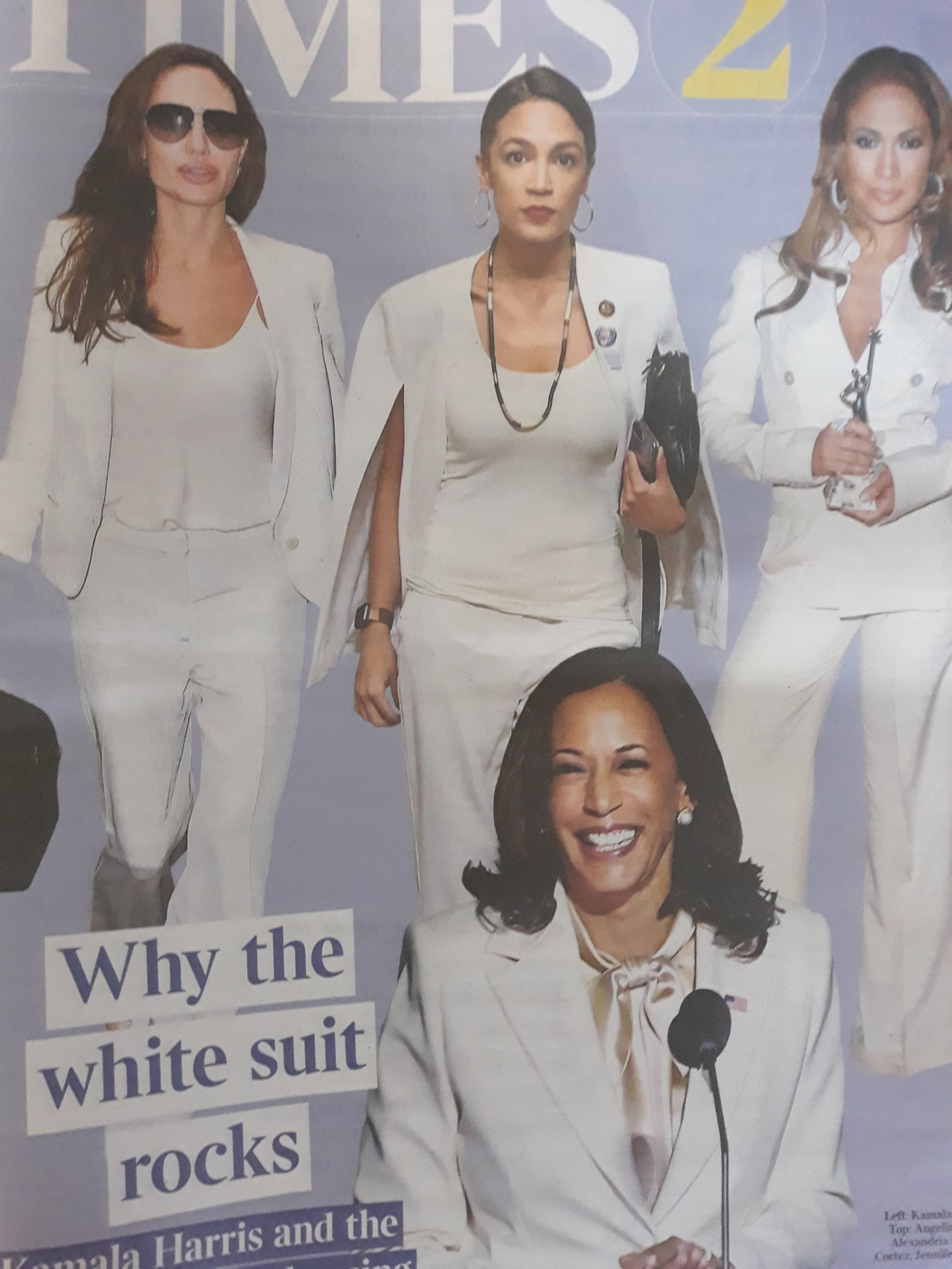
Even though the double standards in how women politicians are treated by the media are almost too obvious for discussion, most stories land into a fuzzy feminist zone. Example: The London Times had Kamala Harris in their Times2 section, which houses entertainment, health advice and my beloved puzzles. Their piece was about the white power suit being worn by powerful women. Fashion and politics collided and I found myself not being appalled as powerful women were being showcased. Perhaps such examples reflect the ambiguity liberal society has towards women in politics. That said, I’m still relishing the victory of last week.

A Serial Killer Sister and Nigerian Fiction

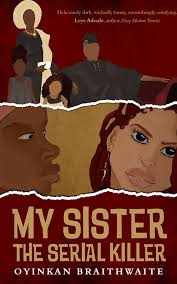
In need of some dark comedy? Oynikan Braithwaite’s My Sister, The Serial Killer is, as implied in the title, comic, darkly comic at times. Yet, it’s not just comedy. I see it as dramedy, a character study that explores a sister relationship in a sexist and superficial world.

The narrator, Korede works as a nurse in a hospital in Lagos. She tells us from the start that her stunningly beautiful sister Ayoola is a serial killer. The reader might at first suspect an unreliable narrator faced with Korede’s nonchalance as she sponges up the blood, helping her sister to cover-up her third murder of a boyfriend in ‘self-defence.’ As the story develops, we see the plain but likeable Korede harbouring a crush on Tade, a doctor at the hospital, while Alooya enjoys the attention from social media once her latest boyfriend-victim is assumed to be ‘missing.’ Memories of the other victims mix in with a family saga involving the sisters’ recently deceased father, a brutish man and unfaithful husband. Korede’s dreams of being with Tade are scuppered when Ayoola drops by the hospital, turns heads and effortlessly charms Tade. This love triangle can only go one direction, and the reader fears that once again the gorgeous Ayoola will get away with murder.

Even though the story is set in Nigeria and is authored by a Nigerian writer, for much of my reading I didn’t see it as ‘Nigerian Fiction.’ The story could have taken place in any urban setting in any country. Its themes of sisterhood and womanhood are universal. The characters’ names and references to national food and clothing serve as subtle reminders that we are in Nigeria. One minor exception to this comes from the narrator’s memory of the time a wealthy tribal chief came to the family home with an interest in the beauty named Ayoola. Korede protects her sister and prohibits any possible union between Ayoola and the chief from ever taking place. This mini-story is more of a reflection than a subplot, but does serve as a reminder of the treatment of women in countries like Nigeria.Braithwaite

Braithwaite’s novel might not fit into categories used by literary critics to describe Nigerian fiction. It’s not Colonial, Post-Colonial, Liberation or Nationalism, thematic categories filled by Nigerian male writers and known mostly outside of Africa through the works of Chinua Achebe. I’d like to think Braithwaite’s modern story is not so much about being Nigerian as it is about being human, about familial relations and the objectification of women. Such themes have long been accepted in the blindingly white Western canon without the need to label a work by its nationality.

It’s Killing Her

There’s been a lot of talk in recent weeks about pandemics and epidemics. Let’s consider another epidemic. To quote historian Rebecca Solnit, ‘Violence against women is an epidemic that takes four lives a day in the USA and leaves millions living in terror or facing the torture of rape, beatings, stalkings, and abuse.’  According to the Office for National Statistics (ONS) in the UK, 80 women were killed by a current or ex-partner in the past year – that’s a 27% increase on the previous year.

You’re welcomed to say that the Coronavirus (Covid-19) is a whole different thing altogether.  After all, the Coronavirus is a biological contagion with no known vaccine. Violence against women is a cultural contagion for which there are blindingly obvious cures.

There is another difference which struck me this week. Like many people around the world, I’ve been following the story of the British couple, the Abels, who were ‘quarantined’ on the Diamond Princess and then caught the virus. Before this incident, the Abels were strangers to me. But now, thanks to the Coronavirus, I know them by name – Sally and David Abel.

Aside from a few women celebrities, I cannot think of the name of one woman, previously unknown to me, who has been the victim of violence perpetrated by a man. On occasion these stories appear in the news, especially if a legal case is involved, but not for long before they fade away. Perhaps, it isn’t just the reporting, but the sheer numbers – to quote Stalin, ‘one death is a tragedy; a million is a statistic.’

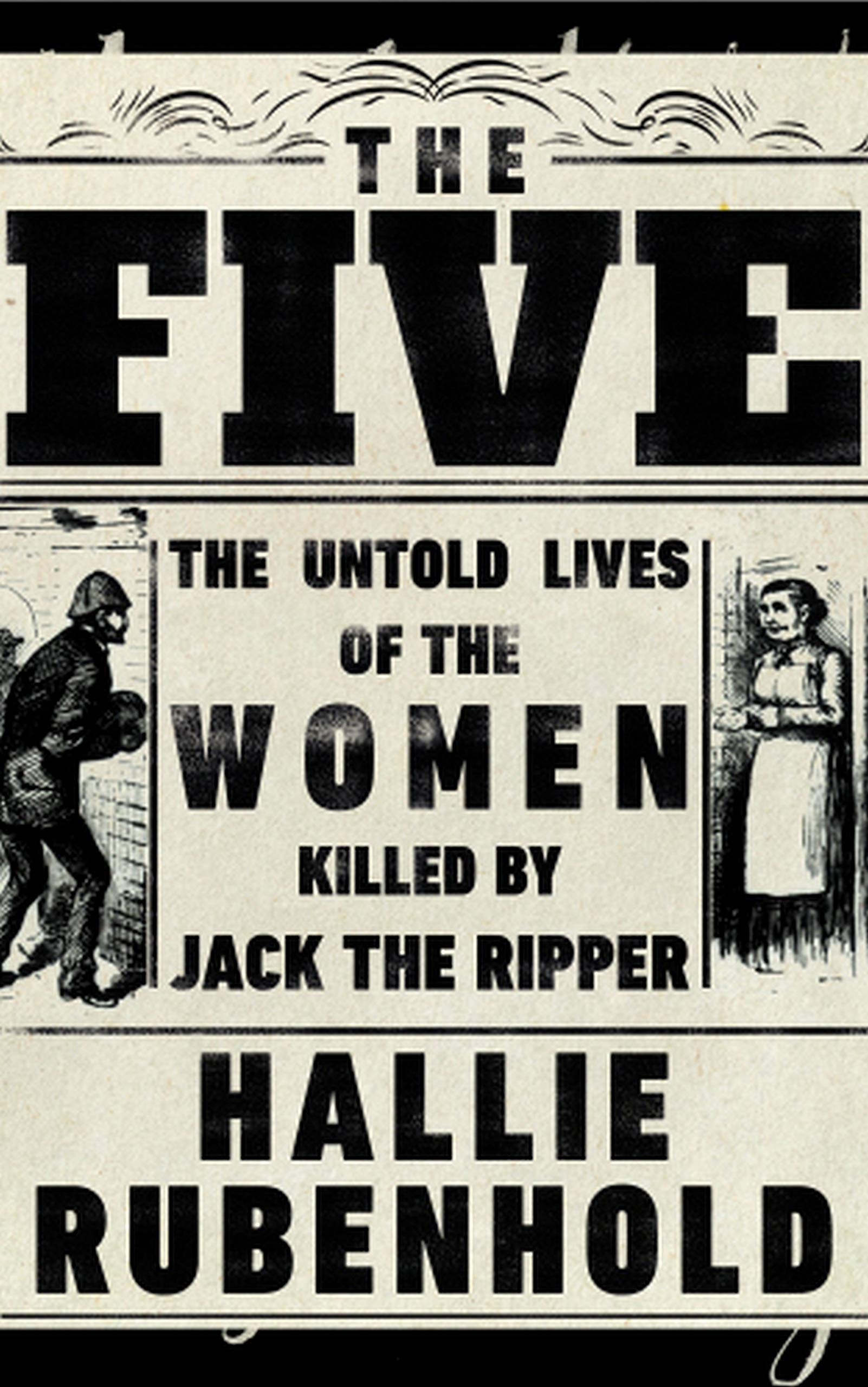
I recently read Hallie Rubenhold’s The Five: The Untold Lives of the Women Killed by Jack the Ripper, a revisionist’s history of the well-known killings. On the premise that there’s been vast interest over the decades in identifying the ripper, and there’s been little about his victims. Furthermore, what has been said about these women is by and large inaccurate. For example, they were not all prostitutes. Only one of the five women was a prostitute when she was killed and another had been a prostitute briefly in her past. A point also worth mentioning is that, contrary to popular lore, none of these women had been raped by their killer. Based on police records, Rubenhold concludes that these women were all killed in their sleep and only one of them in her own bed – the others were sleeping rough on the streets of Victorian London. I leave it to you, dear reader, to extrapolate the levels of misogyny going on there.Femicide 2

Since I started with Rebecca Solnit, I’ll conclude with her as well: ‘Even those of us who are not direct victims are impacted by living in a world where such gender violence is both common and normalized or trivialized, where any woman may be harmed because she is a woman.’


Dipping into British Herstory

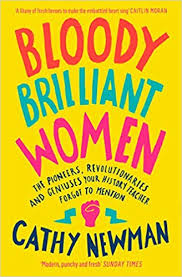
In Bloody Brilliant Women Cathy Newman writes about one of my heroines, Gertrude Bell, with a couple of lively examples exposing male perspectives that has kept Bell out of the history books. In the film version of Michael Ondaatje’s fabulous The English Patient, there is a scene where British soldiers are examining a map, trying to find a way through the mountains. One says, ‘The Bell map shows the way,’ and the other replies, ‘Let’s hope he’s right.’ Newman remarks on this unconscious bias, the assumption that a map maker must be male, behind this scriptwriting. For me, the more astounding point is that this error went unnoticed and unchecked by the script editor and the director’s assistant as well and made it to the screen.

Having read some of Gertrude Bell’s travelogues and letters and having seen an excellent documentary-cum-docudrama about her, Letters from Baghdad , I was pleased by Newman’s find of a letter from Sir Mark Sykes (he of the Sykes-Picot Agreement that carved up parts of the former Ottoman Empire for the likes of Britain, France and Russia). Sykes wrote to his wife describing Bell as ‘a silly chattering windbag of a conceited, gushing, flat-chested, man-woman, globe-trotting, rump-wagging, blithering ass.’ No need to deconstruct the misogyny here. Newman follows this quote with a simple ‘Wow!’ An example of the laid back journalistic style used throughout the book.

Newman’s version of herstory covers some familiar territory with Emmeline Parkhurst, Millicent Fawcett and accounts of women impersonating men in order to fight in wars. But it is well worth a read as the book explains the significance of these pioneering women in their pursuit for justice and equality given the socio-political and legal contexts of their time.

As much of my understanding of herstory is of a more international variety, I’m grateful to Newman for introducing me to a few personages that I would have otherwise missed, and who I now feel compelled to read or read about. There’s Dora Russell who championed contraception, recognising that childbearing wasn’t only controlling women’s lives, but also shortening them. Dora is otherwise known as the second wife of Bertrand Russell. And there is Claudia Jones, a journalist and activist, who founded the Notting Hill Carnival. I close with one of Jones’s most quoted remarks: ‘A people’s art is the genesis of their freedom.’