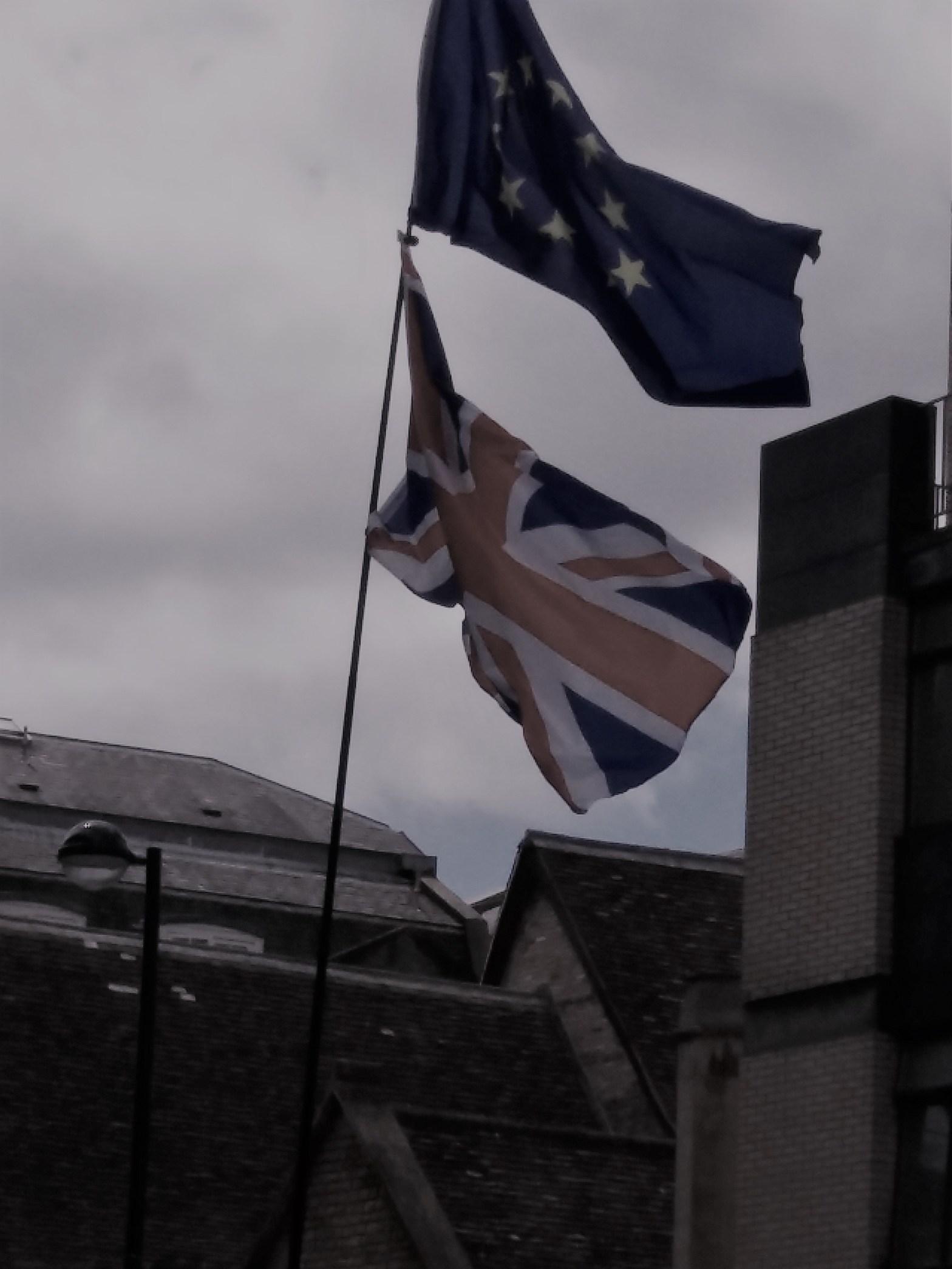
Ely for Europe

Our little group – only little because Ely is little – was formed following the Referendum vote on 23 June 2016. I agreed sometime last year to become the group’s co-chair, thinking that when elections came up I would take a casual step backward and watch as others clamoured for the position. That didn’t happen. I’m still co-chair. But in truth, I don’t mind as we have evolved into a group that’s actually getting things done.

In the early months of our existence, we spent much of our time together grumbling about how the Leave campaign won the vote and consoling each other as if we had been victims of a train crash. Our activities then had to do with keeping each other informed, writing to our MP and attending the protest marches around the triggering of Article 50.

Soon after, we were wrapped up in local elections. This made it difficult for our cross-party group to meet and discuss issues without members gritting their teeth at each other, the odd gibe slipping out. Overlapping with that, in terms of campaigns, was the general election. That too made meetings difficult, but as it was more or less an election about Brexit, we were able to come together on that and deal with the many tasks of being an official organisation – we have a constitution and a presence on Facebook, Twitter and in the local events magazine, along with links to national anti-Brexit organisations.

Now that a lot of our admin tasks are out of the way and we’re into our second year, we continue to attend rallies against Brexit, write to our MP and hand out flyers and leaflets at market stalls. More importantly, we acknowledge that there are different points of view – those that want to stop Brexit before it officially happens and those who are resigned to it happening, but want to limit its damage. While those aims might sound negative or reactionary, the positive sides are still there and are in our name – we want to keep our ties to the rest of Europe, share in its cultures, ideas and languages, and to welcome its citizens, who, like us, are citizens of the world.

The Week in Feminism

With Saudi women finally getting the right to drive and the death of Playboy founder Hugh Hefner, I’m reminded of the continued sexism and misogyny of our day.

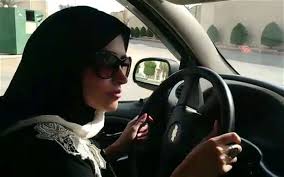
While I’m pleased that women in the Kingdom of Saudi Arabia are not only allowed to drive cars, but are able to do so unescorted by a male, I’m annoyed by the idea that this part of the new Saudi King’s programme of ‘modernisation.’ KSA is technologically one of the most advanced countries in the world. The King Abdulaziz City for Science and Technology was started in Riyadh back in 1977. According to Forbes, KSA is one of the world’s largest investors in technology today. And they have already launched several space satellites. A typical Saudi owns smart phones, tablets, laptops and an array of high-tech home entertainment systems. In terms of education – another indicator of modernisation – their primary and secondary schools were among the first in the Gulf States. Literacy rates in the Kingdom are now comfortably above the global average.

Yet for all of this, women were only given the right to vote in KSA in 2015 and now in 2017 the right to drive. Modernisation has been rather selective.

Of course, many countries, including some in the West, would also fail the fairness test when it comes to women’s rights relative to other developments.Saudi women 2

With this news about Saudi women, I’ve been reminiscing on my driving experiences in Oman, the country next door. While Oman is a country where women could drive, few did. Usually, I was driving with David in the passenger seat and I only had to deal with the dangerous habits of other drivers, typically young, male, on their mobile phones, speeding and cutting across lanes of traffic as if at the Monaco Grand Prix. When I was in the car driving by myself,  I also had to deal with male drivers pretending to drive me off the road, revving up their engines and blinking their lights behind me or driving closely alongside my car, looking at me and laughing.  I should point out that this was often on the highway between home and work with a posted speed limit of 120 kilometres per hour. I knew this harassment was because of my gender. I felt I had landed on a planet where the men – on the road at least – never stopped being teenagers.

This brings me to Hugh Hefner. I’ve been cringing these past few days as glowing tributes have been paid to this professional womaniser. It has been said, mostly by the man himself and now in his obituaries, that he was largely responsible for the sexual revolution of the sixties. If that’s true, such a revolution according to Playboy magazine was for men only.  In a complete and fair sexual revolution, men and women would have been featured in the magazine full frontal nude or engaging in sexual acts together. But we all know that Playboy and the persona that Hefner embodied were about the objectification and demeaning treatment of women. Where women weren’t treated like life-size dolls, they were reduced to bunny rabbits.

Having said this, I’ve also been comforted by the many writers and commentators – nearly all women – who have reminded the public of the man’s misogynistic remarks and his emotional abuse of women which continued until his death. Famous or infamous – the fact that there is a divide in opinion, like the views on women driving in the Gulf, illustrates that the struggle for equality has a long way to go.

Unfinished Fiction

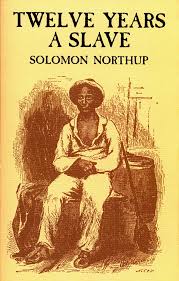
Consider this an un-review. In recent years I’ve surprised myself with a growing number of books that I’ve abandoned before finishing. Sometimes I’m inspired by a film adaptation to read the original story. Such was the case with Twelve Years a Slave, which I thought as a film was an intriguing slave narrative. The book, however, was written as a memoir by Solomon Northup in the mid-1800s. For this modern reader, the prose was too formal and laden with description. Ten pages in, I gave up. But I wasn’t alone. According to Kobo, their e-book of Twelve Years a Slave was left unfinished by over 70% of readers who started it.12 years a slave

When choosing books, another draw for me has been the shortlists of major prizes, such as The Booker and Bailey’s Prize for Women’s Fiction.  This gave me both Ann Pachett’s Bel Canto and Eleanor Catton’s The Luminaries. With both, the writing and pace held my interest until I was just past the halfway mark.  For me, these applauded books sagged in the middle. Bel Canto, a modern-day hostage drama, took its grip off me when I didn’t care about the characters anymore. Some of the hostages were so two-dimensional I was wishing for their release or death just to have them out of the way. With The Luminaries, the middle lost me when I realised the plotlines and characters were too familiar. Of contemporary fiction, I’ve read many a novel set in Australia or New Zealand in the 19th century.  Like other books of this sub-genre, the focus was on characters, many humorously flawed, seeking their fortunes. Without the laughs, I probably wouldn’t have made it halfway.

Perhaps the most disappointing category of unfinished novels is the shelf inhabited by some of my favourite writers who let me down later in their careers. Annie Proulx’s Barkskins did just that. I thought The Shipping News and Brokeback Mountain were exquisite pieces of writing, with passages and scenes that I still remember years later. Barkskins started out well, but killed off a couple of the main characters too soon. I stayed with it for a while into the next part as it is historically interesting, being about logging and the clearing of forests in French Canada in the 17th and 18th centuries. But grieving for these deceased characters, without replacing them with equally or even more interesting ones, got the best of me and I couldn’t continue.

Are there lessons to be learned from all of this? Just a few. The main one is that the appreciation of writing is highly subjective – something I try to remind myself of every time I get a rejection from a publisher.  The other involves the need to give up. Reading shouldn’t be a competition, even with oneself. Giving up on reading a book is not the same as giving up on writing one, especially if what I’m reading isn’t entertaining or helping me to grow as a person.

Where I wasn’t when Diana died

Having just flown back to Seoul from a short break in Guam, we were enjoying a late breakfast and listening to BBC World Service. Breaking news – Diana, Princess of Wales, had been in a car accident. My first thoughts were something along the lines of it being a fender-bender. No big deal. Diana and her boyfriend Dodi Fayed had probably walked away from it. The media makes so much of her life. My second thoughts were that in Britain, it was about one in the morning, while in South Korea it was just after nine. There was a sense of satisfaction knowing that we had heard this nugget of news while most of Britain was sound asleep.

Within an hour, we learned that Dodi Fayed had died and that Princess Diana was in hospital. This was serious after all. Living at the foreign faculty apartments, the rest of the morning was spent in gossipy speculation. Any colleague I bumped into on my way to the laundry room or shops was quick to ask if I’d heard anything. They didn’t have to say what it was about. As the hours passed without any news from the BBC, we suspected that it was likely a life changing injury or that she was dead.

It was late afternoon, David was off playing cricket with some international ex-pats and I was by myself in our tiny apartment preparing my lessons. I turned on CNN for an update and heard for the first time that Princess Diana had died. Even though I expected it, the news still stung and caused my eyes to tear. I was aware too that with an eight-hour time difference, Britain was waking up to this surreal headline. I felt reconnected to Britain, to my friends there and oddly to people I didn’t know.

In the days that followed, I sensed a closer bond to my fellow British, American and other Western colleagues and acquaintances. We were all shocked and felt the sense of a void being created with the young princess’s death.002 (2)

Koreans, on the other hand, couldn’t understand all the fuss. One of my Korea students explained to me that Diana was no longer popular in Korea because she was a divorced woman. They couldn’t understand how people could still like, let alone admire her. Watching British people on the news leaving bouquets and blubbering in front of Buckingham Palace made my students shake their heads, some even smiled. At some point, a Korean student asked me if I was sad about Diana dying. Yes, I guess I was, but not deeply sad.

In truth, Diana didn’t mean much to me. She hadn’t said or written anything famous or thought provoking. But like millions of others around the world, I enjoyed watching her, envying her clothes and style, delighting in her expressions of joy, empathising with her looks of boredom. When she first came on the scene as Lady Diana, she was a breath of fresh air among the stiff, restrained royals. She soon filled her job description giving us the heir and the spare, but was otherwise not particularly interesting. I started to pay attention to her again when she supported AIDS research, holding the HIV babies in her arms and sending a message to the world. Around that time she had started to diminish, becoming thinner by the month. The stresses of her life were there for all of us to see before the advent of reality TV. Only after her divorce did Diana appeared to be a healthier and happier person, travelling the world to draw attention to various charities, entertaining us with her stylish appearance. There was little not to like, but not enough substance to dislike.

As ex-pats, David and I had become regulars at the British Embassy in Seoul. In those days, the Embassy had a pub in the basement, complete with British ales and a dartboard, that was open to UK citizens and their guests.  I can’t imagine, post 9/11, the pub still operating. As most of us didn’t have access to BBC television in Korea – and the internet was in its infancy – the Ambassador invited us pub regulars to his private home to watch the funeral. About thirty of us sat in a grand room silently viewing the service on a wide screen, the only movement, the occasional face dabbed with a handkerchief.

The images and the emotions of those days seem as clear in my mind as if they were yesterday, or the day before. I suppose it’s the effect of shocking news that’s shared with a wider public, along with the fact that I was in South Korea. Having been a toddler when JFK was killed, this is my moment of remembering exactly where I was and what I was doing when I heard the news. And that might be all it will ever amount to.

Crime Fiction and Tana French

When I occasionally read crime fiction I feel as if I’m watching television. That isn’t necessarily a bad thing. In recent years television has improved immensely, especially in the crime department, with the likes of Line of Duty, The Wire, The Fall and Luther, to name a few. But where crime fiction and television fall short are in being plot-driven. With fiction, I invest my time and soul into the activity of reading and I expect at the least a story which is character-driven – for me, a mark of good writing. Of course, some of the best television crime, like those already mentioned, have strong characters, whose lives and character journeys develop as subplots to the main crime plots.

I’ve recently read Tana French’s The Trespasser, a murder story set in Dublin. While it’s a plot-driven page turner, it’s equally about Detective Antoinette Conway. As narrator, Conway is opinionated and fierce, encapsulated in an entertaining Irish idiom. As a detective, she can be sarcastic, brisk and aggressive, especially with her co-workers. She knows that she ‘lacks charm’ but believes it’s her best defence against the squad that wants to be rid of her. With the murder story taking its twists and turns, this character makes her own journey of self-awareness and identity. And like Line of Duty, the story thrives on long, but gripping, interrogation scenes that explore the psychology of the interviewers as much as those of the interviewees.Tana French trespasser

I do wonder if The Trespasser didn’t have detectives and a dead body, it may have been shortlisted for awards in 2016, alongside Sarah Perry’s The Essex Serpent and Rose Tremaine’s The Gustav Sonata.

Fire, fury and Trumpspeak

I’m not calling it language – that would give it too much dignity. As a linguist I’ve been intrigued by the utterances of the current US President. Of course, they wouldn’t be so interesting if they came out of the mouth or the tweet of a teenage boy. I haven’t written about this topic sooner because, not only have satirists done much of the job for me, but I was secretly hoping it would all go away – Trump’s presidency would be so brief, a glitch in the history of US democracy, weird, amusing, at times angering, but a mere footnote in popular culture.

Stripped to its bones, language is about communication. But with Trump, he isn’t communicating as much as he is posing. He has positioned himself as a racist, a sexist, no-nonsense tough guy, but one who is a victim of witch hunts at the same time. What he says – or tweets – is often so lacking in substance that it is more slogan than idea. And then there’s the hyperbole. In Trumpspeak, his proposals are the greatest, the most, the best, the largest. Trump has also completely ruined the word very for me. Okay, very isn’t much of a word anyhow.  It’s one of these thin adverbials used to plump up an even thinner adjective.

He now seems to be posing as a comic book villain with his claims that if North Korea continues their threats – just threats, not military action – “They will be met with fire and fury like the world has never seen … he has been very threatening beyond a normal state. They will be met with fire, fury and frankly power the likes of which this world has never seen before.”

The world is understandably concerned as Trump seems to be saying that he is ready with a pre-emptive strike if these threats continue. He is fitting the persona of the thin-skinned villain who you dare not call chubby or bald. And like the two-dimensional villain, he uses a formal diction – ‘the likes of which.’ This is from someone who has referred to the complicated Russian interference in the US election and more broadly in cyberspace as ‘the Russian thing.’ Trump also, as he does so often, repeat himself, as if the repetition makes the point stronger. Though it is obvious to most of us, this penchant for repetition is likely to come from an inability to understand, let alone articulate the situation this accidental president finds himself in.

The words ‘fire and fury,’ for what we can assume means some sort of military action, are tired metaphors. If Trump were a reader, I’d suspect this came from the Bible or from Shakespeare. My guess is that Trump’s source is more likely the film version of the comic book villain. That’s also where the hyperbole comes from as Trump’s actions will be something the world has never seen before.

While Trump uses words to grandstand or to act out a character, the rest of the world thinks he’s trying to communicate something. As Hillary Clinton said to Trump during one of the debates, as her opponent was being flippant about something he had said, ‘Words matter, Donald.’ He still hasn’t understood that message.

There is a silver lining though. We saw this week how Trump was reluctant to criticise white supremacists for their violence against anti-racism protesters in Charlottesville, Virginia, resulting in the death of a young woman. After public pressure and attacks from influential politicians, Trump finally condemned racism, pointing the finger at the KKK and neo-Nazis. This was delivered at a press conference atrump cartoon 2nd not via Twitter or during a staged rally of his supporters. The statement was obviously written for him – not his usual hyperbolic words, repetition and vague slogans. He was clearly uncomfortable reading the teleprompter. And that’s the good news – behind the scenes, there are people trying to control him and limit the damage. Sometimes he has to answer to them. This could be America’s and the world’s best hope against a man’s whose tendency to ride roughshod with the English language could lead to catastrophe.

Flemish (not so) Primitives

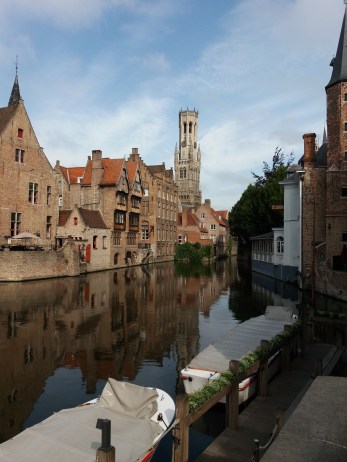
My taste in art has long been mostly modern – 20th century, some late 19th – Klimt, Matisse, Cezanne, O’Keeffe, Picasso, Kandinsky. But this recent trip to Bruges has turned that on its head. As luck would have it, the night before we left we happened upon the start of a new BBC4 series, The Renaissance Unchained, written and hosted by art critic and professional eccentric  Waldemar Januszczak. The first episode was about the so-called Flemish Primitives of the 15th century, for Januszczak the place where the Renaissance started – that is, not in Italy as has long been believed. (Still available on BBC iplayer, with some clips on YouTube.)

Waldemar, as we call him at home, made a good case for these paintings to be regarded as not so ‘primitive’ but instead as true masterworks. In one segment, he focussed on Jan van Eyck’s Madonna and Child with Canon Joris van der Paele, pointing out the detail that could make the viewer easily distinguish the textures of fur, velvet and lace. Although van Eyck was not the first to use oil, he is credited with having perfected oil painting techniques, mixing powdered colours with egg whites to come up with a concoction that spread more thinly and allowed for a greater variety of colours. These Flemish artists are also noted for breaking away from strictly religious themes and painting the everyday lives of real people.FlemishPainting-5.jpg

Some thirty-six hours after watching this programme, there I was at the Groeninge Museum studying this work for myself. Staring at the way the bristles in the carpet opened up over the steps in this magnificent painting, its complexity and visual subtlety transcended me to that place where creativity hinges on spirituality.

At the same time it made me feel ashamed of myself for having scoffed the Renaissance painters for so long. While I can appreciate the craftsmanship of Da Vinci, Botticelli and their ilk, I had tired of Madonnas and their pontificating children and tended to lump Renaissance paintings into a category of over-commercialised art. What’s the old expression – a little bit of knowledge is a dangerous thing? Mea culpa. I’ve now become an unofficial member of the van Eyck unofficial fan club. I’m also cultivating an appreciation for other artists of this early part of the Renaissance, having seen works at the Groeninge by Memling, Bouts and van der Goes.

While in Bruges, somewhere reading placards in a museum, I discovered an interesting take on the term ‘Flemish Primitives.’ It was FlemishPainting-2derived from the French premier, meaning that these FlemishPainting-3artists were the ‘first’ of
their sort.  If true, it’s a shame that this meaning has been lost.


The Ms Thing

Last week saw the death of Sheila Michaels, the woman credited with ‘introducing the honorific Ms into common parlance,’ according to the NYT obit.

While it might be ‘common parlance’ in the United States, it still hasn’t completely caught on here in the United Kingdom.

Virtually any time I give my name to a stranger, whether it be a builder, a ticket office clerk, shop keeper, whatever, I am asked ‘Is that Miss or Mrs.?’ This question in itself divides the UK from the US, where people often don’t use title at all, just the person’s name. Here in England, when I respond with ‘Ms’ I’m typically looked at with a baffled expression. Sometimes the person tries again, as if my accent either made my response incomprehensible or my brain too small to understand that Ms was not one of the options. One time, a Cambridgeshire garage owner even asked me what it meant. I had to explain that Ms is for women whether they are married or not, like what Mr is for men.

But most of the time, the linguistically constipated stranger ignores what I’ve just said, looks at my hand, sees the wedding ring and writes down ‘Mrs.’ Problem – I’m not Mrs Trimarco – that was my mother, or some other woman who married a Mr. Trimarco in generations before mine. Like so many women, I chose not to change my name when I got married. Not only do I object to the symbolism that I become my husband’s goods and chattels upon marriage, but having been published under my birth name makes any name change professional suicide – not to mention downright messy. For those of you who say that it’s easier for the woman to change her name if she has children, I say wake up. With all the stepparents, foster parents and other guardians with different surnames to their little ones these days, people’s expectations have changed.MS-2

I haven’t yet run into an equivalent for Ms in other languages, but there are countries that either no longer or never have used titles to distinguish married women from unmarried ones. These include, surprisingly, Iran and South Korea, two countries with notorious track records for the oppression and ill-treatment of women. Moreover, in both Iran and South Korea a woman keeps her surname after marriage. Having said that, one Korean woman once told me that a woman kept her maiden name so as to not confuse the family tree in a country where ancestor worship is paramount. Her interpretation on all of this was that women didn’t count in the tracing of family trees, that they were mere conduits of babies, not important enough to have their names passed on.

In some South American countries, a woman becomes a signora, but her surname stays the same. When she has children, part of her surname, usually a double-barrelled one like Sanchez-Perez, goes to her children. The other half of the children’s double-barrelled names comes from their fathers.

So, what’s the problem with Britain? Maybe people here resist the title because they’re used to Miss or Mrs, or as one shopkeeper once told me ‘it’s only for feminists’ (as if that were a bad thing). Are things all that bad on this score here? Well, just a couple of years ago, I felt a glimmer of hope when I went to the opticians and was given a form to complete that gave me the options Miss, Mrs, Ms, Dr, Mr. I happily circled Ms. I turned in my completed form to the receptionist, who looked at it carefully and said, ‘Is that Miss or Mrs?’

Fast-forward to a few days ago. I was at Homebase getting a quote for our bathroom refurbishments when the bathroom designer, sitting at her computer, was filling in my contact details. A dropbox for titles came down with Mr, Miss, Mrs, Ms, Dr etc. as she asked me my title. Seeing the options, I said, ‘Well, Ms or Dr, either is fine.’ She looked at the ring on my hand and said, ‘But you are a Mrs, aren’t you?’ It was clear that that was her preferred option, a world she understood.

I replied, ‘But I’m not Mrs Trimarco. My husband isn’t Mr Trimarco. I didn’t change my name when I got married.’

Her expression was too plain for me to tell if she was an anti-feminist, repulsed by the title, or simply confused. Finally, she said, ‘Okay, let’s use Dr then.’

Gertrude Bell in Persia

She’s been described as ‘the female Lawrence of Arabia.’ I confess that I’ve used that glib and convenient phrase myself. But it doesn’t do her the least bit of justice.  One could argue that she accomplished a great deal more than T.E. Lawrence and that she had more barriers to overcome along the way.

Gertrude Bell (1868-1926) was an archaeologist, scholar, writer and a political advisor, helping to establish modern-day Iraq and the National Museum of Iraq. As a contemporary of Lawrence, she worked with him at one point in Egypt. Both were British born and both developed a love and consequently insider’s knowledge of what was then called Arabia and Persia (or even more broadly and strangely to modern ears ‘the Orient.’) While Lawrence’s Seven Pillars of Wisdom is still read by British and American forces stationed in the Middle East, Bell’s writings on Iraq and Syria are studied by military experts and scholars the world over.

I recently read the first book she wrote, Safar Nameh: Persia Pictures.  It’s a journal of her travels in 1892 to what was then Persia, covering modern-day Iran and much of Turkey. She was accompanying her uncle, Sir Frank Lascelles, the British Minister to the region, which gave her access to people and places unavailable to most Westerners, especially women.Gertrude bell

Persia Pictures shows us a travel writer at the naissance of her writing life, before she knew herself the role writing would play in her career and the mark it would leave on her legacy. She relays impressions of the landscape, the towns and villages and the people that inhabit them with a sense of wonderment – that first discovery – of a part of the world few in the West knew much about. With this is her discovery of the Persian language and some of its most revered writers – in preparation for the adventure, she became highly proficient in Persian. (At this point in her life, she was already fluent in French and had begun studying Arabic.) Among the gems of this book are her fragments of translations of the Persian poet Hafiz into English. A few years later she published her translations of The Divan of Hafiz.

Bell concludes this short volume with what can be best described as a meditation on travelling. Here, she summarises her encounters with the locals in her role as traveller: ‘Although your acquaintance may be short in hours, it is long in experience; and when you part you feel as intimate as if you had shared the same slice of bread-and-butter at your nursery and the same bottle of claret in your college hall. The vicissitudes of the road have a wonderful talent for bringing out the fine flavour of character.’

With the films Queen of the Desert and Letters from Baghdad, Bell is slowly emerging from obscurity, but still appears to be relegated to ‘women’s studies’ as opposed to the writer, scholar and historical figure that her feats deserve. Yet, the day might come when T.E. Lawrence is referred to as ‘the male Gertrude Bell.’

Still Fighting

It’s easy to give up on politics and politicians. In a sense, that’s what has already happened. Around this time last year, many people in Britain, fed up with austerity measures and unemployment, decided not to engage in politics. They didn’t listen to cogent arguments or evidence. Instead they joined a movement of emotions and voted to leave the EU. Likewise, in America people, fed up with grid-locked legislation and the paralysis of their personal finances, also decided not to engage in politics. They either joined a similar movement of emotions or they didn’t vote at all. The result, as we all know, was Trump. I don’t mean to oversimplify these events – we all know that racism and sexism play their parts as well.

As a consequence of these electoral debacles, many people have been energised into political action. Online protests, petitions, marches, rallies and media-generated debates have erupted on a scale not experienced in my lifetime. But now the wind seems to be changing. Following the recent UK General Election, where a hard-Brexit government lost its majority, there is talk from politicians and in the media of a much toned-down Brexit, possibly keeping the UK in the single market and/or the customs union (among other things).

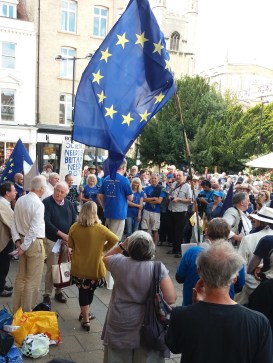
I went to a Pro-EU rally this past weekend, marking the one-year anniversary of the vote to leave the EU. It pains me to report that this rally was poorly attended.  Maybe some 300 people were there.  I wonder if this slight change in the air, this post-election awareness, has made people complacent. Do they believe that it will all work out for the best? That a hard Brexit or the economic downturn from any type of Brexit will never happen?  If they aren’t complacent in their thoughts, perhaps people were suffering from a bit of protest-march fatigue or were simply enjoying the beautiful weather that sunny Saturday afternoon.Cambridge 2nd march 1.jpg

As for me, I’m still in the fight. For those out there who don’t know me, on a personal level I don’t have much of a fighting spirit. I’ll argue to a point, but as soon as I realise that I’m overpowered or that my opposition is mentally/psychologically ill, I back off. I realise that there is no point wasting energy or keeping myself in a victim position. Of course, it’s easy to feel overpowered by political movements and governments. But then I remind myself that I’m empowered as a taxpayer and a voter and that participating in protests is a step out of the victim position. Wasting energy? I don’t think so. But I have to admit that it can be tiring. The opposition knows this too. I think it’s important that they (the Brexit and Trump supporters) do not wear us down.