Women, Power and Mary Beard

FawcettThe Fawcett Society’s latest Sex and Power Index is a reminder that outrage and publicity aren’t enough. The study showed that in the UK, women currently make up just 6% of FTSE 100 CEOs, 16.7% of Supreme Court justices, 17.6% of national newspaper editors, 26% of cabinet ministers and 32% of MPs. I’m experiencing déjà vu. A few times a year, figures like this come out, whether from the UK, US or some international organisation. The women’s marches of the last couple of years and the media frenzy over Harvey Weinstein and #metoo seem to have had little impact when it comes to placing women in positions of power. This is made even more appalling by the fact that over the past decade women have surpassed men in numbers entering higher education – that is, we can no longer say that women aren’t qualified for such positions.

This brings me to Mary Beard, the Cambridge don and television classicist, whose recent book Women and Power: A Manifesto addresses this horrendous imbalance. While she gives some attention to modern examples where women in positions of power are treated differently and more negatively and sexually than their male counterparts – think Hillary Clinton – Beard looks mostly to history and ancient writings for the roots of misogyny and power relationships. She’s a master at relaying such accounts and the book is well worth a read.

But again, I experienced some déjà vu. Other feminist writers have pointed out the historical and institutional oppression of women. Gloria Steinem, Germaine Greer, Betty Friedan, to name a few.

I find some solace in the fact that Beard’s book has sold well and comes out at a time when a new generation of feminists is emerging. I do hope these young activists heed the advice on the back of Beard’s manifesto: ‘You can’t easily fit women into a structure that is already coded as male; you have to change the structure.’


Writing Essays

This was supposed to be a writer’s blog, writing about my writing and others’ writings. But other aspects of life have funnelled in – politics, feminism, visual arts. I make no apology. What brings all of these disparate parts together is actually essay writing. Blogs for me are a warm-up activity, a brain and language stretch for writing essays.

Before I write another word, I should explain that by ‘essay’ I mean creative non-fiction. What I don’t mean, for those of you who have searched #essay writing and landed here, is the formulaic student essay – that academic rag of assessment that takes all of the fun out of essay writing.

Without the structural constraints or the timeliness needed for newspaper articles or columnists’ pieces, essays can have a more varied existence. The Pulitzer Prize-winning author Annie Dillard once said ‘The essay is, and has been, all over the map. There’s nothing you cannot do with it; no subject matter is forbidden, no structure is proscribed.’

Annie Dillard
Annie Dillard

In some of my essays, I’ve worked within an overriding chronological story-telling, but without fictional characters to get in my way and with space for more philosophical ideas than I can get away with in fiction. With other essays, I’ve used more of a mini-collection style, with each vignette on the same theme and some indirectly answering to other vignettes. I try to not ramble in my essays. Perhaps it’s because I ramble in my journals or perhaps because I fear the work won’t get published – being mistaken for bad writing.

That reminds me of something I read a few years ago in Prospect Magazine: ‘The essay is more than an assembly of literary conventions: it ought to be an examination of the facts of the world. This has become clearer with the emergence of new technologies, which threaten to deprofessionalise one of the main historical strands of the essay, the egotistical ramble.’ (P. Hensher)

Aside from the above comment about rambling, this quote is also interesting for its inclusion of ‘facts.’ One thing I’ve learned from writing essays over the years is that while they are not fictional, their ownership of ‘facts’ or ‘truths’ is a bit slippery. I write about what I know to be factual at the time, sometimes having to rely on elusive memories that I’m aware are from my viewpoint. I choose to write about some facts and not others because this fact or that fact has been meaningful to me.

My favourite essayists have been mostly male. In part this is because men are more likely to have collections of essays published as single volumes. I’m thinking Gore Vidal and Clive James. I suspect this has its origins in the essays of the great Western philosophers. Women’s essays appear more often in anthology form along side other authors, such as the works of Rachel Carson and Margaret Atwood (underrated as an essayist).  I’ve noticed the trend too of the rare collection by a single female author being labled ‘women’s writing’ or ‘feminism.’

Well, if I’m going to buck this trend, I had better stop by rambling – I’ve exercised enough with this blog – and get on with essay writing.


A week in the life of a pro-Europe activist

Saturday: Spent one and a half hours in bitterly cold Ely Market Square working at the Liberal-Democrats’ Exit-Brexit market stall. One passer-by screamed at us, once he was far enough away to avoid conversation “The majority voted!” Another man blames the EU for Eastern European workers. I briefly told him how Britain invited Eastern Europeans here in 2004 and that other EU countries have different immigration policies – but I stopped myself. I’m grateful Eastern Europeans are here working on our farms and in our hospitals, making our country culturally richer. The man continued to say that because of the EU he can no longer go to his local pub.  At that point, I gave up and stepped away.

Sunday: Too cold to go out. Stayed indoors and wrote my blog about hearing Lord Adonis addressing Brexit issues earlier that week at a town hall meeting in Peterborough.

Monday: Ely for Europe co-chair Virginie stopped by with Open Britain and European Movement surveys. We discussed a strategy for getting our members to fill them in and get people they know to fill them. With hostilities in the post-referendum air, we can’t expect people to knock on strangers’ doors.

Tuesday: Sent an email to MP Lucy Frazer about the debate on how Brexit will impact the NHS in Parliament scheduled for Thursday. Urged her participation. Started following Lord Adonis on Twitter.

Wednesday: Signed online government petition demanding that the Referendum vote be made null and void due to illegal activities and influence surrounding Cambridge Analytica. A long shot, but worth a try. At least the act of signing the petition felt good.

Thursday: Attended a Q+A session hosted by Ely for Europe with MEP Alex Mayer. Met more pro-Europe supporters, mostly from Labour. Left the event thinking that maybe it’s not a matter of hard Brexit or soft Brexit. It might be a symbolic Brexit that does the trick. In March 2019, British MEPs leave Brussels (and lose their jobs) and the Union Jack is lowered. With the new passports, these gestures might be enough for the Brexiters. Other issues to do with trade, borders, funded research and so on could remain in limbo for years as people in the EU and Britain work around them, effectively remaining linked.

Friday: Learned that 15 cross-party MPs stood up in Parliament to debate how Brexit will impact our NHS – none of them was MP Lucy Frazer. No evidence that she was even there.  Engaged in stealth activism by delivering pro-Europe flyers from the Lib-Dems and the European Movement to unsuspecting letterboxes. Very satisfying and less angering than working market stalls.

Saturday (in France, a week is 8 days): Attended Exit Brexit march in Ipswich. Excellent turnout with pro-Europe groups from across East Anglia. On the train returning to Ely, while reading The New European, I looked up a few times at the flat landscapes, the farms, the villages and wondered what the future holds.

Reading Lolita in Tehran

Even though I’ve done research into reading groups, until recently I hadn’t read Azar Nafisi’s best-seller Reading Lolita in Tehran. While it’s not an academic source for me to cite, it does confirm what the research has found. Simply put, reading is a social activity. We might read a book in a room or on public transport in our own little worlds, but then we talk about books and we integrate our experience of books into our social lives.

Reading Lolita in Tehran uses the reading group, along with classrooms of university students, as vehicles to describe how the revolution in Iran has affected its people, especially its women. It details stories of injustice and oppression in the lives of Nafisi, her students and colleagues, taking readers through the uprisings against the West and the Iran-Iraq war to the post-war period followed by the death of Ayatollah Khomeini and the attempts at liberalising that continue today. (Bearing in mind, the book was published in 2003.)

The reverence for literature permeates throughout this memoir. Along with Lolita, the author covers Daisy Miller, The Great Gatsby and Pride and Prejudice, showing how she and her students reacted to these works. In her own responses, Nafisi provides some passages of literary criticism of the type that reminded me of my years of teaching literature to undergraduates.   Reading Lolita 2

I’m glad that I’ve finally caught up with Reading Lolita and hope to find other such books obviously written for Western audiences that contribute to understanding the Middle East in a modern context.

A Cross-Party Spirit for the Pro-Europe Movement

As party politics in Britain is being reshaped – maybe to the point of extinction – I find myself increasingly involved in cross-party events. This week it was a town hall style gathering billed as a ‘Brexit Listening Tour’ in Peterborough and led by Lord Adonis, a Labour Peer. The attendees for the most part didn’t identify themselves as belonging to or supporting one party or another. Those who did label themselves came from Labour, Lib-Dems, Greens and Conservative parties. Naturally, no one from UKIP, but I suspect they’re not in ‘listening’ mode these days.

From the timing of the applauses, along with the comments and questions, this was clearly an event for those who want the UK to remain in the EU. If you’ve been following my blogs, you know that this is not the first time I’ve been to such an event.  Adonis

I came away from the evening invigorated and inspired to get back to the type of face-to-face activism that I do when I’m back here in Ely. I also came away with a few points worth sharing.

First of all, perhaps the time has come for Brexiters and Remainers to unite against our government for running the simplistic in/out referendum in the first place. It’s easy to accuse the Brexiters of lacking knowledge as there was no mandate in the referendum explaining how we would leave, along with the assumptions (and lies) that made people believe that leaving the EU would make Britain better off. Even though those who voted remain obviously had some sense of what it would be like to stay in, there were still many things about how the EU works that Remainers- and I include myself in this- simply didn’t know. Had we known more about the customs union, the various immigration policies across EU member states, or the problems now facing Ireland and Gibraltar, our arguments would have been different.

Secondly, let’s not forget that Brexit is a symptom of the problems the UK has been unsuccessfully dealing with for the past few decades. Problems like unemployment, housing and a weakening health care system.  Perhaps this point is just another angle on looking at how the pro-leave vote was really a protest vote against life in Britain. Labour, the Greens and the Lib-Dems could easily unite on tackling these problems along with undoing the mess that has become Brexit.

A final point is more a turn of phrase than a point. It’s an answer to the tabloid press and The Daily Telegraph which continue to publish stories about the NHS being drained by immigrates and their children needing medical services. One of the attendees at this cross-party event said ‘You’re more likely to be treated by an immigrant than you are to see them in the waiting room.’  Well said.

Work/Not-Work

When I first heard about a universal basic income, I thought it was a pie-in-the-sky idea, the product of navel-gazing and not living in the real world. Reading George Monbiot’s Out of the Wreckage, I found someone else who initially reacted to universal basic income as I did. But he’s changed his mind – so have I.

Out of the Wreckage only spends a small amount of time on UBI. It does cover the key points. UBI is an income paid to every adult, regardless of employment, poverty or attempts to find work. As it would replace complicated needs-tested welfare with a leaner, less bureaucratic system, many believe it could cut poverty and inequality. Others are looking to UBI as a way of dealing with chronic unemployment brought on by automation. Small scale trial studies – such as in sectors of Finland’s workforce, towns in Brazil and in poverty-stricken regions of India – have been successful so far.

But the success of any such scheme starts with individuals and communities and this is at the heart of Monbiot’s doctrine. Monbiot makes the point that identifying ourselves as, or being, our jobs feeds into an unhealthy protectionism of jobs. This protectionism can override the best interest of communities, national economies and our natural environment. The other weakness inherent in thinking of ourselves as our jobs is the stigma attached to those who do not have jobs. I confess, as you may have read in an earlier blog, my sense of identity comes largely from what I do for a living. I’m having a rethink.Monbiot

Monbiot’s book is also a worthwhile read for the way it explains the damaged done by neo-liberalism (a misnomer if I ever heard one). Unlike other authors who tackle this subject, Monbiot goes beyond describing the flaws of neo-liberalism in terms of deregulation, outmoded economics and capitalism run wild – we’ve all heard these points before.  Monbiot looks to the psychological and social ethos of our age and asks readers to rewrite the story we are living and draw from our cooperative nature and community spirit to supplant the ways of corporations and governments.

In this context, where financial and administrative pressures could be taken off the government with more community participation and less plutocracy, the idea of some sort of universal basic income fits in and perhaps stands a chance.


#SchoolShootings

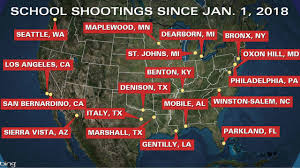
I asked my Facebook friends that I grew up with in Chicago if they remember having fears about mass shootings when we were at school in the 60s and 70s. Like me, they didn’t. Mass shootings at schools were unimaginable.

These friends did however remind me that there were a couple of bomb threats at our grammar school. This was around the time of the Vietnam War and soon after, when radical social movements were placing bombs in busy public places and government buildings. These bomb threats were taken seriously and we all responded to the fire alarm, forming pairs as we hurried out to the playground and baseball diamonds. No bombs were ever found – another hoax inspired by stories in the news.

Aside from the bomb threats, school for my classmates and me was a place of safety – though perhaps more so for the girls than the boys. I’ve learned through this little Facebook chatter that in highschool the boys had to deal with other boys acting tough and gangs picking fights at school sports events.

Our fears of crime and violence came from the world outside of school. We couldn’t go out by ourselves at night. Even a pairing of females felt their lives were at risk after sunset. During my childhood I knew of three teenage girls who were raped on the streets by strangers. A couple of others were attacked at knifepoint, but managed to escape thanks to the help of passers-by. I too had an incident of being followed by a man who had first approached me with his dick hanging out. (Another #metoo.) I hurried passed him and turned the corner. As I neared our building, I saw an apartment with a light on and waved and yelled out as if I saw someone I knew. The creep ran off.

It may not have been halcyon days, but it didn’t include mass shootings. We were, after all, before Columbine. That seems to have been the first. There’s an excellent article on this chain reaction written by the always brilliant Malcom Gladwell.

schoolshooting 2

I don’t think this problem is going to go away in the current mind-set that is sweeping America – especially with its NRA-funded think tanks and politicians. I am, once again, grateful that I’ve emigrated away from the US. Britain and France have their problems, but they don’t allow them to have assault weapons. I’m also grateful at times like these, on the back draft of a recent shooting, not to be in America, embroiled in the polemic. From Europe, I’ll stick to the occasional Twitter and Facebook postings – thumbs up to anyone who points out that this is utter madness – and the reminiscences of my former classmates – thanks for sharing, guys.

Essay: The Heiress

At a hospital in New York she was in a third-floor room that had its number changed to make it harder for people to find her. On the door of this room was a plaque bearing the name Harriet Chase – an alias and a lame one at that – a female name with the same initials.

Hugette Clark’s 5th Avenue apartment covered the entirety of the eighth floor and contained 42 rooms. She also owned a castle in Connecticut on 52 acres of land and a house in California that overlooked the Pacific. For decades, she lived cut off from most of the outside world in her New York apartment with these other homes remaining empty, though well-maintained.

By the time she was thirty, Clark was already worth half a billion dollars. That wealth had been inherited from her father, a copper mining and railway tycoon. He had other children with his first wife and remarried in his 60s, siring Hugette when he was 67 and half deaf. The grandchildren and great-grandchildren of these half-siblings were the reasons for her hospital-room anonymity – they were all after her money.

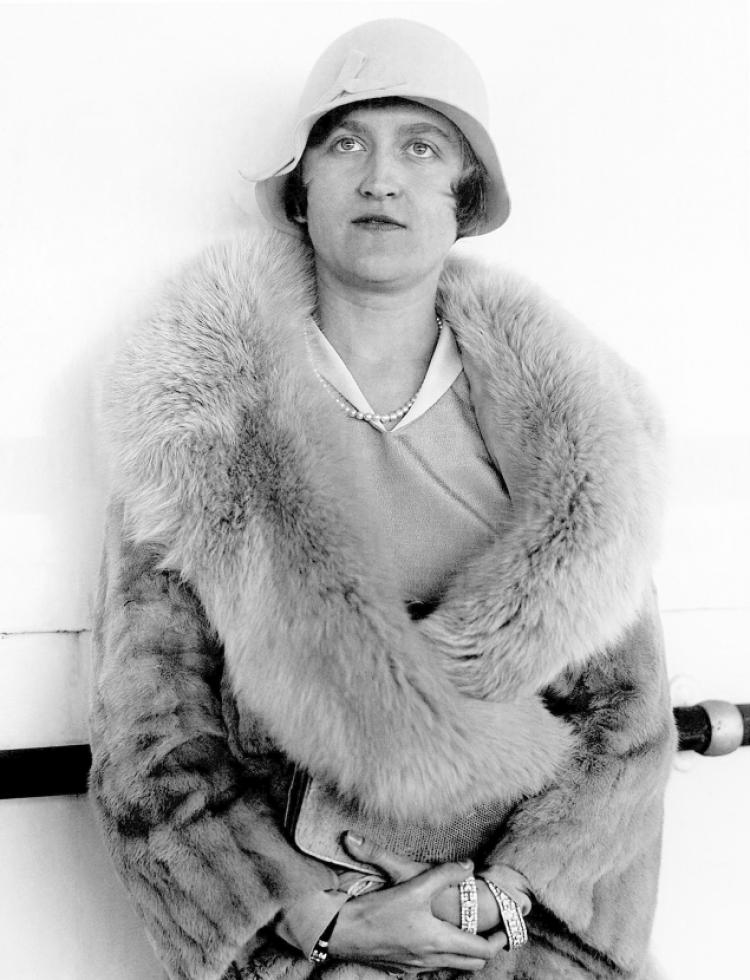
In 1930, Hugette Clark posed for a photograph, wearing a mink coat. Her hands are partially folded in front of her, one grasping a jewel-studded bracelet. She’s wearing a rounded hat that women wore in those days, a silken flower sewn into one side. Her lips, darkened by lipstick, are closed into a gentle smile while her eyes are gazing up in a posed fashion. Soon after the picture was taken, she cut herself off from much of her family and friends and no longer went out in public. There were only a few photographs of her to survive, this was her last, her death mask – a parting gesture for the curious.

She wasn’t a total recluse though, having a few close friends who remained at her side. Among them was her secretary, Suzanne, who claimed that Hugette’s closest friends were actually her dolls. The heiress had a collection of antique dolls that she fussed over, with her servants washing and ironing the little doll clothes. These, her surrogate children, were at her hospital bedside.

Hugette Clark died in May 2011 at the age of 104. She didn’t write any books, nor was she an actor or politician. With only one photo of her left, she hasn’t given the world much of herself. Yet, since her death, stories about her fill a peripheral space in the internet, generating a kind of celebrity that Clark herself would have shunned.  Her legacy has been her lifestyle – her living in isolation, her eccentricity and above all else, her wealth. The size and value of her properties, the cost of her furnishings, jewellery and her dolls speak to our envy and avarice. If she were equally isolated and eccentric, but poor, she probably would have passed without our notice.

Clegg’s How to Stop Brexit

Based on the reviews, I almost didn’t want to read it – it would have been too painful. When Nick Clegg’s book How to Stop Brexit first came out, the media focused on Clegg’s advising people to join the Labour Party. As this isn’t what one would expect from a former leader of the Liberal Democrats, it made for attention-grabbing headlines and news-straps.  Finally, I braced myself and read the book – and saw his remarks in the context they deserve. What he actually does is first to acknowledge that Britain is well and truly a two-party country at the moment and that it in within the two main parties that Brexit could be stopped. By joining Labour or the Conservatives (he says that too), a voter will have more opportunities to effect change in those parties, bearing in mind that both parties are internally divided between Leavers and Remainers. Clegg isn’t asking anyone to leave the Liberal Democrats. Instead he’s appealing to those who are inclined towards Labour or the Conservatives to join those parties and become more involved in their Brexit positions. This is especially the case for the Labour-inclined as this is the current party of opposition – well, at least they’re supposed to be. Joining the Conservatives is less helpful as most of the Conservatives MPs who voted Remain have been whipped into line to follow the disastrous path towards Brexit.

Clegg also makes a good point by reminding us that in 2004, when the EU expanded by including countries from the former Soviet Union, the pre-existing EU countries had a choice about whether and how to receive immigrants from these new EU-member states. Only the UK, Ireland and Sweden had an open-door policy. Other countries, such as France and Germany, imposed restrictions on the number of immigrants and the employment sectors they could work in. In other words, for those pro-Leavers for whom immigration from the EU has clearly been an issue, we cannot blame the EU for choices that we made. Of course, I, like Nick Clegg, think that these were good choices, filling in sectors of our workforce – on top of the many ways British life has been enriched by these other cultures.Clegg book 2

Other points in the book were ones that any Pro-Europe activist has heard before.  A bit of preaching to the choir, though I did enjoy Clegg’s turn of phrase: ‘The battalion of greying Conservative MPs you have never heard of, the shady financiers of the Brexit elite, the loopy rantings of Paul Dacre… all of these people fought  relentlessly for Brexit, over many years, long before the term ‘Brexit’ had even been invented.’

Another quote that made me nod in agreement and wish I had said it in my little blog: ‘By choosing the hardest of Brexits, by attacking them [remain voters] as “citizens of nowhere,” Theresa May made the extraordinary choice to de-legitimise and ignore the millions of people who voted for a different future.’ It was indeed extraordinary and angering as such remarks cut against the structure of our democracy, implying that we have a winner-take-all approach to elections. I’m surprised that more people haven’t caught out Theresa May on this.

Of course, I recommend this book but given its bold title, I fear that the only people who will take me up on this recommendation are those Pro-Europe activists who don’t need to read it.