Sorting out, throwing away

This summer, I embarked on a major project – clearing out the paper clutter. I’ve disposed of two boxes crammed with over 30 old journals and once again triaged my bookcase into categories of sell, donate and keep.

Letting go of my once precious journals – some have travelled to three continents – has brought  two things into focus. 1) Half of these journals were about the craft of writing, developing plots and characters, turning loose ideas into tangible stories. Now that these works have been written and most published or performed – some more successfully than others – I don’t need these notes anymore. 2) The other half of the journals were a chronicle of angst and anxiety in the forms of travelogues and practice prose, observing changes to my lifestyle with each new country, each new job while untangling my neuroses. These pages detailed a younger me – or another me – who, while still present, exists at a distance now. Since my thinking and behaviours have evolved, these journals could be discarded.

Flipping through the pages one last time, I did find a few memories that sparked new ideas for fiction and nonfiction. I’ve already noted them in my current journal, which has been digital for the past five years. I suppose someday that, too, will be deleted. For now, at least they aren’t collecting dust and taking up space that could be used for more useful items.

As I was preparing myself to say goodbye to these now worthless volumes, I stumbled upon a quote from professional New Yorker Fran Lebowitz. When asked if she kept a diary or journal, she responded: ‘Guess what? I don’t need to live my life twice – once was enough.’

The books were a lot easier to purge. I grew up in an apartment full of books. The living room was flanked with two walls of bookcases – classics and encyclopaedias in hardcover and everything else in paperback. All these books were read at some point by my mother, my six siblings and me. Every Saturday, one of us drew the short straw and had to dust the living room – a feather duster along the tops and bindings and a cloth dampened with wood polish for the shelves. Over time, some books were passed on to my mother’s friends or donated to a library, and the empty spaces were quickly filled again.

I inherited this need to be surrounded by books, continuing the tradition of book purges with each move to a new country or city. But in recent years, the rise of e-readers and regular library visits have naturally reduced the content on my shelves. With this summer’s clearing out, I sold some 50 books online and gave another 20 to charity. What remains are a handful of language books that I’m still using and some poetry and French books that I still dip into.

The only books I have held on to for sentimental reasons are my own publications (that are not available in digital form), my high school yearbook and the complete works of Shakespeare. While I have the Bard’s entire canon on my Kindle, I saved this specific edition for the handwritten inscription from my mother. It was a birthday present from her, one of the few positive memories I have. The inscription reads, ‘May you taste of life as deeply as did the masters.’

What I’ve been reading

Samantha Harvey’s Orbital was well-deserving of the Booker Prize last year. It’s the first book set in space to win the prize, which says something about the typical prize judges. Science fiction, while no longer considered pulp, is still seen as too low brow or not literary enough to make the grade. Orbital escapes that by working with science fact. Set on the International Space Station, the lives of six astronauts and cosmonauts – two women and four men – are explored as the spacecraft orbits the Earth 16 times a day.

While the psychological aspects of life in a confined space are compelling, they are within our imagination’s grasp. We can relate to being in tight quarters, working on a team, or feeling unreachable from loved ones. What is far more challenging to comprehend, and therefore more fascinating, is what happens to the human body in space. Harvey’s research is impeccable and aligns with what I’ve discovered in my own reading, including a recent article in The New Yorker on the mysterious and often dangerous long-term effects of gravity on the human body.
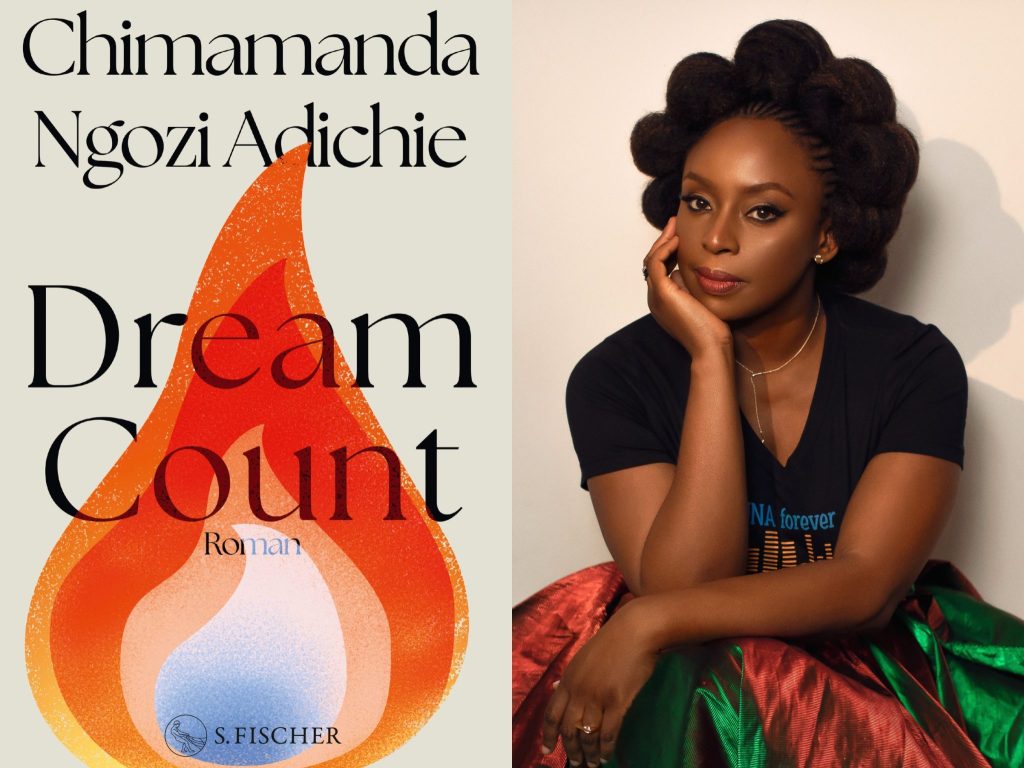
My summer days have concluded with Chiamanda Ngozie Adichie’s latest novel, Dream Counts. Reviews and the book’s jacket blurb emphasize that it is set against the backdrop of the Covid-19 pandemic, with four main characters of Nigerian descent grappling with the isolation and uncertainty of that time. In my reading, however, Covid is present for only a small part of the novel. The interconnected stories of these women cover flashbacks to Nigeria, Britain, and America long before the pandemic struck. The emotional journeys and experiences of the women – including motherhood, sexual violence, relationships, and ambitions – are far more central than the pandemic themes. It’s a story about the complex facets of womanhood, told from a feminist perspective and in Adichie’s signature crisp and fast-paced style.
Surviving January

Nope, this is not a blog from a survivor of Dry January – the wine continued to flow as usual. Nor is this about winter depression – at times, a sad month but luckily without the winter blues (hard to experience in the sunny south of France). As February kicked off this weekend, I was determined to reboot and restart the year afresh. But not before a few reflections on the surreal month that just passed.

Imperia before the storm

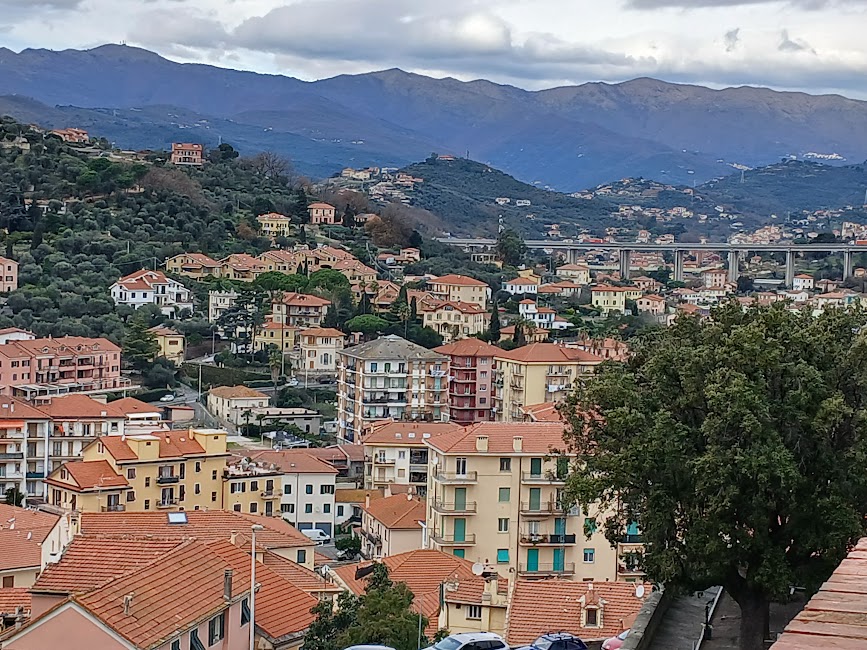
In the second week of January, we gave ourselves a three-day break in Imperia, Italy. I had told friends that this would be our reward for finishing the joyless task of painting the kitchen – including cabinets. True, but the underlying reason was to have a respite before the 47th president was inaugurated, a chance to be preoccupied with Italian language and history while enjoying coastal views and stoned-baked pizzas. I was living in these delightful moments while at the same time imagining myself looking back on them nostalgically – a time before America imploded and the world reacted. Or more immediately, a time before the barrage of news on the vitriolic, anti-environmental, anti-humanitarian, falsehood laden chaos.

Goodbye Facebook

January also marked my last month on Facebook after some fourteen years of posting holiday snaps, images of our protests marches and single-framed comics, while giving my share of thumbs and hearts. I did explain to my followers that this was a political decision against Zuckerberg, the latest technobro to become a Tr*mp enabler and his allowing for hate speech to grow and fester on the site. The reaction to this announcement was mixed. Some support, one serious critic (apparently, I should be happy to have more freedom of speech) and loads of people ignoring me. The latter grouping made me wonder how many closet Tr*mp supporters (including non-Americans) are out there.

Still Jacqueline

The third week of January marked the death of one of my oldest and closest friends. In truth, the sense of loss started a few years ago. The last time I spoke to Jacqueline was over the phone and she was in a care home in Edinburgh. A great raconteur, she told me a few stories that made me laugh, but I later realised that these stories did not involve any of our mutual friends and at no point in the conversation did she ask about my David. That is, she had forgotten who I was. Jacqueline had Alzheimer’s. Like the character in the film Still Alice, Jaqueline was an accomplished linguist and teacher. And like the character in Still Alice, played by Julianne Moore, the signs of this horrible condition had its onset in middle age – Jacqueline was barely sixty when her memory started failing her and her personality began to change. Unlike the film, the experience for Jacqueline and those who loved her could not be encapsulated in two hours. The years of slow deterioration of mental faculties, of speech, of sense of humour had laced a thread of sadness through our lives.

Due to problems scheduling planes and trains and severe weather conditions, I was unable to attend the funeral in person. Instead, on the last day of this surreal month, I watched live stream on my laptop old friends and colleagues at the crematorium reminiscing about Jacqueline and giving her a warm, heartfelt sendoff.

What I’ve been reading

I’ve been engrossed in two books that couldn’t be more different. Sam Freedman’s Failed State explains why Britian is in such a mess, going far beyond Brexit in examining the highly centralised system of government that cripples its ministers. On top of this, the powers of the judicial system, though often necessary but cumbersome, are more than ever challenging the government, making it more accountable, but even less effective. Freedman also points out that ‘the constant need to feed the media beast has led to a rapid proliferation of symbolic legislation designed not to achieve any real-world goal, but to give the impression of activity.’ Good nourishment for this news junkie.

The Overstory by Richard Powers is a book I wish I had discovered before dipping into a couple of soft-science tomes about trees. Yes, she’s harping on about trees again. The first part of this novel introduces nine characters in what I would consider to be interesting and entertaining short stories. The only connection between the stories is their characters’ experiences in one way or another with trees. In some cases, these experiences are accidental and peripheral. For other characters, a hobbyist and a researcher, trees are their raison d’etre. For the latter, I was glad that this book didn’t shy away from the science, and I could revisit words that were new to me just a couple of years ago – raceme, drupe, panicle, etc. Saving our forests brings these lives together in complex thriller-like fashion. While quotables abound in this book, I’ll just leave you with a couple. A geeky teenager concludes, ‘Humankind is deeply ill. The species won’t last long. It was an aberrant experiment. Soon the world will be returned to the healthy intelligences, the collective ones. Colonies and hives.’ Another character is struck by a ‘great truth’: ‘Trees fall with spectacular crashes. But planting is silent and growth is invisible.’

In Powers’ book, I’ve also discovered the phrase guerrilla forestry, where activists illegally plant new saplings. I recently wrote a short story that touched on this idea. Once I’ve learned more about sylviculture, don’t be surprised to find me among the forest warriors. There, I’ve rebooted my year ahead.

My 2024 in review without lists

Regular readers know that I’m not a fan of the listacle – those articles that list the best of or worst of or top 10 etc. They’re click bait and often poor examples of writing. By copping out of the type of commentary or critical review that threads an argument,  they offer mere snapshots brimming with clichés. With this hanging over my head for what I shouldn’t do, I’m reviewing 2024 under a few categories.

My year as a verbivore

Yes, I used to refer to myself as a logophile, but I’ve decided to use verbivore instead despite Word underlining it in red. This word was coined by the writer Michael Chabon in 2007 when talking about his love of words.

I’m afraid 2024 hasn’t been good year for verbivores thanks largely to the many national elections taking place all over the world and where politicians have overused words, such as woke, to the point that it can mean the opposite of their original meaning – or simply have no meaning at all aside from being something to despise. I’m also somewhat miffed that words like demure and mindful have gained new meanings thanks to the verbal grasping of social media influencers. Both words are being used to mean low-key and subtle in fashion and style.

The OED ranked brain rot as the word of the year, one that I never used even once. Apparently, it has come out of the Instagram/TikTok generation’s feeling after scrolling through dozens of posts. It can also refer to the low-quality content found on the internet that I do my best to avoid – a challenge when trying to find vegetarian recipes on Pinterest and having to skirt around videos of cats stuck in jars.

While I don’t go around recording myself, I’ll bet that my most used word during this year was incredible. In part, I’ve picked this up from the French who frequently use incroyable. When the worst president in US history (according to historians) gets re-elected after doing and saying so many things that individually should have made him unelectable, that’s incredible. On a more positive note, given my first-hand experience dealing with builders, plumbers and electricians in the South of France, I  thought it incredible that Notre Dame Cathedral was renovated after the catastrophic fire in just over five years.

My year as a reader

This year has been dominated by two writers as in recent weeks I found myself reading yet  another Robert Harris novel, my third this year, and another Amelie Nothomb foray into autofiction, my second for 2024.

After hearing Harris speak about his latest book, Precipice, in Ely a couple of months ago, I delved into this thriller which begins at the onset of WWI. It’s an historical period I’m strangely fond of and the story recounts the true-life affair between Prime Minister Herbert Henry Asquith and the socialite Venetia Stanley. Asquith’s casualness towards national security is mind-boggling  as his teenage-boy infatuation led him to share with Venetia everything from Cabinet debates to classified documents coming from his wartime generals. Though not as complex or informative as Harris’s Pompeii or as intriguing as his Conclave, Precipice is still an entertaining and interesting book.

Taking advantage of the public library in Menton, I’ve just finished Amelie Nothomb’s La Nostalgie Heureuse (avail in English). The narrator’s view on the world is as quirky as ever and expressed with her usual dry wit. In this story, she’s already a well-known writer living in Paris, who returns to Japan to participate in a documentary about her early life. Key to this is an anxiety-provoking reunion with a man she nearly married some twenty years earlier. A noteworthy aside – she (fictional narrator and real-life author) had written about the relationship in one of her earlier books and when the ex-fiancé is asked by the documentary maker how he felt about that book, he said that he enjoyed it as a ‘work of fiction.’ This is when the narrator realises that her truth could be other people’s fiction – a wink to the reader of this autofiction.

Throughout the year, I have also made it a point to read writers that are highly praised in the literary press that I have never read. Earlier in the year it was Paul Auster and Antonio Scurati and in recent weeks Carson McCullers. I finally read The Heart is a Lonely Hunter, which most people know from the 1968 film. Set in a small town in Georgia during the Great Depression, the story recounts the lives of several characters who are connected by their work and family circumstances. Their sense of isolation is explored against a backdrop of poverty and racism, with a nuanced struggle with homosexuality. The weaving of the stories reminded me of a typical Robert Altman film – very enjoyable despite the grim subject matter.

On the non-fiction side, this year I’ve continued my nerdy interests in bees and trees, trying to find texts for non-specialists that aren’t too scientifically dry or too jokingly flippant. While I’ve also read some excellent biographies and memoirs, the most thought-provoking and impassioned nonfiction  I’ve experienced this year has been in the opinion pages of the New York Times, The Observer (UK) and Le Monde. They serve as reminders that despite populist voting trends, humanity still exists.

My year as a writer

I started out this year with two writing goals. One was to return to novel #4 and give it a thorough rewrite. While I didn’t produce a full rewrite, I have rewritten about half of it and have made notes for the other half. This task was interrupted by an avalanche of editing assignments that came my way in October and lasted until December. The other writing goal was to simply send out either one short story or one essay every month. I did manage to send out 12 stories/essays this year, but without the monthly regularity – there were a couple of inactive months and a couple bubbling with creativity. Five rejections have been taken on the chin (three were competitions after all) and I await 7 replies.

In the second half of the year, my writing took on a more therapeutic purpose – maybe my way of dealing with complex PTSD. For the first time I’m writing about unpleasant childhood memories and with the creative process taking over, I’m fictionalising certain characters and subplots. I’ve been experimenting with the ‘I-narrator’ by taking on the role of persons other than myself, trying to revisit these episodes from others’ points of view. I seemed to have tapped into something as the work I’ve shown readers so far has been extremely well-received in ways unusual for my early drafts.

My year as a human

Being a linguist, reader and writer are all a part of being a human, but I am aware too that there are other identities of my humanity, such as a friend, spouse, sibling, neighbour, citizen etc. For me, all these roles fill one stratum of physical living in all its sociocultural and psychological dimensions. In this stratum, 2024 has been about witnessing climate change, and then climate change denial by some and inaction by others, along with the public discourse of hate that substantial portions of the population engage with, making me feel like an outlier. I know I’m not alone in this, but I no longer inhabit a space in the norm range.

Another stratum of my humanity exists, but I grapple to explain even to myself. The word spiritual has been stretched and abused by religious and anti-religious alike to the point that I avoid using it. Perhaps this stratum covers all things incorporeal, including abstract thought. This year has made me more aware of this disembodied beingness, if awareness is all I have for now. And so, I continue to practice mindfulness (in the pre-2024 sense of the word – nothing to do with fashionable clothes).

Thank you, readers, for your comments and emoji reactions over the year. I wish you all peace and joy for 2025.

Gisele Pelicot, my choice for Person of the Year