Scraping sounds better than stealing

The topic was AI. Today, the topic is always AI. Let’s be honest, whether we see it as a sophisticated search engine, a gushing editor or techno teacher, most of us are using it.

At this online writers’ group, we started by regaling each other with our experiences of dabbling in AI – those silly hallucinations and unnatural conversations where very answer ends in question. Of course, what was said in that meeting ‘stayed in the room.’ With that rule, I braced myself for writers admitting they used AI to help them create and edit their work. But no, a few of us admitted trying it as an editor while others sought its help with research. In my case – I’ll step outside the room – I’ve used it for editing passages of a novel I wrote years ago and was undergoing a major editing/rewriting. I would give Co-Pilot a few pages of a chapter that I felt was sagging and asked it to tighten it up. The Co-Pilot version rearranged some sentences to make them more concise, but in many cases more adjective laden – I’m not a huge fan of adjectives in creative writing. Let the verbs and metaphors do the heavy lifting I say. For me, this teaching tool showed me what I needed to look for in my writing that could be effectively rewritten.

The conversation quickly turned from how we were using it to how it was using us. One author moaned at how Anthropic ‘scraped’ seven of his novels without his permission or financial compensation. He is currently involved in a class-action lawsuit being spearheaded by the Society of Authors. Using a link now available on the SoA website, another novelist discovered one of her books had also been scraped. Outrage mixed with fear – what about the other AI platforms? How do we find out about them? And what about those unscrupulous so-called writers who are using AI – our books – to write formulaic tripe that will sell like hotcakes?

I probably didn’t make myself popular by mentioning that a publisher of one of my academic textbooks contacted me to ask my permission to use my book for training an AI platform. If I opted in, whenever my work is used, it will be referenced with a link to the publisher’s website, and I would receive a small royalty. Of course, I opted in. Really, it wasn’t for the money. My reasoning, which I shared with my fellow writers, is that at least I know my book draws on and refers to peer-reviewed studies, and the final draft of my book was peer-reviewed by two scholars in the field. I was pleased to contribute a reliable source to an LLM. Better this than the grey literature and internet folk linguistics that is being scraped as I write this blog.

No one commented. I was likely to be seen as a traitor.

A few days after the meeting I stumbled across a counterbalance to all this by Wired magazine’s editor, Kevin Kelly. He feels honoured to have his books included in AI training. Kelly says that in the not-too-distant future, ‘authors will be paying AI companies to ensure that their books are included in the education and training of AIs.’ That is, authors will pay for the influence of AI responses that include their works – a type of indirect advertising. Hard to believe this in the current climate.

The one word that didn’t come up at this writers’ meeting, which in hindsight I wish had, is ‘creativity.’ For me, it’s not so much about my published books being so precious. It’s more about the process. The creation and recreation of texts. In the words of Henry Miller ‘Writing is its own reward.’ No bot can take that experience away from me (to paraphrase an old song).

What I’ve been reading

Ocean Vuong is a brilliant writer – an utterly unique voice. On Earth We’re Briefly Gorgeous was his first novel and is written as a letter from a Vietnamese American son to his illiterate mother, knowing she will never read it. Using poetic language and humour, the novel explores themes like identity, trauma and homosexuality. It also conveys a strong social message about the damage done to American families and communities by the opioid crisis. While so much of this novel is philosophically and poetically quotable, I’ll close with this gem:

‘Do you ever wonder if sadness and happiness can be combined, to make a deep purple feeling, not good, not bad, but remarkable simply because you didn’t have to live on one side or the other?’

I can’t imagine a bot producing that, let alone enjoying the act of creating it.

Finding humour in uncomfortable spaces

I follow Robert Reich, the former Secretary of Labour under Clinton, on Substack. With his constitutional expertise, Reich has been pointing out the authoritarianism and fascism being perpetrated by the MAGA White House. But this isn’t just a grand whinge. Reich also reminds readers of the powers we, especially Americans living in America, have for fighting these assaults on democracy using the courts, protesting in the streets and through boycotting anything Tesla. And there have been some victories. Most importantly, while the messages are serious and often alarming, Reich injects some levity with his weekly caption competition, where he provides the drawings and gives readers the chance to create and find humour even in the grimmest of times.

From Robert Reich’s Substack

Okay, you’re thinking it’s easy to laugh at the ridiculousness of the actions and claims spouting out of MAGA. Jon Stewart, SNL and other satirists across the globe are having a field day. True, but still necessary for the soul. Having said that, I’m concerned that while humour is always good medicine, I think we shouldn’t forget the malaise. I don’t wish to be caught off guard, being entertained as world economies collapse and America spirals in fascism.

What I’ve been reading

A serious moment, but I’ll get back to humour.

My growing fandom of Leila Slimani continues with finally reading her first novel, Dans le jardin de l’ogre (In the Ogre’s Garden, available in English). It’s a hard-hitting and thought-provoking story about a female sex addict. Some reviewers of the book have used the word nymphomaniac, but I’m resisting that as nympho is often used lightly in a fun way, and there is little that is amusing about the life of this protagonist. Adele is a journalist married to a surgeon with whom she has had a child. Despite the appearances of midclass normalcy, Adele is in constant need of sexual gratification outside her marriage. It’s a tale of addiction and the solitude that comes with living a double life.

When I tackled this same subject some years ago, I chose to do it in a short story. Reading Slimani has made me wonder if this was the right format as I didn’t give myself room to work in the character’s backstory or develop the topic from different angles as Slimani does. The other difference in our approaches is that I decided to navigate this uncomfortable space by using some gentle humour, but in a way that doesn’t laugh at the protagonist. Addiction is serious business – ‘Every addiction starts with pain and ends with pain’ (Eckart Tolle). I ended up with two versions – a 3,000-word short story and with this flash fiction version that stops before the sex begins (sorry, reader).

LAUREN ON TOUR

She saw her name on a piece of cardboard, the letters in black marker. The woman holding the sign was in her mid-twenties, about the same age as Lauren but taller and bigger, with tanned muscular legs, bulging in cut-off shorts. As Lauren approached her, the woman exposed a toothy grin that looked like a horse neighing. “Hi, I’m Debbie.” She had an American accent. “Welcome to Korea. Is that all your stuff?”

Lauren’s voice was raspy from the flight, but she managed a “Hello. Yeah.”

“Great.” Debbie was too perky for Lauren at that moment.

Outside the terminal, the air was heavy with humidity. A driver from the college was waiting for them – a bit old, Lauren thought, but a possibility. Too bad her body smelled like stale bread and her hair felt greasy and flat. He bowed and averted his gaze as he speedily loaded the suitcases into the van.

Leaving Incheon Airport Lauren’s thoughts jumped around – Debbie and the driver – the bright lights from shops whizzing past – an image of a Korean man, not too muscular, with slender fingers, his eyes would be full of hesitation and awe – the grey high-rises of Seoul in the distance.

Debbie broke the silence and played the role of tour guide, speaking at times with great authority. Though the American had only been there a year herself, she was armed with statistics – population of Seoul, nearly 11 million. Lauren sometimes responded with “yeah,” and other times with “really,” until finally she was forced into answering some questions. She explained where her village was in relation to London, the only place in England where Debbie had been. Lauren avoided any mention her of family, but not wanting to appear unsociable, she explained that she was still fairly new to English teaching. Of course, she did not mention her real reason for being there.

“That’s cool. I mean, don’t sweat it. Lots of people here are teaching English and they have degrees in history or things like that.” Debbie spoke most of the time as if rushing to catch a bus.

Lauren raised her brows to show interest, but in her mind, she was being kissed on her legs.

 “This place is cool,” Debbie said, brushing back brunette strands with her fingers. “But hey, it’s not exactly Harvard.”

Lauren just smiled. She returned to her own thoughts, wondering why Debbie was teaching in Korea. Was it all about the money – the tax-free income? Or was Debbie also operating under fabricated pretenses, living a double life?

The American took a swig of bottled water and said, “Yeah, I think you’ll like it here. They treat us well and like, hey, I’m here to help you. Not only am I your roommate – we’re sharing this great apartment – you have the bigger bedroom – and I’m also your mentor at the college.”

Sharing an apartment? Lauren felt as though she had fallen off a diving board and landed hard on her back. Her plans, her months of research, her fantasies – all gone in a flash. No female flat mate would put up with her.

Debbie’s eyes grew wide. “Oh, shit. They told you that you were going to have an apartment to yourself, huh?”

Lauren nodded.

“Yeah, they can be shitty on things like that.” Debbie took another gulp of water. She paused to check Lauren’s reaction, which was still a blank stare. “It’ll be fine, really.”

The next morning wasn’t the next morning, but the next afternoon. Lauren had woken up wildly alert in a strange bed in an unfamiliar room of bare white walls.

When she stepped out of the bathroom into the living room, she noted the linoleum floors and bright tubes of light along the ceiling. She started to think of ways that she could at least make her own bedroom cozy and sensual, a place to melt into a dark silk-covered mattress.

“Hey, Lauren, I’m in here,” Debbie called out from the kitchen.

The familiar aroma of coffee greeted her. Debbie stood at the cooker in baggy trousers with a halter top, exposing a fleshy chest, her feet in bright red flip-flops with matching toenails.

“Okay,” Debbie said, serving fried eggs and placing herself in charge once again. “So, like, you’ve slept for what? Some 12 hours?” Before Lauren could answer, Debbie continued, “Now you need to stay awake until midnight. Trust me. I know my jetlag.” She looked at her watch. “At twenty hundred hours, we go to Itaewon for serious clubbing and alcoholic beverages to be administered at regular intervals.”

Lauren chuckled, amused by Debbie’s delivery.

“At twenty-three hundred hours, you shall take melatonin and then I, being the best roommate in Seoul, shall tuck you into bed no later than zero hundred hours, otherwise known as midnight.”

“Aye, aye,” Lauren played along.

She finished her breakfast and went to her room to unpack. While separating work clothes from play clothes – lacy underwear, corsets – she thought about her research. Korean men and men from neighboring Asian countries could be found in the backrooms of discos and karaoke bars. For the Asian man, she – Lauren, the freckled Western woman – would be the exotic attraction. It would be easy – she wouldn’t charge them anything. She wanted to shock her American roomie. She wanted to say, “You know, women can be sex tourists too.”

  • Paola Trimarco (Copyright 2015)

Cultural words in the time of MAGA

Aside from having a form of the word cultural, what do these words have in common: cultural competence, cultural heritage, cultural differences, culturally appropriate, cultural relevance, cultural sensitivity, culturally responsive and sociocultural? Answer: These are words the Tr*mp administration has ordered government agencies to remove from all their documents and websites. Some more amusing and just plain weird examples can be found on this banned word list (such as autism, belong, fluoride and marijuana). But as a sociolinguist – and a human being – I’m bothered and perplexed by these cultural words being treated with such scorn.

Firstly, defining culture as a set of ideas and norms belonging to a societal or national group, culture and things cultural are innately part of being human and terms that we use to describe these aspects of our humanity. In other words, language and culture are intertwined – a language emerges from a culture with shared concepts and experiences – and the flipside – a culture is expressed in its language(s). The writer Rita Mae Brown summed it up when she said, ‘Language is the road map of a culture. It tells you where its people come from and where they are going.’ How could we ban cultural anything from our language?

On a more practical matter, many of these banned cultural terms are used by scholars and teachers as part of their disciplines. Some of my own research has been in heritage languages, where words like cultural heritage and sociocultural regularly crop up. Only the other day, I was speaking to a friend who teaches English to immigrants in Australia, and she used the term cultural competence. By banning the official use these words, the MAGA government is defunding language and teaching programmes and research, not to mention all the government-funded museums and arts and music programmes which rightly operate in a multicultural framework.

Among the monstrous acts carried out by the US president, this blatant and hypocritical censorship – this is from the administration that claimed the woke are denying us our freedom of speech – might seem small potatoes. Yet, it taps into something far more sinister if we consider areas outside of sociolinguistics. The ban on some of the other cultural words – cultural difference, cultural sensitivity and culturally responsive – are clearly targeting hiring policies and workplace training programmes in diversity. Since the variety of peoples in America are not going to lose or want to relinquish their cultural heritages, such policing of language condones discrimination and division among employees. Sadly, we know from history that this mindset has a tendency of spreading, these days with the unsafeguarded assistance of social media. One has to wonder what the ultimate goal is. Perhaps MAGA is simply striving for a monoculture (if such a thing were possible) and wearing its bigotry as a badge of honour.

What I’ve been reading

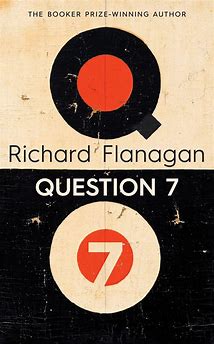
Occasionally a book comes along that I don’t want to end. Australian writer Richard Flanagan’s Question 7 is a memoir combined with history and sociocultural (!) commentary rolled into one. Beautifully crafted with anecdotes and personal insights, the memoir parts focus on the author’s father and his relationship with him, culminating with the author’s own near-death experience. Flanagan’s father was a prisoner of war at a slave camp in Japan when the bomb was dropped on Hiroshima. The author intersperses this story with an historical account of some of the nuclear physicists who created the atomic bomb, in particular Hungarian American Leo Szilard and with the true-life love story between Rebecca West and H.G. Wells. The dots between Szilard and Wells are connected by Szilard devotion to Wells’s 1914 novel The World Set Free, which describes a world at war where atomic energy is used to make deadly explosives. Szilard, whom to my shame I only knew through the Oppenheimer movie, was best known for discovering nuclear chain reactions and later for his activism against nuclear arms. He was also an amateur biologist and environmentalist.

Since Flanagan made several references to H.G. Wells’s The World Set Free, I thought I should give this prophetic book a go. Written as a ‘science romance’ as these SF books were called, it’s quite different from the writing of contemporary novelists. Telling outweighs showing, and the poor reader is a good 10% into the book before the first character appears. But to his credit, the writer doesn’t tell and show the same events, and the prose at the sentence and paragraph level is tight. That is, the novel is more historically interesting from a post-modernist’s perspective than it is enjoyable to read.

I came away from these past couple of weeks speculating about SF written today of a future where multiculturalism has been outlawed – hard to imagine, but people once felt this way about the worlds depicted by H.G. Wells.

Surviving January

Nope, this is not a blog from a survivor of Dry January – the wine continued to flow as usual. Nor is this about winter depression – at times, a sad month but luckily without the winter blues (hard to experience in the sunny south of France). As February kicked off this weekend, I was determined to reboot and restart the year afresh. But not before a few reflections on the surreal month that just passed.

Imperia before the storm

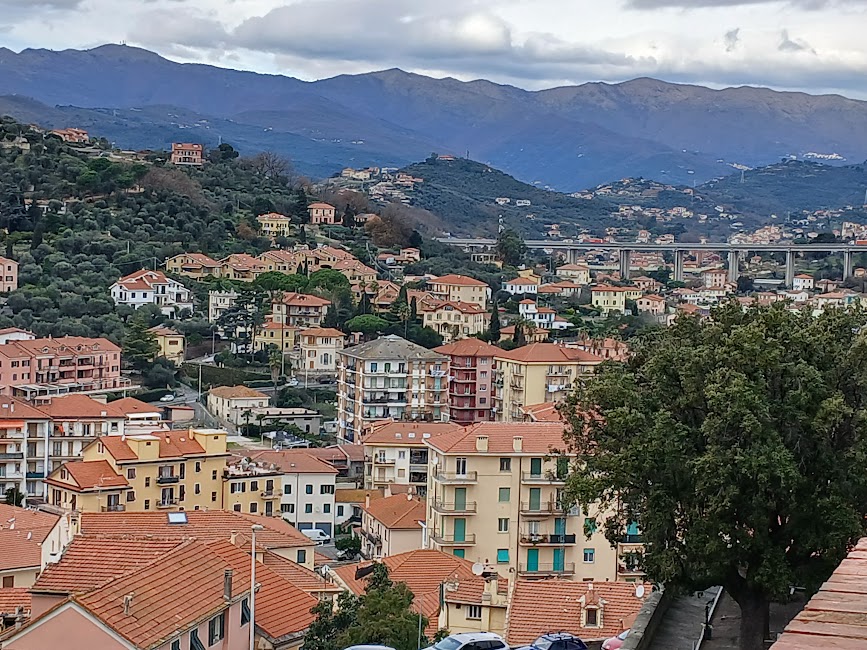
In the second week of January, we gave ourselves a three-day break in Imperia, Italy. I had told friends that this would be our reward for finishing the joyless task of painting the kitchen – including cabinets. True, but the underlying reason was to have a respite before the 47th president was inaugurated, a chance to be preoccupied with Italian language and history while enjoying coastal views and stoned-baked pizzas. I was living in these delightful moments while at the same time imagining myself looking back on them nostalgically – a time before America imploded and the world reacted. Or more immediately, a time before the barrage of news on the vitriolic, anti-environmental, anti-humanitarian, falsehood laden chaos.

Goodbye Facebook

January also marked my last month on Facebook after some fourteen years of posting holiday snaps, images of our protests marches and single-framed comics, while giving my share of thumbs and hearts. I did explain to my followers that this was a political decision against Zuckerberg, the latest technobro to become a Tr*mp enabler and his allowing for hate speech to grow and fester on the site. The reaction to this announcement was mixed. Some support, one serious critic (apparently, I should be happy to have more freedom of speech) and loads of people ignoring me. The latter grouping made me wonder how many closet Tr*mp supporters (including non-Americans) are out there.

Still Jacqueline

The third week of January marked the death of one of my oldest and closest friends. In truth, the sense of loss started a few years ago. The last time I spoke to Jacqueline was over the phone and she was in a care home in Edinburgh. A great raconteur, she told me a few stories that made me laugh, but I later realised that these stories did not involve any of our mutual friends and at no point in the conversation did she ask about my David. That is, she had forgotten who I was. Jacqueline had Alzheimer’s. Like the character in the film Still Alice, Jaqueline was an accomplished linguist and teacher. And like the character in Still Alice, played by Julianne Moore, the signs of this horrible condition had its onset in middle age – Jacqueline was barely sixty when her memory started failing her and her personality began to change. Unlike the film, the experience for Jacqueline and those who loved her could not be encapsulated in two hours. The years of slow deterioration of mental faculties, of speech, of sense of humour had laced a thread of sadness through our lives.

Due to problems scheduling planes and trains and severe weather conditions, I was unable to attend the funeral in person. Instead, on the last day of this surreal month, I watched live stream on my laptop old friends and colleagues at the crematorium reminiscing about Jacqueline and giving her a warm, heartfelt sendoff.

What I’ve been reading

I’ve been engrossed in two books that couldn’t be more different. Sam Freedman’s Failed State explains why Britian is in such a mess, going far beyond Brexit in examining the highly centralised system of government that cripples its ministers. On top of this, the powers of the judicial system, though often necessary but cumbersome, are more than ever challenging the government, making it more accountable, but even less effective. Freedman also points out that ‘the constant need to feed the media beast has led to a rapid proliferation of symbolic legislation designed not to achieve any real-world goal, but to give the impression of activity.’ Good nourishment for this news junkie.

The Overstory by Richard Powers is a book I wish I had discovered before dipping into a couple of soft-science tomes about trees. Yes, she’s harping on about trees again. The first part of this novel introduces nine characters in what I would consider to be interesting and entertaining short stories. The only connection between the stories is their characters’ experiences in one way or another with trees. In some cases, these experiences are accidental and peripheral. For other characters, a hobbyist and a researcher, trees are their raison d’etre. For the latter, I was glad that this book didn’t shy away from the science, and I could revisit words that were new to me just a couple of years ago – raceme, drupe, panicle, etc. Saving our forests brings these lives together in complex thriller-like fashion. While quotables abound in this book, I’ll just leave you with a couple. A geeky teenager concludes, ‘Humankind is deeply ill. The species won’t last long. It was an aberrant experiment. Soon the world will be returned to the healthy intelligences, the collective ones. Colonies and hives.’ Another character is struck by a ‘great truth’: ‘Trees fall with spectacular crashes. But planting is silent and growth is invisible.’

In Powers’ book, I’ve also discovered the phrase guerrilla forestry, where activists illegally plant new saplings. I recently wrote a short story that touched on this idea. Once I’ve learned more about sylviculture, don’t be surprised to find me among the forest warriors. There, I’ve rebooted my year ahead.

My 2024 in review without lists

Regular readers know that I’m not a fan of the listacle – those articles that list the best of or worst of or top 10 etc. They’re click bait and often poor examples of writing. By copping out of the type of commentary or critical review that threads an argument,  they offer mere snapshots brimming with clichés. With this hanging over my head for what I shouldn’t do, I’m reviewing 2024 under a few categories.

My year as a verbivore

Yes, I used to refer to myself as a logophile, but I’ve decided to use verbivore instead despite Word underlining it in red. This word was coined by the writer Michael Chabon in 2007 when talking about his love of words.

I’m afraid 2024 hasn’t been good year for verbivores thanks largely to the many national elections taking place all over the world and where politicians have overused words, such as woke, to the point that it can mean the opposite of their original meaning – or simply have no meaning at all aside from being something to despise. I’m also somewhat miffed that words like demure and mindful have gained new meanings thanks to the verbal grasping of social media influencers. Both words are being used to mean low-key and subtle in fashion and style.

The OED ranked brain rot as the word of the year, one that I never used even once. Apparently, it has come out of the Instagram/TikTok generation’s feeling after scrolling through dozens of posts. It can also refer to the low-quality content found on the internet that I do my best to avoid – a challenge when trying to find vegetarian recipes on Pinterest and having to skirt around videos of cats stuck in jars.

While I don’t go around recording myself, I’ll bet that my most used word during this year was incredible. In part, I’ve picked this up from the French who frequently use incroyable. When the worst president in US history (according to historians) gets re-elected after doing and saying so many things that individually should have made him unelectable, that’s incredible. On a more positive note, given my first-hand experience dealing with builders, plumbers and electricians in the South of France, I  thought it incredible that Notre Dame Cathedral was renovated after the catastrophic fire in just over five years.

My year as a reader

This year has been dominated by two writers as in recent weeks I found myself reading yet  another Robert Harris novel, my third this year, and another Amelie Nothomb foray into autofiction, my second for 2024.

After hearing Harris speak about his latest book, Precipice, in Ely a couple of months ago, I delved into this thriller which begins at the onset of WWI. It’s an historical period I’m strangely fond of and the story recounts the true-life affair between Prime Minister Herbert Henry Asquith and the socialite Venetia Stanley. Asquith’s casualness towards national security is mind-boggling  as his teenage-boy infatuation led him to share with Venetia everything from Cabinet debates to classified documents coming from his wartime generals. Though not as complex or informative as Harris’s Pompeii or as intriguing as his Conclave, Precipice is still an entertaining and interesting book.

Taking advantage of the public library in Menton, I’ve just finished Amelie Nothomb’s La Nostalgie Heureuse (avail in English). The narrator’s view on the world is as quirky as ever and expressed with her usual dry wit. In this story, she’s already a well-known writer living in Paris, who returns to Japan to participate in a documentary about her early life. Key to this is an anxiety-provoking reunion with a man she nearly married some twenty years earlier. A noteworthy aside – she (fictional narrator and real-life author) had written about the relationship in one of her earlier books and when the ex-fiancé is asked by the documentary maker how he felt about that book, he said that he enjoyed it as a ‘work of fiction.’ This is when the narrator realises that her truth could be other people’s fiction – a wink to the reader of this autofiction.

Throughout the year, I have also made it a point to read writers that are highly praised in the literary press that I have never read. Earlier in the year it was Paul Auster and Antonio Scurati and in recent weeks Carson McCullers. I finally read The Heart is a Lonely Hunter, which most people know from the 1968 film. Set in a small town in Georgia during the Great Depression, the story recounts the lives of several characters who are connected by their work and family circumstances. Their sense of isolation is explored against a backdrop of poverty and racism, with a nuanced struggle with homosexuality. The weaving of the stories reminded me of a typical Robert Altman film – very enjoyable despite the grim subject matter.

On the non-fiction side, this year I’ve continued my nerdy interests in bees and trees, trying to find texts for non-specialists that aren’t too scientifically dry or too jokingly flippant. While I’ve also read some excellent biographies and memoirs, the most thought-provoking and impassioned nonfiction  I’ve experienced this year has been in the opinion pages of the New York Times, The Observer (UK) and Le Monde. They serve as reminders that despite populist voting trends, humanity still exists.

My year as a writer

I started out this year with two writing goals. One was to return to novel #4 and give it a thorough rewrite. While I didn’t produce a full rewrite, I have rewritten about half of it and have made notes for the other half. This task was interrupted by an avalanche of editing assignments that came my way in October and lasted until December. The other writing goal was to simply send out either one short story or one essay every month. I did manage to send out 12 stories/essays this year, but without the monthly regularity – there were a couple of inactive months and a couple bubbling with creativity. Five rejections have been taken on the chin (three were competitions after all) and I await 7 replies.

In the second half of the year, my writing took on a more therapeutic purpose – maybe my way of dealing with complex PTSD. For the first time I’m writing about unpleasant childhood memories and with the creative process taking over, I’m fictionalising certain characters and subplots. I’ve been experimenting with the ‘I-narrator’ by taking on the role of persons other than myself, trying to revisit these episodes from others’ points of view. I seemed to have tapped into something as the work I’ve shown readers so far has been extremely well-received in ways unusual for my early drafts.

My year as a human

Being a linguist, reader and writer are all a part of being a human, but I am aware too that there are other identities of my humanity, such as a friend, spouse, sibling, neighbour, citizen etc. For me, all these roles fill one stratum of physical living in all its sociocultural and psychological dimensions. In this stratum, 2024 has been about witnessing climate change, and then climate change denial by some and inaction by others, along with the public discourse of hate that substantial portions of the population engage with, making me feel like an outlier. I know I’m not alone in this, but I no longer inhabit a space in the norm range.

Another stratum of my humanity exists, but I grapple to explain even to myself. The word spiritual has been stretched and abused by religious and anti-religious alike to the point that I avoid using it. Perhaps this stratum covers all things incorporeal, including abstract thought. This year has made me more aware of this disembodied beingness, if awareness is all I have for now. And so, I continue to practice mindfulness (in the pre-2024 sense of the word – nothing to do with fashionable clothes).

Thank you, readers, for your comments and emoji reactions over the year. I wish you all peace and joy for 2025.

Gisele Pelicot, my choice for Person of the Year

Preparing for Winter

This weekend, we turn the clocks back. Ten days later, the US has its presidential election. These two events are bumping into each other in my brain’s anxiety lobe.

My David anticipates the clocks going back with a sense of dread. He pulls faces – the emoji with his eyes squinted, a tongue half out. David suffers from SAD (seasonal affective disorder), which is at its worse when we find ourselves in England in the winter months. I’m not so affected by the onset of winter. This is because I grew up in Chicago, where winter meant snowmen, ice skating, mittens drying on the radiator while our hands cradled cups of hot chocolate. That’s not to say I haven’t experienced that greyscale world of depression, but my occasional bouts of it have not been linked to the seasons of shorter days. They’re simply not linked to anything. Nevertheless, sharing a life together, David’s clouds of SAD cover my head as well.

Psychologist Kari Leibowitz has observed that contrary to popular belief, people who live in Scandinavian countries do not have high rates of SAD. Their prevalence of the winter blues is among the lowest in Western countries. This is because Scandinavians embrace the winter months with outdoor festivals, activities and sports and indoor candlelight gatherings with friends and family. That is, our moods and feelings towards winter have a lot to do with our mindsets (as this former Chicagoan knows). Leibowitz explains:

‘…we might have a mindset that winter is limiting or that it is full of opportunity, dreadful or delightful. We conflate the objective circumstances – that winter is cold, dark and wet – with subjective things, like it being gloomy, boring and depressing, when you could just as easily make the case that it is cosy, magical and restorative.’ (from an interview in The Observer )

Leibowitz makes a good point, not only for the onset of winter, but for anything. Our mindsets can predispose us to how we experience situations and events. In this vein, while David is dreading the 26th of October, I’m fearing the 6th of November. Yes, the US election is on the 5th, but given the time difference, the results won’t trickle in until the following day here in Europe. I’m not looking forward to learning that either America will soon have the MAGA version of fascism or that Harris has won, and the Tr*mp/Musk ticket reacts with inciting riots and cyber-pandemonium. Both could ripple  disastrously across the States (another civil war is no longer the stuff of dystopic fiction) and across the world in ways ranging from the environmental to the geopolitical. Of course, logic tells me that other scenarios might occur – American politics is never short on surprises. But that’s not found in the anxiety lobe.

Taking Leibowitz’s advice, I’ve suggested to David that he ‘resets his mindset’ for the weeks we’re in the UK after the clocks go back and before we migrate to France for the winter, starting with evenings of candlelight to soften the mood. We are also planning nights at the cinema, concerts and book talks, along with socialising at our local pubs.

As for resetting my own mindset, my version of candlelight is found in meditation and practicing mindfulness as each new disturbing situation emerges from America. In seeking the ‘delightful,’ to use Leibowitz’s word, I can look forward to the social and political satire in the months and years ahead.

What I’ve been reading

The last two novels I’ve read do not use quotation marks when characters are speaking. This meant careful reading at times to distinguish thoughts from dialogue, but in both cases this style of writing was effective. The first was Sandrine Collette’s On Était des Loups (avail. in English), a dark novel about a hunter who lives in the wilderness with his wife and child until the wife is brutally killed by a bear. He reacts by setting  out on a journey through the mountains and forests with his son in order to find a more appropriate home for the boy, the five-year-old he barely knows and didn’t want in the first place. Both live in the haze of trauma and grief left from the bear attack and deal with it in their own contrasting ways. Like the winter months, light moments can be found flickering in the gloom through character study interwoven with nature writing. A strangely life-affirming novel.

By sheer coincidence on my part, Paul Auster’s Baumgartner is also about a man whose wife had a premature death. When the story starts, he’s nearing retirement, and his wife has been dead for a decade. Set in the town of Princeton, Baumgartner is a professor of phenomenology who encounters falling in love again and incidences, such as falling down the stairs, against the backdrop of the loss of his wife. Without quotation marks getting in the way, the descriptive narrative, blends in beautifully with Baumgartner’s philosophical and mundane thoughts.

Edmund de Waal’s The Hare with the Amber Eyes is an absorbing account of the British ceramicist’s family history, traced through the ownership of Japanese figurines, called netsuke. These objects were brought to Europe by art collector Charles Ephrussi of the well-known banking family. Years later, he gave the 200 plus netsuke as a wedding gift to his cousin in Vienna, who later had her money and possessions confiscated by the Nazis. De Waal’s descriptions of the acts of antisemitism are chilling. Luckily, while Nazi soldiers occupied the family home, a housekeeper saved the tiny figurines by hiding them in her mattress. Eventually, they’re returned to the Ephrussi’s and inherited by de Waal. This work has inspired me to read more biographies about artists. De Waal mentions the works and lives of Impressionists and Post-Impressionists linked to his family, including Berthe Morisot, whose paintings and drawings I saw  recently at an exhibition in Nice. I’m now reading a biography of her by Dominique Bona. There’s something about the connected world of artists and writers in France at the end of the 19th century and into the early twentieth that makes me wish I lived at that time (though not as a woman).

Journalists in the firing line

You would be forgiven if you assumed that this blog is about intrepid war reporters donning padded vests and helmets. Instead, I’m looking at another type of journalist. The marking of World Press Freedom Day last month brought to my attention the targeting and suppression of environmental journalists.

UNESCO reports that since 2010 at least 44 journalists investigating environmental issues were killed, with only five resulting in convictions. UNESCO also observed the growing number of journalists and news outlets reporting on environmental issues that have been the victims of targeted violence, online harassment, detention and legal attacks. Just looking at Afghanistan, according to the Committee to Protect Journalists, since 2004 more environmental journalists have been killed there than those who died covering the country’s military conflicts.

To no surprise the top issue that makes journalists targets is climate change. The power of the fossil fuel industries and their links to governments are certainly one of the driving forces behind these attacks. So too – and equally worrying – is the growing polemic around this issue that makes ordinary people, often hiding behind the anonymity of online platforms, hostile to environmental activists and journalists.

I dabbled in environmental journalism but felt a bit of a fraud because I don’t hold a degree in life sciences or environmental studies. Even though my articles were more political than scientific, I never thought I was doing anything courageous or risky by writing them. Yet, I wouldn’t want to be caught out underestimating the power of those who disagree with my views or prefer the public to be ignorant of the evidence, scientific or experienced. These days I’ve taken up the safer option of nature writing with its indirect pleas to polluters.

The importance of protecting environmental journalism is summed up on the UNESCO website:

‘The climate and biodiversity crisis are not only affecting the environment and ecosystems but also the lives of billions of people around the world. Their stories of upheaval and loss deserve to be known and shared. They are not always pretty to watch. They can even be disturbing. But it’s only by knowing that action is possible. Exposing the crisis is the first step to solving it.’

What I’ve been reading

John Boyne’s The House of Special Purpose is an enjoyable read, though lacking the depth and irony of his The Boy in the Stripe Pyjamas. The story is set in Russia at the time of the revolution and in London over the years that follow until the late twentieth century. It is I’m afraid another fictional account of the massacre of the Romanov’s and the fate of Princess Anatasia, who many believe escaped unharmed and lived under an alias for the rest of her live. Given the horrible deaths of the Romanovs, the colourful character of Rasputin and the intrigue over Anatasia, this is a story that keeps on giving. In Boyne’s version, the human story is in the foreground and makes this a worthy read even if the Romanov saga is starting to wear.

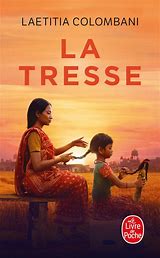
La Tresse (The Braid) by Laetitia Colombani was recommended to me by one of my French language partners. It’s a thin middlebrow book that has been enormously popular in France and now all over the world in translation. It recounts the lives of three women who, as you can guess, like the strands of a braid overlap into a single unit. How this narrative braid is formed is what keeps the pages turning. Each of the three women struggles against the hand they’ve been dealt. Smita is an untouchable in India, where she cleans the village latrines and endeavours at all costs for a different life for her daughter. Giulia lives in Italy and works at her father’s wig factory. Her troubles arise when her father falls into a coma, leaving young Giulia to discover that the family is on the verge of bankruptcy and could lose their home and factory. The third woman, Sarah, is a high-profile lawyer and single mother in Canada who is struck down by illness and the ruthlessness of her colleagues too eager to capitalise from it. These weighty topics are recounted in prose interspersed with poetry, language brimming with metaphors and motifs that gently creep up on the reader.

My non-fiction reading these days has been monopolised by newspaper and magazine commentaries on the verdict against a former US president, now a felon, who is prohibited from entering the UK to play golf on his own Scottish golf course. Reminding readers of the horrors of the Tr*mp years – including his attacks on the press – and what this verdict might yield in the not-too-distant future, worth reading are David Remnick in the New Yorker and Simon Tisdall in The Observer. Of course, both are expressing views I share.

Arrival Menton

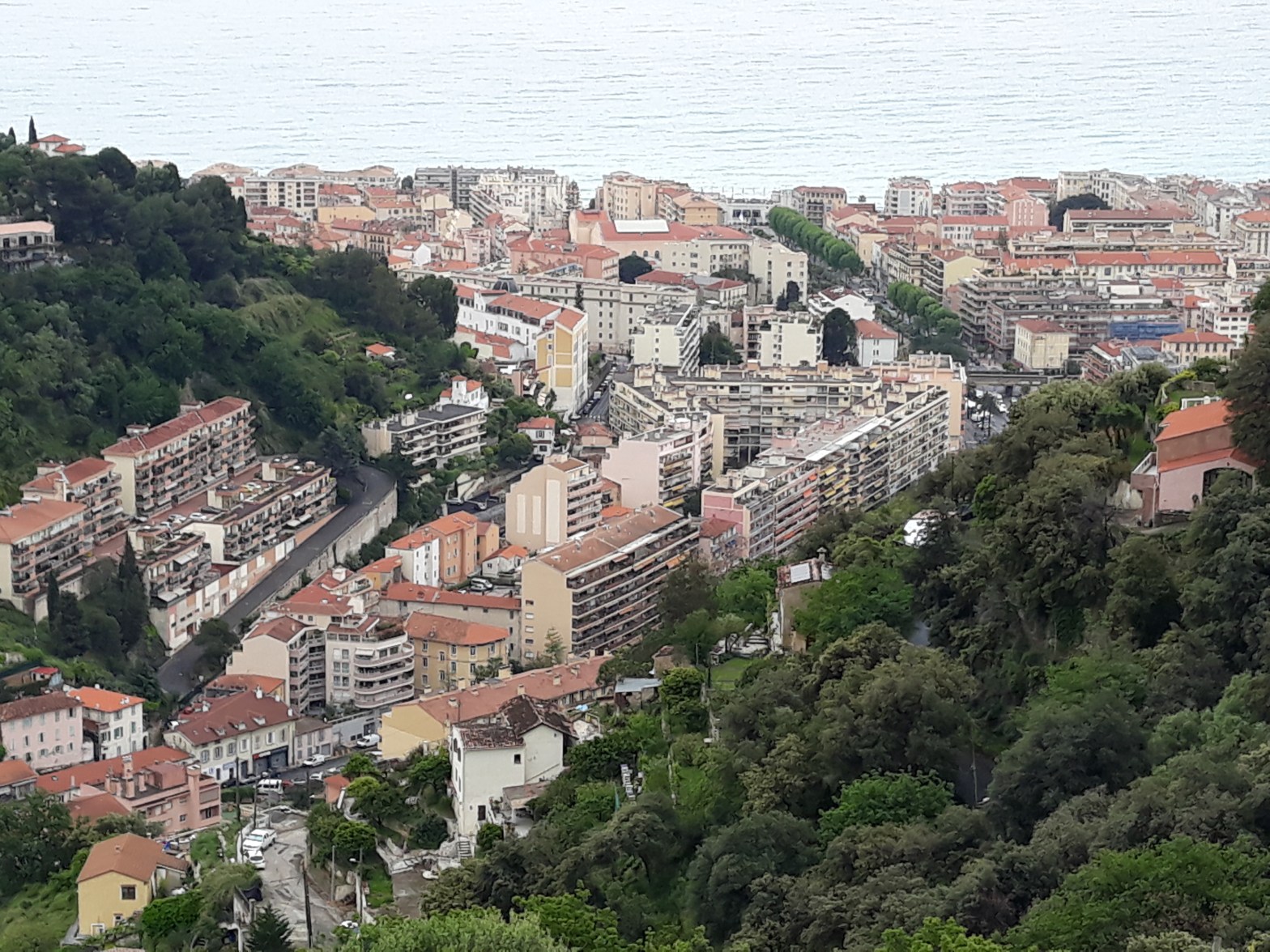
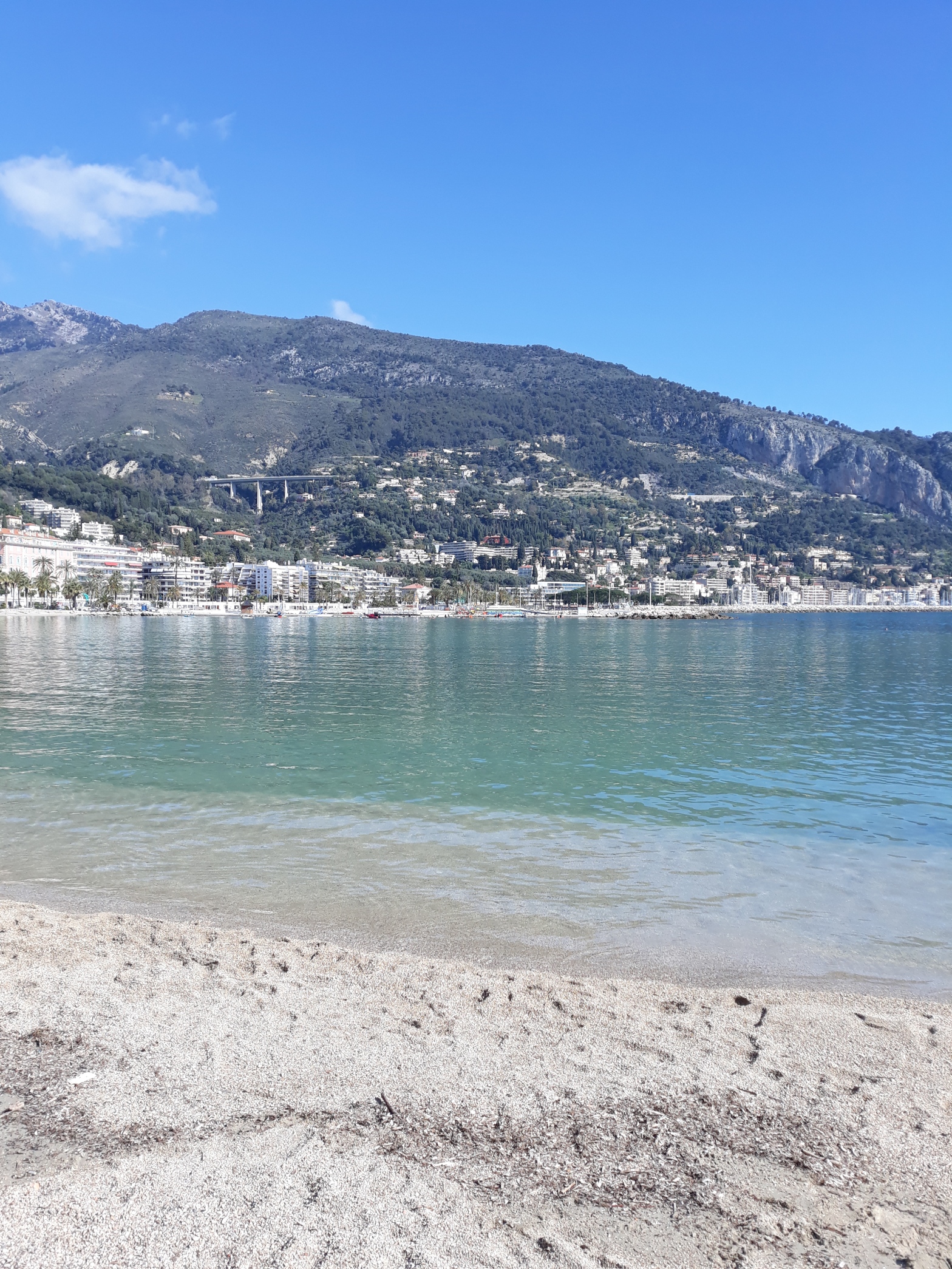
My pause from blogland can be attributed to one thing – moving and settling in Menton. If you’ve been following this blog for a while, you’ll know that David and I have had a second home in Nice for nearly 15 years. We sold that and most of the furniture in it back in September and waited five months for the deal to close on our new apartment in Menton, up the coast from Nice. We’re still in the same neck of the beaches, the Cote d’Azur, famous for its year-round sunshine, clement winters and history of artistic and celebrity residents.

Recreating a home in the south of France has involved an embarrassing amount of shopping – from a flatpack bed to drill bits, with a second-hand sofa, dining table, chairs and curtains along the way – and intensive decorating, featuring the massacre of butterfly and floral decals and the removal of in-built wardrobe and cabinets, leaving behind the tasks of scraping off wallpaper and filling vacant screw holes marks with buckets of Polyfilla, soon to be followed by painting. Luckily, no major renovations are needed. We have a tastefully tiled bathroom with walk-in shower and a fully functioning kitchen, albeit with a temperamental washing machine that prefers to work in the mornings.

My bloggery silence hasn’t been just about furnishing and DIY in extremis. This move marks the start of my retirement in earnest, the deletion of the prefix semi before retirement to describe my academic position. I’ll finish my last contract with my final doctoral student in the autumn. That’s all that’s left. My life is now devoid of course writing and research and the publish or perish culture. That is strange – as strange as a local bus trip to Italy, as strange as swimming in the winter sea. Like so many retired people, I’ll continue to ‘keep a hand in’ as they say, taking on the odd editing assignment that comes my way. The difference now is that for the first time in my adult life, I’m not looking for work or trying to keep the work I’ve got.

This naturally makes me think about my other career as a writer. I haven’t considered myself semi-retired from that. I used to think that writers never retire, but some writers have packed it in (Phillip Roth and Wendy Cope come to mind). I’m starting to wonder if I should take at least a partial retirement from writing. This means working to my own pace on fiction and creative non-fiction and still calling myself a writer (it’s too sexy to shake off). This isn’t too different from what I have been doing in recent years, since I stopped scriptwriting and therefore applying for funding, managing a theatre group and delivering workshops. Yet something different is palpable, my ambition, my desire for writer recognition, ended around the time we put in our offer on the Menton apartment.

I can’t stop all together – writing is as natural as breathing and as necessary as meditation. And there still are things to write about – nature, personal growth, language, books…

What I’ve Been Reading

A Little Life by Hanya Yanagihara makes for a long book (700 plus pages) but is also one of the best novels I’ve read in decades. It tackles difficult subjects, like abuse, torture and self-harm, and this can make for painful reading at times. But there are payoffs. The psychological depths of the story, revolving around the friendships of four men over the years and one man in particular, Jude, presents a complex and believable narration. Jude is a perpetual victim, but also a survivor that other characters (and this reader) agonise over and applaud in equal measure.

The Authority Gap byMary Ann Sieghart,written a few years ago, covers the myriad of ways in which men are assumed to have more authority, more knowledge and experience than their female counterparts. By the author’s own admission, you would have thought that this has all been said before and that we have moved on to a more equal co-existence. Yet, it’s something that we know still happens and have become desensitised to and have stopped talking about. Or in my case, being all too aware of this, occasionally I have used my bone-dry sense of humour to point out that I’m the Supervisor and not a mature student or that yes, I really did this [fill in the blank with something technical] all by myself without causing grievous injury. Seighart points out how the authority gap is played out in our actions, individual and institutional, and in our use of language. Specific examples come from a hefty dataset of anecdotes from powerful women, including some of my heroes like Christine Lagarde, Julia Gillard and Madeleine Albright, who have all been undermined and underestimated. Amusing and cringeworthy at the same time.

Seven Days to Tell You by Ruby Soames is a remarkable thriller, full of twists that go beyond the plot-driven variety, questioning the ideas of love and commitment. Since I don’t want to give anything away – discovery and speculation are key to reader enjoyment – I’ll have to be brief. A woman’s husband disappears for three years. To say more than that would even spoil the curious first chapter. I will say this – it takes place mostly in London, but also has flashbacks to the French Riviera, hence, I conclude this blog from where it began.

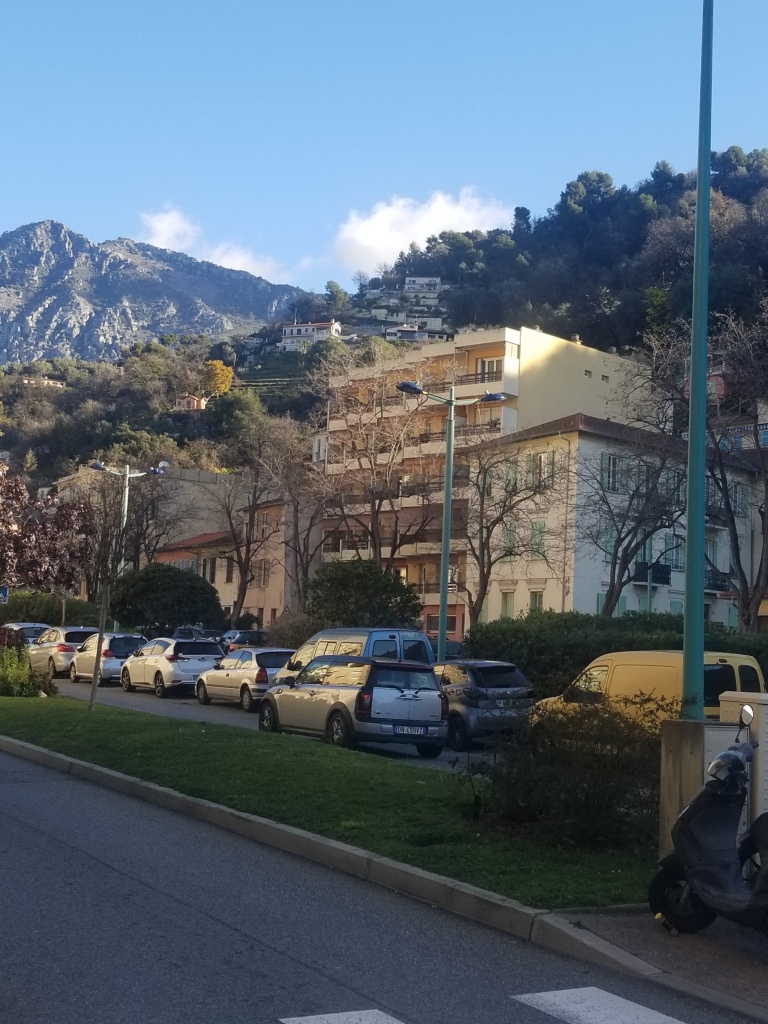
Our new street in the Carei valley in Menton.

Winding down my year of blogging

My writing goal at the start of 2023 was to write a blog every week. I’ve done it – well, nearly. According to my WordPress stats, this final blog of 2023 will be my 51st of the year. I managed to stretch the meaning of a week to 8 days here, nine days there, while changing my posting date from Friday to Monday to get more hits, ending up a week behind. In France, however, a ‘good week’ means 10 to 12 days if you’re a builder or government worker. By that calculation, and since I spent half of 2023 in France, I have over-blogged this year.

WordPress also informs me that these blogs have totalled nearly 30,000 words, a solid novella length. But that’s an unfair comparison as blogs belong to a type of creative non-fiction. Or at least they can be. I appreciate the often-quoted Dr Ian Sussman who said, ‘Blogging is not writing. It’s graffiti with punctuation.’ To paraphrase Sussman, blogging can also be long-winded, soft-sell advertising.

My blogs have been neither the swear-laden ranting of graffiti or promotional writing being masked as information. Blogging, as a creative exercise, has given me the chance to author pieces about items in the news without falling into reportage and to write about books without following the standard book review format, often combining books together under sociocultural or environmental themes. Speaking of the latter, looking back on this year’s blog, I’m surprised that I didn’t write more about the environment, aside from three pieces around this year being my year of trees. I suspect this is because I now subscribe to David Wallace-Wells’s brilliant newsletter that covers environmental topics I would otherwise write about and at more length.

These blogs are creative too as no one assigns me the topics. Even with writing every week, I usually have too many ideas bouncing around my head to write about and have had to quickly choose one before the weekly deadline has caught up with me.

I’ve enjoyed the creative side of blogging. It’s what has kept me going with it. George Eliot called her creative life, her ‘higher life – a life that is young and grows, though in my other life I’m getting old and decaying.’ Too true. But there’s only so much creativity and time to go around and this blogging year has taken away from other creative writing. I’ve noticed less journalling and only two new essays and one short story for the entire year. Having said that, I won’t be too hard on myself as I managed two academic articles and a book review, along with a couple of editing jobs. (Self pats her back.)

So, what’s the writing goal for 2024? To paraphrase John Updike, I plan to rewrite, rewrite and rewrite my fourth unpublished novel, the focus this coming year being on quality instead of quantity. As for this blog, it’ll continue to be my public notebook, but not likely in weekly instalments – once every fortnight or so.

I wish you all a creative and joyful 2024.

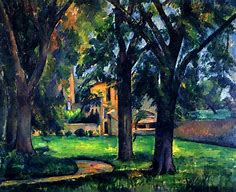
To conclude my year of trees, Paul Cezanne’s Chestnut Tree and Farm (1885)

Digital Fictions and other Ephemeral Writings

About a dozen years ago I was teaching a course on analysing digital texts, those texts that can only be read on computers and that used the affordances of computer technology in their production.  The course included hypertext fiction, digital poetry and novels using adobe flash interface to tell their stories with words, images and music. Fascinating stuff.

I recall one of my luddite colleagues making an off-handed comment about the texts on my syllabus just being fads of technology and not real ‘literature.’ I admitted that there was some truth to that in the sense that technologies develop and change so quickly, other ways of writing creatively using new digital platforms are likely to come along. I shocked my colleague even more by saying that my course was likely to become superfluous in the coming years as digital texts become more common and would be studied alongside print books as part of courses on literature and critical studies. (That was me talking in a world that is ruthlessly territorial when it comes to who teaches what. I was always an odd fit in academia.)

In a recent interview, the British Library’s curator of digital publications, Giuilia Carla Rossi, noted that many ‘born-digital’ works, like the ones on my old course, are structurally and technically more complex than the pdfs and e-books we use today. These older publications – by that, I mean even eight years old – relied on the software and hardware they were designed for. With changes in computer technology, these works are no longer accessible. Painfully, that has been the case for a couple of the digital poems I used in my book Digital Textuality. These innovative multimodal poems were produced on Adobe Flash, which was discontinued in 2020.

Other texts analysed in my book have been rescued by digital archivists. The much-praised Patchwork Girl by Shelley Jackson first appeared in 2001 as a floppy disc (remember those?) with embedded specialist software. This hypertext fiction, where you can choose different paths to reading it, is a wonderful retelling of Frankenstein with a female monster. To read this work when I was teaching it, a CD driver was required. How many of us have computers with CD drivers in them these days? Luckily, thanks to digital archivists, Patchwork Girl is now available online as a download. This is because it was a seminal work in hypertext fiction. Other lesser-known works in this sub-genre have evaporated.

My prediction spoken to my colleague turned out to be too true, and many digital texts are now just texts. Digital Textuality only had one edition. But I don’t mind. Firstly, I managed to get a few articles and book chapters published on the back of this book. Secondly, these digital works and studies about them are not all that different from the many stage plays out there that are never recorded, and their scripts never published. As a former playwright, I’ve grown to accept that. Plays and their performances are re-experienced in our memories. Perhaps that makes me less clingy when it comes to digital texts and the short shelf life of my writing about them.

As I was taking a break from putting together this blog, I happen to read John Naughton’s latest column in The Observer, where he has coincidently taken up a similar topic. Naughton points out that we shouldn’t assume our stored digital data is going to be around forever. Not only is the technology changing in ways that make our digital artefacts inaccessible, but the companies that store these artefacts could go out of business, taking our data with them. WordPress, the platform for this blog, recognises the concern among its bloggers that our work might not last in perpetuity and has offered us a solution. For a fee of $38,000 WordPress will secure ‘your online legacy’ for 100 years.

Dear Reader, I’m afraid you’re going to have to treat this blog, like so many digital texts, as a fleeting thing, a mere transient writing of the moment.