Il Duce and the Donald

It’s easy to see how much these two men are alike, down to their speeches made through puckered lips and puffed-up chests. But I’m going to stick my neck out and say how much these two are different. After recently reading Antonio Scuratti’s M: Man of the Century, I look at Mussolini in a different way and as less of a cardboard cutout. This first history-come-novel  of a trilogy depicts Mussolini’s early political life from the time of post First World War Italy until he gained power in 1924.

Unlike Tr*mp, Mussolini was not born gagging on a silver spoon. His father was a blacksmith and his mother a schoolteacher. Mussolini trained to be a teacher but worked for a living as the editor of Il Popolo d’Italia, a newspaper for the fasci movement. Mussolini also served in his country’s armed forces during WWI and was wounded. Not so with the former US president, who avoided the draft with student deferments and finally, when those ran out, a medical exemption. Tr*mp’s CV consists of basically one thing – businessperson, a position obtained with properties inherited from his father.

Unlike Tr*mp, Mussolini knew politics and the ways of government. He was active in the Socialist Party before defecting with others to create their own movement over the issue of pacifism during WWI. Mussolini supported workers’ rights while supporting the industrialists, who were trying to reshape and capitalise off the country left bloodied and poor after the war, with little help from their allies America, France and Britain. Tr*mp’s political career was a spin-off from his media personality and self-publicity as a ‘successful’ businessperson.

While both men, once they achieved political power, encouraged and denounced violence in the same breath, Mussolini’s hands were dripping in blood. Metaphorically, of course, since he sent out others to do his dirty work. He specifically ordered the killing of his enemies, including the leader of the socialist party. Some would argue that the orange one is responsible for the deaths on 6 January 2021 at the Capitol, the deaths of anti-racists activists during his term in office and even the deaths of thousands of Americas due to his reckless response as president to the Covid pandemic. But all these examples are about responsibility through verbal coercion and propagandizing.

When it comes to public speaking, while the two men may have presented themselves in similar fashions and to my bewilderment been able to stir up a crowd, the prose of their speeches are starkly different. A skilled writer, Mussolini could craft his language and make logical arguments. And unlike Tr*mp, he never attacked his opponents with schoolchild slurs and name calling, which I’m not going to reprint here as I have reached my saturation point. Mussolini’s discourse would typically pick apart his rivals’ arguments and then tip the rhetorical balance by making threats of  violence: “The Socialists ask what is our program? Our program is to smash the heads of the Socialists.”

While both men attacked democracy, it’s worth considering the nuanced differences. Mussolini called democracy a ‘fallacy’ because people do not know what they want and because  ‘democracy is talking itself to death.’ Tr*mp said that if he lost the 2020 election, it proved that democracy was an ‘illusion’ because ‘the system is rigged’ and ‘everyone knows it.’

One final noteworthy difference, Mussolini’s fascism, unlike the MAGA campaign, spawned an art movement. Il Novecento rejected the avant garde of the early 20th century in favour of more traditional large landscapes and cityscapes, reflecting the fascists’ ideology. From Scuratti’s book, I’ve learned that this movement was founded in part by one of Mussolini’s many mistresses. Whatever the motivations and manipulations of Il Novecento, Tr*mp and his MAGA movement are in a word artless.
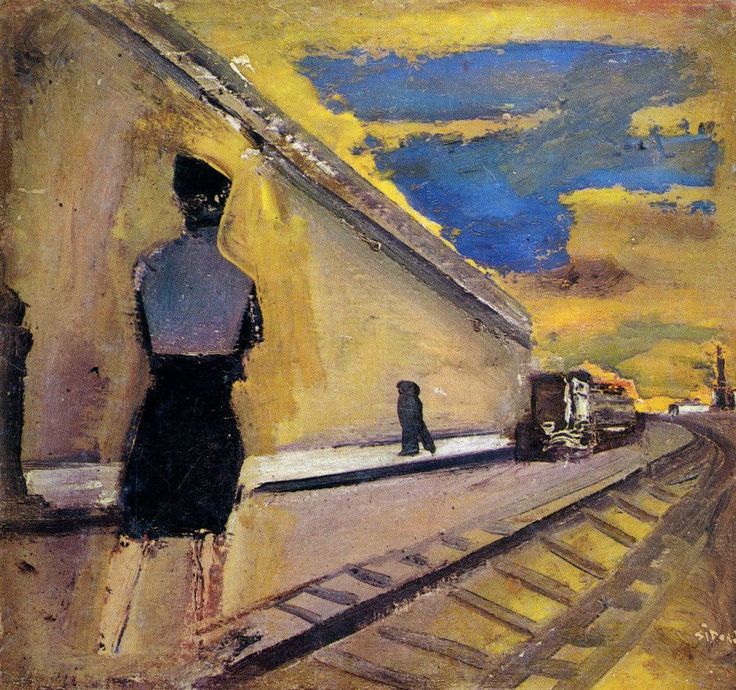
Painting by Mario Sironi of Il Novecento

Pointing out the differences between these two leaders not only highlights the unfitness of the former US president for any position of governmental leadership, but it makes me think that fascism is an overused term that like so many political and ideological words, changes its meaning over time. Yet, the essence of it remains as noted in a recent interview with writer Naomi Klein. On the topic of fascism, she said ‘I’m scared whenever we get whipped up in a mob and don’t think for ourselves. That’s how the updated far-right is drawing people in. It’s extremely dangerous.’

What else I’ve been reading

This has turned out to be a summer of big fat reads, with the Antonio Scuratti book weighing it at 750+ small print pages. To counter this, two excellent novellas have capped off the summer. I’ve finally gotten around to reading something by the Belgium writer Amélie Nothomb. Stupeur et Tremblement (avail. in English) is a drole, at times laugh-aloud funny, story of a young Belgium woman’s experience working for a Japanese company. The expected East meets West clashes are there, but so too is a humorous take on workplace bullying (I know, it can be serious and soul-destroying).

The other lightweight but not intellectually so was Thomas Mann’s classic Death in Venice. I first read it decades ago at university. Having since seen the film with Dirk Bogarde, I could only envisage his twinkling brown eyes  as those of Aschenbach. The older me also appreciated the references to the paintings of Caspar David Friedrich (who wasn’t on my radar until 5 years ago), adding more meaning to the book’s meditation on aestheticism.

The Pauline Boty Coincidence

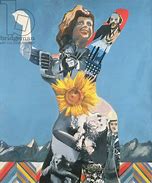
I first came across the artist Pauline Boty in Ali Smith’s Autumn, where the protagonist, Elisabeth, is working on her PhD in art history and discovers Boty’s work. She is so struck by the artist’s quirky paintings, popular in their time but now obscure, that she changes her thesis topic rather late in the game to Pauline Boty.

Elisabeth describes Boty’s paintings and collages as joyous, inventive and bold. Traits not allowed for women artists in the 1960s. As Smith’s book reminds us, when Pauline Boty attended the Royal College of Arts, there weren’t even toilets for women students. Naturally, this piqued my interest, and I found online a cache of Boty’s works, most depicting the personalities and popular culture of the 60s. Several sources refer to her as one of the greatest British female artists of the 20th century. She’s also credited as a founding member of the British Pop Art Movement. On top of that, Boty enjoyed a brief career as an actor in film and television and as a radio presenter. So, how did this celebrity artist pass me by?

In Autumn, Elisabeth thinks Boty’s present day obscurity is owed to her being female and the fact that she had a short life, dying of cancer at the age of 28. Yet, her legacy includes some 50 paintings, hundreds of drawings and several stained glasses – one of which can be found at the Stained Glass Museum of Ely Cathedral – that’s a five-minute walk from my house!

But that’s not the coincidence I started this with. About two weeks ago, when I was three quarters into Smith’s novel that refers to Boty’s life and work, my Sunday paper had an article about a new Boty exhibition at the Gazelli Art House in London. An artist I had never heard of is suddenly coming at me from different angles. I don’t see much in this coincidence. It’s not a calling to become an art historian or that I must have a special connection to Boty. Life is too random to think that way, but I enjoyed the coincidence all the same. It put a magnifying glass on this experience of discovery.

Of course, the article mentioned that Boty has been forgotten and how popular and outrageous she was during her brief lifetime. According to Rob Walker of The Observer, this exhibition will introduce Boty to a new generation. Maybe so, but will this woman artist enjoy the posthumous recognition of other modern artists who died young? Aubrey Beardsley and Jackson Pollock come to mind.

When Elisabeth tells another character that her thesis is about Pauline Boty, she soon finds herself explaining Boty’s brushes with fame after her death: ‘Ignored. Lost. Rediscovered years later. Then ignored. Lost. Rediscovered again years later. Then ignored. Lost. Rediscovered ad infinitum.’

It appears I have jumped into one of these cycles.

Art or Commerce? Orlinski in Nice

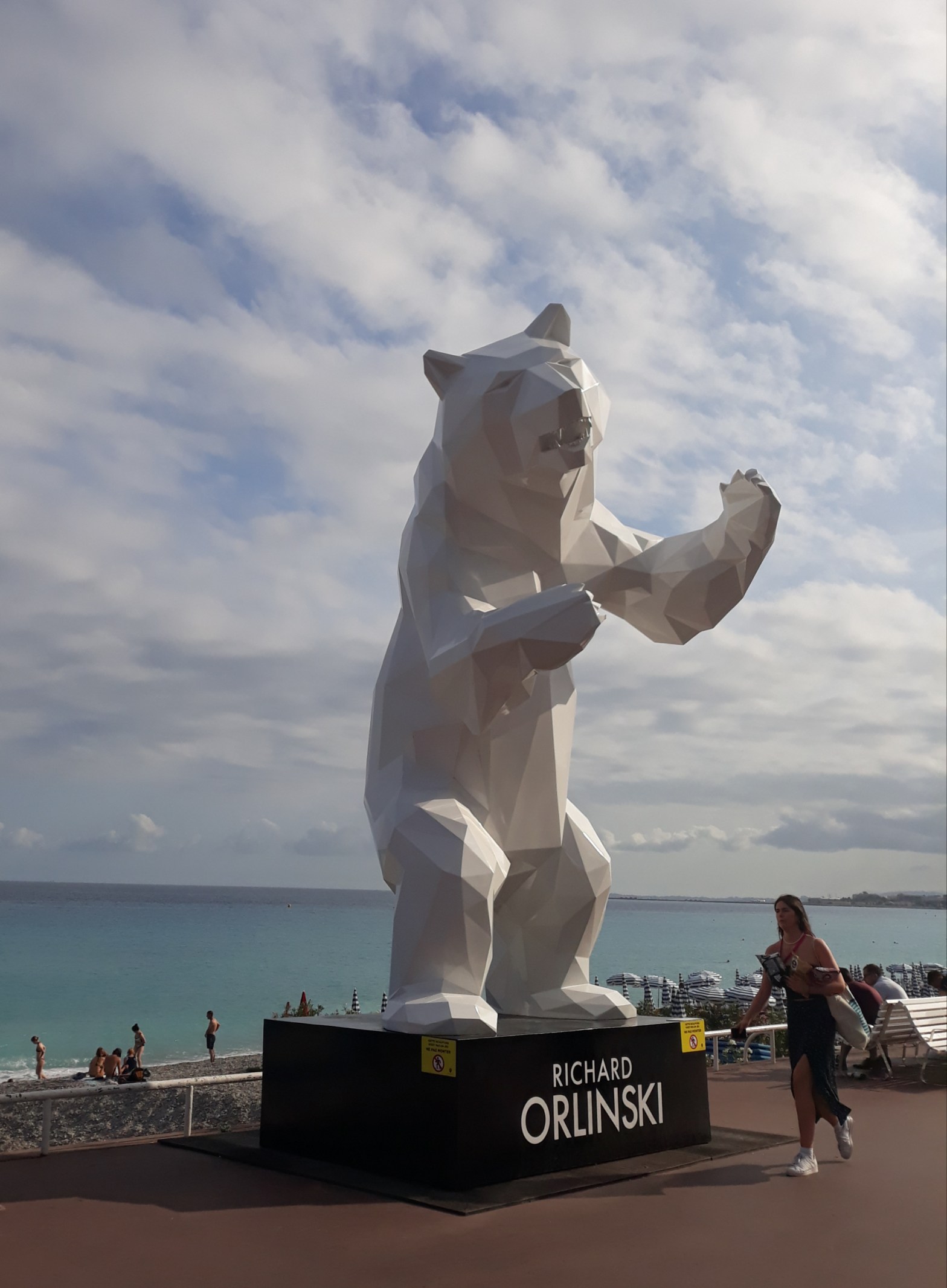
This trip to France has been decorated with some controversial street art. An installation by the French neo-pop artist Richard Orlinski of colossal animal sculptures has the French culturati polemicizing and passersby posing for selfies with the plasticine creatures. The monochrome structures use the bright colours of the original ten-pack of Crayola crayons and resemble children’s toys. These qualities and their placement in public squares, the famous promenade and even one at the airport give them a sense of fun.

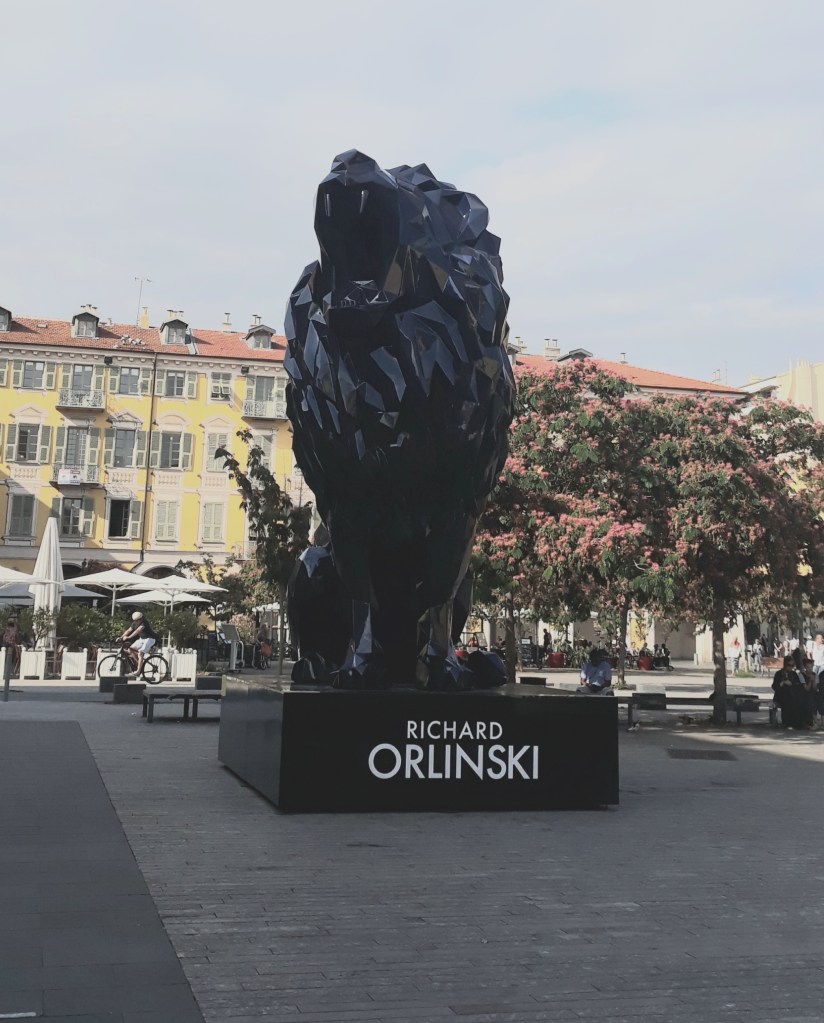
Since the first sculpture I noticed in the installation was of a white polar bear, on its hind legs with a ferocious scowl, I thought there was an environment message or meaning. My other thoughts were to do with the bear as a symbol for Russia. As Nice has a sizable Russian community, I thought the creature was well placed and could have something to do with the war in Ukraine. All these ideas fell apart when I saw a huge black lion and a red tyrannosaurus rex in other parts of the city centre. Then there was Kong. A yellow King Kong wields a barrel over his head in Place Massena and a red version of Kong is amusing arrivals at the airport. I haven’t taken a picture of these Kongs as I feel some copyright issues should be taken into consideration. Kong might be iconic, but he was the creation of American filmmaker Merian C. Cooper, who deserves some credit and his estate some money for the use (or overuse) of the image.

Critics of Orlinski’s animal sculptures point out that they are simplistic and negate the complexities of art. I agree with that as I aimlessly search for meanings. Edgar Degas once said that ‘art is not what you see, but what you make others see.’ These sculptures, neither individually or as a collection, make me see or understand anything differently.

Orlinski is also unpopular with galleries as he draws costumers away from indoor installations and the more traditional paintings-on-walls exhibitions. The works have thus been reduced to ‘instagramable’ and ‘industrialised art.’ Orlinski’s own giant-sized replicas sell for 500,000€ and figurine versions for 2,000€. Being accessible to the public for me is a point in their favour. I can’t find fault in a sharing of creativity, even if their most creative feature lies in their enormity and placement in unlikely public spaces. They have at least been a source of gentle amusement during this working holiday.

Not the Van Gogh trail

I know I’ve criticized the Van Gogh industry before – the posters, tea towels, coasters and the astronomical price tags on his originals. Underlying this is the fact that this master is known as much for his self-mutilation as for his paintings. Despite all that, I am a fan of Vincent Van Gogh. While I’ve tired of the ubiquitous sunflowers, I still get mesmerized by The Potato Eaters, the Japanese orchards and best of all discovering those lesser-known gems, those paintings secreted away in museum corners waiting for me to find them. With this in mind, I brushed aside my misgivings about commercializing dead artists and headed off to Arles, France for a day trip.

Van Gogh only lived in Arles for fifteen months. He spent more time in Paris (2 years) and in Brixton, London (3 years). Yet Arles tourism has etched out a place for the master since after all in Arles, Van Gogh made over 300 paintings and drawings, some of his best-known works. That was enough to convince me it would be worth doing the Van Gogh trail with the hope of discovering something new, or as in the case of Paul Cezanne in Aix-en-Provence, get a feel for how the artist once lived.

The tourist office provided a map of walks in and around Arles, of which the footsteps of Van Gogh were included. There were six places of interest, with two of those places not existing as they once did – the famous yellow house where he lived with Paul Gaugin for a while was bombed out during WW2. The other ghost site was the view from the river, which Van Gogh famously painted. Today the view is mostly cluttered with 1980s apartment blocks. I saw the ‘night café’ in the daytime which is when it is now at its liveliest, full of tourists taking photos while locals try to have their espressos in peace. The public gardens and most of the stone bridge were still intact, evoking images vaguely reminiscent of Van Gogh’s landscapes. Perhaps that couldn’t be helped – what my eyes witnessed were closer to photographs than impressionist paintings.

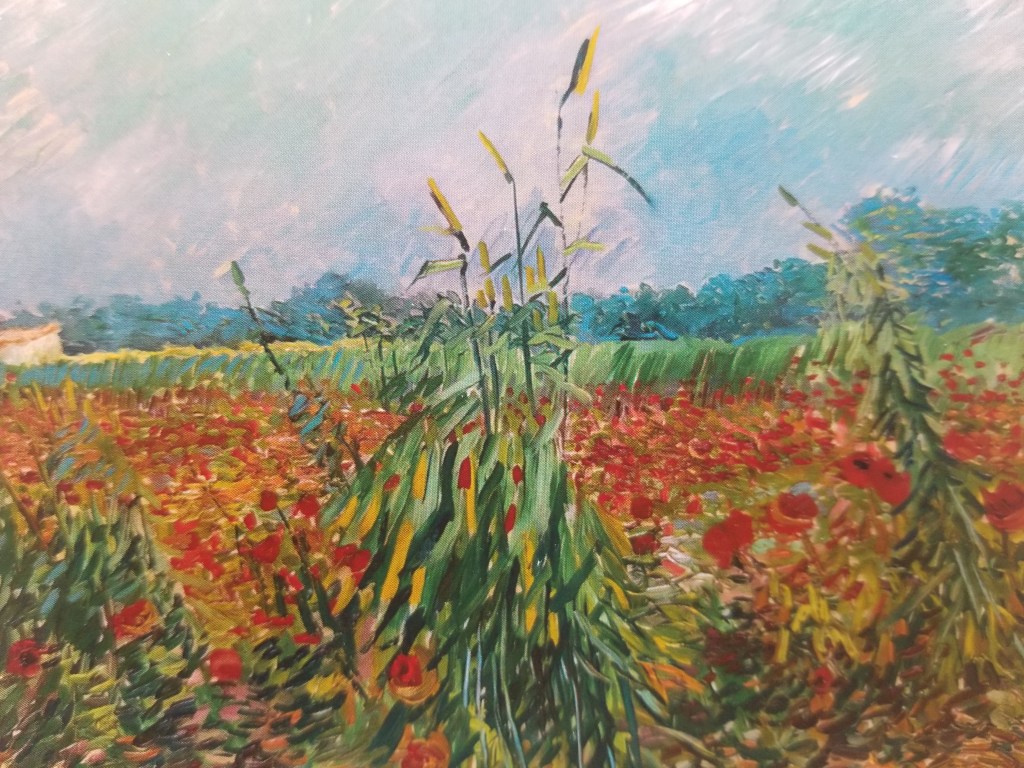
What about the paintings and drawings? Two museums were on the Van Gogh trail. The one didn’t have any artworks but could boast having one letter written by Van Gogh to Gaugin. The other museum, the Foundation Vincent Van Gogh, not living up to its name housed five paintings by Van Gogh and bizarrely had them on display in an exhibition of female abstract artists. Yet, among those five I did find the gem – the painting I hadn’t seen before. Les Epis Verts is of shafts of green wheat in a field somewhere around Arles and was painted in 1888.

It is ironic that on the rare occasion I was prepared to not be cynical about commercializing art and overkill of the great masters, I was left underwhelmed and wanting more. C’est la vie.

Les épis verts (1888)

Five Vignettes About Trees

1.

I attended Joyce Kilmer Elementary School in Chicago, where the first line of Kilmer’s best-known poem was painted in old-worldly script above the stage of the auditorium: ‘I think that I shall never see a poem as lovely as a tree.’ The metaphor still works for me, but the rhymed couplets throughout the poem (I will spare you) edge close to doggerel. Thankfully, loads of other poems about trees have been published. I’ve recently discovered the French-Canadian poet Hélène Dorion, whose collection ‘Mes forêts,’ as the title suggests, features trees. Here’s a sample:

Trees bite into the soil
their bodies parched
in the cold of their roots
gaunt shadows bodies
pressed together
we hear the song
of fracture and desire
body like the tide going out
pale boat
lost in its night

body of love and storm
given over to the earth
that it licks as if
it were a wall to pierce through

  • Hélène Dorion (Translated by Susanna Lang)

2.

With talk of today being the Spring Equinox in the marginalia of the news, I was reminded of St Joseph’s Day. It’s the day before the equinox, but nevertheless it was for me as a child the Italo-American version of St Patrick’s Day. It was customary to wear red. In Italy, it’s also celebrated by gorging on a zeppola, a custard-filled pastry with cherries on top – the cherries represent the buds on the trees in spring.

3.

At the start of the year, I enrolled in another MOOC intended for French undergraduates to help me expand my French vocabulary. The course, entitled ‘Les Arbes,’ was about the biology of trees and their contribution to the Earth’s biodiversity. Once again, learning scientific French highlighted the paucity of my scientific English. Many of the words I looked up in French were the same or close to it in English.

4.

In Cambridgeshire where I live, a furore has erupted over new plans led by the county council to build a busway (a bus-only road) from a new 6000-home development to the town of Cambridge. Building such a road will involve cutting down 1,000 trees. The majority of these arboreal victims are in the Coton Orchard, one of the UK’s largest and oldest orchards, with a unique ecosystem that cannot be mitigated with planting new trees elsewhere. This is part of a pattern in Britain, where the mass felling of trees has been carried out in the interest of road building. In 2018, despite two years of protests from residents in Sheffield, the city council allowed for the felling of some 17,500 trees. It later turned out that the justification for this was based on misunderstandings of an environmental survey coupled with misinforming the public.

I’m not just being sentimental about trees – all trees everywhere. Trees are also a crop that provide wood for furniture and pulp for toilet paper, among other things. Some trees also need to be cut down due to disease or public health reasons. The destruction of trees in our parks and towns is a different matter altogether. With the loss of these trees, the bird and insect populations, already in catastrophic decline, suffer greatly. To this, it’s necessary to add negative effects of such barbarous acts on the human population, both in terms of our physical health (such as the quality of the air that we breathe) and psychological health (where studies have shown improvements in emotional well-being with the introduction of sylvan spaces).

5.

Every year, I buy an artsy calendar to add some colour and visual creativity to my home office in Ely. It’s also a place to jot down writing deadlines, meetings and health club activities – things that are on my phone calendar as well but are sometimes forgotten when my head is in the comfort of clouds. My 2023 calendar has a tree theme. Every month displays a painting of trees by some famous, and some not so famous, European artists. Looking at these photos of paintings everyday – these meadows, these tree-lined shores, these shaded forests – gives my days a natural sense of calm and beauty. Since according to a French professor lecturing on the MOOC, there are over 60,000 species of trees, every year could have a tree theme, a different tree calendar, and in the remainder of my lifetime, I still will have only scratched the surface.

Above: Emmanuel Gondouin, La Forêt, 1912
Feature image: Henri Charles Manguin, Les oliviers à Cavalière,  1905

Caryatids and Turning 60

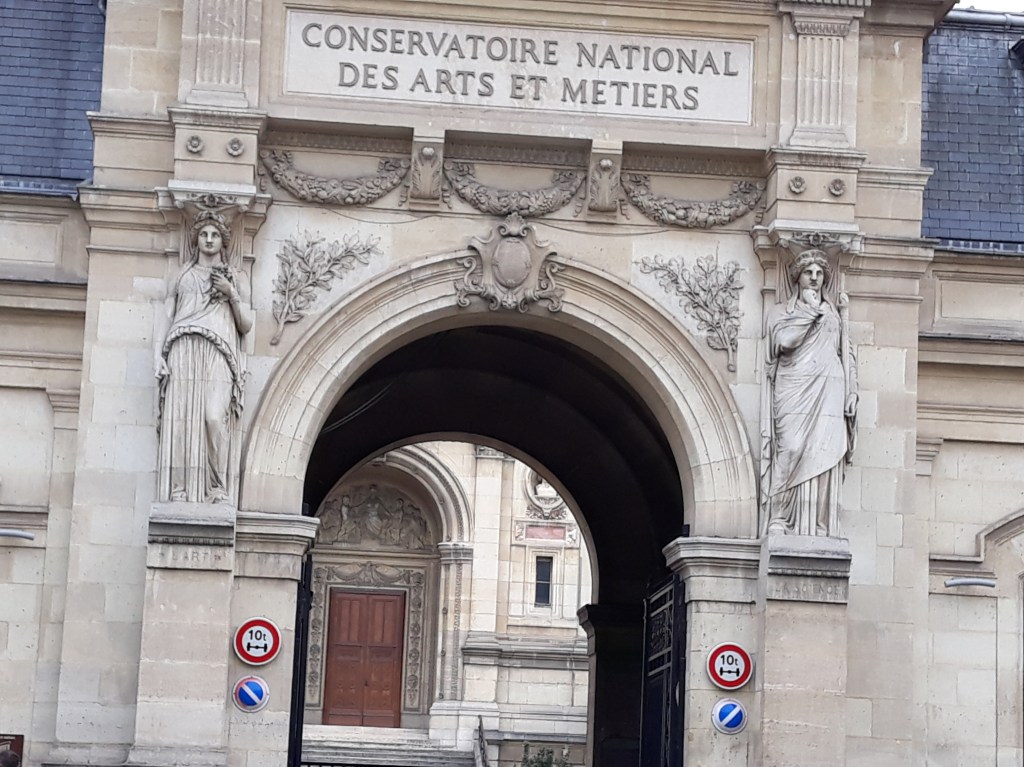
Wandering around Paris with her camera, the director Agnès Varda once made a short film about them, Les Dites-Cariatides (The So-Called Caryatids). Caryatids are stone statues of women which form load-bearing columns at the front of buildings. Sometimes these women appear to be supporting the lintel above an entranceway, other times they’re preventing a terrace from crumbling down. For all this arduous work, they never grimace or perspire.

According to Lauren Elkin, author of Flaneuse: Women Walk the City in Paris, New York, Tokyo, Venice and London, ‘They’re all over Paris, these caryatids. They come in sets of two or four and sometimes many more than that, depending on the building’s ostentation.’ With this in mind, before heading off to Paris last weekend, I investigated caryatids online and found claims of over 500 of these stone women holding up Parisian buildings. The first was sculpted in 1550 by Jean Goujon and can be found in the Louvre – which having seen it years ago, is the last museum I would want to see in Paris, overrated with too many tourists ticking their bucket lists.

Walking all over the 18th arrondissement near Sacré Coeur, I couldn’t find any caryatids, not even a pair of them that I had read about online and knew which street they were on – or not, as the case may be. It wasn’t until the end of our second full day that my David spotted a couple of caryatids on the edge of the 10th arrondissement where we were staying. Typical of the caryatids I’d seen in photos, they were draped in tunics, held neutral expressions and had smooth wrinkleless even-toned skin. Idealised women.

I on the other hand am not a caryatid. In Paris celebrating my 60th birthday, I was aware of the fine wrinkles around my eyes, the patches of dark beige on my hands and those internal signs of aging – the knee that aches after jogging and feeling dozy before 10 pm among them. By the time we were in Paris, I was past the how-could-this-be-happening-to-me stage and had come to accept this milestone birthday as the start of a new, and hopefully worthwhile and productive, stage of life. It is a new stage. As much as I still feel ‘middle-aged,’ sixty has given me my ‘senior’ railcard and other discounts all over Europe. It has also made me think more about full retirement – if a writer can ever be fully retired – and how I will spend the years ahead, hoping to stay active in every sense and to experience new things, discovering writers and artists and the hidden gems – such as caryatids – in cities like Paris, Nice and London.

In the end I only saw ten caryatids (five sets of two). Agnès Varda’s film is 12 minutes long and only shows some 30 caryatids, which confirms my suspicion of the exaggerated claims of their ubiquity in Paris. The film is worth seeing for the beauty of the images and the accompanying poetry of Charles Baudelaire, a film made when Varda was 56. She continued making films well past her sixtieth birthday.

Blue and Yellow

There’s an awful lot of blue and yellow out there these days. According to a few online ‘-edias’ and ‘-ictionaries’, the blue and yellow of the Ukrainian flag represent the sky and fields of wheat. This combination of colours comes from the flag of the Kingdom of Galicia–Volhynia, used in the 12th century for the lands that include modern-day Ukraine.

Even the Covid-19 pandemic has failed to unite people the way Putin’s attack on Ukraine has. The pandemic was beleaguered from the start with different theories on how it spreads and what strategies governments should take to protect people. And let’s not forget the covid-deniers and anti-vaxers. The war in Ukraine is more straightforward. Though the solutions and ways of taming Putin are complex, we have all witnessed this unprovoked attack on a liberal democracy and recognise propaganda when we hear it.

I suspect that we’re sporting the blue and yellow, not only because we’re humanitarians, but because we feel vulnerable. I sure do. The possibility of another world war, one that would be, unlike its predecessors, fuelled in part by cyber-attacks and nuclear arsenals leaves me edging towards panic, that sensation of falling from high without a net.

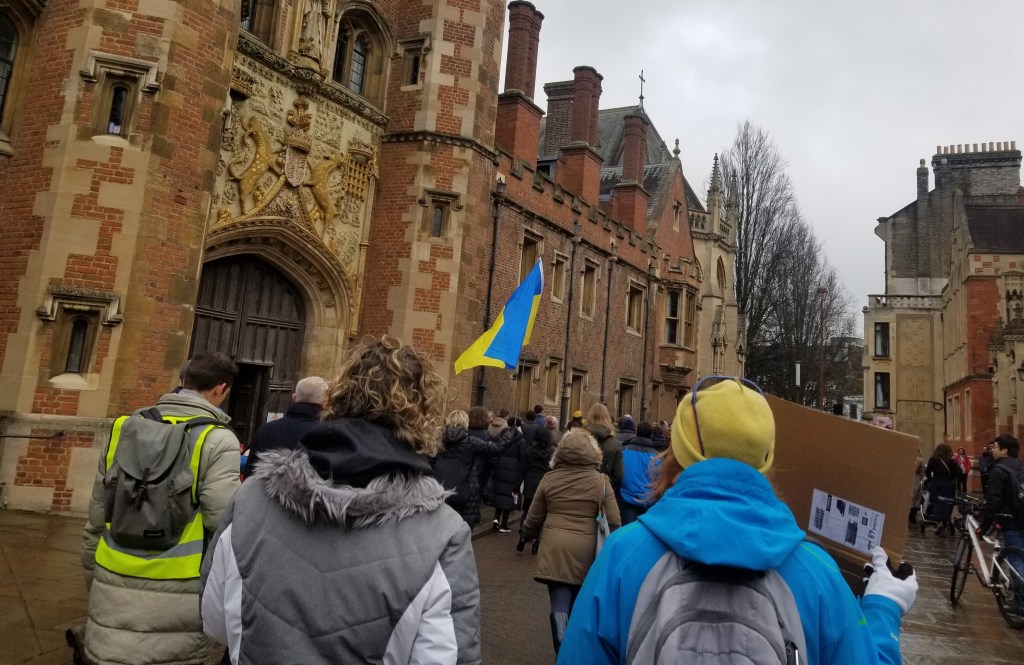
Everyone has their own means of dealing with this feeling of vulnerability. I find myself meditating longer and more often, trying to live in the moment as vulnerability entails some projection into the future. I’ve also tried to do something for the people of Ukraine in a couple of small ways – a donation to the Red Cross and participating in a march through the streets of Cambridge, UK. (I’m aware that by mentioning this I risk being accused of virtue signalling.)

March in Cambridge, 5 March 2022

Above all else, I’ve sought solace in the Ukrainian writings and artistic works that have been surfacing en masse in mainstream and social media. Before this war, I was only familiar with a handful of Ukrainian writers, including Natalka Bilotserkivets. I found one of her poems again and reread it, forced by the present to interpret it differently:

ROSE

It’s time to pack your bag and go.
You don’t know what to take – something easy
to carry; everything you’d possibly need,
instantly found.

Two or three brushes, soap and a towel.
Clean underwear, just in case your lover
meets you – or God. Either way,
you should have clean underwear.

In a secluded place, among weeds
of a dense, heavenly forest, I’ll meet a rose.
Like Blake’s symbol of delicate mysticism –
the rose who loves the worm.

Having allowed him into her alluring womb,
she trembles, hidden, to avoid me,
and all poetry – a shame, a bore,
oh, poor flower, lovely, dear . . .

© Translation: 2002, Dzvinia Orlowsky
First published on Poetry International, 2006

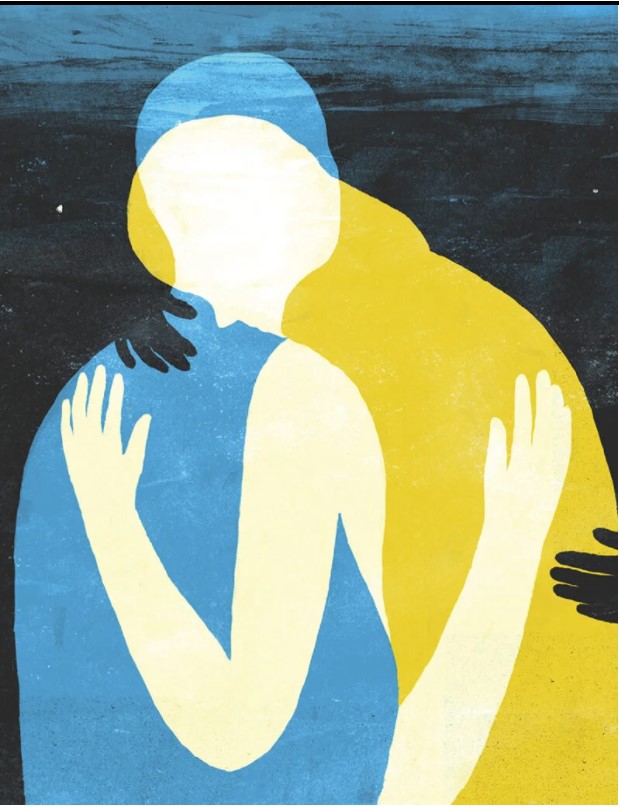
Now I imagine a yellow rose against a blue sky and people packing hurriedly as if leaving their lovers, but with the hope of meeting them again.

‘Support’ by Olga Shtonda

A Saturday in London

This is not a travelogue, nor is it packed with recommendations for places to eat in the Big Smoke – apparently the most popular nickname for London, according to Google. Yesterday marked my first daytrip to London in well over two years. That’s not to say I haven’t seen London at all during the pandemic, but those were trips getting to or from airports, with fleeting glimpses of the skyline from an overground train. Ely to Nice is inevitably via London. But Nice, the fourth largest city in France, has nothing on London when it comes to crowds and narrow spaces, where I have been imagining spiky Covid cells floating from one Londoner to the next. My day in our country’s crowded capital was my act of defiance, my coming to terms with the idea that I must learn to live with ‘it.’

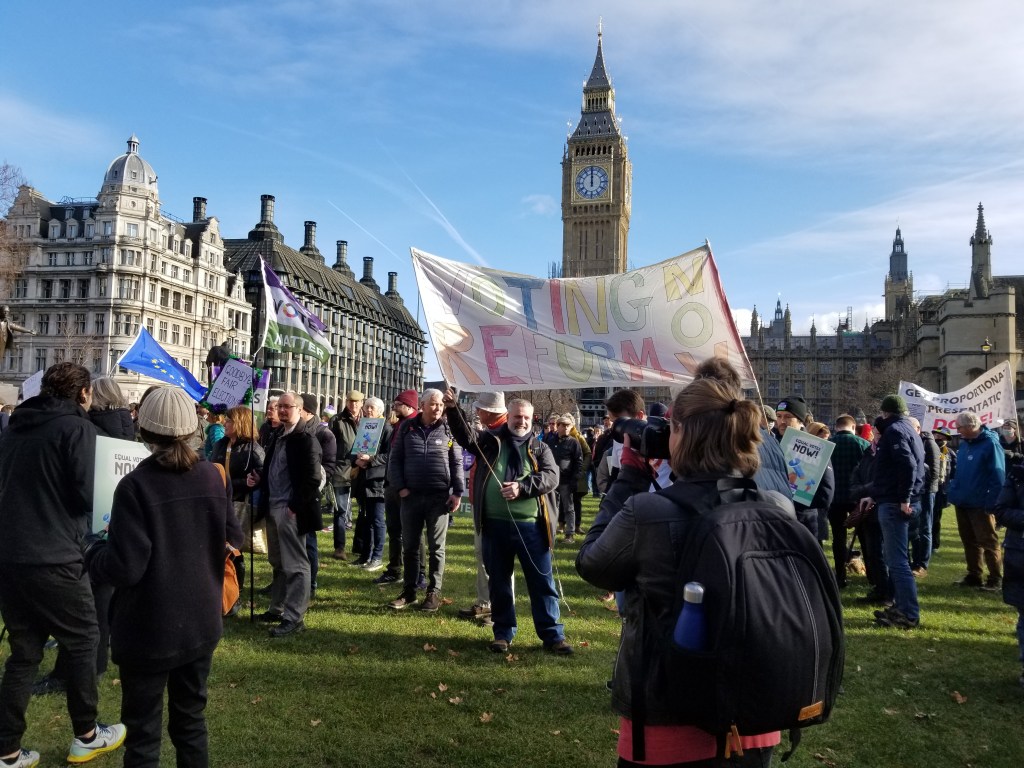
Like so many of my past trips to London, this one was spawned by political activism.  Make Votes Matter had organised a rally in Parliament Square to protest against voter suppression and in support of proportional representation. Voter suppression is the hidden agenda of this government’s proposed Elections Bill, currently getting readings back and forth in the two houses of Parliament. As for proportional representation, the current system for voting in the UK gives victories to candidates with the most votes and the party with the most seats, even if these results are far less than 50%. Stay with me. This means that in a country with more than two viable political parties, the majority of the votes could be against the Conservatives, for example, but the Conservatives still win because the opposition votes are divided among say four other parties. If you’ve been following British politics, you’ll have recognised that my example is in fact the reality. The last time Parliament was won by a majority was in 1935 (Statista) and the unpopular Conservatives were in power for most of the 20th century and since 2010.

While these are causes worth rallying around, more important for me was being outside in the gathering of some 500 people. We didn’t need to wear masks or keep two meters apart. We talked to people we knew and to a couple of strangers and we joined the group chant of ‘No way,’ responding to a speaker’s rallying cry. We were in a dome where Covid seemed a distant memory.

Yet, the true highlight of my London day was a visit to the Tate. I’ve been to some museums in Nice during the pandemic but felt safe doing so with pass sanitaires being scanned for entry.  At the Tate, some Covid protocols were in place. We had to book our free tickets in advance as numbers entering were limited, and we had to wear masks – all sensible measures. The health protocols kept me aware of the times we live in, but the works of art – J.M.W. Turners, Henry Moore, the Pre-Raphaelites – transported to that other space where only art and creativity can take me. A true and real space, to loosely paraphrase Aristotle.

The rally and the museum were the pleasurable parts of the day, as was a long stroll in the winter sun from Parliament Square to Blackfriars Station to catch the Thameslink train back to St Pancreas. The not so pleasurable experience came when riding an underground train, the aptly named Tube – in these small carriages, designed in the days of Victoria, I felt like a rat in an underground pipe, encrusted with dirt, potentially with disease.

On a more positive note about the Tube, I’m reminded of a much-quoted passage from Peter Ackroyd’s London Under which encapsulates how I felt at the end of the day:

‘The passenger travels within the origin of the city. It is a curious fact that the further the train moves from the centre of the city, the more anonymous it becomes. The journey becomes less intense. It becomes less intimate. It loses its mystery.’

London in these Covid days of partial restrictions has become less mysterious and less intimidating as I have grown more used to living with the pandemic.

Photos by Yann Arthus-Bertrand

I’ve been a fan of photography as far back as I can remember, and it could have been my metier had I been born later, into the age of digital and affordable photography. As an admirer of others’ works, among my favourite photographers are Annie Leibovitz, Henri Cartier-Bresson and Georgia O’Keeffe (yes, she was a photographer too).

I can now add to this list Yann Arthus-Bertrand, having recently discovered his work in Nice. This French-born photographer and film director is known for his environmental and socially conscious works, including the films Human (2015), Woman (2019) and Legacy (2021).

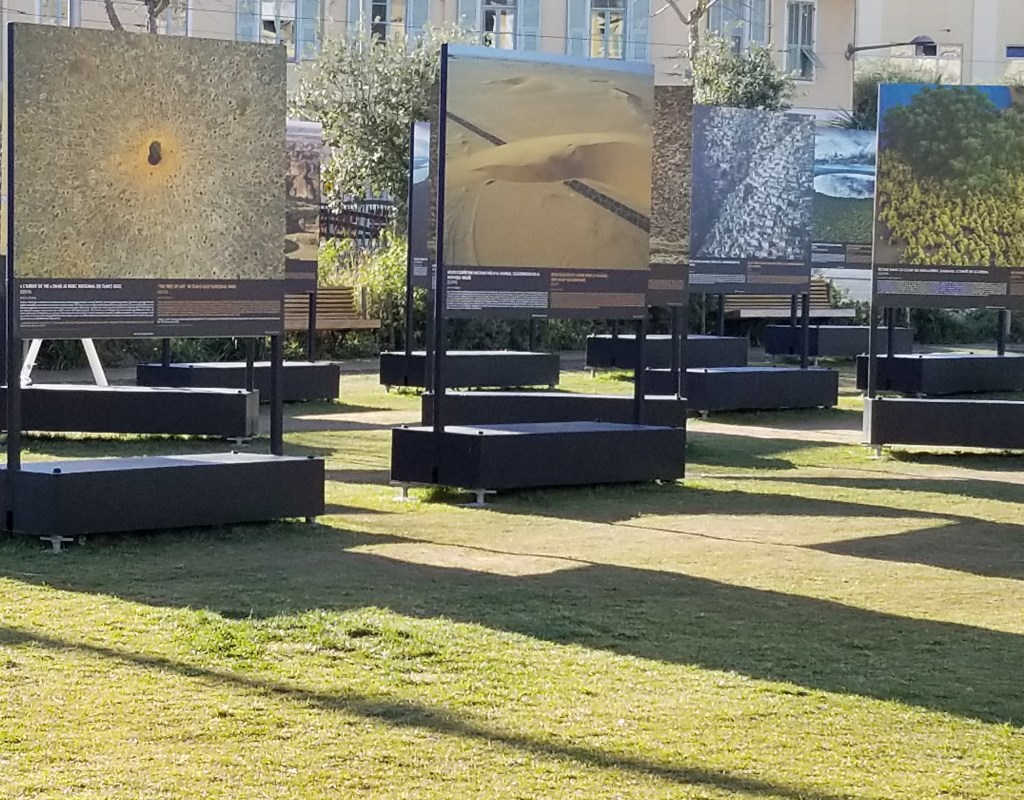
The exhibit I saw was indoors at the Musée de la Photographie and outdoors in a public square and the popular Promenade du Paillon – a public park in the city centre. As art in public spaces has long been the preserve of sculptors and architects, I was delighted to see visual art’s poor cousin photography in these open spaces for all to experience.

I was most struck by Arthus-Bertrand’s aerial photos taken all over the world. It’s hard to summarise them as they depict scenes as eclectic as life itself. Some of these aerial shots verged on optical illusions, appearing at first to be one thing, but revealed to be something else upon close inspection. Whether capturing the wonders of the natural world or freezing in time the spectrum of poverty and human labour, the images hold an aesthetic as haunting as they are enjoyable. I did feel a slight discomfort in marvelling at the beautiful colours and boxy shapes of a favela in Sao Paulo as seen from the air.

When talking about art, images support the words. I recommend visiting Arthus-Bertrand’s website or doing a search for him on Pinterest, where his fans have pinned hundreds of his photos. On this note, I close on the words of Arthus-Bertrand, who like many of us wanted one career, but ended up doing something else:

I wanted to be a scientist. I did a thesis on lions. But I realised photography can show things writing can’t. Lions were my professors of photography.

Schjerfbeck, really

Since the last International Women’s Day, I’ve blogged about, among other things, the historical violence against suffragettes, the exclusion of women from medical studies and the alarming rise in femicide. At the risk of appearing to downplay the plight of women, I’m taking a more positive approach to this year’s holiday, for which no one anywhere gets the day off work.

Last autumn I went to the Royal Academy of Arts in London to see their exhibition on the works of painter Helene Schjerfbeck (1862-1946). Who? Exactly – unless you’re from Finland. Not being from Finland, I hadn’t heard of her until the exhibition came along and received thunderous reviews in the press. The Guardian referred to Schjerfbeck as ‘Finland’s Munch.’ Other papers described her techniques in terms of Frans Hals and Velazquez and mentioned her being influenced by her contemporaries Cezanne and Picasso. All a rather blokey affair.

Yet, Schjerfbeck’s works have also been described as realism and expressionism, as haunting and melancholic and as pensive and intelligent. I went to the exhibition with these gender-neutral descriptors in mind, determined to judge the works devoid of comparisons to the male masters. Here are some examples of the paintings that moved me and made me feel that I had made a worthwhile discovery:

I especially liked the self-portraits made over time, drawing attention to the inevitable changes nature puts us through.

I suppose I could have written about this exhibition closer to the time, but as the weeks and months passed what seemed novel and intriguing simply become less so.  I wonder now if my mind had subconsciously compartmentalize Schjerfbeck’s paintings as being like this man’s and that man’s, and that I was no better than the arts reviewers in the newspapers. Asking myself to unlearn years of exposure to the male masters may have been a tall order. Yet, I’m glad I’m reacquainting myself with Schjerfbeck’s works and for having discovered many more of them online – she lived a long life and was highly prolific.

For those who say International Women’s Day serves little purpose and that men have the other 364 days of the year, without it, I probably wouldn’t have given Schjerfbeck a second chance. Happy International Women’s Day 2020!