Today’s Inbox – or WTF is happening to America?

Still surfacing from a deep night’s sleep, I checked my inbox to find an email from the US Social Security Administration. The subject header read: ‘Social Security Applauds Passage of Legislation Providing Historic Tax Relief for Seniors.’ That woke me up quickly.

This is an agency of the US government that used to communicate, like other government agencies, in dry non-partisan language. It gets worse in the body of the email:

‘The bill ensures that nearly 90% of Social Security beneficiaries will no longer pay federal income taxes on their benefits, providing meaningful and immediate relief to seniors who have spent a lifetime contributing to our nation’s economy. “This is a historic step forward for America’s seniors,” said Social Security Commissioner Frank Bisignano. “For nearly 90 years, Social Security has been a cornerstone of economic security for older Americans. By significantly reducing the tax burden on benefits, this legislation reaffirms President Trump’s promise to protect Social Security and helps ensure that seniors can better enjoy the retirement they’ve earned.”’

Since when do civil servants (as we call them in the UK) publicly praise the policies of any president or prime minister? Worse still – to allude to political campaign promises? Short answer – when that civil servant is Frank Bisignano, former CEO of Fiserv (a payment processing enterprise), a staunch Republican and one of the richest people in America. Tr*mp appointed him Commissioner of the SSA soon after retaking office in January of this year (yes, it’s not even 6 months yet).

This being from the SSA, the email got away with not mentioning how America’s most vulnerable would have their financial support lacerated. Medicaid in under another government agency: the Centers for Medicare and Medicaid Services (CMS). I’m waiting for their email to all US citizens and suspect I’m going to have a long wait.

The next email I opened also had a thing or two to say about the One Big Beautiful Bill – I hate even writing in this hyperbolic language. But it’s clever to use the propagandist parlance in legislation so that, like it or not, we all start sounding like MAGA morons.

From Robert Reich:

‘It is a disgrace. It takes more than $1 trillion out of Medicaid — leaving about 12 million Americans without insurance by 2034 — and slashes Food Stamps, to give a giant tax cut to wealthy Americans. It establishes an anti-immigrant police state in America, replete with a standing army of ICE agents and a gulag of detention facilities that transform ICE into the most heavily funded law enforcement agency in the government.’

Reich continues by recounting how moderate Republicans were bullied by the president’s threats and insults, mostly via X and Truth Social.

I retreated from my emails and opened the Le Monde app. One of their top stories covered OBBB – they’ve avoided both the English language and the embarrassing phrase by abbreviating it. They’ve also taken a more objective tone and have expressed all the above – it’s a bill that reduces taxes on the better-off, funds anti-immigration policing and leaves America’s most needy worse off, and that the US president attacked members of his own party to get it passed.  Even the purring beauty of the French language doesn’t help to make this more palatable.

What I’ve been reading

Helen Dunmore’s award-winning novel A Spell of Winter has provided the perfect escape from the horrors of American politics. Firstly, the story starts far away from modern America in England soon before the first World War and continues to a few years after the war. Cathy and Rob are siblings living with their grandfather and a servant in an old manor house. The children had been abandoned by their mother and witnessed their father’s declining health in a mental sanitorium. The children grow into teenagers, and their co-dependent relationship becomes incestual and later deadly. The story explores the power of class, of loss and of family. Secondly, the articulateness and sensitivity of the writing made this often disturbing and sad tale – some call it gothic – a delight to read. A snippet from Dunmore’s book: “The past was not something we could live in, because it had nothing to do with life. It was something we lugged about, as heavy as a sack of rotting apples.” 

Quite different from the vulgar vernacular and semantic satiation coming out of Washington these days.

Titanic Languages

This is not another linguistic term, nor is it figurative. I literally mean the big cruise ship whose sinking continues to intrigue and entertain over a century later. I’ve been listening to the BBC Sounds podcast Ship of Dreams, which puts the tragic voyage under a microscope, examining everything from the workings and perils of the engine room to what was on the menu for the upper deck passengers. Following an introduction covering the sociocultural and economic background that led to the construction of such a ship and the weeks leading up to Titanic setting sail, the podcast re-enacts the disaster with the help of historians, nautical experts and survivors’ accounts.

Among the fascinating factoids to emerge is information about the languages spoken on the Titanic. After English, the most spoken language was Swedish. Of the 1,300 passengers on board, 123 were Swedish (with 327 British and 306 Americans). Of the 994 crew members, some 34 were Swedish nationals. While these crew members were mostly dining staff who worked the luxury liners with the full expectation of returning to Sweden, all the Swedish passengers were travelling third class  and immigrating to America for a better life. The Italians and French, by the way, ran the kitchen.

In this potpourri of languages, Arabic could also be heard on the Titanic, though the exact number of speakers is hard to ascertain, especially given the bilinguals on board and the poor record keeping of the day. Among these Arabic speakers were some 150 Lebanese immigrants who came from rural villages and were fleeing poverty. Sadly, only 29 made it to America. When these survivors arrived in New York, they were given temporary lodgings, food and clothing by the Hebrew Immigrant Aid Society. According to the podcast and other accounts (Encyclopedia Titanica), anyone from that part of the Middle East was categorised and treated as the same by Euro-Americans. It has also been noted that the Hebrew Aid Society was a non-discriminatory humanitarian organisation.

It’s hard not to think about these Swedish and Lebanese immigrants without reflecting on the plight and treatment of immigrants to America today, or the hostilities between Arab nations and Israel. The adage about history repeating misses the mark.

What I’ve been reading

Annie Ernaux may have won the Noble Prize for Literature, but I’m not convinced of the literary merit of her work. By literary I mean work that makes the reader aware of its language and style of presentation. I’ll admit that I grumbled when Bob Dylan – a lyricist, not a poet – won the prize, but now I have to say that his lyrics are far more literary than Ernaux’s prose. To be fair to the French writer, she has often said that she is an author of autofiction and not a novelist. I’ve just finished reading her ‘autofiction,’ Une Femme, about the life and death of her mother. While the story holds some interesting reflections on the lives of women and family dynamics in France from the early twentieth century to the 1980s, the writing was so matter-of-fact that I didn’t come away from it with any satisfaction of having read a work of literature.

The flipside of this was reading Bill Browder’s Red Notice, which doesn’t aim at fiction or literariness. Yet, it read like a thriller with feelings of frustration and pathos that gave it emotional force worthy of any literary writer. Browder, a US citizen, recounts his experience of setting up an investment company in Russia following the end of the Soviet Union when the country was a wild west for investors. His run-ins with corruption and dubious politicians reached its peak with the torture and murder in a Russian prison of Sergei Magnitsky, Browder’s lawyer. Holding people responsible couldn’t happen within Russia, so Browder involved the US government, international human rights organisations and the media. And none of that was easy. Today, Browder is recognised as a human rights activist.

Finally, noting the death of writer Edmund White, I reread his brilliant essay published in Granta in 2008 about his view of Europeans when he was a child in America and his first experience of travelling in Europe years later. So much of what he said then resonated with me (an American who has immigrated to Europe) that I still remembered much of the essay 17 years later. I owe that not only to the content, but to the magic of his prose. RIP.

My 2024 in review without lists

Regular readers know that I’m not a fan of the listacle – those articles that list the best of or worst of or top 10 etc. They’re click bait and often poor examples of writing. By copping out of the type of commentary or critical review that threads an argument,  they offer mere snapshots brimming with clichés. With this hanging over my head for what I shouldn’t do, I’m reviewing 2024 under a few categories.

My year as a verbivore

Yes, I used to refer to myself as a logophile, but I’ve decided to use verbivore instead despite Word underlining it in red. This word was coined by the writer Michael Chabon in 2007 when talking about his love of words.

I’m afraid 2024 hasn’t been good year for verbivores thanks largely to the many national elections taking place all over the world and where politicians have overused words, such as woke, to the point that it can mean the opposite of their original meaning – or simply have no meaning at all aside from being something to despise. I’m also somewhat miffed that words like demure and mindful have gained new meanings thanks to the verbal grasping of social media influencers. Both words are being used to mean low-key and subtle in fashion and style.

The OED ranked brain rot as the word of the year, one that I never used even once. Apparently, it has come out of the Instagram/TikTok generation’s feeling after scrolling through dozens of posts. It can also refer to the low-quality content found on the internet that I do my best to avoid – a challenge when trying to find vegetarian recipes on Pinterest and having to skirt around videos of cats stuck in jars.

While I don’t go around recording myself, I’ll bet that my most used word during this year was incredible. In part, I’ve picked this up from the French who frequently use incroyable. When the worst president in US history (according to historians) gets re-elected after doing and saying so many things that individually should have made him unelectable, that’s incredible. On a more positive note, given my first-hand experience dealing with builders, plumbers and electricians in the South of France, I  thought it incredible that Notre Dame Cathedral was renovated after the catastrophic fire in just over five years.

My year as a reader

This year has been dominated by two writers as in recent weeks I found myself reading yet  another Robert Harris novel, my third this year, and another Amelie Nothomb foray into autofiction, my second for 2024.

After hearing Harris speak about his latest book, Precipice, in Ely a couple of months ago, I delved into this thriller which begins at the onset of WWI. It’s an historical period I’m strangely fond of and the story recounts the true-life affair between Prime Minister Herbert Henry Asquith and the socialite Venetia Stanley. Asquith’s casualness towards national security is mind-boggling  as his teenage-boy infatuation led him to share with Venetia everything from Cabinet debates to classified documents coming from his wartime generals. Though not as complex or informative as Harris’s Pompeii or as intriguing as his Conclave, Precipice is still an entertaining and interesting book.

Taking advantage of the public library in Menton, I’ve just finished Amelie Nothomb’s La Nostalgie Heureuse (avail in English). The narrator’s view on the world is as quirky as ever and expressed with her usual dry wit. In this story, she’s already a well-known writer living in Paris, who returns to Japan to participate in a documentary about her early life. Key to this is an anxiety-provoking reunion with a man she nearly married some twenty years earlier. A noteworthy aside – she (fictional narrator and real-life author) had written about the relationship in one of her earlier books and when the ex-fiancé is asked by the documentary maker how he felt about that book, he said that he enjoyed it as a ‘work of fiction.’ This is when the narrator realises that her truth could be other people’s fiction – a wink to the reader of this autofiction.

Throughout the year, I have also made it a point to read writers that are highly praised in the literary press that I have never read. Earlier in the year it was Paul Auster and Antonio Scurati and in recent weeks Carson McCullers. I finally read The Heart is a Lonely Hunter, which most people know from the 1968 film. Set in a small town in Georgia during the Great Depression, the story recounts the lives of several characters who are connected by their work and family circumstances. Their sense of isolation is explored against a backdrop of poverty and racism, with a nuanced struggle with homosexuality. The weaving of the stories reminded me of a typical Robert Altman film – very enjoyable despite the grim subject matter.

On the non-fiction side, this year I’ve continued my nerdy interests in bees and trees, trying to find texts for non-specialists that aren’t too scientifically dry or too jokingly flippant. While I’ve also read some excellent biographies and memoirs, the most thought-provoking and impassioned nonfiction  I’ve experienced this year has been in the opinion pages of the New York Times, The Observer (UK) and Le Monde. They serve as reminders that despite populist voting trends, humanity still exists.

My year as a writer

I started out this year with two writing goals. One was to return to novel #4 and give it a thorough rewrite. While I didn’t produce a full rewrite, I have rewritten about half of it and have made notes for the other half. This task was interrupted by an avalanche of editing assignments that came my way in October and lasted until December. The other writing goal was to simply send out either one short story or one essay every month. I did manage to send out 12 stories/essays this year, but without the monthly regularity – there were a couple of inactive months and a couple bubbling with creativity. Five rejections have been taken on the chin (three were competitions after all) and I await 7 replies.

In the second half of the year, my writing took on a more therapeutic purpose – maybe my way of dealing with complex PTSD. For the first time I’m writing about unpleasant childhood memories and with the creative process taking over, I’m fictionalising certain characters and subplots. I’ve been experimenting with the ‘I-narrator’ by taking on the role of persons other than myself, trying to revisit these episodes from others’ points of view. I seemed to have tapped into something as the work I’ve shown readers so far has been extremely well-received in ways unusual for my early drafts.

My year as a human

Being a linguist, reader and writer are all a part of being a human, but I am aware too that there are other identities of my humanity, such as a friend, spouse, sibling, neighbour, citizen etc. For me, all these roles fill one stratum of physical living in all its sociocultural and psychological dimensions. In this stratum, 2024 has been about witnessing climate change, and then climate change denial by some and inaction by others, along with the public discourse of hate that substantial portions of the population engage with, making me feel like an outlier. I know I’m not alone in this, but I no longer inhabit a space in the norm range.

Another stratum of my humanity exists, but I grapple to explain even to myself. The word spiritual has been stretched and abused by religious and anti-religious alike to the point that I avoid using it. Perhaps this stratum covers all things incorporeal, including abstract thought. This year has made me more aware of this disembodied beingness, if awareness is all I have for now. And so, I continue to practice mindfulness (in the pre-2024 sense of the word – nothing to do with fashionable clothes).

Thank you, readers, for your comments and emoji reactions over the year. I wish you all peace and joy for 2025.

Gisele Pelicot, my choice for Person of the Year

Elections, elections, everywhere

Thanks to President Macron calling a snap election of the French National Assembly, this year, the country of my birth and my two adopted countries, where I hold citizenship in one and residency in the other, are all going to the polls in national elections. In the case of France, Macron will stay president, but his Prime Minister and most ministers in the National Assembly could be from another party. With a power share arrangement like this, we can expect legislative gridlock, more political farce (if nothing else, this election has been entertaining) and what the French do best – protesting in the streets.

The British are less likely to be protesting after this coming election, where it is highly likely Labour will win with a crushing majority. After 14 years of Conservative governments, which drained our social services and gave us the Brexit debacle and four bungling jingoistic Prime Ministers in five years, many citizens of all political colours are going to breathe better knowing that this era of populism is winding down. Whatever the Labour Leader Keir Starmer can achieve or whatever he fails at, his competence and lack of bluster will make him a welcomed change.

I still hold voting rights in the US, where I have not lived in over thirty years. Yet, given America’s place in the world, I believe it’s important to participate in preventing a criminal felon, indicted sexual assailant and fraudster from returning to the White House. I fear that if he keeps to his campaign promises, he will close branches of government which serve to protect democratic processes, repeal environmental legislation (as he did in his first term) and turn America into an international joke – the joke that isn’t funny when it joins other pariah states bent on hatred and war.

A few points of note: 1) France, the place where I spend most of my time, is the place where I cannot vote. 2) I would be able to vote in French local elections if Britain had not left the EU, and it was the travel rights lost to Brexit that made me seek French residency in the first place. In other words, due to Brexit, I have French residency, but due to Brexit, my rights as a resident are restricted. 3) This morning, I dropped into the post box my UK Postal Ballot at the same time as my bowel cancer screening sample.

What I’ve been reading

By sheer coincidence, that is, the lottery of the public library’s reservation system, the last two novels I’ve read were both set in marshes. The international best-seller Where the Crawdads Sing by Delia Owens tells the story of a marsh girl, living in America’s south from the 50s to the 70s. Here the marsh is pivotal to the storyline and the development of themes around the environment and what Edward Said would call ‘othering.’ In Rachel Cusk’s Second Place, the marsh serves as a gentle backdrop for a family story suffused in art, psychology and philosophy. While both novels were engaging with well-crafted plots and characters, reading Cusk’s prose was a deeper, more edifying experience.

Online, I’ve been reading poems by the post-war avant-garde poet Amelia Rosselli, who was trilingual Italian, French and English. Her father and uncle were assassinated by the fascists when she was a child, and her poetry often reflects on the personal impact of fascism and social injustice. This brings me back to this election year and a poem by Rosselli from her collection War Variations with its references to Mussolini and Hitler:

‘The night-wind departed and dreamt grandiose things: I rhymed within my powers and took part in the void. The spinal column of your sins harangued the crowd: the train ground to a halt and it was within its talk that truth paused. In the encounter with the fairytale resided outlaws.’

I’m struck in particular by the line ‘it was within its talk that truth paused.’ Both Mussolini and Hitler were elected to power.

Amelia Rosselli (1930-1996)

Retiring, doing, being

Not doing anything important or worthy of a salary left me feeling a bit lost at first. For all my years of freelancing and part-time employment, I still had the attitude of a career professional. Even if I was no longer career-minded and shimming up the greasy pole, I had made a connection between earning and doing something purposeful and meaningful to someone aside from myself. Being aware that I felt uncomfortable in my retirement skin and deconstructing the reasons for it has weakened the intensity of these negative thoughts. Awareness is always a first step. I no longer think about not earning and its social link to what is important.

I’m still deconstructing the concept of doing – doing something rather than nothing – doing something purposeful or meaningful (words laden with subjectivity). An article by the science writer Ed Young in the New York Times has put perspective on this. He was writing about his fascination with birds and all his bird-watching activities. He writes, interestingly with bird as a verb:

‘Of course, having the time to bird is an immense privilege. As a freelancer, I have total control over my hours and my ability to get out in the field. “Are you a retiree?” a fellow birder recently asked me. “You’re birding like a retiree.” I laughed, but the comment spoke to the idea that things like birding are what you do when you’re not working, not being productive. I reject that. These recent years have taught me that I’m less when I’m not actively looking after myself, that I have value to my world and my community beyond ceaseless production and that pursuits like birding that foster joy, wonder and connection to place are not sidebars to a fulfilled life but their essence.’

Indeed, some of the things I’ve been doing in my retirement have fostered ‘joy, wonder and connection to place,’ or in my case places – Ely, England and Menton, France. Perhaps doing in retirement connects one more to being.

What I’ve been reading

La Decision by Karin Tuille (available in English) is a novel set in the world of the French judiciary soon after the Charlie Hebdo terrorist attack. It’s a glimpse into the world of terrorism and the law that other books and certainly films rarely jump into with such depth and introspection. Told in two narrative strands it has a first-person narrator, Alma, an examining magistrate, recounting her forensic examination of the life and motivations of a young terrorist suspect at a time when her marriage is falling apart – it too, receives an intense examination. The second strand has the terror suspect being interrogated by a judge, presented in the style of a courtroom transcript. Both strands carry personal and social weight, encouraging the reader to experience a range of emotions along the way.

Pompeii by Mary Beard is a book I heard the author speak about several years ago on the back of her TV series of the same name. This historical account updates what we know about the life in the famous town at the time of the volcanic eruption. Savouring the details of daily life, the coverage might be too precise for some readers, and I confess, at times it made for a good bedtime read. I’ve had the pleasure of hearing Beard speak live about Pompeii and again more recently about Roman emperors. What I like about her work is that she spends considerable time looking at the assumptions held by other historians and archaeologists, punching holes in their views and admitting that there still is a lot that we simply do not know. Incidentally, Mary Beard is 69 and is clearly busy doing.

A Renaissance person and a polymath went into a bar…

People say Renaissance man – and my spellcheck has just scolded me for not being ‘inclusive,’ telling me that I should be using ‘person.’ Yet, if you search online for a renaissance person, all you get are Renaissance men. Even worse, if you look up Renaissance woman, images appear of women painted by men of the Renaissance, followed by various articles on the lifestyles of European women who lived during the 15th and 16th centuries. No surprise that the online definitions of Renaissance man are steeped in the ideals and sexist language of that time. From Encyclopaedia Britanica:

‘Renaissance man, an ideal that developed in Renaissance Italy from the notion expressed by one of its most-accomplished representatives, Leon Battista Alberti (1404–72), that “a man can do all things if he will.” The ideal embodied the basic tenets of Renaissance humanism, which considered man the centre of the universe, limitless in his capacities for development, and led to the notion that men should try to embrace all knowledge and develop their own capacities as fully as possible.’

In other definitions these capacities specify physical strength and artistic ability. I wonder if Renaissance man has been replaced by polymath – a fine word though it might lack the gravitas of the Renaissance person. The difference being that a polymath is a person of wide knowledge and learning who’s not required to excel in arts or sports. The word polymath didn’t come along until the early 17th century at a time of burgeoning sciences and an affinity for Latin and Greek. It’s derived from the Greek polys, meaning many, and mendh, meaning to learn.

What brought me to this subject of humans who excel is different fields was the recent discovery that the 19th century chemist Sir Humphry Davy was also secretly a prolific poet even though, unknown to most people, only a couple of his poems were published in his lifetime. It turns out his scientific journals were sprinkled with his verse. In the popular press, this idea that a scientist can also be literary seems to come as something of a shock. Is this the result of the specialist world we live in? Or is there some provincial side, a kind of lazy thinking going on? That is, it’s easier to put people into one box than the many boxes most of us inhabit whether we are accomplished or not.

The Observer quotes Sharon Ruston of Lancaster University commenting on Sir Humphry Davy’s journals: “He’s writing about nitrous oxide or galvanism. But then there are lines of poetry as well. These two things are happening simultaneously for him. He is trying to figure out what the world is and how to understand the world.” In this light, it’s not surprising that thoughts about chemistry and poetry were intertwined. So much of the sciences and technologies use the language of metaphors to explain how things work.

Incidentally, a search for women polymaths was more successful than that for Renaissance women. The obvious candidates included the composer, philosopher and abbess Hildegard of Bingen and Florence Nightingale (a statistician as well as a nurse). The not so obvious candidates from the pop-culturally biased world of algorithms were Michelle Obama and Taylor Swift.

What I’ve been reading…

Over the festive season, I read a couple of excellent novels that both revolve around a strong bond between a brother and sister. Ann Patchett’s The Dutch House is an entertaining and thoughtful family saga that questions the importance of the homestead and of family possessions. Yuri Herrera’s short novel, Signs Preceding the End of the World, is about a young Mexican woman who crosses the US border to bring her brother back home. While both books are well-written, Herrera’s lyrical style and Dantesque narrative journey left more of an impression.

e.e. cummings at bedtime

Poet Ishion Hutchinson recently described e.e. cummings as ‘a great gateway drug’ to give to a young person who’s disinterested in poetry. Agreed. I discovered cummings (who rebelliously always spelled his name in lowercase) when I was thirteen. Every few years since, I pick up a cummings collection and dip in, soon becoming immersed, amused and sometimes baffled (but enjoying the challenge– dear reader, you know me by now).

Finding myself between novels, I’ve had cummings’s 73 Poems on the bedside table all week. This was the poet’s last collection, published in 1963, a year after his sudden death from a stroke.  The poems are all short and make for good bedtime reading, unlike T. S. Eliot’s ‘The Wasteland’ that kept me up and gave me stressful dreams (lesson learned). 73 Poems is an eclectic collection that is hard to sum up – joyous, reflective and yearning are words that come to mind.

Hutchinson explained that cummings is a great gateway drug because ‘he has a sharp ear for the inner music of language.’ This is true. Even the poems that break spacing rules and look odd sliding down a page, when read have rhythm and phrasing that rolls lyrically off the tongue.

What I particularly like about cummings is the way he creates words by working with morphemes or bringing together words into unusual (or nonsensical) collocations. Some examples from 73 Poems, without the line breaks as this blog is already irritating Word’s automated editor:

  • of all things under our blonder than blondest star…
  • …these more than eyes restroll and stroll some never deepening beach locked in foreverish time’s tide at poise…
  • …and (stealing towards the blissful pair) skilfully wafted over themselves this implacable unthing…

Reading these lines again, I feel cummings is winking us.

With cummings at my bedside, I can replace the prayer of my early childhood (the ‘now I lay me down to sleep’) with this version:

Poem 44

Now i lay (with everywhere around)

me (that great dim sound

of rain; and of always and of nowhere) and

what a greatly welcoming darkness –

now i lay me down (in a most steep

more than music) feeling that sunlight is

(life and day are) only loaned; whereas

night is given (night and death and the rain

are given; and given is how beautifully snow)

now i lay me down to dream of (nothing

i or any somebody or you

can begin to begin to imagine)

something that nobody may keep.

now i lay me down to dream of Spring

Good night, dear reader.

Digital Fictions and other Ephemeral Writings

About a dozen years ago I was teaching a course on analysing digital texts, those texts that can only be read on computers and that used the affordances of computer technology in their production.  The course included hypertext fiction, digital poetry and novels using adobe flash interface to tell their stories with words, images and music. Fascinating stuff.

I recall one of my luddite colleagues making an off-handed comment about the texts on my syllabus just being fads of technology and not real ‘literature.’ I admitted that there was some truth to that in the sense that technologies develop and change so quickly, other ways of writing creatively using new digital platforms are likely to come along. I shocked my colleague even more by saying that my course was likely to become superfluous in the coming years as digital texts become more common and would be studied alongside print books as part of courses on literature and critical studies. (That was me talking in a world that is ruthlessly territorial when it comes to who teaches what. I was always an odd fit in academia.)

In a recent interview, the British Library’s curator of digital publications, Giuilia Carla Rossi, noted that many ‘born-digital’ works, like the ones on my old course, are structurally and technically more complex than the pdfs and e-books we use today. These older publications – by that, I mean even eight years old – relied on the software and hardware they were designed for. With changes in computer technology, these works are no longer accessible. Painfully, that has been the case for a couple of the digital poems I used in my book Digital Textuality. These innovative multimodal poems were produced on Adobe Flash, which was discontinued in 2020.

Other texts analysed in my book have been rescued by digital archivists. The much-praised Patchwork Girl by Shelley Jackson first appeared in 2001 as a floppy disc (remember those?) with embedded specialist software. This hypertext fiction, where you can choose different paths to reading it, is a wonderful retelling of Frankenstein with a female monster. To read this work when I was teaching it, a CD driver was required. How many of us have computers with CD drivers in them these days? Luckily, thanks to digital archivists, Patchwork Girl is now available online as a download. This is because it was a seminal work in hypertext fiction. Other lesser-known works in this sub-genre have evaporated.

My prediction spoken to my colleague turned out to be too true, and many digital texts are now just texts. Digital Textuality only had one edition. But I don’t mind. Firstly, I managed to get a few articles and book chapters published on the back of this book. Secondly, these digital works and studies about them are not all that different from the many stage plays out there that are never recorded, and their scripts never published. As a former playwright, I’ve grown to accept that. Plays and their performances are re-experienced in our memories. Perhaps that makes me less clingy when it comes to digital texts and the short shelf life of my writing about them.

As I was taking a break from putting together this blog, I happen to read John Naughton’s latest column in The Observer, where he has coincidently taken up a similar topic. Naughton points out that we shouldn’t assume our stored digital data is going to be around forever. Not only is the technology changing in ways that make our digital artefacts inaccessible, but the companies that store these artefacts could go out of business, taking our data with them. WordPress, the platform for this blog, recognises the concern among its bloggers that our work might not last in perpetuity and has offered us a solution. For a fee of $38,000 WordPress will secure ‘your online legacy’ for 100 years.

Dear Reader, I’m afraid you’re going to have to treat this blog, like so many digital texts, as a fleeting thing, a mere transient writing of the moment.

Reading around the war in Gaza

With all the news coverage of the situation in Israel, I hadn’t planned to read any books on the topic any time soon. When taking in such horrible and complex news, I tend to mix reportage with commentary, newsprint with television and podcasts, trying to make sense of it and to distinguish between factoids and misinformation. All the while, I’m too aware that the unfolding humanitarian crisis is being presented in ways intended to tug on heartstrings and stir up anger. I thought I was getting close to my news saturation point with this war.

But then, I realised that two books I happen to be reading these days are related to this conflict. Both books draw from personal accounts of well-known and documented events of the twentieth century. One is The Escape Artist: The Man Who Broke Out of Auschwitz to Warn the World by Jonathan Freedland, a non-fiction book I mentioned earlier this year, having first heard the author talk about it in an interview. The other book, Le Pays des Autres (The Country of Others), is Leila Slimani’s reimagining of the lives of her French grandmother, Mathilde, and Moroccan grandfather, Amine, who settled in his native Morocco post-WWII during the fight for independence from France.

These stories overlap during the Second World War, presented in Slimani’s book in flashbacks of Amine fighting for the French colonisers when he met and fell in love with Mathilde. The Middle East as we know it today was geopolitically constructed by western powers of the past two centuries through force and exploitation. In the aftermath of WWII, Muslim cultures revolting against the West and their allies reverberated across North African to the eastern Mediterranean. As Slimani taps into this resentment and deep-seated hatred of the French in post-war Morocco, it’s hard to not make parallels with the contemporaneous creation of the state of Israel and the consequences of years of deadly conflicts.

The first half of The Escape Artist is set in Auschwitz during the war while the mass murder of Jews was taking place and follows the story of Walter, a Slovakian Jew, who was deported to a labour camp at the age of 18 and miraculously escaped two years later with a fellow Slovakian prisoner. These escapees kept mental records and described what they witnessed in forensic detail to Jewish leaders in Slovakia. The second half of the book recounts the difficulties in getting governments across the world to act on this Auschwitz Report before thousands more were killed, and the story continues with Walter’s troubled personal and political life after the war. Such events related to the war have been referred to throughout this most recent war in Israel.

Both books present the complexities of ethic bias and hatred, highlighting the sense of otherness with an awareness of inexplicable contradictions. Even though Amine has married a French woman and appears to harbour a secret esteem for the French, he becomes violent with rage when he learns that his sister is having a relationship with a Frenchman. By taking the narrative to the years following Walter’s escape, Freedland’s book covers the stories of Jewish leaders who collaborated with the Nazis to save their own families and who after the war – with nothing to personally gain – became character witnesses for Nazis that were put on trial. When the current Israeli conflict is looked back on, I suspect we’ll find similar sentiments and anomalies.

While I hadn’t intended on reading any more about the Gaza conflict beyond the daily news reports and their commentaries, it seems I have. This makes me even more aware of colonialism and the Second World War being as much about the present as they are about the past.

A Sense of Place

I submitted my story only a day before the deadline. I don’t like running so close to the edge, but I’ve been busy with moving house in France. The story is for a literary magazine with an upcoming issue on the theme of place. Of course, place is everywhere, and every story takes place somewhere. Bringing place into the foreground is, I assume, what the editors meant by calling it a theme.

My story is set in India and is about a young woman who is somewhere on the spectrum (as we say these days). The treatment of animals (a contrary mix of despise and adoration) and of the poor (a mix of tolerance and alienation) makes this Western woman realise something about herself. I don’t know if I have succeeded in keeping place in the foreground. My main character has stolen the scene, and I suspect the editors will put my story into the neuro-diversity box either for another issue or for the overflowing rejection bin.

All of this has me thinking about place in fiction writing. I recall a playwright once explaining to fellow writers that he treated place as if it were a character. Place shouldn’t just be wallpaper. Whether it’s developing characters or causing certain actions to occur, place needs to play a meaningful role in the story.

In a book I just finished reading, The Paper Palace by Miranda Cowley Heller, the author does a particularly good job of using place as if it were a character. A New York family’s summer home is referred to as the paper palace. It is a tranquil, beautiful place that draws the family together and is where two key events occur. One event is a traumatic childhood experience, which triggers a tragic death and more painful memories. The other is a secret romantic relationship, which creates the main conflict of the story and a decision for the protagonist to grapple with until the very end. The summer home is feared and desired, and most importantly is unavoidable for the main characters.

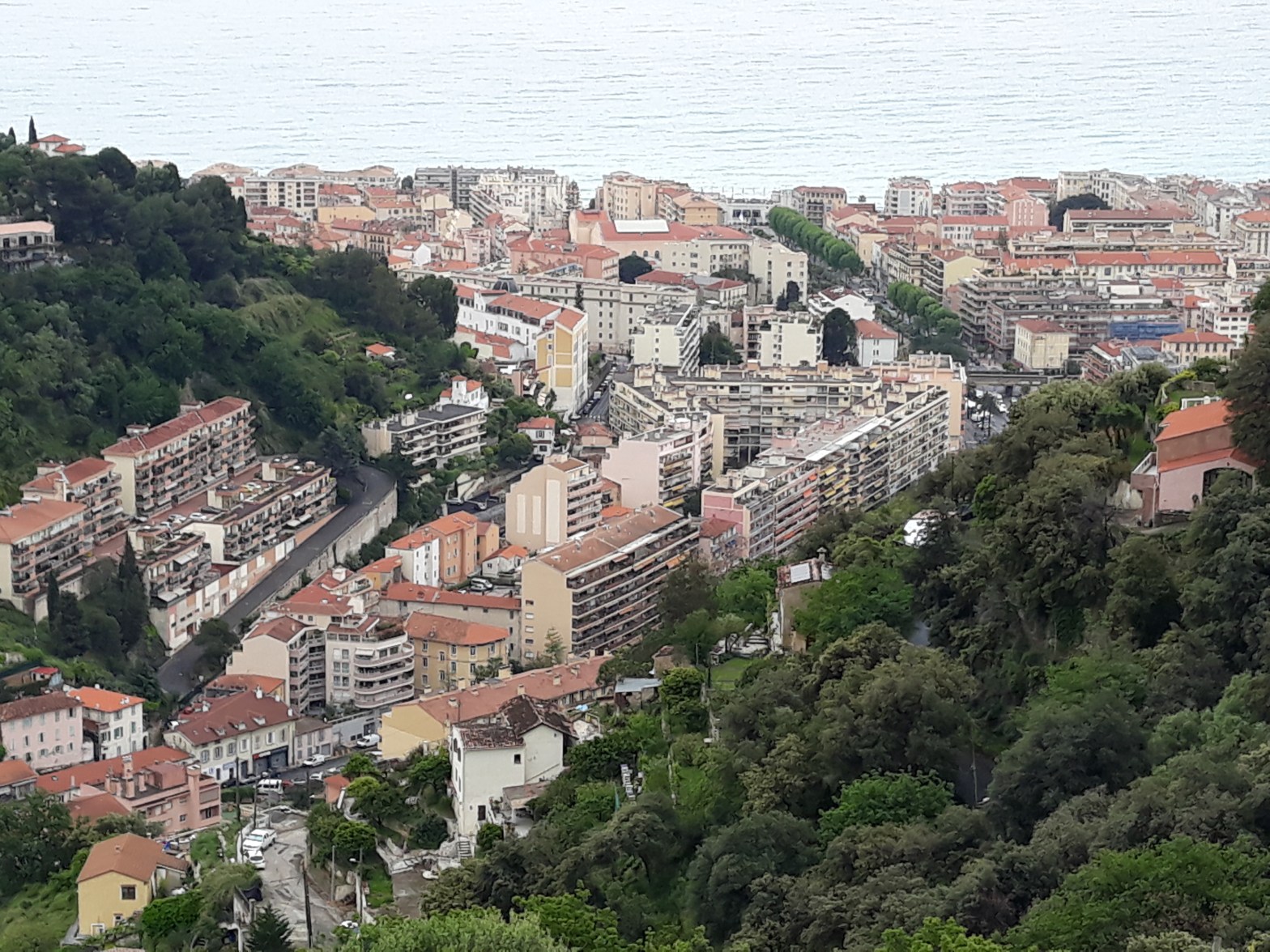
While working on my short story and reading the Heller book, I’ve been reflecting on my sense of place in Nice, where David and I have had a second home for nearly 14 years. At one time, Nice was our escape from British winters. Now, it has become an escape from British life post-Brexit. As it has also become a place to spend more of my retirement (if writers every really retire), we’re looking for a larger apartment, a quieter city and a location closer to Italy for weekend jaunts. And thus, we’re apartment shopping in Menton. I trust that once we have left Nice, it, like India, will be a place I can write about from the vantage point of memories. Having said that, I’m reminded of a quote attributed to Benjamin Disraeli: ‘Like all great travellers, I have seen more than I remember and remember more than I have seen.’