Last month The Nerve published an extract from Luke Harding’s new book Betrayal, a study of world politics in these unsettled times. The extract focused on the UK’s Reform Party and its connections to the Russian government – including the ways Reform helped the Kremlin’s efforts to discourage the EU from accepting Ukraine as a member. It’s a dense, complex web of a story, but rather than unpack all of it, allow me to linger on one line about Oleh Voloshyn, a pro‑Kremlin Ukrainian diplomat and journalist:
‘The speeches were chameleonic. Voloshyn used the language of human rights and European values to advance anti-democratic, imperial Russian objectives.’
Chameleonic describes a large subset of language used by the far right these days. Following a recent case of sexual assault committed by an asylum seeker in Britain, anti-immigration messaging has claimed that migrants have to be kept out of the country in order to ‘protect women and girls.’ This phrase is used by feminists and politicians against sex-based violence, trafficking and exploitation. While those who are genuinely concerned about the welfare of women and girls don’t fall for this linguistic hijacking, many others do – and that’s precisely the point.
The same linguistic sleight of hand appears in the rhetoric of US Vice President JD Vance and other members of the MAGA government, who claim progressives are stripping people of their freedoms, especially freedom of speech. This agenda stealing from liberals comes from an administration that routinely trolls and intimidates news organisations, arrests reporters and pursues legal action against critics.
Last week, I stumbled across another example of Orwellian language manipulation with the word identitarian. Here I’m translating from the Italian. Roberto Vannacci, the leader of Italy’s newest extreme right party, Futuro Nazionale, describes himself as ‘an identitarian, rooted in Roman and Christian tradition.’ It’s a neat rhetorical trick – identity framed as heritage, tradition, civilisation. Anything else – especially the identity politics of the woke (yes, the term has migrated into Italian) – is cast as false and deserving of ridicule. Beneath the varnish lies the party’s nationalistic, Eurosceptic strain of neo‑fascism.
Which brings me to the US president’s habit of stamping his own identity onto buildings, institutions and even unassuming waterways like the Gulf of Mexico and Lake Ontario. Some identity politics, it seems, are permissible – provided they are his.
These are just drops in the cesspool of contemporary propaganda.
What I’ve been reading
In 2011 Penguin marked the 50th anniversary of its Modern Classics series by releasing fifty slim volumes of short fiction. Among them was Italo Calvino’s The Queen’s Necklace, paired with “The Workshop Hen.” Having read Calvino in Italian, I can say Tim Parks’s translation preserves the dry, ironic humour that makes Calvino’s stories so distinctive and memorable.
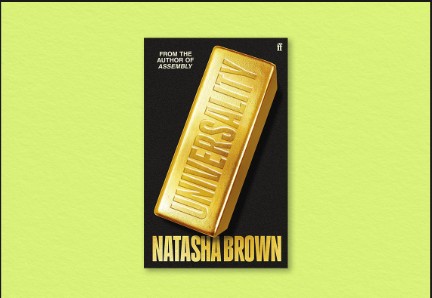
For something more openly funny, Natasha Brown’s Universality is one of the cleverest novels I’ve read recently. Its plotlines and character portraits form a satirical microcosm of our age of upheaval and the self‑promoting public discourse that shadows it. The story centres on Jake, a resident of a commune called the Universalist, who hosts an illegal rave and ends up in a brutal fight, bludgeoning the commune’s leader with a gold bar. The aftermath unfolds through multiple narrative perspectives – among them is Richard, owner of the gold bar; Hannah, a journalist investigating the incident; and Lenny, Jake’s anti‑woke provocateur mother. In fiction, the chameleonic language and hypocrisy are easy to digest. In life, they’re hard to escape.