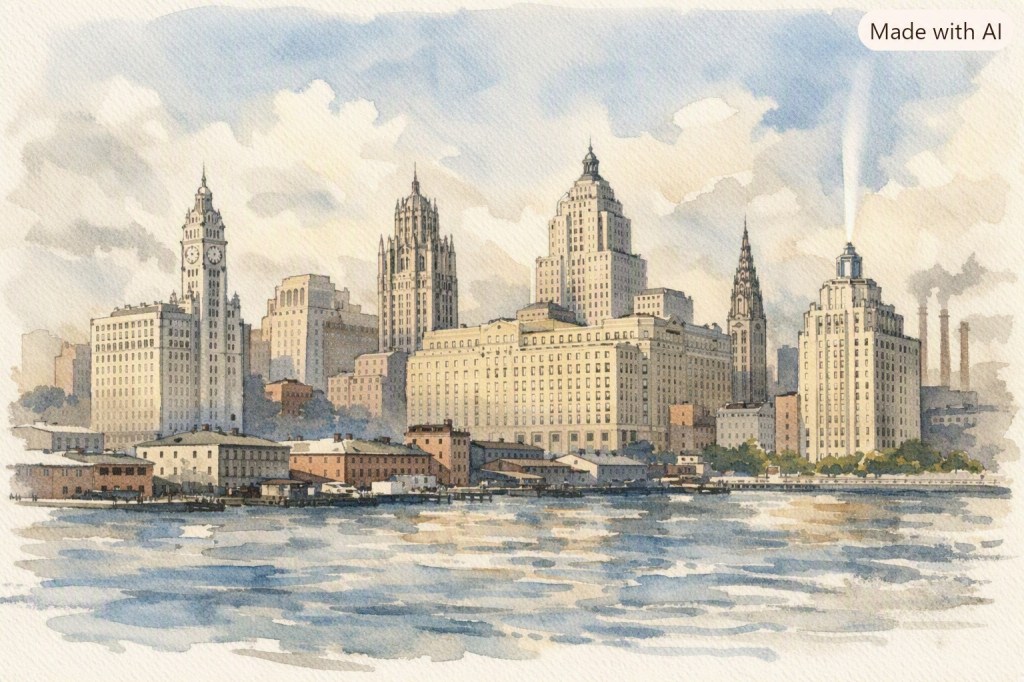
To read previous vignettes from this fictional series, visit Bunny’s Vignettes.
The Cocktail Party – 1971
My grandmother wiped down the ebony coffee table with spray polish one last time, knowing the slightest smudge would catch Millie’s attention, and a prompt jokey remark would follow. Grandma could never be the butt of jokes.
Her living room looked like a Hollywood set from a Rogers and Astaire film – glamourous white stuffed sofa and chairs blended into the soft beige wall-to-wall carpeting, a crystal chandelier dangling from the ceiling, end-table lamps with squared shades in an Art Deco style. The paintings were mostly impressionist reproductions – a Monet and a Manet and two Cezanne’s – along with a watercolour my mother painted in her youth of the Lake Michigan coastline from our Chicago neighbourhood.
A half-lit cigarette in her hand, my grandmother walked the long corridor back to the kitchen where the radio was still playing the Saturday afternoon opera live from the Met. Like the living room, the kitchen was nearly all white except for a couple of hand towels and matching oven gloves with a sunflower motif. That morning, she had placed four stemmed cocktail glasses on the table to reclean and buff the water stains off the way bartenders do. Everything needed to be perfect for the girls.
In a large pitcher, Grandma measured out five shots of vodka – no, make that six. Elsa had complained last time that the martinis were a bit weak. She added tonic water and a shot of vermouth. Picking up one of the stem glasses, she poured in a thimble-sized portion of vermouth and swirled it around, barely coating the surface. This would be Rosalin’s, which she would fill with cherry Kool-Aid, calling it a Shirley Temple and adding what she always said, ‘In just a few more years, you can have the real stuff.’
She took a last long drag of her cigarette and crushed the lipstick-stained butt into a crystal ashtray.
The glasses full, she added a green olive on a plastic stick to each. A plate with some twenty more olives was placed on the serving tray along with a porcelain tube of beef jerky sticks, a bowl of mini pretzels and another of salted peanuts. As she stepped along the corridor, she glanced admiringly at herself in the mirror – svelte in her yellow stilettos. That day she wore a floral dress that cinched tight in the waist and flared out like something Grace Kelly wore in Rear Window.
She positioned the snacks and drinks on the coffee table so that Millie and Rosalin, mother and daughter, would sit together on the sofa. Elsa and my grandmother, the two sisters, would have armchairs for themselves.
A firm knock on the door startled her.
That was me. The scene I’ve just described is from my imagination. I wasn’t really there yet, but I knew it went something like that based on what my brother had told me.
With that thick carpet, I couldn’t hear her walking towards the door, but I felt her there with an ear pressed against it, hoping I would go away. So, I knocked harder the second time. The door flew open.
‘I’m not deaf you know!’
A wave of tobacco smoke mingled with Yardley perfume hit me head on.
‘Hi, grandma.’ I was all smiles, which I knew bothered her.
‘It’s the rat. I should have known.’ There was the usual sharpness in her voice when she saw me alone. Though it wasn’t always that way. When I was much smaller, I was her little hamster. Even after I started to call myself Bunny, I was still her hamster. Somehow by the age of nine, I had become a rat.
I held out the October issue of Better Homes and Gardens with its glossy cover of autumnal colours and a perfectly smiling woman at its centre. ‘I’m returning this. Mom said that she copied out the recipe already.’
She squinted her eyes. ‘And you had to return it today, huh?’
That was the only time I heard her acknowledge what my mother called ‘one of Grandma’s sad days’ – the 22nd of February, the 15th of May and the 10th of October – ‘best to leave her alone.’ I just shrugged and glanced past her into the living room. ‘Are you expecting someone today, grandma?’
‘None of your beeswax,’ she snapped, grabbing the magazine. ‘Thank you for this. Goodbye.’
The door slammed shut before I could utter another word.
Earlier that year Brian had to go to our grandmother’s apartment on one of those sad days because she had blown a fuse. She hated anything to do with electricity. He was seventeen at the time and already quite handy with electrical things. He pretended he hadn’t seen the set up in the living room but reported it to me and my sisters. That was the anniversary of Elsa’s death – Grandma’s sister, who had died of tuberculosis in the 1920s. February 22 was when Cousin Millie died in a car crash. That day, the 10th of October 1971, when I returned the magazine, marked Rosalin’s death. According to our mother, Rosalin had died suddenly, mysteriously at the age of fourteen.
After I told my siblings what I had seen in Grandma’s living room, little Tina looking perplexed asked, ‘What happened to the booze?’
Brian struggled to control his laughter. ‘The ghosts drank it, silly!’
Tina’s eyes and mouth opened wide – the expression she wore for much of her childhood, perpetually frightened or amazed by something.
The following day, I was reprimanded by my mother for ‘spying on Grandma and frightening your little sister.’
‘But I wasn’t spying – and I didn’t scare Tina, Brian did!’
‘Not according to Tina and Franny.’ My mother crossed her arms and waited for a response. She tried to look stern, but her rounded face and pillowy arms would defeat her at moments like this.
I stood motionless, trying to figure out why my sisters lied and why my mother believed them without question. I didn’t trust Brian to admit it. I knew if I said the truth again, it would still sound unbelievable. If I pressed the issue, all three siblings would dislike me more than they already did. A change of topic was needed.
‘I don’t understand why Grandma pretends to have company when…’
‘Enough.’ My mother uncrossed her arms and softened her tone. ‘She’s a Capricorn – that’s why.’
‘Huh?’
‘You’ll understand when you’re older.’
I often thought it strange how my grandmother didn’t have one of her sad days on the anniversary of her husband’s death. But I knew better than to ask about it.