Standing Up to Racism and Fascism

Is it a multi-circled Venn diagram or a spider-gram that will best illustrate the connections between Nigel Farage, Steve Bannon, Geert Wilders, Belgium’s racist-right politician Filip Dewinter, current UKIP leader Gerard Batten, Donald Trump and British Nazi Tommy Robinson? It would be too easy to draw circles and lines around the racist and fascist ideas these political figures have come to represent. What also connects these men is far more disturbing. They have all publically endorsed at least two of the names on this list and in doing so have helped to spread each other’s popularity and toxic beliefs. They’ve succeeded in making the hate-filled lone wolves across the West feel and act as members of an international pack.

This wider picture makes a lot of us feel out of control and helpless. Of course, we can always find like-minded people amongst our friends, co-workers and fellow liberal activists. We can choose to read the newspapers and follow on social media those who share our anger and disgust. These things might take the edge off, but it wasn’t until this past Saturday that I found a more satisfying way of confronting this barbarism – by yelling at it.

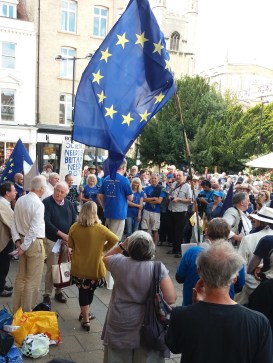
On a hot Saturday afternoon in Cambridge, a couple thousand protesters gathered to rally and march against another march planned by a group of Tommy Robinson supporters. For my international readers, Robinson is a former leader of the far-right English Defence League who is currently in prison for contempt of court. His supporters, including Steve Bannon, Nigel Farage, Geert Wilders and Gerard Batten, want him released from prison on grounds of freedom of speech. (See what I mean about Venn Diagrams.)

A small group (perhaps 200) of Robinson’s lesser known supporters appeared at the march in Cambridge. We easily out-numbered them – which is intensely empowering.  Unlike Trump’s visit to the UK earlier that week, these racists/fascists were within earshot and I felt justified in participating. Will our screamed chants of ‘Nazi scum off our streets’ change the minds of these fascists? Of course, not. Will they think twice before they return to Cambridge for another march? Maybe. Just maybe.  And that’s worth holding on to. Aside from the obvious therapeutic effects of yelling at these racist/fascists characters, I’d like to think these groups lose some of their influence and power to directly offend each time they’re pushed away.

National Democracy Week 2018

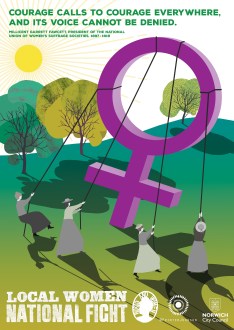
It was last week. Yes, I missed it too. If it weren’t for an email I received with a couple of suffragette posters, I wouldn’t have known about it at all.

This inaugural week to pay tribute to democracy in Britain ran from the 2nd to the 8th of July. The date was chosen to mark the 90th anniversary of the 1928 Equal Franchise Act, which gave women the same voting rights as men. Women had gained the right to vote here ten years earlier, but that right was limited to women over the age of 30 who had property – in case you were wondering why we’ve been celebrating in recent months the centenary of women getting the right to vote.

I received my posters to celebrate democracy a few days before the start of the week. Vaguely curious, I put them aside, expecting to hear more about it through the media. But I saw nothing on it when I watched BBC or Channel 4. In the UK newspapers I typically read – The Guardian, The Observer, The Independent, The Times, The New European – there were no reports or commentaries to do with National Democracy Week. Without some sort of reminder and with too many other things clambering for space in my head, I easily forgot about it.

I do wonder if the lack of fanfare or even interest in National Democracy Week had anything to do with what was going on last week. England winning a place in the World Cup semi-finals and the rescue operation for the Thai boys and their football coach trapped in a cave dominated our casual news talk – and they have nothing to do with democracy. In the middle of the week, democracy appeared in the form of freedom of speech when London Mayor Sadiq Khan gave permission to anti-Trump protesters to launch an angry baby Trump balloon during the US president’s visit. Whether such permission should be allowed is still being debated as I write. The week ended with our PM presenting her Brexit proposal to her cabinet ministers at a secluded day retreat at Chequers. This involved an elite group within a minority government agreeing to a proposal that they know will likely be rejected by the EU. To make this exercise in democracy even more futile, two days after agreeing to support the PM, two of the ministers resigned in disagreement.

Perhaps National Democracy Week decided it was best to keep a low profile.

National Democray Week 2
This and the featured image are the posters designed by Vicki Johnson.

Having realised that the celebrations had passed me by, I went to the government website to see what I missed. I clicked on ‘events’ and was sent to another webpage, where I could click on ‘events’ to find events in my area. That brought me back to the first page where I had clicked on ‘events.’ I was in a loop. What an appropriate analogy for our modern democracy. It appears I’ve participated after all.

To Protest or Not To Protest

To quote Albert Einstein, ‘If I remain silent, I am guilty of complicity.’

President Tr**p arrives in Britain on Friday the 13th of July. (Supposedly – he could cancel at any minute.) When I first heard about this visit some two months ago, my gut instinct was to appear outside Downing Street with a placard saying ‘Women of the World Against Trump.’ This sign would sum up a number of issues ranging from ‘grabbing pussy’ to cutting off overseas aid for women’s health.

But two months is a long time in the hate-filled-mud-slinging world of this US president. Since the announcement of Tr**p’s upcoming visit, the US has pulled out of the Iran nuclear deal, the US Embassy has moved to Jerusalem (unravelling decades of diplomacy), some 2000 migrant children have been separated from their parents and put into detention centres, without tougher gun laws another 25 mass shootings occurred in America (including one yesterday at a newspaper in Maryland – hard to separate this from the anti-media atmosphere of this president), and now his Muslim travel ban has been given the go ahead. While all of this is going on, a slew of environmental protection laws are being axed. There’s simply too much to protest against and not enough placards to go around.

On the other hand, I wonder if I should show up at all. POTUS seems to thrive on attention, positive and negative. Since most of what he does is deserving of a negative response, I fear that giving him attention is going to produce more of the same. That is, we need child psychology for dealing with this man-child.

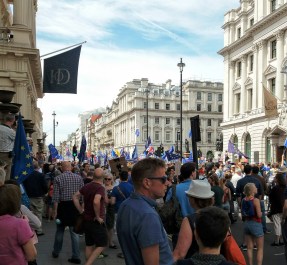
I also wonder about the power of protests. That sounds like a contradiction coming from me. Yes, of course, I was in London Saturday among the 100,000 plus anti-Brexit protesters demanding a people’s vote of the final Brexit deal. And it was a success. Our protest was the lead story on most of the news programmes that night and on the front covers of most of the newspapers Sunday morning. The initial analysis from the political pundits is that this protest sent a message to the minority of hard Brexiters in government and possibly the inert Jeremy Corbyn, along with jump starting some of those remainers who have given up the fight. That’s all fine and good.

protests against trump 2.jpg
People’s Vote march 23 June 2018.

A protest against Tr**p is another matter. It’s likely to be on the news, but what kind of message is it going to send? There’s no single solid message or legalisation coming up (as in the case of Brexit) to be impacted or potential votes to be lost by protesting against him.  Tr**p has secured his Alt-Right base, held on to reluctant Republican support with tax cuts and corporate welfare and normalised his hateful and child-like rhetoric through saturation.

Returning to Einstein, I refuse to remain silent. But I think there are more effective ways than another street protest for confronting Tr**p and all his nastiness. From this side of the Atlantic, petitioning and writing to our own governments to stand up to this US president on particular issues is a start. So too is supporting the many NGOs, such as Amnesty International and NRDC (Natural Resources Defence Council), whose organised lobbies and legal teams have a fighting chance. With these ideas in mind, this time, I’m staying at home with my cardboard and placard stick.

A Couple of Books About Tr**p

Now that the buzz around Michael Wolff’s Fire and Fury is starting to fade – being side-lined by the Commander-in Chief’s latest verbal tantrum – I’m taking a step back and looking at a couple of recent books about the most shambolic US presidency in living memory.

Based on reading excerpts of Wolff’s book in the press and skimming and reading sections from the online-bootlegged copy that’s floating around, I can say that there were few surprises. White House pundits have been reporting for months on the president’s eating habits, idiosyncrasies, aversion to books, toddler-like attention span and lapsing memory. The power in this book rests not so much in its confirmation that this president is unfit for office – the world is witnessing this in a near-daily basis – but in the quotes from Steve Bannon. Trump’s former Chief Strategist, involved in both the presidential campaign and the early months of the presidency, describes Trump’s campaign as having a ‘treasonous’ meeting with Russian officials. This is significant. The FBI’s Russian investigation is moving closer to Trump while at the same time looking into the White House cover up, culminating in the firing of FBI Director James Comey. The FBI Director’s dismissal is also described by Bannon as a concerted effort to ‘get him’ led by Jared Kushner. These are serious allegations that could be part of Trump’s undoing if the Republicans lose their majority in Congress after the 2018 mid-term elections. (The other part might come from the international community.)fire and fury

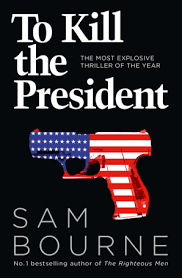
Having said all of that, the better book of recent months on the subject of Trump is the one that doesn’t even mention him by name. Sam Bourne’s fictional account of how Washington insiders cope with a narcissistic, racist and misogynistic US president is by far more interesting and informative. To Kill The President might be fictional, but it relies on knowing the workings of the US government and its laws. The premise is a simple one and one that has been in many of our imaginations for over a year now – what if the US president is insulted by North Korea leader and decides to teach him a lesson by ordering a nuclear attack? In this story he’s stopped for the time being by White House staff and Pentagon officials who trick him into thinking the North Koreans have apologised. Given that, legally speaking, the president could order such an attack without congressional approval, this event triggers concerns about the president’s mental instability. Once it’s realised that getting rid of the president based on mental health is constitutionally difficult to pull off, an assassination is planned. The story uses all of the plot twists and devices that one would expect of a thriller – a murder, a cover-up, secret codes and blackmail. Like a popular thriller, the writing is straight forward and not the stuff of literary fiction. But it’s nonetheless enjoyable for its satirical humour that edges close to the reality we find ourselves in during the era of Trump.

Bourne’s book is full of many quotable remarks from these insider characters.  I’ll close with this one, which comes from Mac, the president’s Chief Strategist and staunch ally (a fictional Bannon perhaps):

These liberals soiling their Depends undergarments about truth. They never stop! Always going on about facts and evidence and all of that shit, even when they have the biggest possible dataset showing them – proving to them – that the American people do not give a rat’s ass about any of it.

The ‘dataset’ that he refers to is the election – the votes that won the presidency.

A flying visit to Le Petit Prince

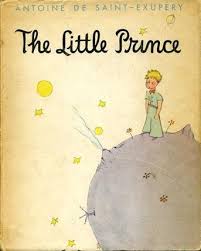
The first time I read The Little Prince I was twelve and naturally read it in English. This was when pop psychology ruled my thinking, and I saw the book as a fictionalised dialogue between the author, Antoine de Saint-Exupery, and his inner child.  I recently reread this novella, this time in French, which gave it a different flavour in my mind – more intellectual and whimsical at the same time. With this reading, I’m more struck by what it says about human nature in broader political contexts than with the personal and psychological. From here it was easy to see how it reflects the age we’re living in now.

Early in the story, the little prince asks a stranded aviator to draw him a sheep. After a couple of awkward attempts, the aviator draws a picture of a box with some holes in it and tells the prince the sheep is in the box. The prince accepts this and their friendship is cemented. In the present day, I’ll call this image the current British government, who received the picture of the box from the Leave campaign. I don’t think I need to explain this metaphor in any great detail. Any sensible person knows that the box is filled with the likes of a well-funded NHS, a robust economy and a lucrative trade deal with the remaining EU. The air holes are there to make this world seem real, a place where people live and breathe.

Another passage reflects pertinently in our age of the internet. The little prince climbs up to the top of a mountain and calls out to see if anyone is there. All he gets is an echo, which he mistakes for conversation.

The story also has plenty of characters suited for today’s headlines – an illogical king who claims he controls the movement of the starts, a vain man who craves attention, but whose vanity keeps him isolated, and a geographer who draws maps, but never leaves his own desk to experience the world he has helped to construct. I don’t think I need to mention the true life characters by name.

I’ve met people who reread Le Petit Prince every few years or once a decade. I don’t think I’ll join either of those clubs. Having read it once as a child going through puberty and now in my middle-age, my next appointment with this book could be in my very-old age. Who knows what metaphors, insights, ideas this little literary gem will conjure up then.

Petit Prince 2

Brexit, Trump and W.B. Yeats

Yeats’ ‘The Second Coming’ has had a revival over the past year or so. With reactions to Brexit and Trump, the poem was quoted more in 2016 than in the total of the previous 30 years. (Wall Street Journal and Factiva).


Now here we are in 2017. So far, Brexit has unleashed a rise in hate crimes, economic uncertainty and feelings of general incomprehension in the UK as ‘things fall apart’ and as we watch as ‘the centre cannot hold.’ In Trump’s America, a ‘blood-dimmed tide’ is both present and inevitable as mass shootings are condoned and conflicts overseas are rekindled with heated rhetoric.

But what is to come of all of this? I revisit the poem:

The Second Coming

Turning and turning in the widening gyre
The falcon cannot hear the falconer;
Things fall apart; the centre cannot hold;
Mere anarchy is loosed upon the world,
The blood-dimmed tide is loosed, and everywhere
The ceremony of innocence is drowned;
The best lack all conviction, while the worst
Are full of passionate intensity.

Surely some revelation is at hand;
Surely the Second Coming is at hand.
The Second Coming! Hardly are those words out
When a vast image out of Spiritus Mundi
Troubles my sight: a waste of desert sand;
A shape with lion body and the head of a man,
A gaze blank and pitiless as the sun,
Is moving its slow thighs, while all about it
Wind shadows of the indignant desert birds.

The darkness drops again but now I know
That twenty centuries of stony sleep
Were vexed to nightmare by a rocking cradle,
And what rough beast, its hour come round at last,
Slouches towards Bethlehem to be born?

Written in 1919, soon after the First World War and the Russian Revolution, this work reacts to the horrors and violence of such conflicts. More importantly, it expresses apprehension over what is to come. Over the years, many have seen this poem as an accurate premonition of a second coming in the form of an anti-Christ – Adolph Hitler. As has been pointed out by many in the press, the present day holds startling parallels to pre-War Germany, with the rise of nationalistic propaganda and untruths capable of seducing millions.

Yet, I feel the need to put this into perspective. Others have alluded to this poem over the years. Joan Didion’s collection of essays Slouching Towards Bethlehem, Chinua Achebe’s Things Fall Apart and Joni Mitchell’s song ‘Night Ride Home’ are among the many works to keep this poem alive. These works were written long before Brexit and Trump and each with their own political concerns and fears at their time.  Seen collectively like this, I do wonder if the recent malaise – the far-right, the hate crimes, the nationalistic fervour – are all part of a tide that will inevitably ebb back to something perhaps different, but manageable, less worrying.

Yet, the recent surge in quoting from ‘The Second Coming’ is still significant in itself. Most of these allusions can be found in the press, where the educated, the so-called ‘urban elite,’ dwell. As recent investigative reporting and British and American government enquiries are starting to show, it was the elite class of billionaires who indirectly funded both Brexit and Trump’s presidential campaigns. Both employed social media, which spread into mainstream media, to disseminate their propaganda and untruths. The response to this has come, during these campaigns and even more now, from the true masses – the urban and educated. We are the ones seeking to understand what is going on, turning to Yeats en masse. In our bewilderment and fear, we ask if what we have witnessed is a sign of the ‘rough beast, its hour come round at last.’

Fire, fury and Trumpspeak

I’m not calling it language – that would give it too much dignity. As a linguist I’ve been intrigued by the utterances of the current US President. Of course, they wouldn’t be so interesting if they came out of the mouth or the tweet of a teenage boy. I haven’t written about this topic sooner because, not only have satirists done much of the job for me, but I was secretly hoping it would all go away – Trump’s presidency would be so brief, a glitch in the history of US democracy, weird, amusing, at times angering, but a mere footnote in popular culture.

Stripped to its bones, language is about communication. But with Trump, he isn’t communicating as much as he is posing. He has positioned himself as a racist, a sexist, no-nonsense tough guy, but one who is a victim of witch hunts at the same time. What he says – or tweets – is often so lacking in substance that it is more slogan than idea. And then there’s the hyperbole. In Trumpspeak, his proposals are the greatest, the most, the best, the largest. Trump has also completely ruined the word very for me. Okay, very isn’t much of a word anyhow.  It’s one of these thin adverbials used to plump up an even thinner adjective.

He now seems to be posing as a comic book villain with his claims that if North Korea continues their threats – just threats, not military action – “They will be met with fire and fury like the world has never seen … he has been very threatening beyond a normal state. They will be met with fire, fury and frankly power the likes of which this world has never seen before.”

The world is understandably concerned as Trump seems to be saying that he is ready with a pre-emptive strike if these threats continue. He is fitting the persona of the thin-skinned villain who you dare not call chubby or bald. And like the two-dimensional villain, he uses a formal diction – ‘the likes of which.’ This is from someone who has referred to the complicated Russian interference in the US election and more broadly in cyberspace as ‘the Russian thing.’ Trump also, as he does so often, repeat himself, as if the repetition makes the point stronger. Though it is obvious to most of us, this penchant for repetition is likely to come from an inability to understand, let alone articulate the situation this accidental president finds himself in.

The words ‘fire and fury,’ for what we can assume means some sort of military action, are tired metaphors. If Trump were a reader, I’d suspect this came from the Bible or from Shakespeare. My guess is that Trump’s source is more likely the film version of the comic book villain. That’s also where the hyperbole comes from as Trump’s actions will be something the world has never seen before.

While Trump uses words to grandstand or to act out a character, the rest of the world thinks he’s trying to communicate something. As Hillary Clinton said to Trump during one of the debates, as her opponent was being flippant about something he had said, ‘Words matter, Donald.’ He still hasn’t understood that message.

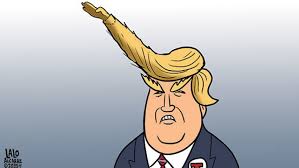
There is a silver lining though. We saw this week how Trump was reluctant to criticise white supremacists for their violence against anti-racism protesters in Charlottesville, Virginia, resulting in the death of a young woman. After public pressure and attacks from influential politicians, Trump finally condemned racism, pointing the finger at the KKK and neo-Nazis. This was delivered at a press conference atrump cartoon 2nd not via Twitter or during a staged rally of his supporters. The statement was obviously written for him – not his usual hyperbolic words, repetition and vague slogans. He was clearly uncomfortable reading the teleprompter. And that’s the good news – behind the scenes, there are people trying to control him and limit the damage. Sometimes he has to answer to them. This could be America’s and the world’s best hope against a man’s whose tendency to ride roughshod with the English language could lead to catastrophe.
Still Fighting

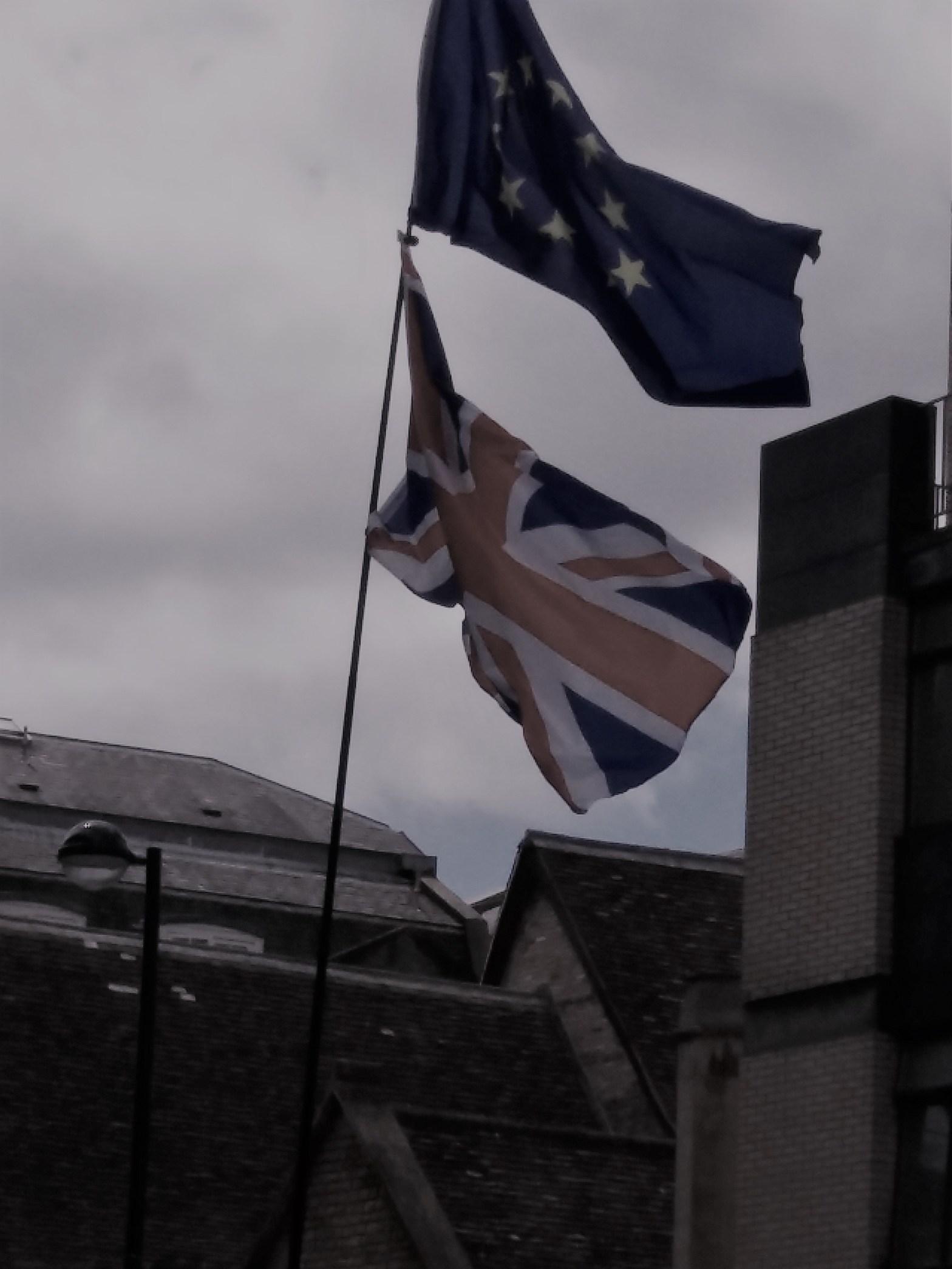
It’s easy to give up on politics and politicians. In a sense, that’s what has already happened. Around this time last year, many people in Britain, fed up with austerity measures and unemployment, decided not to engage in politics. They didn’t listen to cogent arguments or evidence. Instead they joined a movement of emotions and voted to leave the EU. Likewise, in America people, fed up with grid-locked legislation and the paralysis of their personal finances, also decided not to engage in politics. They either joined a similar movement of emotions or they didn’t vote at all. The result, as we all know, was Trump. I don’t mean to oversimplify these events – we all know that racism and sexism play their parts as well.

As a consequence of these electoral debacles, many people have been energised into political action. Online protests, petitions, marches, rallies and media-generated debates have erupted on a scale not experienced in my lifetime. But now the wind seems to be changing. Following the recent UK General Election, where a hard-Brexit government lost its majority, there is talk from politicians and in the media of a much toned-down Brexit, possibly keeping the UK in the single market and/or the customs union (among other things).

I went to a Pro-EU rally this past weekend, marking the one-year anniversary of the vote to leave the EU. It pains me to report that this rally was poorly attended.  Maybe some 300 people were there.  I wonder if this slight change in the air, this post-election awareness, has made people complacent. Do they believe that it will all work out for the best? That a hard Brexit or the economic downturn from any type of Brexit will never happen?  If they aren’t complacent in their thoughts, perhaps people were suffering from a bit of protest-march fatigue or were simply enjoying the beautiful weather that sunny Saturday afternoon.Cambridge 2nd march 1.jpg

As for me, I’m still in the fight. For those out there who don’t know me, on a personal level I don’t have much of a fighting spirit. I’ll argue to a point, but as soon as I realise that I’m overpowered or that my opposition is mentally/psychologically ill, I back off. I realise that there is no point wasting energy or keeping myself in a victim position. Of course, it’s easy to feel overpowered by political movements and governments. But then I remind myself that I’m empowered as a taxpayer and a voter and that participating in protests is a step out of the victim position. Wasting energy? I don’t think so. But I have to admit that it can be tiring. The opposition knows this too. I think it’s important that they (the Brexit and Trump supporters) do not wear us down.


In my echo chamber

If I’ve learned one thing from the Brexit vote and the ascent of Trump, it’s that inside social media I live in my own echo chamber. Both events took me by surprise. While the mainstream media showed support from all sides in these contests, in Facebook and Twitter, I was seeing overwhelming support for remaining in the EU and strong arguments and jokes against Trump – though divided between supporting Saunders and Clinton.

Of course, in Facebook my ‘friends’ are mostly my former students and colleagues, fellow writers and a few friends who really are friends, in the sense of the word before Facebook. It is no surprise that educated and liberal would define this select group. On top of that, my Facebook interactions have been infiltrated by Mark Zuckerberg’s algorithms, sending me postings from people and organisations which are not my friends, but are clearly like-minded – but sadly, not always accurate – I’ve stopped waiting for the ‘child-rape’ charges to be pressed against Trump.

Twitter is another matter. I started my Twitter account when I was still working in academia fulltime and used it as a way of furthering my own research. As a writer, I also follow other writers, certain publishing houses and publications, etc. In other words, I’ve been following loads of people I don’t know personally. Yet, many of these strangers were touting the same views as I was when it came to the Brexit and Trump. We retweet and like each other’s tweets. It could be argued that these people were indirectly hand-picked because they were likely to share the same views – after all, they’re academics or in creative fields.

Since the Brexit vote, in order to keep sane and to participate in the fight against a hard Brexit, I have deliberately started following political organisations, e.g. the Lib-Dems and Open Britain, for the latest news and information on protest marches and petitions. Hence, reinforcing the walls of my online echo chamber.

Offline, while my choice of friends keeps me contently among the like-minded, I also find myself in situations with people who are my political polar-opposites. In Nice, for instance, the expat community sometimes has me face-to-face with regular readers of The Daily Telegraph, which openly backed Brexit. Such encounters challenge me to show up prepared with statistics and references. I do my best, though probably to little or no effect.

At least with Trump’s win my online and offline worlds are not so different. I have not had to come face-to-face with any Trump supporter – I don’t know what I would say to one if I did. It would be like confronting someone who has joined a cult – they have chosen to believe the unbelievable and they are clearly nurturing a need that places them beyond reason.

Yet, my offline world – and my online world outside of social media – with news programmes and newspapers, keep me informed about what others are thinking – the polemics of the debates. The walls of my echo chamber might be strong, but they do have windows.