Lemons and Oranges: Coping, or not, with the new world order

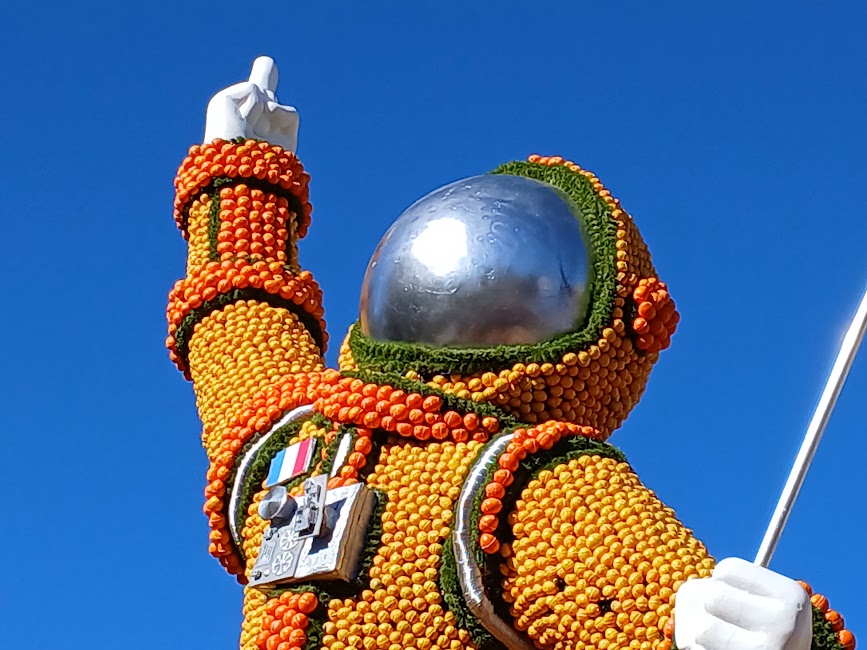
The nursery rhyme goes ‘Oranges and lemons, say the bells of St Clements.’ But in Menton, France, lemons come first. With the annual lemon festival kicking off last weekend, the city’s central garden is decorated with large figures made of lemons and oranges. This year’s theme is outer space, featuring an astronaut (French, of course), spaceships and aliens while lively parades bring traffic to a halt.

I’m aware that I’m enjoying this traditional fete more this year than in previous years. I don’t think this has anything to do with rockets, space beings and sparkling dancers. This has been about partaking in a tradition and allowing myself to be entertained, passive and receptive. I wonder if this is escapism, pretending that life goes on as normal despite what is happening in America, despite the consequences that have us here in Europe shaken and nervously waiting for the next move by our world leaders.

On the one hand, I’m buying into normalcy bias. Carole Cadwalladr explains in her blog what this means: ‘There is an inability to process, accept and confront the dangerous new reality we are in and to focus on the big picture and the pivot of history that’s occurred in the last two weeks.’ She was criticising the New York Times for not reporting on the coup of the tech billionaires that has taken over the White House. She has a point. Cadwalladr’s conclusion offers some hope: ‘It’s a coup. And the international order is collapsing. We aren’t helpless but we need to cycle through the denial part to get to the bit where we start fighting back and take immediate steps to protect ourselves.’

My other hand is not in denial and is all too aware of the history-making events of the past ten days. While the streets of Menton were filled with tourists and shops promoting all things lemon, the US president was slinging cruel and falsely based insults at Volodymyr Zelenski that sounded like they were written by Putin and full of warped narratives. Worse still, this current US government is engaged in so-called ‘peace talks’ where neither the Ukrainians nor the EU have been invited. (This reminds me of the adage that I heard again this week – if you’re not at the table, your on the menu.) Such actions shift the balance of power, making more fragile the international organisations set up to protect democracies and their citizens. This is where another bias comes in – recency bias, where we tend to think of recent events as being far worse than anything in the past. I’m clearly experiencing this and wondering if we are on the brink of WWIII, coupled with financial collapse resulting from trumpanomics.

I’ve run out of hands to refer to, and so, I’m back to contemplating citrus fruit and festivals to get  through the winter months, traditions that go back to medieval times as we are living in a world not too different. If I put both hands together, I can pray.

What I’ve been reading

As The New Yorker is celebrating its centenary, I renewed by subscription – for a while at least. Every few years I take advantage of some special offer and subscribe for three to six months. This 100th anniversary edition is a real treat. For me, the highlights have been two brilliant essays and a surprising poem. Tara Westover, author of Educated – a powerful memoir about growing up in a deeply religious and anti-education family – writes on being estranged from her parents and how a friend tried to lend her his mother. Being estranged from most of my dysfunctional family, I can identify with Westover’s need to feel connected despite all that has happened and despite the patent benefits of estrangement. The other essay appealed to my science nerdiness. Dhruv Khullar provides a sobering account of why it’s going to be difficult, if not impossible, for humans to live on any planet or space station outside the earth’s orbit – basically, it will make us ill. Really ill.

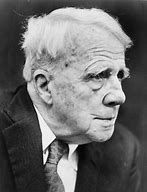
The poem comes from Robert Frost and is surprisingly not a reprint from a New Yorker of decades ago. This is from a recent discovery of an unpublished poem entitled ‘Nothing New.’ It has been authenticated by scholars, including Jay Parini, who writing for The New Yorker, puts the poem into the context of other works by Frost. Parini comments that ‘Frost’s unique gift was to write poems that burn a hole in your brain. You never forget his best lines. They stick with you—and they change your life.’  So true. I still remember lines from Frost that I learned in primary school.

Hence, I’ll conclude with reprinting the poem here. I’m sure other Frost fans and societies have already posted this all over social media, and well they should, especially in times like these, wintery in both season and perspective.

Nothing New

(Amherst 1918)

One moment when the dust to-day

Against my face was turned to spray,

I dreamed the winter dream again

I dreamed when I was young at play,

Yet strangely not more sad than then—

Nothing new—

Though I am further upon my way

The same dream again.

—Robert Frost (1874-1963)

Inauguration Poetry

Agreed, Amanda Gorman’s reading of her poem was the highpoint of the Biden/Harris inauguration. ‘The Hill We Climb’ is clearly inspirational, a poetic version of a political speech that like Biden’s inaugural address identified the malaise America finds itself in while not shaming by naming the last occupant of the White House. Gorman’s poem was beautifully delivered and appropriate in the context of place and ceremony.

Reading it on the page, however, was a less satisfying experience for me. The repetition of ideas expressed through different analogies and the length of the work took away some of the sparkle. Having said that, I’ll quote the passage that struck me as the most valuable for our times:

We will not be turned around or interrupted by intimidation because we know our inaction and inertia will be the inheritance of the next generation.
Our blunders become their burdens.

It may have been written for America, battered from the last presidency and threatened by domestic terrorism, but it applies to all citizens of our planet. We are all stricken with an environmental crisis for which inaction is no longer an option. I also like this passage’s cathedral thinking – a willingness to work on project that we know will not be completed in our lifetimes.

The final stanza of Gorman’s poem, with its repetition of ‘we will rise from…’ I assume to be a nod to Maya Angelou’s ‘Still I Rise,’ a more famous poem than ‘On the Pulse of the Morning,’ which she wrote and performed (she was truly a performer) for Bill Clinton’s inauguration.

Common to these inauguration poems, including Richard Blanco’s ‘One Today’, read at President Obama’s swearing in, are the references to different states and parts of the country with their varied landscapes. A bit of ‘American The Beautiful’ meets Woody Guthrie’s ‘This Land is Your Land.’ Which I think is a shame, making the works appear more derivative than intertextual.

Perhaps one of the best inauguration poems wasn’t intended for the ceremony at all. For Kennedy’s inauguration Robert Frost struggled with sun in his eyes and the wind flapping the pages of his specially written poem. He soon gave up and  recited from memory ‘The Gift Outright,’ which he knew was a favourite of JFK’s. First published in the 1940s, ‘The Gift Outright,’ unlike the other mentioned poems, is short and doesn’t go from sea to shining sea. It recounts the founding of America by the early colonists, who claimed the land, but didn’t actually possess it until they fought for it and created their own government. The poem ends fittingly with the idea that America’s future lies in the creation of its own history, stories and art:

To the land vaguely realizing westward, 
But still unstoried, artless, unenhanced, 
Such as she was, such as she will become.

Postscript: The last president didn’t have any poetry at his inauguration. But in this way he wasn’t unique or his usual un-presidential self. No Republican has ever had a poet read at his inauguration. Even poetry is partisan in America.

Walls

Last week, I visited Berlin with the intention of, among other things, dipping into the world of Cabaret and the writings of Christopher Isherwood. This might sound odd given that Isherwood’s Berlin was during the 1930s. But I haven’t been in this city since the early 80s, when I could only go to West Berlin, and I rationalised that the present day with a reunited Berlin might appear more like the days of Weimar Germany than my last visit.

We stayed in a hotel in the former East Berlin, with its 60s and 70s austere blocks of buildings and its wide roads, intended for tanks to topple any revolution. Aside from the timeless train stations and pillar boxes covered with posters, little else felt like Goodbye to Berlin, Christopher and his Friends or those iconic scenes from Cabaret. My imagination could have filled in the gaps if I hadn’t run up against a wall – the Berlin Wall, of course.

The remnants of the wall serve as reminders of the latter half of the 20th century and fears that the cold war would escalate into a combative war, or worse still, a nuclear war. My mind shifted far from the world of seedy night clubs and Sally Bowles. I was once again tainted by living in the age of Trump. With the reign of the 45th president, literal and metaphorical walls have become pervasive. While I write this, armed guards along the US-Mexican border have started using teargas against economic migrants and asylum-seeking refugees.  These acts seem that much more ludicrous in the knowledge that illegal crossings at this border are at their lowest since they peaked in the early 2000s (Source: USGov Border Statistics).

I’m reminded of a poem I first read as a child. Robert Frost’s ‘Mending Wall,’ pointed to the absurdity of such walls with obvious political metaphors:

There where it is we do not need the wall:

He is all pine and I am apple orchard.

My apple trees will never get across

And eat the cones under his pines, I tell him.

He only says, “Good fences make good neighbours.

The physical wall that Trump is trying to build has been drummed up with the president’s usual bluster and hate-filled rhetoric. More concerning to me are those other walls being built behind the scenes and not necessarily from Trump himself, but from the far-right that supports him and have been empowered by him. Again, I return to Frost:

I see him there

Bringing a stone grasped firmly by the top

In each hand, like an old-stone savage armed.

He moves in darkness as it seems to me,

Not of woods only and the shade of trees.

For Germany, and more importantly for western Europe, the tale has a happy ending. Not only did the wall come down – as ideological walls inevitably do – but it also helped to nurture the peace movement that continues in many forms across Europe today. One stretch of the old wall captures this spirit with paintings and graffiti.

As I return to life in France and England, I wonder what Christopher Isherwood, who became an American citizen and died three years before the wall came down, would have thought of all of this.