Digging for Dharma and Finding Dickinson

According to Wikipedia, dharma is ‘untranslatable into English.’ Maybe so, as a single word, but the idea of it certainly could be understood across languages, and it’s a useful one for the times we live in.

The term dharma has different meanings across religions. In Hinduism it’s ‘behaviours that are considered to be in accord with the order and custom that makes life and the universal possible. It is the moral law combined with spiritual discipline that guides one’s life. (more Wikipedia – do forgive me). This fits in with its use in the novel La Tress, which I wrote about this summer. In La Tress, a poor woman in India who is an untouchable and works in the public cesspool describes her situation as her dharma. She accepts her job as her place in the world, this ‘order and custom’ that makes everything possible. Of course, there are plenty of social constraints and customs that rule our lives – love them or loathe them – but I struggle to give them moral and spiritual importance. That is, I can see societies using concepts like dharma to keep the poor and women in ‘their place.’

I’m less uncomfortable with the Buddhist’s understanding of dharma. Even though Buddha did not write any doctrines, there are loads of books and websites devoted to the Buddhist understanding of dharma, packed with deconstructions and taxonomies. The most concise workable definition I have found comes from scholar Rupert Gethin, who defines dharma as ‘the basis of things, the underlying nature of things, the way things are; in short it is the truth about things, the truth about the world’  (not Wikipedia, but Tricycle.org). While this might be a bit esoteric, it’s not muddied by debatable concepts such as morality of spirituality.

To put this another way still, and although she wasn’t writing about dharma, Emily Dickinson depicted truth as ‘stirless.’

The Truth—is stirless—
Other force—may be presumed to move—
This—then—is best for confidence—
When oldest Cedars swerve—

And Oaks untwist their fists—
And Mountains—feeble—lean—
How excellent a Body, that
Stands without a Bone—

How vigorous a Force
That holds without a Prop—
Truth stays Herself—and every man
That trusts Her—boldly up—

Why am I waxing on about dharma and truth? With the viciously false and conspiracy-riddled election campaigns going on across the world this year, I’m seeking some solace. For now, I’m finding it by embracing the concepts of dharma and truth, allowing me to assume that there are underlying truths in the basis and nature of things. Even if people chose not to believe them, they exist.

What I’ve been reading

Continuing my geeky interest in bees, I picked up Lev Parikian’s Taking Flight: How Animals Learned to Fly and Transformed Life on Earth. As an aside, the secondary title in the US version is: The Evolutionary Story of Life on the Wing. Written for a generalist audience, it’s filled with fun facts about creatures with wings. For example, humming birds (the smallest of all birds), bats (the only mammals that fly) and mayflies that in fact live longer than just a day – most of their lives are spent in the nymph stage, which could last up to two years, and it is the adults that live one or two days. Other flying things get fair coverage, such as pterosaurs, dragonflies and my adorable bees. Unfortunately, the latter is subjected to a lightweight approach full of awe, but a little too low on science for my taste. That aside, highly readable, this book has its place on the grown-up’s shelf as an introduction to one corner of evolutionary zoology.

Robert Harris’s An Officer and a Spy is typical of Harris’s books – historical fiction told in the style of a page-turning spy thriller. The subject this time, the Dreyfus Affair, was already a spy story before it got the Harris treatment. In Harris’s version, the focus is on the French officer Georges Picquart, who worked in military intelligence at the time that Alfred Dreyfus was wrongly convicted for spying and sent to the notorious Devil’s Island. Picquart realises that the case against Dreyfus is flimsy at best. During his investigation, he uncovers the true spy, but when he tries to bring this to light, he too is punished in military fashion. Spoiler alert for readers not familiar with the Dreyfus Affair – eventually the truth wins out. As always, the details and use of real materials and quotes are admirable and what I’ve come to expect from Harris. This brings me back to truths and dharma and at one level what the story is really about. What we think is the truth can change with knowledge and the courage to change the opinions of others and ourselves.
Biden to the rescue – in a manner of speaking

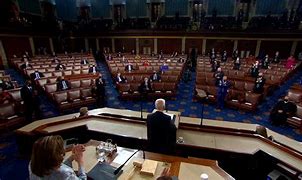
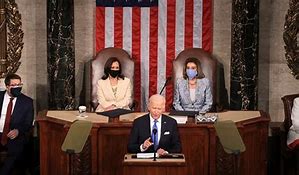
More progressive and radical than anticipated, Biden’s address to the nation to mark his first 100 days in office last week may have been dull in delivery, but its impact cannot be understated. While political pundits are still sizing up what can actually be achieved from the president’s proposals, I’ve been thinking about what all of this means in more existential terms.

Despite not being legally or constitutionally meaningful, the first 100 days of a US presidency has become a symbolic marker. FDR was the first to attach significance to the 100-day anniversary as he was out to prove his worth for getting America out of the Great Depression. Unlike many of his predecessors, Biden finds himself in a similar position to FDR as the world deals with waves of a pandemic and its economic aftermath, along with the kaleidoscope of damage left in the wake of the Trump years.

Biden’s first 100 days have been busy with government taking a more active role, and due to the pandemic, which has killed over half a million in the US and left one out of five Americans out of a job, people obviously need that. In his address to the nation, he spoke about continuing in this vein, along with green energy and healthcare being controlled and financed to a greater extent by government. Going against the ethos of the past forty years from Republic and Democratic presidents alike, Biden noted that ‘trickle-down economics has never worked.’ He has proposed growing ‘the economy from the bottom up and the middle out’ by reforming corporate tax, which has long favoured the rich, and raising the minimum wage.

Reading the analyses these past few days and now the reports of Biden trying to sell his ideas to Republicans and their supporters, I’m left with a couple of thoughts. First, Biden is no longer the anyone-but-Trump president. He is starting to become a leader characterised by his own agenda.  With this I’ve already notice the change in public discourse. It’s not likely that Biden will be able to fulfil all of these promises, and there will be compromises and lost battles along the way. But by setting these humanitarian goals in a boring presidential language, Biden is changing what people are talking about and how they are talking about it. Trump promised that a wall would be built between the US and Mexico. That promise was not fulfilled, the wall never built, but for four years people talked about immigration and white supremacy – often aggressively, either following Trump’s rhetoric or vehemently ridiculing and mocking him.

This leads me to the second thought: I’m enjoying for the first time in some years the feeling of hope. I’m not alone in this – only last night I heard socio-political author Michael Lewis answering the question of what he thought of Biden’s presidency so far, and without hesitation he said ‘It gives me hope.’  Hope holds incredible powers. Emily Dickinson once said, ‘Hope is a thing with feathers,’ and like birds, hope can survive the harshest of conditions, navigate through the unknown and inspire us to keep living. As her words are better than mine, I close with the full poem:

Hope is the thing with feathers
That perches in the soul,
And sings the tune without the words,
And never stops at all,

And sweetest in the gale is heard;
And sore must be the storm
That could abash the little bird
That kept so many warm.

I’ve heard it in the chillest land,
And on the strangest sea;
Yet, never, in extremity,
It asked a crumb of me.

-Emily Dickinson

The US President flanked by two women congressional leaders.

Revisiting Emily Dickinson

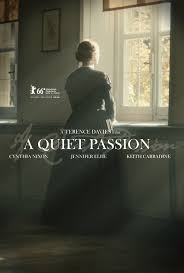
Occasionally the screensaver on my Kindle pops up with the dour face of Emily Dickinson. She has become one of the most recognisable faces in American literature. Yet, only recently has her life been transferred to the screen with Terence Davies’ A Quiet Passion.  The film d’auteur has its tableau moments, which slows down the pace and might not appeal to some viewers. But I found this fitting with the nature of Dickinson’s poetry – her elliptical language could cause images to freeze in the air. I liked too that the film contained sharp, intelligent dialogue in keeping with the dialogic style of many of Dickinson’s poems.  At the same time, these dialogues – many between Emily and her sister – remind audiences of the social liEmily D 2mitations thrusted upon 19th century New England life, especially for women. Although mostly a contemplative and melancholic film, humour and wit are present in a way that I felt was realistic to the poet’s life (Dickinson scholars are free to differ on this point.)

I’m also grateful to this film for reminding me that Dickinson wrote some poems about the US Civil War. We tend to think of Walt Whitman as the Civil War poet and of war poetry as being a male preserve.  But here is a Dickinson sampling:

(582)

Inconceivably solemn!
Things go gay
Pierce — by the very Press
Of Imagery —

Their far Parades — order on the eye
With a mute Pomp —
A pleading Pageantry —

Flags, are a brave sight —
But no true Eye
Ever went by One —
Steadily —

Music’s triumphant —
But the fine Ear
Winces with delight
Are Drums too near —

Since I was a teenager, I’ve liked Dickinson’s work, though I confess that there was a lot I didn’t understand younger. I think her writing and people’s understanding of it has been more helped by cognitive poetics (and other areas of literary stylistics) than by traditional literary criticism with its focus on biography, religion and history. Cognitive stylistics has shown how Dickinson manipulates grammar and word-choice to create different worlds that wrangle with, among other things, ontological questions. Here, I’m thinking mainly of the scholarship of Margaret Freeman, who gives a wonderful analysis of one of my favourite Dickinson poems:

A Spider sewed at Night

Without a Light

Upon an Arc of White

If Ruff it was of Dame

Or Shroud of Gnome

Himself himself inform.

Of Immortality

His Strategy Was Physiognomy.

(J 1138, lines 1-6; ms)

I think it’s time to return to this poet and see how I get on with her language and wisdom in my middle age.