Brexit:  The next steps for this activist

Working with grassroots organisations like Ely for Europe and the European Movement is one way of tackling a problem like Brexit. It’s helped me to become better informed on the issues and to participate in the protest against the inanity that is Brexit. While I’ve had the honour and pleasure of Co-Chairing Ely for Europe over the past two years, I’m now stepping down from my chairing post. I’ll still be involved with the group and on their committee. But if there’s one thing I’ve learned from years of volunteering it’s that the helm has to be passed around from time to time to keep others involved and to ensure the group doesn’t become a clique.

So, what now? In a matter of weeks, the big decisions concerning Brexit will be made, whether it’s how we’re going to leave the EU or if battle-weary politicians seek to save face by implementing a people’s vote. Much of this will be in parliament’s hands. This leaves me with the feeling that a lot of my work has been done on the Brexit front.

I’ve been getting more involved with local politics and the workings of the local councils – in Ely, we have city, district and county levels. I’ve been somewhat involved in the past, but stayed on the fringes. My willingness to plunge in – if I’m not mixing my metaphors – has come from a sense of hopelessness at the national level. In Britain, our politicians have let us down. They aggressively spout forth on the ‘will of the people’ but seem blind to the majority of polls and surveys over the past two years showing that most people in Britain do not wish to leave the European Union. Before that, there were austerity measures and the growing gap between rich and poor. Anyone who has been following British politics will tell you that these ills are entangled in party politics and not in the best interest of the country. That is, we’re not talking about competing ideologies – we’re talking power games.

Last night I was having drinks with friends from America and South Africa. International travellers, broadsheet readers – yes, I know, the chattering classes. Our consensus:  Britain was turning into another Italy. The political sway of Nigel Farage, the popularity of Jeremy Corbyn, the bumbling incompetence of Boris Johnson and Therese May are paralleled by Berlusconi, Matteo Salvini and so on. Britain, like Italy, has become a laughing stock. But what makes Italy work, and has kept it working since the war despite political chaos at the top, has been local governments and concerned citizens. With that thought in mind, I take my next steps.

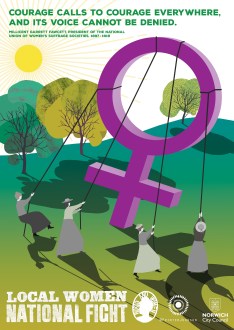
National Democracy Week 2018

It was last week. Yes, I missed it too. If it weren’t for an email I received with a couple of suffragette posters, I wouldn’t have known about it at all.

This inaugural week to pay tribute to democracy in Britain ran from the 2nd to the 8th of July. The date was chosen to mark the 90th anniversary of the 1928 Equal Franchise Act, which gave women the same voting rights as men. Women had gained the right to vote here ten years earlier, but that right was limited to women over the age of 30 who had property – in case you were wondering why we’ve been celebrating in recent months the centenary of women getting the right to vote.

I received my posters to celebrate democracy a few days before the start of the week. Vaguely curious, I put them aside, expecting to hear more about it through the media. But I saw nothing on it when I watched BBC or Channel 4. In the UK newspapers I typically read – The Guardian, The Observer, The Independent, The Times, The New European – there were no reports or commentaries to do with National Democracy Week. Without some sort of reminder and with too many other things clambering for space in my head, I easily forgot about it.

I do wonder if the lack of fanfare or even interest in National Democracy Week had anything to do with what was going on last week. England winning a place in the World Cup semi-finals and the rescue operation for the Thai boys and their football coach trapped in a cave dominated our casual news talk – and they have nothing to do with democracy. In the middle of the week, democracy appeared in the form of freedom of speech when London Mayor Sadiq Khan gave permission to anti-Trump protesters to launch an angry baby Trump balloon during the US president’s visit. Whether such permission should be allowed is still being debated as I write. The week ended with our PM presenting her Brexit proposal to her cabinet ministers at a secluded day retreat at Chequers. This involved an elite group within a minority government agreeing to a proposal that they know will likely be rejected by the EU. To make this exercise in democracy even more futile, two days after agreeing to support the PM, two of the ministers resigned in disagreement.

Perhaps National Democracy Week decided it was best to keep a low profile.

National Democray Week 2
This and the featured image are the posters designed by Vicki Johnson.

Having realised that the celebrations had passed me by, I went to the government website to see what I missed. I clicked on ‘events’ and was sent to another webpage, where I could click on ‘events’ to find events in my area. That brought me back to the first page where I had clicked on ‘events.’ I was in a loop. What an appropriate analogy for our modern democracy. It appears I’ve participated after all.

To Protest or Not To Protest

To quote Albert Einstein, ‘If I remain silent, I am guilty of complicity.’

President Tr**p arrives in Britain on Friday the 13th of July. (Supposedly – he could cancel at any minute.) When I first heard about this visit some two months ago, my gut instinct was to appear outside Downing Street with a placard saying ‘Women of the World Against Trump.’ This sign would sum up a number of issues ranging from ‘grabbing pussy’ to cutting off overseas aid for women’s health.

But two months is a long time in the hate-filled-mud-slinging world of this US president. Since the announcement of Tr**p’s upcoming visit, the US has pulled out of the Iran nuclear deal, the US Embassy has moved to Jerusalem (unravelling decades of diplomacy), some 2000 migrant children have been separated from their parents and put into detention centres, without tougher gun laws another 25 mass shootings occurred in America (including one yesterday at a newspaper in Maryland – hard to separate this from the anti-media atmosphere of this president), and now his Muslim travel ban has been given the go ahead. While all of this is going on, a slew of environmental protection laws are being axed. There’s simply too much to protest against and not enough placards to go around.

On the other hand, I wonder if I should show up at all. POTUS seems to thrive on attention, positive and negative. Since most of what he does is deserving of a negative response, I fear that giving him attention is going to produce more of the same. That is, we need child psychology for dealing with this man-child.

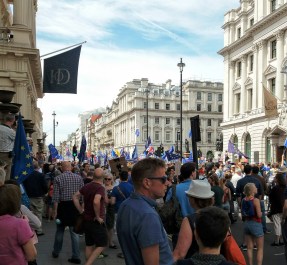
I also wonder about the power of protests. That sounds like a contradiction coming from me. Yes, of course, I was in London Saturday among the 100,000 plus anti-Brexit protesters demanding a people’s vote of the final Brexit deal. And it was a success. Our protest was the lead story on most of the news programmes that night and on the front covers of most of the newspapers Sunday morning. The initial analysis from the political pundits is that this protest sent a message to the minority of hard Brexiters in government and possibly the inert Jeremy Corbyn, along with jump starting some of those remainers who have given up the fight. That’s all fine and good.

protests against trump 2.jpg
People’s Vote march 23 June 2018.

A protest against Tr**p is another matter. It’s likely to be on the news, but what kind of message is it going to send? There’s no single solid message or legalisation coming up (as in the case of Brexit) to be impacted or potential votes to be lost by protesting against him.  Tr**p has secured his Alt-Right base, held on to reluctant Republican support with tax cuts and corporate welfare and normalised his hateful and child-like rhetoric through saturation.

Returning to Einstein, I refuse to remain silent. But I think there are more effective ways than another street protest for confronting Tr**p and all his nastiness. From this side of the Atlantic, petitioning and writing to our own governments to stand up to this US president on particular issues is a start. So too is supporting the many NGOs, such as Amnesty International and NRDC (Natural Resources Defence Council), whose organised lobbies and legal teams have a fighting chance. With these ideas in mind, this time, I’m staying at home with my cardboard and placard stick.

Brexit Bullies

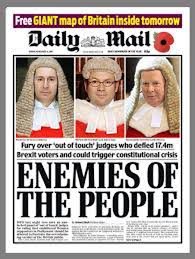
No, this is not about The Daily Mail, Boris Johnson or David Davis. Nor is it about high-profile victims Gina Miller, Supreme Court Justices or Peers in the House of Lords. This is far more personal.

We think it started during the EU Referendum campaign, when my David and I discovered that an egg had been thrown at our front door. Ours was the only house at that end of our long street with a Remain sign in the window. We didn’t think at first that the splattered egg had anything to do with politics. When we entertained the notion, we quickly dismissed it. After all, we live on a street with pedestrian traffic between the convenience store and the primary school. It was probably kids mucking about. We also reminded ourselves that we live in Ely, among other things a dormitory town for Cambridge with its universities and high-tech businesses – people who are likely to vote remain.

Those explanations have been reconsidered and our analysis has been rewritten in recent days after the rear windscreen wiper of our car had been torn off – no easy feat. It had happened during the night. But why our car when we’re at the brightly-lit end of the street? Straight away we suspected that this act of vandalism had something to do with the small EU flag in our front window – the only EU flag on our street and only one of a few in the whole town.

The gooey broken egg and now a part of our car. We were feeling targeted.

I’ve been on the wrong end of bullying before, once at a job and at other times in my own family. But my past experiences with bullying had some sort of logic to them, an acting out of envy, with the intention of removing me from the scene. That is, I held meaning in the lives of the bullies.

When an absolute stranger(s) attacks, one wonders why. Instead of acting out of envy, these aggressive brexiteers are likely acting out their anger that Brexit is not going the way it was planned or promised – the NHS is not going to receive more funds, in fact, it’s losing staff – the great trade deals with America and Commonwealth countries are laughably unlikely – problems with the Irish border could result in a fudged Brexit within the domain of the EU – to name a few.

The displaced anger is obvious, the intent less so. Do these vandals think that their actions will turn me into a brexiteer? Or are they trying to scare us into removing our signs and flags so as to not advertise that there is an organised movement against their views?

I filled in an online police report about the ripped off windscreen wiper. After giving all of the routine information – make, model, location, damage etc. – I was asked if I suffered any personal physical or mental injury. I ticked the mental injury box without hesitation. I was upset and shaken and felt vulnerable. This triggered another box to appear, asking if I wanted to join a support group. Really? Is there a support group for people who have had their cars vandalised? Or better still – is there a support group for people who have been bullied by brexiteers? This latter group I imagine would be full to capacity and I’d have a place on one of those notorious NHS waiting lists.

enemies of the peopleThere’s also the possibility that I’m all wrong. Our egg-stained door and damaged car could be coincidences and could have nothing to do with Brexit.  But in the socio-political climate we live in, an innocent explanation is hard to contemplate. I guess I’ve been writing about The Daily Mail and its political heroes after all.
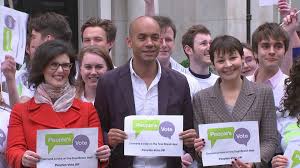
Brexit: Time for a People’s Vote

Writing in anger is a lot like speaking in anger. It’s soon laden with regrets. With that in mind, I waited some days before writing about a couple of recent infuriating incidents.

Incident 1 – As I was handing out leaflets about a People’s Vote on the final Brexit Deal, one person angrily barked at me, ‘We already voted – it was democratic.’ To which I said, ‘So is this – that vote was nearly two years ago.’ As is often the case, this person stomped off in a huff before I could say anything more.

Incident 2 – When I mentioned to a friend, who had surprised us all by voting Leave, that I was supporting the People’s Vote campaign, he dismissed it, saying ‘it’s trying to overturn a democratic vote.’ I was offended by this suggestion that I wasn’t being democratic – so offended that I couldn’t answer to it, and I usually do answer to his comments about Brexit. While I tried to find my composure and words, the dinner table, full of chatter, quickly changed topic.

Thank the gods for blogs – here’s what I wanted to say.

What kind of democracy do we have in the UK? It’s certainly not winner-take-all. After a general election, the winning party isn’t the only party in parliament. As other parties win constituencies, they too are represented and have a right to debate and vote in parliament. Okay, we know that referendums aren’t quite the same thing.  But PM Theresa May has interpreted the EU referendum result in a way that alienates about half of the country, giving the losers nothing and referring to us remainers, us ‘citizens of the world’ as ‘citizens of nowhere.’ If the PM and the Brexit elite in her cabinet continue down the road to a hard Brexit, those who didn’t want any Brexit or who expected a soft Brexit have not had their voices heard. I have a hard time seeing the democracy in this – unless of course, the people can vote on the final Brexit deal.

Democracy, no matter how you define it, also didn’t end on 23 June 2016. Things have happened since then.  Trump has been elected. He’s a libertarian protectionist and cannot be counted on for a good trade deal. Nor can we count on the Commonwealth countries – India has already snuffed us on trade without a loosening of visa restrictions. As the Brexit wheels have started turning, trade deals aren’t the only items to start falling off the cart – the Irish border, the Customs Union and Euratom, to name a few. I don’t recall these points coming up during the referendum campaign and now they’re key issues. And let’s not forget that since the vote in June 2016, we’ve had a general election. Result: the pro-Brexit government lost its majority. Now we’re being led by a minority government being bolstered by a political party that most of us in the UK cannot even vote for – or more importantly, vote out of power. The only way to counter all of these changes is a people’s vote on the final deal.

End of rant.

Obviously my opposition to Brexit has generated a lot of anger in me. While anger is often an emotion that can impede reason and turn grown-ups into children, it can also be useful. I’m hoping that enough British voters, angry at being duped during the referendum campaign or angry at the minority government’s ineptitude at Brexit negotiations, can put their anger to good use and demand a final vote.

peoplesvote2

A week in the life of a pro-Europe activist

Saturday: Spent one and a half hours in bitterly cold Ely Market Square working at the Liberal-Democrats’ Exit-Brexit market stall. One passer-by screamed at us, once he was far enough away to avoid conversation “The majority voted!” Another man blames the EU for Eastern European workers. I briefly told him how Britain invited Eastern Europeans here in 2004 and that other EU countries have different immigration policies – but I stopped myself. I’m grateful Eastern Europeans are here working on our farms and in our hospitals, making our country culturally richer. The man continued to say that because of the EU he can no longer go to his local pub.  At that point, I gave up and stepped away.

Sunday: Too cold to go out. Stayed indoors and wrote my blog about hearing Lord Adonis addressing Brexit issues earlier that week at a town hall meeting in Peterborough.

Monday: Ely for Europe co-chair Virginie stopped by with Open Britain and European Movement surveys. We discussed a strategy for getting our members to fill them in and get people they know to fill them. With hostilities in the post-referendum air, we can’t expect people to knock on strangers’ doors.

Tuesday: Sent an email to MP Lucy Frazer about the debate on how Brexit will impact the NHS in Parliament scheduled for Thursday. Urged her participation. Started following Lord Adonis on Twitter.

Wednesday: Signed online government petition demanding that the Referendum vote be made null and void due to illegal activities and influence surrounding Cambridge Analytica. A long shot, but worth a try. At least the act of signing the petition felt good.

Thursday: Attended a Q+A session hosted by Ely for Europe with MEP Alex Mayer. Met more pro-Europe supporters, mostly from Labour. Left the event thinking that maybe it’s not a matter of hard Brexit or soft Brexit. It might be a symbolic Brexit that does the trick. In March 2019, British MEPs leave Brussels (and lose their jobs) and the Union Jack is lowered. With the new passports, these gestures might be enough for the Brexiters. Other issues to do with trade, borders, funded research and so on could remain in limbo for years as people in the EU and Britain work around them, effectively remaining linked.

Friday: Learned that 15 cross-party MPs stood up in Parliament to debate how Brexit will impact our NHS – none of them was MP Lucy Frazer. No evidence that she was even there.  Engaged in stealth activism by delivering pro-Europe flyers from the Lib-Dems and the European Movement to unsuspecting letterboxes. Very satisfying and less angering than working market stalls.

Saturday (in France, a week is 8 days): Attended Exit Brexit march in Ipswich. Excellent turnout with pro-Europe groups from across East Anglia. On the train returning to Ely, while reading The New European, I looked up a few times at the flat landscapes, the farms, the villages and wondered what the future holds.

A Cross-Party Spirit for the Pro-Europe Movement

As party politics in Britain is being reshaped – maybe to the point of extinction – I find myself increasingly involved in cross-party events. This week it was a town hall style gathering billed as a ‘Brexit Listening Tour’ in Peterborough and led by Lord Adonis, a Labour Peer. The attendees for the most part didn’t identify themselves as belonging to or supporting one party or another. Those who did label themselves came from Labour, Lib-Dems, Greens and Conservative parties. Naturally, no one from UKIP, but I suspect they’re not in ‘listening’ mode these days.

From the timing of the applauses, along with the comments and questions, this was clearly an event for those who want the UK to remain in the EU. If you’ve been following my blogs, you know that this is not the first time I’ve been to such an event.  Adonis

I came away from the evening invigorated and inspired to get back to the type of face-to-face activism that I do when I’m back here in Ely. I also came away with a few points worth sharing.

First of all, perhaps the time has come for Brexiters and Remainers to unite against our government for running the simplistic in/out referendum in the first place. It’s easy to accuse the Brexiters of lacking knowledge as there was no mandate in the referendum explaining how we would leave, along with the assumptions (and lies) that made people believe that leaving the EU would make Britain better off. Even though those who voted remain obviously had some sense of what it would be like to stay in, there were still many things about how the EU works that Remainers- and I include myself in this- simply didn’t know. Had we known more about the customs union, the various immigration policies across EU member states, or the problems now facing Ireland and Gibraltar, our arguments would have been different.

Secondly, let’s not forget that Brexit is a symptom of the problems the UK has been unsuccessfully dealing with for the past few decades. Problems like unemployment, housing and a weakening health care system.  Perhaps this point is just another angle on looking at how the pro-leave vote was really a protest vote against life in Britain. Labour, the Greens and the Lib-Dems could easily unite on tackling these problems along with undoing the mess that has become Brexit.

A final point is more a turn of phrase than a point. It’s an answer to the tabloid press and The Daily Telegraph which continue to publish stories about the NHS being drained by immigrates and their children needing medical services. One of the attendees at this cross-party event said ‘You’re more likely to be treated by an immigrant than you are to see them in the waiting room.’  Well said.

Clegg’s How to Stop Brexit

Based on the reviews, I almost didn’t want to read it – it would have been too painful. When Nick Clegg’s book How to Stop Brexit first came out, the media focused on Clegg’s advising people to join the Labour Party. As this isn’t what one would expect from a former leader of the Liberal Democrats, it made for attention-grabbing headlines and news-straps.  Finally, I braced myself and read the book – and saw his remarks in the context they deserve. What he actually does is first to acknowledge that Britain is well and truly a two-party country at the moment and that it in within the two main parties that Brexit could be stopped. By joining Labour or the Conservatives (he says that too), a voter will have more opportunities to effect change in those parties, bearing in mind that both parties are internally divided between Leavers and Remainers. Clegg isn’t asking anyone to leave the Liberal Democrats. Instead he’s appealing to those who are inclined towards Labour or the Conservatives to join those parties and become more involved in their Brexit positions. This is especially the case for the Labour-inclined as this is the current party of opposition – well, at least they’re supposed to be. Joining the Conservatives is less helpful as most of the Conservatives MPs who voted Remain have been whipped into line to follow the disastrous path towards Brexit.

Clegg also makes a good point by reminding us that in 2004, when the EU expanded by including countries from the former Soviet Union, the pre-existing EU countries had a choice about whether and how to receive immigrants from these new EU-member states. Only the UK, Ireland and Sweden had an open-door policy. Other countries, such as France and Germany, imposed restrictions on the number of immigrants and the employment sectors they could work in. In other words, for those pro-Leavers for whom immigration from the EU has clearly been an issue, we cannot blame the EU for choices that we made. Of course, I, like Nick Clegg, think that these were good choices, filling in sectors of our workforce – on top of the many ways British life has been enriched by these other cultures.Clegg book 2

Other points in the book were ones that any Pro-Europe activist has heard before.  A bit of preaching to the choir, though I did enjoy Clegg’s turn of phrase: ‘The battalion of greying Conservative MPs you have never heard of, the shady financiers of the Brexit elite, the loopy rantings of Paul Dacre… all of these people fought  relentlessly for Brexit, over many years, long before the term ‘Brexit’ had even been invented.’

Another quote that made me nod in agreement and wish I had said it in my little blog: ‘By choosing the hardest of Brexits, by attacking them [remain voters] as “citizens of nowhere,” Theresa May made the extraordinary choice to de-legitimise and ignore the millions of people who voted for a different future.’ It was indeed extraordinary and angering as such remarks cut against the structure of our democracy, implying that we have a winner-take-all approach to elections. I’m surprised that more people haven’t caught out Theresa May on this.

Of course, I recommend this book but given its bold title, I fear that the only people who will take me up on this recommendation are those Pro-Europe activists who don’t need to read it.


A flying visit to Le Petit Prince

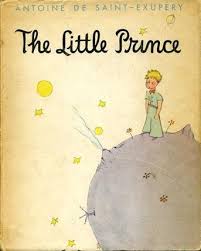
The first time I read The Little Prince I was twelve and naturally read it in English. This was when pop psychology ruled my thinking, and I saw the book as a fictionalised dialogue between the author, Antoine de Saint-Exupery, and his inner child.  I recently reread this novella, this time in French, which gave it a different flavour in my mind – more intellectual and whimsical at the same time. With this reading, I’m more struck by what it says about human nature in broader political contexts than with the personal and psychological. From here it was easy to see how it reflects the age we’re living in now.

Early in the story, the little prince asks a stranded aviator to draw him a sheep. After a couple of awkward attempts, the aviator draws a picture of a box with some holes in it and tells the prince the sheep is in the box. The prince accepts this and their friendship is cemented. In the present day, I’ll call this image the current British government, who received the picture of the box from the Leave campaign. I don’t think I need to explain this metaphor in any great detail. Any sensible person knows that the box is filled with the likes of a well-funded NHS, a robust economy and a lucrative trade deal with the remaining EU. The air holes are there to make this world seem real, a place where people live and breathe.

Another passage reflects pertinently in our age of the internet. The little prince climbs up to the top of a mountain and calls out to see if anyone is there. All he gets is an echo, which he mistakes for conversation.

The story also has plenty of characters suited for today’s headlines – an illogical king who claims he controls the movement of the starts, a vain man who craves attention, but whose vanity keeps him isolated, and a geographer who draws maps, but never leaves his own desk to experience the world he has helped to construct. I don’t think I need to mention the true life characters by name.

I’ve met people who reread Le Petit Prince every few years or once a decade. I don’t think I’ll join either of those clubs. Having read it once as a child going through puberty and now in my middle-age, my next appointment with this book could be in my very-old age. Who knows what metaphors, insights, ideas this little literary gem will conjure up then.

Petit Prince 2

Brexit, Trump and W.B. Yeats

Yeats’ ‘The Second Coming’ has had a revival over the past year or so. With reactions to Brexit and Trump, the poem was quoted more in 2016 than in the total of the previous 30 years. (Wall Street Journal and Factiva).


Now here we are in 2017. So far, Brexit has unleashed a rise in hate crimes, economic uncertainty and feelings of general incomprehension in the UK as ‘things fall apart’ and as we watch as ‘the centre cannot hold.’ In Trump’s America, a ‘blood-dimmed tide’ is both present and inevitable as mass shootings are condoned and conflicts overseas are rekindled with heated rhetoric.

But what is to come of all of this? I revisit the poem:

The Second Coming

Turning and turning in the widening gyre
The falcon cannot hear the falconer;
Things fall apart; the centre cannot hold;
Mere anarchy is loosed upon the world,
The blood-dimmed tide is loosed, and everywhere
The ceremony of innocence is drowned;
The best lack all conviction, while the worst
Are full of passionate intensity.

Surely some revelation is at hand;
Surely the Second Coming is at hand.
The Second Coming! Hardly are those words out
When a vast image out of Spiritus Mundi
Troubles my sight: a waste of desert sand;
A shape with lion body and the head of a man,
A gaze blank and pitiless as the sun,
Is moving its slow thighs, while all about it
Wind shadows of the indignant desert birds.

The darkness drops again but now I know
That twenty centuries of stony sleep
Were vexed to nightmare by a rocking cradle,
And what rough beast, its hour come round at last,
Slouches towards Bethlehem to be born?

Written in 1919, soon after the First World War and the Russian Revolution, this work reacts to the horrors and violence of such conflicts. More importantly, it expresses apprehension over what is to come. Over the years, many have seen this poem as an accurate premonition of a second coming in the form of an anti-Christ – Adolph Hitler. As has been pointed out by many in the press, the present day holds startling parallels to pre-War Germany, with the rise of nationalistic propaganda and untruths capable of seducing millions.

Yet, I feel the need to put this into perspective. Others have alluded to this poem over the years. Joan Didion’s collection of essays Slouching Towards Bethlehem, Chinua Achebe’s Things Fall Apart and Joni Mitchell’s song ‘Night Ride Home’ are among the many works to keep this poem alive. These works were written long before Brexit and Trump and each with their own political concerns and fears at their time.  Seen collectively like this, I do wonder if the recent malaise – the far-right, the hate crimes, the nationalistic fervour – are all part of a tide that will inevitably ebb back to something perhaps different, but manageable, less worrying.

Yet, the recent surge in quoting from ‘The Second Coming’ is still significant in itself. Most of these allusions can be found in the press, where the educated, the so-called ‘urban elite,’ dwell. As recent investigative reporting and British and American government enquiries are starting to show, it was the elite class of billionaires who indirectly funded both Brexit and Trump’s presidential campaigns. Both employed social media, which spread into mainstream media, to disseminate their propaganda and untruths. The response to this has come, during these campaigns and even more now, from the true masses – the urban and educated. We are the ones seeking to understand what is going on, turning to Yeats en masse. In our bewilderment and fear, we ask if what we have witnessed is a sign of the ‘rough beast, its hour come round at last.’