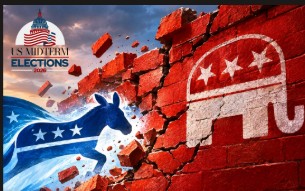
I promise not to use any marine metaphors to describe what happened in America on Tuesday the 3rd of November. While I’m still basking in the warm glow left by the Democrats astounding victory, the aftermath is starting to sink in. For those of us living outside the US, we’ll have to be content in the role of spectators as the Democratic majority in Congress attempts to clear up the mess left by the 45th/47th president and his enablers. Of course, between now and January, when all of these election winners are sworn in, all we really have is guesswork and pundits’ predictions. The only certainty is that both sides of the aisle are plotting away and strategizing for the months ahead.
So, here are my ramblings, based on pure speculation.
With Democrats now more dominant at state level as well, something that has received relatively little coverage in the international press, Americans could benefit, particularly on issues such as healthcare and education. Despite mixed feelings about the US remaining a superpower, I don’t wish Americans harm or ill-fortune, and I remain hopeful on these fronts.
At congressional level, we can expect to see committees set up to investigate the president’s corruption and abuses of power, along with the questionable (and perhaps illegal) conduct of Attorney General Todd Blanche and Defence Secretary Pete Hegseth. Naturally, Republicans will argue that these investigations are politically motivated. However, Democrats would be remiss not to pursue accountability. It was, after all, one of the principal reasons people voted for them.
Meanwhile, the commander-in-chief will doubtless continue to demand attention. I don’t think for a moment that this president has any genuine interest in governing or improving his country’s place in the world. It’s all about him and his fortune. This, along with the president’s apparent dysfunctional personality and mental decline could spell grim times ahead for us all, wherever we live. As David Remnick of The New Yorker has pointed out, ‘Trump can still do damage, and, in defeat, may prove even more unhinged and vengeful. But restraints in Congress and beyond are now far stronger. This aging autocrat, repudiated by an electorate he once believed to be under his spell, has been significantly weakened.’
Enough speculation – on to action. I think it’s important not to become complacent after this and other recent victories for democracy in countries such as Hungary, Brazil and Serbia. I’m following the advice of Robert Reich, the former US Secretary of Labor, who said soon after the mid-terms: ‘The contest between democracy and authoritarianism is hardly over. We have won this battle, but we have not won this war.’ I need to add a note of caution – I’m not certain the war is ever truly won when it comes to democracy. It’s a slippery concept that’s easily threatened. To quote Thomas Jefferson: ‘The price of liberty is eternal vigilance.’
What I’ve been Reading
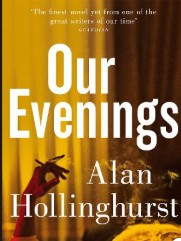
Alan Hollinghurst’s Our Evenings gave me the escape I needed from the saturation of media coverage around the mid-terms. Not ‘escape’ in the sense of lightweight, daydreamy fiction. There’s nothing lightweight about it. It’s the life story of Dave Win, a gay man of Burmese and White British parents, tracing his journey from childhood in the 1960s through a career as an actor and into the comforts and compromises of later life. Hollinghurst’s writing transports the reader into another world with precise observations of British society from the second half of the twentieth century through to the present day. Although Dave’s life moves forward, he is never far from the formative experiences of a childhood tarnished by racism and classism. Narrated in the first person, the novel knows when to hold back, allowing Dave’s developing character to emerge gradually as he comes to understand himself and how he is seen by others.
My thoughts eventually drifted back to the mid-terms, leading me to Percy Bysshe Shelley’s The Masque of Anarchy, written in response to the Peterloo Massacre of 1819. Nearly two centuries later, its themes remain strikingly relevant. Shelley argues that authoritarianism is ultimately defeated not by force but by non-violent resistance. Like Jefferson, Shelley believed that the defence of democracy is always unfinished work.

