Digging for Dharma and Finding Dickinson

According to Wikipedia, dharma is ‘untranslatable into English.’ Maybe so, as a single word, but the idea of it certainly could be understood across languages, and it’s a useful one for the times we live in.

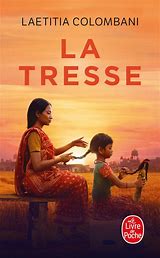
The term dharma has different meanings across religions. In Hinduism it’s ‘behaviours that are considered to be in accord with the order and custom that makes life and the universal possible. It is the moral law combined with spiritual discipline that guides one’s life. (more Wikipedia – do forgive me). This fits in with its use in the novel La Tress, which I wrote about this summer. In La Tress, a poor woman in India who is an untouchable and works in the public cesspool describes her situation as her dharma. She accepts her job as her place in the world, this ‘order and custom’ that makes everything possible. Of course, there are plenty of social constraints and customs that rule our lives – love them or loathe them – but I struggle to give them moral and spiritual importance. That is, I can see societies using concepts like dharma to keep the poor and women in ‘their place.’

I’m less uncomfortable with the Buddhist’s understanding of dharma. Even though Buddha did not write any doctrines, there are loads of books and websites devoted to the Buddhist understanding of dharma, packed with deconstructions and taxonomies. The most concise workable definition I have found comes from scholar Rupert Gethin, who defines dharma as ‘the basis of things, the underlying nature of things, the way things are; in short it is the truth about things, the truth about the world’  (not Wikipedia, but Tricycle.org). While this might be a bit esoteric, it’s not muddied by debatable concepts such as morality of spirituality.

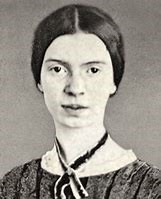
To put this another way still, and although she wasn’t writing about dharma, Emily Dickinson depicted truth as ‘stirless.’

The Truth—is stirless—
Other force—may be presumed to move—
This—then—is best for confidence—
When oldest Cedars swerve—

And Oaks untwist their fists—
And Mountains—feeble—lean—
How excellent a Body, that
Stands without a Bone—

How vigorous a Force
That holds without a Prop—
Truth stays Herself—and every man
That trusts Her—boldly up—

Why am I waxing on about dharma and truth? With the viciously false and conspiracy-riddled election campaigns going on across the world this year, I’m seeking some solace. For now, I’m finding it by embracing the concepts of dharma and truth, allowing me to assume that there are underlying truths in the basis and nature of things. Even if people chose not to believe them, they exist.

What I’ve been reading

Continuing my geeky interest in bees, I picked up Lev Parikian’s Taking Flight: How Animals Learned to Fly and Transformed Life on Earth. As an aside, the secondary title in the US version is: The Evolutionary Story of Life on the Wing. Written for a generalist audience, it’s filled with fun facts about creatures with wings. For example, humming birds (the smallest of all birds), bats (the only mammals that fly) and mayflies that in fact live longer than just a day – most of their lives are spent in the nymph stage, which could last up to two years, and it is the adults that live one or two days. Other flying things get fair coverage, such as pterosaurs, dragonflies and my adorable bees. Unfortunately, the latter is subjected to a lightweight approach full of awe, but a little too low on science for my taste. That aside, highly readable, this book has its place on the grown-up’s shelf as an introduction to one corner of evolutionary zoology.

Robert Harris’s An Officer and a Spy is typical of Harris’s books – historical fiction told in the style of a page-turning spy thriller. The subject this time, the Dreyfus Affair, was already a spy story before it got the Harris treatment. In Harris’s version, the focus is on the French officer Georges Picquart, who worked in military intelligence at the time that Alfred Dreyfus was wrongly convicted for spying and sent to the notorious Devil’s Island. Picquart realises that the case against Dreyfus is flimsy at best. During his investigation, he uncovers the true spy, but when he tries to bring this to light, he too is punished in military fashion. Spoiler alert for readers not familiar with the Dreyfus Affair – eventually the truth wins out. As always, the details and use of real materials and quotes are admirable and what I’ve come to expect from Harris. This brings me back to truths and dharma and at one level what the story is really about. What we think is the truth can change with knowledge and the courage to change the opinions of others and ourselves.

Il Duce and the Donald

It’s easy to see how much these two men are alike, down to their speeches made through puckered lips and puffed-up chests. But I’m going to stick my neck out and say how much these two are different. After recently reading Antonio Scuratti’s M: Man of the Century, I look at Mussolini in a different way and as less of a cardboard cutout. This first history-come-novel  of a trilogy depicts Mussolini’s early political life from the time of post First World War Italy until he gained power in 1924.

Unlike Tr*mp, Mussolini was not born gagging on a silver spoon. His father was a blacksmith and his mother a schoolteacher. Mussolini trained to be a teacher but worked for a living as the editor of Il Popolo d’Italia, a newspaper for the fasci movement. Mussolini also served in his country’s armed forces during WWI and was wounded. Not so with the former US president, who avoided the draft with student deferments and finally, when those ran out, a medical exemption. Tr*mp’s CV consists of basically one thing – businessperson, a position obtained with properties inherited from his father.

Unlike Tr*mp, Mussolini knew politics and the ways of government. He was active in the Socialist Party before defecting with others to create their own movement over the issue of pacifism during WWI. Mussolini supported workers’ rights while supporting the industrialists, who were trying to reshape and capitalise off the country left bloodied and poor after the war, with little help from their allies America, France and Britain. Tr*mp’s political career was a spin-off from his media personality and self-publicity as a ‘successful’ businessperson.

While both men, once they achieved political power, encouraged and denounced violence in the same breath, Mussolini’s hands were dripping in blood. Metaphorically, of course, since he sent out others to do his dirty work. He specifically ordered the killing of his enemies, including the leader of the socialist party. Some would argue that the orange one is responsible for the deaths on 6 January 2021 at the Capitol, the deaths of anti-racists activists during his term in office and even the deaths of thousands of Americas due to his reckless response as president to the Covid pandemic. But all these examples are about responsibility through verbal coercion and propagandizing.

When it comes to public speaking, while the two men may have presented themselves in similar fashions and to my bewilderment been able to stir up a crowd, the prose of their speeches are starkly different. A skilled writer, Mussolini could craft his language and make logical arguments. And unlike Tr*mp, he never attacked his opponents with schoolchild slurs and name calling, which I’m not going to reprint here as I have reached my saturation point. Mussolini’s discourse would typically pick apart his rivals’ arguments and then tip the rhetorical balance by making threats of  violence: “The Socialists ask what is our program? Our program is to smash the heads of the Socialists.”

While both men attacked democracy, it’s worth considering the nuanced differences. Mussolini called democracy a ‘fallacy’ because people do not know what they want and because  ‘democracy is talking itself to death.’ Tr*mp said that if he lost the 2020 election, it proved that democracy was an ‘illusion’ because ‘the system is rigged’ and ‘everyone knows it.’

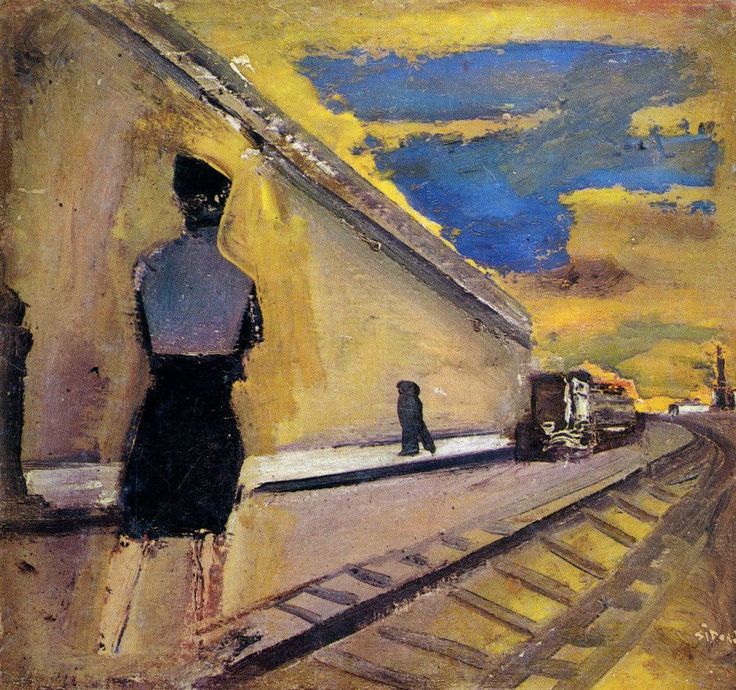
One final noteworthy difference, Mussolini’s fascism, unlike the MAGA campaign, spawned an art movement. Il Novecento rejected the avant garde of the early 20th century in favour of more traditional large landscapes and cityscapes, reflecting the fascists’ ideology. From Scuratti’s book, I’ve learned that this movement was founded in part by one of Mussolini’s many mistresses. Whatever the motivations and manipulations of Il Novecento, Tr*mp and his MAGA movement are in a word artless.

Painting by Mario Sironi of Il Novecento

Pointing out the differences between these two leaders not only highlights the unfitness of the former US president for any position of governmental leadership, but it makes me think that fascism is an overused term that like so many political and ideological words, changes its meaning over time. Yet, the essence of it remains as noted in a recent interview with writer Naomi Klein. On the topic of fascism, she said ‘I’m scared whenever we get whipped up in a mob and don’t think for ourselves. That’s how the updated far-right is drawing people in. It’s extremely dangerous.’

What else I’ve been reading

This has turned out to be a summer of big fat reads, with the Antonio Scuratti book weighing it at 750+ small print pages. To counter this, two excellent novellas have capped off the summer. I’ve finally gotten around to reading something by the Belgium writer Amélie Nothomb. Stupeur et Tremblement (avail. in English) is a drole, at times laugh-aloud funny, story of a young Belgium woman’s experience working for a Japanese company. The expected East meets West clashes are there, but so too is a humorous take on workplace bullying (I know, it can be serious and soul-destroying).

The other lightweight but not intellectually so was Thomas Mann’s classic Death in Venice. I first read it decades ago at university. Having since seen the film with Dirk Bogarde, I could only envisage his twinkling brown eyes  as those of Aschenbach. The older me also appreciated the references to the paintings of Caspar David Friedrich (who wasn’t on my radar until 5 years ago), adding more meaning to the book’s meditation on aestheticism.

Unsubscribed

I’ve been going through my inbox unsubscribing to any newsletter or advertising that I’ve tended to ignore or delete. This e-version of clearing out the closet has me wondering about a couple of things.

For a start, there’s language. The word unsubscribe first appeared in print in the 1570s and its antonym subscribe a century earlier. But in those days, subscribing referred to signing documents. These words didn’t gain their sense of joining something or paying for something until the early 1700s with magazine subscriptions. According to the Corpus of Contemporary American English, the most frequent collocates for unsubscribe are you can… and …at any time. I suspect similar findings in other varieties of English. My any time has come, and I’ve unsubscribed to over twenty newsletters and marketing lists.

Have I been unsubscribing or disengaging? Some of the marketing emails I’ve blocked came from IKEA and other middle-class home stores that I no longer need now that the apartment in France and the house in England are furnished and functioning fine thank you very much. I don’t want clutter in my homes or my inbox. I’ve also closed the door on sports clothing – how many wetsuits does a person need?

Reducing consumerism is easy compared to unsubscribing to newsletters. Among those to get my e-axe have been six literary magazines, one British centre-left political magazine, one leftist French newspaper and one centre-right Italian rag. I wonder if I’m disengaging from elements of public discourse out of saturation and/or utter despair. Thanks to writing courses and degrees, literary magazines are ten a penny. Wading through this glut, I occasionally find a publication of a high standard that I might want to send my own work to. I duly subscribe to their newsletter to get free samples of stories and essays. As months pass, I find myself dipping into and quickly out of worn tropes and plot devices that smack of writers’ workshops.

As a political junkie I should be basking in this mega-election year, especially when the recent UK and French elections saw victories for the left. Yet – and here is where despair comes in – the extreme right had significant gains and showed that they shouldn’t be taken lightly. And while I’m pleased that Uncle Joe has stepped aside to give the Democrats a better chance, the Republicans – who have tilted towards authoritarian far-right – are well-funded and could continue their menacing presence for years to come. These vituperative forces are currently exhausting us with their infantile and distorted racist and misogynistic attacks on VP Harris. Media outlets of all political stripes are reporting – posting in those e-newsletters – more on these click-bait comments than they are on the issues at stake in this election. I recall a remark from Kafka: ‘In the struggle that pits the individual against the world, always bet on the world.’ Disengaging, unsubscribing, call it what you will, might not be empowering, but it is therapeutic.

What I’ve been reading

Two exceptional novels of the past couple of years have been inspired by the writings and life of Charles Dickens and have kept me entertained for half of this summer. Zadie Smith’s The Fraud is an historical novel about the writer William Ainsworth, a contemporary of Dickens, who is also a minor character in the book. It explores the roles of Victorian women, attitudes about slavery in the post-abolitionist era and the famous Tichborne trial, involving a working-class man claiming to be the only surviving inheritor of an aristocratic estate. Like Dickens, Smith is a keen observer of human frailty and pretences. Barbara Kingsolver’s Demon Copperhead is a more obvious nod to Dickens. Following in the footsteps of David Copperfield, this eponymous narrator recounts the story of his life from childhood to early adulthood. But this is set in modern times in the poverty-stricken hills of Tennessee amidst the opioid crisis and is a story told with caustic wit, edging at times on satire. At one point the author winks to the reader by having Demon discover Dickens and comment about how it reflected poverty and the life of orphans in a way that could have been written today.

I obviously have not disengaged from these social issues, but it helps to interact with them through the lens of creative prose.

UK Elections 2024 – My Winners and Losers

I had no intention on writing about the results of the election, but I find it hard not to after waking up this morning only to discover my David in front of the tele in his robe, coffee cup in hand. Having been awake since 2 am and finding his brain buzzing with exit poll results, he decided to exorcise the cerebral demons by watching the true results unfurl. Since 6 am my earworms have been repeating results and analyses. To shake these strings of words out of my head, I’m writing.

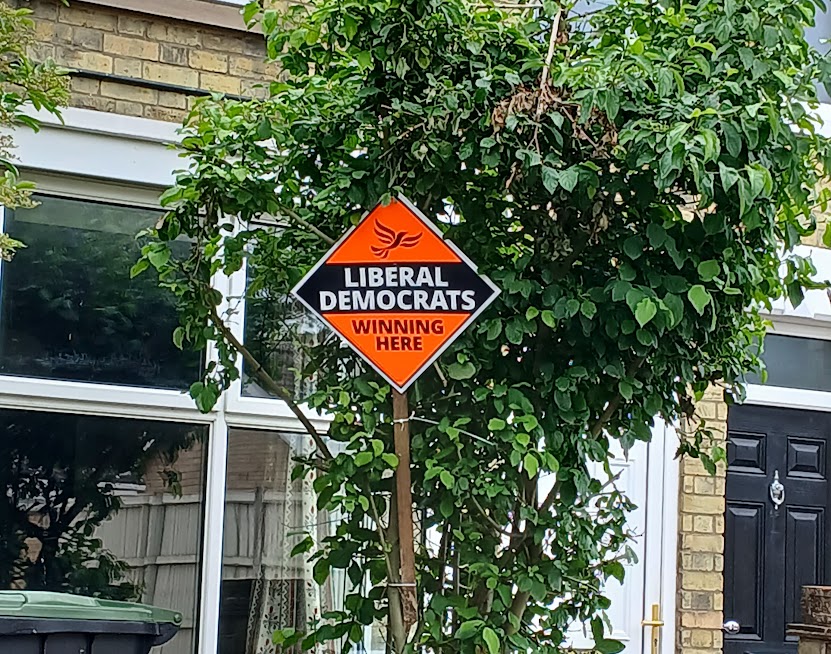
You, dear reader, know by now that this was a landslide victory for the Labour party with excellent results for some of the smaller, less funded parties, like the Liberal Democrats, the Greens and dare I admit it Reform UK (Nigel Farage’s party). Rather than revisit these themes, I’ll share with you what I am left thinking about, the real winners and losers.

Winners:

The Remainers, those of us who wanted to stay in the EU. Our new PM is a Remainer, and I recall having the pleasure of hearing him speak at one of the many anti-Brexit rallies I attended. Of course, he won’t put us back in the EU as that would involve another referendum, and the country is still dabbing the wounds from participating in the last one. But Starmer has already spoken about closer trade ties to the EU, and that is a key first step, economically and spiritually.

Women are also winners. The number of women MPs has gone up from 226 to 263, which is 40%. Ideally, it ought to be 50%, but I’ll take it. It’s also likely that Rachel Reeves will become Britain’s first ever female Chancellor of the Exchequer. For my US readers, this is the senior government minister in charge of all things economic and financial.

Losers:

As always, the people who didn’t vote. Voter turnout was only 60%, the lowest since 1885.

I would love to say that the far-right populists were the big losers, but they’re still kicking in the guise of Reform UK. They did take a beating though, with many high-profile far-right Conservatives losing their seats.

Finally, the media coverage of the election campaign deserves a wooden spoon. Sound bites and click-bait culture reduced candidates to automatons repeating well-chosen scripted phrases with little substance. The media’s attempt at ‘balanced coverage’ translated into one party’s negative story having to be offset by the other party’s negative story, even if the later had to be created through exaggeration of loose facts.

Whew. I hope this has killed the earworms. Time to check up on David to see if he’s still awake.

What I’ve been reading

After hearing Irish writer Anne Enright being interviewed on This Cultural Life (BBC Sounds podcast), I ordered from the library her latest book, The Wren, The Wren. At one level this is a story about three generations of resilient women, exploring the complexities of their relationships to each other along with the themes of love and abandonment. The underlying catalyst that shapes these relationships is a renowned poet, Phil McDaragh. He was married to the first generation of these women. When Phil leaves his family for a new life, and in time for a new wife, in America, his daughter Carmel tries to reconcile the beautiful love poetry he wrote to her mother with his betrayal. Carmel’s daughter, Nell, who was born after her grandfather’s death, is also under the magical spell of Phil’s poetry and uses it discover her own direction in life and the terms of her relationship with her mother. All of this is told in prose and poetry rich in wit and Irish vernacular. It’s worth mentioning that while working on this novel, Enright had some of Phil McDaragh’s poems accepted for publication using his name as her pseudonym.

Elections, elections, everywhere

Thanks to President Macron calling a snap election of the French National Assembly, this year, the country of my birth and my two adopted countries, where I hold citizenship in one and residency in the other, are all going to the polls in national elections. In the case of France, Macron will stay president, but his Prime Minister and most ministers in the National Assembly could be from another party. With a power share arrangement like this, we can expect legislative gridlock, more political farce (if nothing else, this election has been entertaining) and what the French do best – protesting in the streets.

The British are less likely to be protesting after this coming election, where it is highly likely Labour will win with a crushing majority. After 14 years of Conservative governments, which drained our social services and gave us the Brexit debacle and four bungling jingoistic Prime Ministers in five years, many citizens of all political colours are going to breathe better knowing that this era of populism is winding down. Whatever the Labour Leader Keir Starmer can achieve or whatever he fails at, his competence and lack of bluster will make him a welcomed change.

I still hold voting rights in the US, where I have not lived in over thirty years. Yet, given America’s place in the world, I believe it’s important to participate in preventing a criminal felon, indicted sexual assailant and fraudster from returning to the White House. I fear that if he keeps to his campaign promises, he will close branches of government which serve to protect democratic processes, repeal environmental legislation (as he did in his first term) and turn America into an international joke – the joke that isn’t funny when it joins other pariah states bent on hatred and war.

A few points of note: 1) France, the place where I spend most of my time, is the place where I cannot vote. 2) I would be able to vote in French local elections if Britain had not left the EU, and it was the travel rights lost to Brexit that made me seek French residency in the first place. In other words, due to Brexit, I have French residency, but due to Brexit, my rights as a resident are restricted. 3) This morning, I dropped into the post box my UK Postal Ballot at the same time as my bowel cancer screening sample.

What I’ve been reading

By sheer coincidence, that is, the lottery of the public library’s reservation system, the last two novels I’ve read were both set in marshes. The international best-seller Where the Crawdads Sing by Delia Owens tells the story of a marsh girl, living in America’s south from the 50s to the 70s. Here the marsh is pivotal to the storyline and the development of themes around the environment and what Edward Said would call ‘othering.’ In Rachel Cusk’s Second Place, the marsh serves as a gentle backdrop for a family story suffused in art, psychology and philosophy. While both novels were engaging with well-crafted plots and characters, reading Cusk’s prose was a deeper, more edifying experience.

Online, I’ve been reading poems by the post-war avant-garde poet Amelia Rosselli, who was trilingual Italian, French and English. Her father and uncle were assassinated by the fascists when she was a child, and her poetry often reflects on the personal impact of fascism and social injustice. This brings me back to this election year and a poem by Rosselli from her collection War Variations with its references to Mussolini and Hitler:

‘The night-wind departed and dreamt grandiose things: I rhymed within my powers and took part in the void. The spinal column of your sins harangued the crowd: the train ground to a halt and it was within its talk that truth paused. In the encounter with the fairytale resided outlaws.’

I’m struck in particular by the line ‘it was within its talk that truth paused.’ Both Mussolini and Hitler were elected to power.

Amelia Rosselli (1930-1996)

Journalists in the firing line

You would be forgiven if you assumed that this blog is about intrepid war reporters donning padded vests and helmets. Instead, I’m looking at another type of journalist. The marking of World Press Freedom Day last month brought to my attention the targeting and suppression of environmental journalists.

UNESCO reports that since 2010 at least 44 journalists investigating environmental issues were killed, with only five resulting in convictions. UNESCO also observed the growing number of journalists and news outlets reporting on environmental issues that have been the victims of targeted violence, online harassment, detention and legal attacks. Just looking at Afghanistan, according to the Committee to Protect Journalists, since 2004 more environmental journalists have been killed there than those who died covering the country’s military conflicts.

To no surprise the top issue that makes journalists targets is climate change. The power of the fossil fuel industries and their links to governments are certainly one of the driving forces behind these attacks. So too – and equally worrying – is the growing polemic around this issue that makes ordinary people, often hiding behind the anonymity of online platforms, hostile to environmental activists and journalists.

I dabbled in environmental journalism but felt a bit of a fraud because I don’t hold a degree in life sciences or environmental studies. Even though my articles were more political than scientific, I never thought I was doing anything courageous or risky by writing them. Yet, I wouldn’t want to be caught out underestimating the power of those who disagree with my views or prefer the public to be ignorant of the evidence, scientific or experienced. These days I’ve taken up the safer option of nature writing with its indirect pleas to polluters.

The importance of protecting environmental journalism is summed up on the UNESCO website:

‘The climate and biodiversity crisis are not only affecting the environment and ecosystems but also the lives of billions of people around the world. Their stories of upheaval and loss deserve to be known and shared. They are not always pretty to watch. They can even be disturbing. But it’s only by knowing that action is possible. Exposing the crisis is the first step to solving it.’

What I’ve been reading

John Boyne’s The House of Special Purpose is an enjoyable read, though lacking the depth and irony of his The Boy in the Stripe Pyjamas. The story is set in Russia at the time of the revolution and in London over the years that follow until the late twentieth century. It is I’m afraid another fictional account of the massacre of the Romanov’s and the fate of Princess Anatasia, who many believe escaped unharmed and lived under an alias for the rest of her live. Given the horrible deaths of the Romanovs, the colourful character of Rasputin and the intrigue over Anatasia, this is a story that keeps on giving. In Boyne’s version, the human story is in the foreground and makes this a worthy read even if the Romanov saga is starting to wear.

La Tresse (The Braid) by Laetitia Colombani was recommended to me by one of my French language partners. It’s a thin middlebrow book that has been enormously popular in France and now all over the world in translation. It recounts the lives of three women who, as you can guess, like the strands of a braid overlap into a single unit. How this narrative braid is formed is what keeps the pages turning. Each of the three women struggles against the hand they’ve been dealt. Smita is an untouchable in India, where she cleans the village latrines and endeavours at all costs for a different life for her daughter. Giulia lives in Italy and works at her father’s wig factory. Her troubles arise when her father falls into a coma, leaving young Giulia to discover that the family is on the verge of bankruptcy and could lose their home and factory. The third woman, Sarah, is a high-profile lawyer and single mother in Canada who is struck down by illness and the ruthlessness of her colleagues too eager to capitalise from it. These weighty topics are recounted in prose interspersed with poetry, language brimming with metaphors and motifs that gently creep up on the reader.

My non-fiction reading these days has been monopolised by newspaper and magazine commentaries on the verdict against a former US president, now a felon, who is prohibited from entering the UK to play golf on his own Scottish golf course. Reminding readers of the horrors of the Tr*mp years – including his attacks on the press – and what this verdict might yield in the not-too-distant future, worth reading are David Remnick in the New Yorker and Simon Tisdall in The Observer. Of course, both are expressing views I share.

A Matter of Perspective

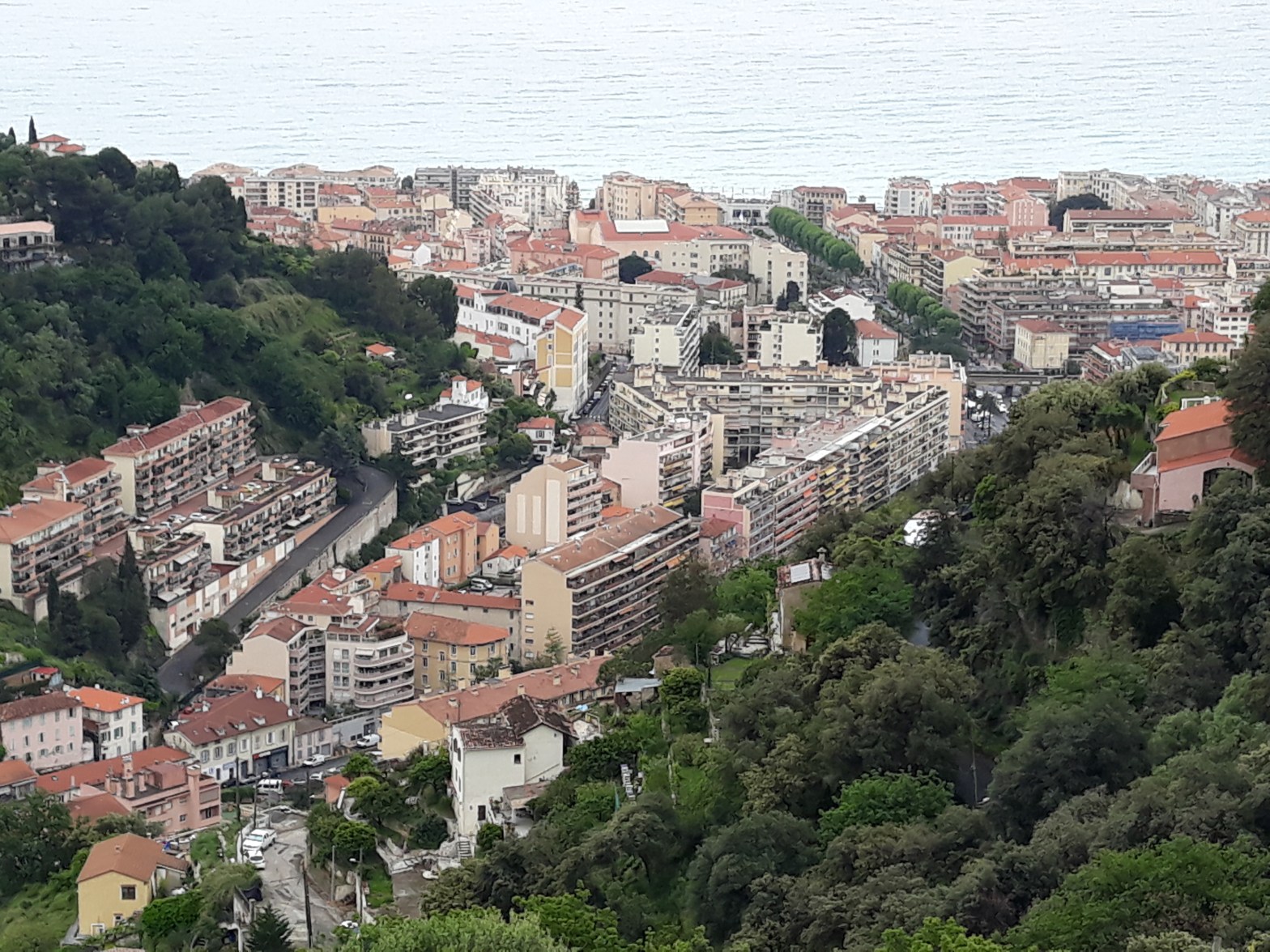
We have a splendid view from our Menton balconies. Not the sea view on the postcards, ours is a view of some trees immediately opposite us and the homes across the road, apartment buildings on the main street and above them villas nestled in an arboreous hill, though I call them the mountains – we are after all at the foot of the Alpes. At the top of the hill, I can see a rounded wall, reminiscent of medieval fortifications, and alongside it some other small pale-yellow building mostly blocked from view by trees. I can just discern a bell tower.

Thanks to Google Maps and Wikipedia, I learned that I was looking at a former monastery with a pale-yellow chapel. The Monastere de l’Annonciade goes back to the times of the city of Podium Pini in the eleventh century, though only used as a monastery between 1866-1999. In 2000, it was bought by an order of nuns who renovated it and opened the chapel to the public.

Taking the path with fewer steps up (only 434 steep thigh stretchers), I used a seventeenth century short cut called le chemin du Rosaire. Walking, I thought about the past lives that once went up the wide stairs clearly intended for horses and mules. Just before reaching the monastery grounds, I stopped to catch my breath and could look down through the budding trees and see the city streets below – one that I thought was my street, with its row of yellow and cream buildings, its parked cars and trees. But I wonder if it was the same street as it looked so different from what I thought it was. Had I gotten turned around along the twisted path?

At the top, the tight world of winding steps enclosed by villas and patches of forest had ended and a wide sky with feathery clouds and mountain tops in the distance lay open before me. The hill was a hill after all and not mountainous in the neighbourhood of real mountains. The chapel was sweet in its simple boxy exterior and austere interior, nothing like the ornate, heavily baroque churches and basilica in the town below.

The stone wall that looked like a fortress when viewed from our balcony, at eye level wasn’t not so tall, a metre at the most. I could easily lean over the stone wall and see the streets below. Our street was immediately recognisable as was our apartment building. Staring a little longer our one-bedroom apartment came into view thanks to recognising our dark blue sheets hanging on a drying rack. Our art works and soft furnishings hidden inside – the apartment was a utilitarian unit of a rabbit warren. From the hilltop the building was a tiny part of a large Lego village with a partial terracotta rooftop I hadn’t realised existed.

With a change in perspective, the monastery up close was different from what I had imagined it from below, and the apartment had altered its appearance when looked at from above. Both monastery and apartment building had transformed in character. One became less foreboding, the other diminished in its importance.

For writers, perspective has two meanings. On the one hand, it’s about tone and the author’s relationship to the subject and characters. On the other hand, perspective is about point of view, the narrative voice of first, second or third person, with variations on third person (an all-knowing narrator, a limited one, etc). The day that I took this little jaunt to the top of the hill, I had been for a few weeks working on a short story, in which an elderly woman has dementia. Her world view is often situated in the past as a young woman. It’s only when someone tells her that she is ‘confused’ that the spell is broken, and she quickly changes her thoughts to something else, unaware of her muddled state. I was writing the story from her perspective using a third person narration, and even though it wasn’t her voice, the focalisation was on her and at times as if a voice in her head speaking back at her. I love writing in this style as it always reminds me of my first encounter with it in James Joyce’s The Dubliners.

During the walks up and back down, I must have had the main character somewhere in my mind. Walking is a writer’s tool next to none, and Wordsworth was known to walk some ten miles a day on average. When I returned from the hill and was on flat land, I suddenly decided to write another version of the story from the perspective of the person who tells her she’s confused. This other character deals with the old woman’s state of mind as if speaking to a child. His inner voice is comic and sarcastic. And so, I persevere.

What I’ve been reading

For nonfiction, The Bells of Old Tokyo: Meditations on Time and a City by Anna Sherman has made for good bedtime reading because it can be read in small segments. I like the premise of the book – to examine Japanese culture and history through its famous bells and the stories surrounding them. The writing is fine and absorbing at times, but when it comes to travelogues and other travel-based nonfiction, I’ve been spoiled by Bruce Chatwin.

I nearly gave up on Wandering Souls by Cecile Pin as I found myself reading yet another story about refugees and their harrowing experiences of escape from terror followed by their arduous attempts at assimilation in unwelcoming countries. This is a story of Vietnamese boat people fleeing soon after US troops pulled out. What kept me going was the texture of the writing. One of the narrators is a child ghost while other narrators come from the family that has survived. In some sections, the story is continued by a newspaper report as a narrator with a more detached tone. These different perspectives enriched the story, making it something else, something outside of this subgenre of fiction.

To close, I’ve been reading brilliant tributes to short story virtuoso Alice Munro. RIP.

Retiring, doing, being

Not doing anything important or worthy of a salary left me feeling a bit lost at first. For all my years of freelancing and part-time employment, I still had the attitude of a career professional. Even if I was no longer career-minded and shimming up the greasy pole, I had made a connection between earning and doing something purposeful and meaningful to someone aside from myself. Being aware that I felt uncomfortable in my retirement skin and deconstructing the reasons for it has weakened the intensity of these negative thoughts. Awareness is always a first step. I no longer think about not earning and its social link to what is important.

I’m still deconstructing the concept of doing – doing something rather than nothing – doing something purposeful or meaningful (words laden with subjectivity). An article by the science writer Ed Young in the New York Times has put perspective on this. He was writing about his fascination with birds and all his bird-watching activities. He writes, interestingly with bird as a verb:

‘Of course, having the time to bird is an immense privilege. As a freelancer, I have total control over my hours and my ability to get out in the field. “Are you a retiree?” a fellow birder recently asked me. “You’re birding like a retiree.” I laughed, but the comment spoke to the idea that things like birding are what you do when you’re not working, not being productive. I reject that. These recent years have taught me that I’m less when I’m not actively looking after myself, that I have value to my world and my community beyond ceaseless production and that pursuits like birding that foster joy, wonder and connection to place are not sidebars to a fulfilled life but their essence.’

Indeed, some of the things I’ve been doing in my retirement have fostered ‘joy, wonder and connection to place,’ or in my case places – Ely, England and Menton, France. Perhaps doing in retirement connects one more to being.

What I’ve been reading

La Decision by Karin Tuille (available in English) is a novel set in the world of the French judiciary soon after the Charlie Hebdo terrorist attack. It’s a glimpse into the world of terrorism and the law that other books and certainly films rarely jump into with such depth and introspection. Told in two narrative strands it has a first-person narrator, Alma, an examining magistrate, recounting her forensic examination of the life and motivations of a young terrorist suspect at a time when her marriage is falling apart – it too, receives an intense examination. The second strand has the terror suspect being interrogated by a judge, presented in the style of a courtroom transcript. Both strands carry personal and social weight, encouraging the reader to experience a range of emotions along the way.

Pompeii by Mary Beard is a book I heard the author speak about several years ago on the back of her TV series of the same name. This historical account updates what we know about the life in the famous town at the time of the volcanic eruption. Savouring the details of daily life, the coverage might be too precise for some readers, and I confess, at times it made for a good bedtime read. I’ve had the pleasure of hearing Beard speak live about Pompeii and again more recently about Roman emperors. What I like about her work is that she spends considerable time looking at the assumptions held by other historians and archaeologists, punching holes in their views and admitting that there still is a lot that we simply do not know. Incidentally, Mary Beard is 69 and is clearly busy doing.

Arrival Menton

My pause from blogland can be attributed to one thing – moving and settling in Menton. If you’ve been following this blog for a while, you’ll know that David and I have had a second home in Nice for nearly 15 years. We sold that and most of the furniture in it back in September and waited five months for the deal to close on our new apartment in Menton, up the coast from Nice. We’re still in the same neck of the beaches, the Cote d’Azur, famous for its year-round sunshine, clement winters and history of artistic and celebrity residents.

Recreating a home in the south of France has involved an embarrassing amount of shopping – from a flatpack bed to drill bits, with a second-hand sofa, dining table, chairs and curtains along the way – and intensive decorating, featuring the massacre of butterfly and floral decals and the removal of in-built wardrobe and cabinets, leaving behind the tasks of scraping off wallpaper and filling vacant screw holes marks with buckets of Polyfilla, soon to be followed by painting. Luckily, no major renovations are needed. We have a tastefully tiled bathroom with walk-in shower and a fully functioning kitchen, albeit with a temperamental washing machine that prefers to work in the mornings.

My bloggery silence hasn’t been just about furnishing and DIY in extremis. This move marks the start of my retirement in earnest, the deletion of the prefix semi before retirement to describe my academic position. I’ll finish my last contract with my final doctoral student in the autumn. That’s all that’s left. My life is now devoid of course writing and research and the publish or perish culture. That is strange – as strange as a local bus trip to Italy, as strange as swimming in the winter sea. Like so many retired people, I’ll continue to ‘keep a hand in’ as they say, taking on the odd editing assignment that comes my way. The difference now is that for the first time in my adult life, I’m not looking for work or trying to keep the work I’ve got.

This naturally makes me think about my other career as a writer. I haven’t considered myself semi-retired from that. I used to think that writers never retire, but some writers have packed it in (Phillip Roth and Wendy Cope come to mind). I’m starting to wonder if I should take at least a partial retirement from writing. This means working to my own pace on fiction and creative non-fiction and still calling myself a writer (it’s too sexy to shake off). This isn’t too different from what I have been doing in recent years, since I stopped scriptwriting and therefore applying for funding, managing a theatre group and delivering workshops. Yet something different is palpable, my ambition, my desire for writer recognition, ended around the time we put in our offer on the Menton apartment.

I can’t stop all together – writing is as natural as breathing and as necessary as meditation. And there still are things to write about – nature, personal growth, language, books…

What I’ve Been Reading

A Little Life by Hanya Yanagihara makes for a long book (700 plus pages) but is also one of the best novels I’ve read in decades. It tackles difficult subjects, like abuse, torture and self-harm, and this can make for painful reading at times. But there are payoffs. The psychological depths of the story, revolving around the friendships of four men over the years and one man in particular, Jude, presents a complex and believable narration. Jude is a perpetual victim, but also a survivor that other characters (and this reader) agonise over and applaud in equal measure.

The Authority Gap byMary Ann Sieghart,written a few years ago, covers the myriad of ways in which men are assumed to have more authority, more knowledge and experience than their female counterparts. By the author’s own admission, you would have thought that this has all been said before and that we have moved on to a more equal co-existence. Yet, it’s something that we know still happens and have become desensitised to and have stopped talking about. Or in my case, being all too aware of this, occasionally I have used my bone-dry sense of humour to point out that I’m the Supervisor and not a mature student or that yes, I really did this [fill in the blank with something technical] all by myself without causing grievous injury. Seighart points out how the authority gap is played out in our actions, individual and institutional, and in our use of language. Specific examples come from a hefty dataset of anecdotes from powerful women, including some of my heroes like Christine Lagarde, Julia Gillard and Madeleine Albright, who have all been undermined and underestimated. Amusing and cringeworthy at the same time.

Seven Days to Tell You by Ruby Soames is a remarkable thriller, full of twists that go beyond the plot-driven variety, questioning the ideas of love and commitment. Since I don’t want to give anything away – discovery and speculation are key to reader enjoyment – I’ll have to be brief. A woman’s husband disappears for three years. To say more than that would even spoil the curious first chapter. I will say this – it takes place mostly in London, but also has flashbacks to the French Riviera, hence, I conclude this blog from where it began.

Our new street in the Carei valley in Menton.

The falling centre

I’ve been absorbed in Jon Ronson’s BBC podcast, Things Fell Apart, about the origins of the culture wars going on in the West, especially in the US. It uncovers misunderstandings, misrepresentations and conflations that have morphed into the polemics of our times.

Ronson was recently interviewed in the New Yorker where it was noted that the title of the podcast comes from the W.B. Yeats poem ‘The Second Coming.’ When questioned about the centre crumbling and if he was trying to achieve a centre, his answer included: ‘For me, “things fall apart, the centre cannot hold”—it’s a sort of human centre of being curious and trying to understand people’s perspective and look for the nuances. It’s not the centre that, to be honest, the centrists talk about.’

This resonated with me as in recent years I’ve struggled to call myself a left-of-centre person. Politically, as the right becomes the far-right, the centre is tilting towards the right. Socially, what was once left-leaning liberalism has edged towards the acceptable centre. I don’t know what left or centre are anymore. Ronson’s humanist and less political take on this is a far more comfortable space for me to inhabit. It can also be found in Buddhism and in the self-therapy promoted by Judson Brewer (who helps people overcome anxiety and addiction). Both are integral to my daily life – my ‘practices’ as I call them. Yet, until I read Ronson’s comments, I wouldn’t have seen them as a kind of centrism – but now I do.

What I’ve been reading

Mostly, things Italian, though not intended to be a thematic spell of reading. Filling a gap in my George Elliot education, I thought I’d give Romola a go. It’s not her best work, written when she was steeped in philosophy and translating Spinoza, the novel comes off as a vehicle for ideas and debates rather than the evolving narrative and character study I would expect. It’s set in 15th century Florence and has been praised for its historical detail. Readers might also find it enjoyable in a nerdy way for its use of Latin and Italian.

A much better read was Elena Ferrante’s The Lying Life of Adults (translated into English by Ann Goldstein). Set in Naples and its environs like most of Ferrante’s work, the protagonist is a teenage girl dealing with her parents’ divorce, interfamilial feuds and the onset of womanhood. It’s full of memorable and gently humorous characters and renders deception into a truly creative act.

This Italian journey ended with Robert Harris’s Conclave, set in the Vatican during the election of a new pope. It has the intrigue that one would expect from Harris, along with his attention to liturgical detail and in this case a seasoning of Latin, culminating in a cracking good ending (I’ll stop myself there as this is a non-spoiler zone).

To close, and having nothing to do with Italy, the death of N. Scott Momaday last week has had me reading his poems again. Masterful.