Brexit:  The next steps for this activist

Working with grassroots organisations like Ely for Europe and the European Movement is one way of tackling a problem like Brexit. It’s helped me to become better informed on the issues and to participate in the protest against the inanity that is Brexit. While I’ve had the honour and pleasure of Co-Chairing Ely for Europe over the past two years, I’m now stepping down from my chairing post. I’ll still be involved with the group and on their committee. But if there’s one thing I’ve learned from years of volunteering it’s that the helm has to be passed around from time to time to keep others involved and to ensure the group doesn’t become a clique.

So, what now? In a matter of weeks, the big decisions concerning Brexit will be made, whether it’s how we’re going to leave the EU or if battle-weary politicians seek to save face by implementing a people’s vote. Much of this will be in parliament’s hands. This leaves me with the feeling that a lot of my work has been done on the Brexit front.

I’ve been getting more involved with local politics and the workings of the local councils – in Ely, we have city, district and county levels. I’ve been somewhat involved in the past, but stayed on the fringes. My willingness to plunge in – if I’m not mixing my metaphors – has come from a sense of hopelessness at the national level. In Britain, our politicians have let us down. They aggressively spout forth on the ‘will of the people’ but seem blind to the majority of polls and surveys over the past two years showing that most people in Britain do not wish to leave the European Union. Before that, there were austerity measures and the growing gap between rich and poor. Anyone who has been following British politics will tell you that these ills are entangled in party politics and not in the best interest of the country. That is, we’re not talking about competing ideologies – we’re talking power games.

Last night I was having drinks with friends from America and South Africa. International travellers, broadsheet readers – yes, I know, the chattering classes. Our consensus:  Britain was turning into another Italy. The political sway of Nigel Farage, the popularity of Jeremy Corbyn, the bumbling incompetence of Boris Johnson and Therese May are paralleled by Berlusconi, Matteo Salvini and so on. Britain, like Italy, has become a laughing stock. But what makes Italy work, and has kept it working since the war despite political chaos at the top, has been local governments and concerned citizens. With that thought in mind, I take my next steps.

Standing Up to Racism and Fascism

Is it a multi-circled Venn diagram or a spider-gram that will best illustrate the connections between Nigel Farage, Steve Bannon, Geert Wilders, Belgium’s racist-right politician Filip Dewinter, current UKIP leader Gerard Batten, Donald Trump and British Nazi Tommy Robinson? It would be too easy to draw circles and lines around the racist and fascist ideas these political figures have come to represent. What also connects these men is far more disturbing. They have all publically endorsed at least two of the names on this list and in doing so have helped to spread each other’s popularity and toxic beliefs. They’ve succeeded in making the hate-filled lone wolves across the West feel and act as members of an international pack.

This wider picture makes a lot of us feel out of control and helpless. Of course, we can always find like-minded people amongst our friends, co-workers and fellow liberal activists. We can choose to read the newspapers and follow on social media those who share our anger and disgust. These things might take the edge off, but it wasn’t until this past Saturday that I found a more satisfying way of confronting this barbarism – by yelling at it.

On a hot Saturday afternoon in Cambridge, a couple thousand protesters gathered to rally and march against another march planned by a group of Tommy Robinson supporters. For my international readers, Robinson is a former leader of the far-right English Defence League who is currently in prison for contempt of court. His supporters, including Steve Bannon, Nigel Farage, Geert Wilders and Gerard Batten, want him released from prison on grounds of freedom of speech. (See what I mean about Venn Diagrams.)

A small group (perhaps 200) of Robinson’s lesser known supporters appeared at the march in Cambridge. We easily out-numbered them – which is intensely empowering.  Unlike Trump’s visit to the UK earlier that week, these racists/fascists were within earshot and I felt justified in participating. Will our screamed chants of ‘Nazi scum off our streets’ change the minds of these fascists? Of course, not. Will they think twice before they return to Cambridge for another march? Maybe. Just maybe.  And that’s worth holding on to. Aside from the obvious therapeutic effects of yelling at these racist/fascists characters, I’d like to think these groups lose some of their influence and power to directly offend each time they’re pushed away.

National Democracy Week 2018

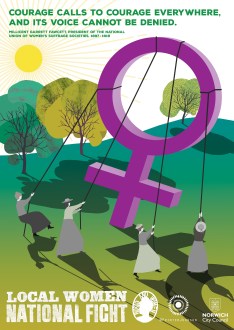
It was last week. Yes, I missed it too. If it weren’t for an email I received with a couple of suffragette posters, I wouldn’t have known about it at all.

This inaugural week to pay tribute to democracy in Britain ran from the 2nd to the 8th of July. The date was chosen to mark the 90th anniversary of the 1928 Equal Franchise Act, which gave women the same voting rights as men. Women had gained the right to vote here ten years earlier, but that right was limited to women over the age of 30 who had property – in case you were wondering why we’ve been celebrating in recent months the centenary of women getting the right to vote.

I received my posters to celebrate democracy a few days before the start of the week. Vaguely curious, I put them aside, expecting to hear more about it through the media. But I saw nothing on it when I watched BBC or Channel 4. In the UK newspapers I typically read – The Guardian, The Observer, The Independent, The Times, The New European – there were no reports or commentaries to do with National Democracy Week. Without some sort of reminder and with too many other things clambering for space in my head, I easily forgot about it.

I do wonder if the lack of fanfare or even interest in National Democracy Week had anything to do with what was going on last week. England winning a place in the World Cup semi-finals and the rescue operation for the Thai boys and their football coach trapped in a cave dominated our casual news talk – and they have nothing to do with democracy. In the middle of the week, democracy appeared in the form of freedom of speech when London Mayor Sadiq Khan gave permission to anti-Trump protesters to launch an angry baby Trump balloon during the US president’s visit. Whether such permission should be allowed is still being debated as I write. The week ended with our PM presenting her Brexit proposal to her cabinet ministers at a secluded day retreat at Chequers. This involved an elite group within a minority government agreeing to a proposal that they know will likely be rejected by the EU. To make this exercise in democracy even more futile, two days after agreeing to support the PM, two of the ministers resigned in disagreement.

Perhaps National Democracy Week decided it was best to keep a low profile.

National Democray Week 2
This and the featured image are the posters designed by Vicki Johnson.

Having realised that the celebrations had passed me by, I went to the government website to see what I missed. I clicked on ‘events’ and was sent to another webpage, where I could click on ‘events’ to find events in my area. That brought me back to the first page where I had clicked on ‘events.’ I was in a loop. What an appropriate analogy for our modern democracy. It appears I’ve participated after all.

To Protest or Not To Protest

To quote Albert Einstein, ‘If I remain silent, I am guilty of complicity.’

President Tr**p arrives in Britain on Friday the 13th of July. (Supposedly – he could cancel at any minute.) When I first heard about this visit some two months ago, my gut instinct was to appear outside Downing Street with a placard saying ‘Women of the World Against Trump.’ This sign would sum up a number of issues ranging from ‘grabbing pussy’ to cutting off overseas aid for women’s health.

But two months is a long time in the hate-filled-mud-slinging world of this US president. Since the announcement of Tr**p’s upcoming visit, the US has pulled out of the Iran nuclear deal, the US Embassy has moved to Jerusalem (unravelling decades of diplomacy), some 2000 migrant children have been separated from their parents and put into detention centres, without tougher gun laws another 25 mass shootings occurred in America (including one yesterday at a newspaper in Maryland – hard to separate this from the anti-media atmosphere of this president), and now his Muslim travel ban has been given the go ahead. While all of this is going on, a slew of environmental protection laws are being axed. There’s simply too much to protest against and not enough placards to go around.

On the other hand, I wonder if I should show up at all. POTUS seems to thrive on attention, positive and negative. Since most of what he does is deserving of a negative response, I fear that giving him attention is going to produce more of the same. That is, we need child psychology for dealing with this man-child.

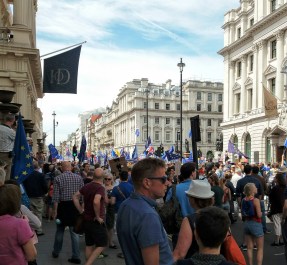
I also wonder about the power of protests. That sounds like a contradiction coming from me. Yes, of course, I was in London Saturday among the 100,000 plus anti-Brexit protesters demanding a people’s vote of the final Brexit deal. And it was a success. Our protest was the lead story on most of the news programmes that night and on the front covers of most of the newspapers Sunday morning. The initial analysis from the political pundits is that this protest sent a message to the minority of hard Brexiters in government and possibly the inert Jeremy Corbyn, along with jump starting some of those remainers who have given up the fight. That’s all fine and good.

protests against trump 2.jpg
People’s Vote march 23 June 2018.

A protest against Tr**p is another matter. It’s likely to be on the news, but what kind of message is it going to send? There’s no single solid message or legalisation coming up (as in the case of Brexit) to be impacted or potential votes to be lost by protesting against him.  Tr**p has secured his Alt-Right base, held on to reluctant Republican support with tax cuts and corporate welfare and normalised his hateful and child-like rhetoric through saturation.

Returning to Einstein, I refuse to remain silent. But I think there are more effective ways than another street protest for confronting Tr**p and all his nastiness. From this side of the Atlantic, petitioning and writing to our own governments to stand up to this US president on particular issues is a start. So too is supporting the many NGOs, such as Amnesty International and NRDC (Natural Resources Defence Council), whose organised lobbies and legal teams have a fighting chance. With these ideas in mind, this time, I’m staying at home with my cardboard and placard stick.

Brexit Bullies

No, this is not about The Daily Mail, Boris Johnson or David Davis. Nor is it about high-profile victims Gina Miller, Supreme Court Justices or Peers in the House of Lords. This is far more personal.

We think it started during the EU Referendum campaign, when my David and I discovered that an egg had been thrown at our front door. Ours was the only house at that end of our long street with a Remain sign in the window. We didn’t think at first that the splattered egg had anything to do with politics. When we entertained the notion, we quickly dismissed it. After all, we live on a street with pedestrian traffic between the convenience store and the primary school. It was probably kids mucking about. We also reminded ourselves that we live in Ely, among other things a dormitory town for Cambridge with its universities and high-tech businesses – people who are likely to vote remain.

Those explanations have been reconsidered and our analysis has been rewritten in recent days after the rear windscreen wiper of our car had been torn off – no easy feat. It had happened during the night. But why our car when we’re at the brightly-lit end of the street? Straight away we suspected that this act of vandalism had something to do with the small EU flag in our front window – the only EU flag on our street and only one of a few in the whole town.

The gooey broken egg and now a part of our car. We were feeling targeted.

I’ve been on the wrong end of bullying before, once at a job and at other times in my own family. But my past experiences with bullying had some sort of logic to them, an acting out of envy, with the intention of removing me from the scene. That is, I held meaning in the lives of the bullies.

When an absolute stranger(s) attacks, one wonders why. Instead of acting out of envy, these aggressive brexiteers are likely acting out their anger that Brexit is not going the way it was planned or promised – the NHS is not going to receive more funds, in fact, it’s losing staff – the great trade deals with America and Commonwealth countries are laughably unlikely – problems with the Irish border could result in a fudged Brexit within the domain of the EU – to name a few.

The displaced anger is obvious, the intent less so. Do these vandals think that their actions will turn me into a brexiteer? Or are they trying to scare us into removing our signs and flags so as to not advertise that there is an organised movement against their views?

I filled in an online police report about the ripped off windscreen wiper. After giving all of the routine information – make, model, location, damage etc. – I was asked if I suffered any personal physical or mental injury. I ticked the mental injury box without hesitation. I was upset and shaken and felt vulnerable. This triggered another box to appear, asking if I wanted to join a support group. Really? Is there a support group for people who have had their cars vandalised? Or better still – is there a support group for people who have been bullied by brexiteers? This latter group I imagine would be full to capacity and I’d have a place on one of those notorious NHS waiting lists.

enemies of the peopleThere’s also the possibility that I’m all wrong. Our egg-stained door and damaged car could be coincidences and could have nothing to do with Brexit.  But in the socio-political climate we live in, an innocent explanation is hard to contemplate. I guess I’ve been writing about The Daily Mail and its political heroes after all.

Rosewater: another side of journalism

Based on the best-selling memoir Then They Came for Me, Jon Stewart’s film about journalist Maziar Bahari serves as a reminder of how fragile freedom of the press can be. Rosewater chronicles the capture and imprisonment of the Iran-born Canadian journalist, who was arrested for filming protests in Iran against Ahmadinejad’s dubious victory over Mousavi. Bahari was charged with espionage and for 118 days underwent Kafkaesque interrogations and torture along with being held in solitary confinement.

For fans of Jon Stewart and The Daily Show, there isn’t much humour in Rosewater. It nonetheless is aware of an entertainment value, taking mise-en-scène and cinematography into artistry. The narrative is also for a more discerning audience. Instead of following the formula of scenes cutting back and forth between the prisoner and his distraught family, we see the imprisonment through the eyes of the prisoner. As he doesn’t know what his wife or his colleagues are doing to secure his release, we don’t see any of that until quite late in the story and only when Bahari learns that Secretary of State Clinton is trying to get him out. A brief flashback follows, filling us in on the parallel story of family, colleagues and news coverage, mixing Bahari’s imagination with the true happenings. The same drama in the hands of another director, say Ron Howard, would have followed the more traditional formula and milked the family story, especially as the wife was pregnant at the time.

Bahari is just one among many journalists who have been arrested, detained, even killed for reporting events that expose flaws in governments or protests against them. We see this in Erdogan’s Turkey, in Iran, Syria, Myanmar and Trump’s America, to name a few. These cases of attacking the messenger are even more disturbing at a time when so-called democracies are accusing the media of producing fake news. Of course, we are bombarded with fake news, politically bias news and what I call propagandist’s news (as in The Daily Mail in the UK and America’s Fox News). As odious as some of these can be, they do have a right to express themselves. It just puts more demands on the public to fact check stories and to support the more reputable news outlets. I make that sound easier than it is – which brings me back to Rosewater and the case of Maziar Bahari. Journalism has become a more complex endeavour, a multi-sided object, where one side risks obscuring the other.

I conclude this look at another side of journalism by purloining a campaign slogan from Amnesty International – Journalism is not a crime.

Brexit: Time for a People’s Vote

Writing in anger is a lot like speaking in anger. It’s soon laden with regrets. With that in mind, I waited some days before writing about a couple of recent infuriating incidents.

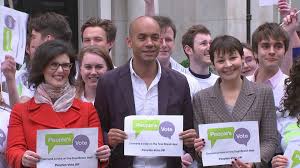
Incident 1 – As I was handing out leaflets about a People’s Vote on the final Brexit Deal, one person angrily barked at me, ‘We already voted – it was democratic.’ To which I said, ‘So is this – that vote was nearly two years ago.’ As is often the case, this person stomped off in a huff before I could say anything more.

Incident 2 – When I mentioned to a friend, who had surprised us all by voting Leave, that I was supporting the People’s Vote campaign, he dismissed it, saying ‘it’s trying to overturn a democratic vote.’ I was offended by this suggestion that I wasn’t being democratic – so offended that I couldn’t answer to it, and I usually do answer to his comments about Brexit. While I tried to find my composure and words, the dinner table, full of chatter, quickly changed topic.

Thank the gods for blogs – here’s what I wanted to say.

What kind of democracy do we have in the UK? It’s certainly not winner-take-all. After a general election, the winning party isn’t the only party in parliament. As other parties win constituencies, they too are represented and have a right to debate and vote in parliament. Okay, we know that referendums aren’t quite the same thing.  But PM Theresa May has interpreted the EU referendum result in a way that alienates about half of the country, giving the losers nothing and referring to us remainers, us ‘citizens of the world’ as ‘citizens of nowhere.’ If the PM and the Brexit elite in her cabinet continue down the road to a hard Brexit, those who didn’t want any Brexit or who expected a soft Brexit have not had their voices heard. I have a hard time seeing the democracy in this – unless of course, the people can vote on the final Brexit deal.

Democracy, no matter how you define it, also didn’t end on 23 June 2016. Things have happened since then.  Trump has been elected. He’s a libertarian protectionist and cannot be counted on for a good trade deal. Nor can we count on the Commonwealth countries – India has already snuffed us on trade without a loosening of visa restrictions. As the Brexit wheels have started turning, trade deals aren’t the only items to start falling off the cart – the Irish border, the Customs Union and Euratom, to name a few. I don’t recall these points coming up during the referendum campaign and now they’re key issues. And let’s not forget that since the vote in June 2016, we’ve had a general election. Result: the pro-Brexit government lost its majority. Now we’re being led by a minority government being bolstered by a political party that most of us in the UK cannot even vote for – or more importantly, vote out of power. The only way to counter all of these changes is a people’s vote on the final deal.

End of rant.

Obviously my opposition to Brexit has generated a lot of anger in me. While anger is often an emotion that can impede reason and turn grown-ups into children, it can also be useful. I’m hoping that enough British voters, angry at being duped during the referendum campaign or angry at the minority government’s ineptitude at Brexit negotiations, can put their anger to good use and demand a final vote.

peoplesvote2

Women, Power and Mary Beard

FawcettThe Fawcett Society’s latest Sex and Power Index is a reminder that outrage and publicity aren’t enough. The study showed that in the UK, women currently make up just 6% of FTSE 100 CEOs, 16.7% of Supreme Court justices, 17.6% of national newspaper editors, 26% of cabinet ministers and 32% of MPs. I’m experiencing déjà vu. A few times a year, figures like this come out, whether from the UK, US or some international organisation. The women’s marches of the last couple of years and the media frenzy over Harvey Weinstein and #metoo seem to have had little impact when it comes to placing women in positions of power. This is made even more appalling by the fact that over the past decade women have surpassed men in numbers entering higher education – that is, we can no longer say that women aren’t qualified for such positions.

This brings me to Mary Beard, the Cambridge don and television classicist, whose recent book Women and Power: A Manifesto addresses this horrendous imbalance. While she gives some attention to modern examples where women in positions of power are treated differently and more negatively and sexually than their male counterparts – think Hillary Clinton – Beard looks mostly to history and ancient writings for the roots of misogyny and power relationships. She’s a master at relaying such accounts and the book is well worth a read.

But again, I experienced some déjà vu. Other feminist writers have pointed out the historical and institutional oppression of women. Gloria Steinem, Germaine Greer, Betty Friedan, to name a few.

I find some solace in the fact that Beard’s book has sold well and comes out at a time when a new generation of feminists is emerging. I do hope these young activists heed the advice on the back of Beard’s manifesto: ‘You can’t easily fit women into a structure that is already coded as male; you have to change the structure.’

A week in the life of a pro-Europe activist

Saturday: Spent one and a half hours in bitterly cold Ely Market Square working at the Liberal-Democrats’ Exit-Brexit market stall. One passer-by screamed at us, once he was far enough away to avoid conversation “The majority voted!” Another man blames the EU for Eastern European workers. I briefly told him how Britain invited Eastern Europeans here in 2004 and that other EU countries have different immigration policies – but I stopped myself. I’m grateful Eastern Europeans are here working on our farms and in our hospitals, making our country culturally richer. The man continued to say that because of the EU he can no longer go to his local pub.  At that point, I gave up and stepped away.

Sunday: Too cold to go out. Stayed indoors and wrote my blog about hearing Lord Adonis addressing Brexit issues earlier that week at a town hall meeting in Peterborough.

Monday: Ely for Europe co-chair Virginie stopped by with Open Britain and European Movement surveys. We discussed a strategy for getting our members to fill them in and get people they know to fill them. With hostilities in the post-referendum air, we can’t expect people to knock on strangers’ doors.

Tuesday: Sent an email to MP Lucy Frazer about the debate on how Brexit will impact the NHS in Parliament scheduled for Thursday. Urged her participation. Started following Lord Adonis on Twitter.

Wednesday: Signed online government petition demanding that the Referendum vote be made null and void due to illegal activities and influence surrounding Cambridge Analytica. A long shot, but worth a try. At least the act of signing the petition felt good.

Thursday: Attended a Q+A session hosted by Ely for Europe with MEP Alex Mayer. Met more pro-Europe supporters, mostly from Labour. Left the event thinking that maybe it’s not a matter of hard Brexit or soft Brexit. It might be a symbolic Brexit that does the trick. In March 2019, British MEPs leave Brussels (and lose their jobs) and the Union Jack is lowered. With the new passports, these gestures might be enough for the Brexiters. Other issues to do with trade, borders, funded research and so on could remain in limbo for years as people in the EU and Britain work around them, effectively remaining linked.

Friday: Learned that 15 cross-party MPs stood up in Parliament to debate how Brexit will impact our NHS – none of them was MP Lucy Frazer. No evidence that she was even there.  Engaged in stealth activism by delivering pro-Europe flyers from the Lib-Dems and the European Movement to unsuspecting letterboxes. Very satisfying and less angering than working market stalls.

Saturday (in France, a week is 8 days): Attended Exit Brexit march in Ipswich. Excellent turnout with pro-Europe groups from across East Anglia. On the train returning to Ely, while reading The New European, I looked up a few times at the flat landscapes, the farms, the villages and wondered what the future holds.

Reading Lolita in Tehran

Even though I’ve done research into reading groups, until recently I hadn’t read Azar Nafisi’s best-seller Reading Lolita in Tehran. While it’s not an academic source for me to cite, it does confirm what the research has found. Simply put, reading is a social activity. We might read a book in a room or on public transport in our own little worlds, but then we talk about books and we integrate our experience of books into our social lives.

Reading Lolita in Tehran uses the reading group, along with classrooms of university students, as vehicles to describe how the revolution in Iran has affected its people, especially its women. It details stories of injustice and oppression in the lives of Nafisi, her students and colleagues, taking readers through the uprisings against the West and the Iran-Iraq war to the post-war period followed by the death of Ayatollah Khomeini and the attempts at liberalising that continue today. (Bearing in mind, the book was published in 2003.)

The reverence for literature permeates throughout this memoir. Along with Lolita, the author covers Daisy Miller, The Great Gatsby and Pride and Prejudice, showing how she and her students reacted to these works. In her own responses, Nafisi provides some passages of literary criticism of the type that reminded me of my years of teaching literature to undergraduates.   Reading Lolita 2

I’m glad that I’ve finally caught up with Reading Lolita and hope to find other such books obviously written for Western audiences that contribute to understanding the Middle East in a modern context.