A Cross-Party Spirit for the Pro-Europe Movement

As party politics in Britain is being reshaped – maybe to the point of extinction – I find myself increasingly involved in cross-party events. This week it was a town hall style gathering billed as a ‘Brexit Listening Tour’ in Peterborough and led by Lord Adonis, a Labour Peer. The attendees for the most part didn’t identify themselves as belonging to or supporting one party or another. Those who did label themselves came from Labour, Lib-Dems, Greens and Conservative parties. Naturally, no one from UKIP, but I suspect they’re not in ‘listening’ mode these days.

From the timing of the applauses, along with the comments and questions, this was clearly an event for those who want the UK to remain in the EU. If you’ve been following my blogs, you know that this is not the first time I’ve been to such an event.  Adonis

I came away from the evening invigorated and inspired to get back to the type of face-to-face activism that I do when I’m back here in Ely. I also came away with a few points worth sharing.

First of all, perhaps the time has come for Brexiters and Remainers to unite against our government for running the simplistic in/out referendum in the first place. It’s easy to accuse the Brexiters of lacking knowledge as there was no mandate in the referendum explaining how we would leave, along with the assumptions (and lies) that made people believe that leaving the EU would make Britain better off. Even though those who voted remain obviously had some sense of what it would be like to stay in, there were still many things about how the EU works that Remainers- and I include myself in this- simply didn’t know. Had we known more about the customs union, the various immigration policies across EU member states, or the problems now facing Ireland and Gibraltar, our arguments would have been different.

Secondly, let’s not forget that Brexit is a symptom of the problems the UK has been unsuccessfully dealing with for the past few decades. Problems like unemployment, housing and a weakening health care system.  Perhaps this point is just another angle on looking at how the pro-leave vote was really a protest vote against life in Britain. Labour, the Greens and the Lib-Dems could easily unite on tackling these problems along with undoing the mess that has become Brexit.

A final point is more a turn of phrase than a point. It’s an answer to the tabloid press and The Daily Telegraph which continue to publish stories about the NHS being drained by immigrates and their children needing medical services. One of the attendees at this cross-party event said ‘You’re more likely to be treated by an immigrant than you are to see them in the waiting room.’  Well said.

Work/Not-Work

When I first heard about a universal basic income, I thought it was a pie-in-the-sky idea, the product of navel-gazing and not living in the real world. Reading George Monbiot’s Out of the Wreckage, I found someone else who initially reacted to universal basic income as I did. But he’s changed his mind – so have I.

Out of the Wreckage only spends a small amount of time on UBI. It does cover the key points. UBI is an income paid to every adult, regardless of employment, poverty or attempts to find work. As it would replace complicated needs-tested welfare with a leaner, less bureaucratic system, many believe it could cut poverty and inequality. Others are looking to UBI as a way of dealing with chronic unemployment brought on by automation. Small scale trial studies – such as in sectors of Finland’s workforce, towns in Brazil and in poverty-stricken regions of India – have been successful so far.

But the success of any such scheme starts with individuals and communities and this is at the heart of Monbiot’s doctrine. Monbiot makes the point that identifying ourselves as, or being, our jobs feeds into an unhealthy protectionism of jobs. This protectionism can override the best interest of communities, national economies and our natural environment. The other weakness inherent in thinking of ourselves as our jobs is the stigma attached to those who do not have jobs. I confess, as you may have read in an earlier blog, my sense of identity comes largely from what I do for a living. I’m having a rethink.Monbiot

Monbiot’s book is also a worthwhile read for the way it explains the damaged done by neo-liberalism (a misnomer if I ever heard one). Unlike other authors who tackle this subject, Monbiot goes beyond describing the flaws of neo-liberalism in terms of deregulation, outmoded economics and capitalism run wild – we’ve all heard these points before.  Monbiot looks to the psychological and social ethos of our age and asks readers to rewrite the story we are living and draw from our cooperative nature and community spirit to supplant the ways of corporations and governments.

In this context, where financial and administrative pressures could be taken off the government with more community participation and less plutocracy, the idea of some sort of universal basic income fits in and perhaps stands a chance.


#SchoolShootings

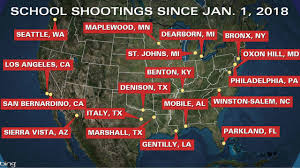
I asked my Facebook friends that I grew up with in Chicago if they remember having fears about mass shootings when we were at school in the 60s and 70s. Like me, they didn’t. Mass shootings at schools were unimaginable.

These friends did however remind me that there were a couple of bomb threats at our grammar school. This was around the time of the Vietnam War and soon after, when radical social movements were placing bombs in busy public places and government buildings. These bomb threats were taken seriously and we all responded to the fire alarm, forming pairs as we hurried out to the playground and baseball diamonds. No bombs were ever found – another hoax inspired by stories in the news.

Aside from the bomb threats, school for my classmates and me was a place of safety – though perhaps more so for the girls than the boys. I’ve learned through this little Facebook chatter that in highschool the boys had to deal with other boys acting tough and gangs picking fights at school sports events.

Our fears of crime and violence came from the world outside of school. We couldn’t go out by ourselves at night. Even a pairing of females felt their lives were at risk after sunset. During my childhood I knew of three teenage girls who were raped on the streets by strangers. A couple of others were attacked at knifepoint, but managed to escape thanks to the help of passers-by. I too had an incident of being followed by a man who had first approached me with his dick hanging out. (Another #metoo.) I hurried passed him and turned the corner. As I neared our building, I saw an apartment with a light on and waved and yelled out as if I saw someone I knew. The creep ran off.

It may not have been halcyon days, but it didn’t include mass shootings. We were, after all, before Columbine. That seems to have been the first. There’s an excellent article on this chain reaction written by the always brilliant Malcom Gladwell.

schoolshooting 2

I don’t think this problem is going to go away in the current mind-set that is sweeping America – especially with its NRA-funded think tanks and politicians. I am, once again, grateful that I’ve emigrated away from the US. Britain and France have their problems, but they don’t allow them to have assault weapons. I’m also grateful at times like these, on the back draft of a recent shooting, not to be in America, embroiled in the polemic. From Europe, I’ll stick to the occasional Twitter and Facebook postings – thumbs up to anyone who points out that this is utter madness – and the reminiscences of my former classmates – thanks for sharing, guys.

Clegg’s How to Stop Brexit

Based on the reviews, I almost didn’t want to read it – it would have been too painful. When Nick Clegg’s book How to Stop Brexit first came out, the media focused on Clegg’s advising people to join the Labour Party. As this isn’t what one would expect from a former leader of the Liberal Democrats, it made for attention-grabbing headlines and news-straps.  Finally, I braced myself and read the book – and saw his remarks in the context they deserve. What he actually does is first to acknowledge that Britain is well and truly a two-party country at the moment and that it in within the two main parties that Brexit could be stopped. By joining Labour or the Conservatives (he says that too), a voter will have more opportunities to effect change in those parties, bearing in mind that both parties are internally divided between Leavers and Remainers. Clegg isn’t asking anyone to leave the Liberal Democrats. Instead he’s appealing to those who are inclined towards Labour or the Conservatives to join those parties and become more involved in their Brexit positions. This is especially the case for the Labour-inclined as this is the current party of opposition – well, at least they’re supposed to be. Joining the Conservatives is less helpful as most of the Conservatives MPs who voted Remain have been whipped into line to follow the disastrous path towards Brexit.

Clegg also makes a good point by reminding us that in 2004, when the EU expanded by including countries from the former Soviet Union, the pre-existing EU countries had a choice about whether and how to receive immigrants from these new EU-member states. Only the UK, Ireland and Sweden had an open-door policy. Other countries, such as France and Germany, imposed restrictions on the number of immigrants and the employment sectors they could work in. In other words, for those pro-Leavers for whom immigration from the EU has clearly been an issue, we cannot blame the EU for choices that we made. Of course, I, like Nick Clegg, think that these were good choices, filling in sectors of our workforce – on top of the many ways British life has been enriched by these other cultures.Clegg book 2

Other points in the book were ones that any Pro-Europe activist has heard before.  A bit of preaching to the choir, though I did enjoy Clegg’s turn of phrase: ‘The battalion of greying Conservative MPs you have never heard of, the shady financiers of the Brexit elite, the loopy rantings of Paul Dacre… all of these people fought  relentlessly for Brexit, over many years, long before the term ‘Brexit’ had even been invented.’

Another quote that made me nod in agreement and wish I had said it in my little blog: ‘By choosing the hardest of Brexits, by attacking them [remain voters] as “citizens of nowhere,” Theresa May made the extraordinary choice to de-legitimise and ignore the millions of people who voted for a different future.’ It was indeed extraordinary and angering as such remarks cut against the structure of our democracy, implying that we have a winner-take-all approach to elections. I’m surprised that more people haven’t caught out Theresa May on this.

Of course, I recommend this book but given its bold title, I fear that the only people who will take me up on this recommendation are those Pro-Europe activists who don’t need to read it.


A Couple of Books About Tr**p

Now that the buzz around Michael Wolff’s Fire and Fury is starting to fade – being side-lined by the Commander-in Chief’s latest verbal tantrum – I’m taking a step back and looking at a couple of recent books about the most shambolic US presidency in living memory.

Based on reading excerpts of Wolff’s book in the press and skimming and reading sections from the online-bootlegged copy that’s floating around, I can say that there were few surprises. White House pundits have been reporting for months on the president’s eating habits, idiosyncrasies, aversion to books, toddler-like attention span and lapsing memory. The power in this book rests not so much in its confirmation that this president is unfit for office – the world is witnessing this in a near-daily basis – but in the quotes from Steve Bannon. Trump’s former Chief Strategist, involved in both the presidential campaign and the early months of the presidency, describes Trump’s campaign as having a ‘treasonous’ meeting with Russian officials. This is significant. The FBI’s Russian investigation is moving closer to Trump while at the same time looking into the White House cover up, culminating in the firing of FBI Director James Comey. The FBI Director’s dismissal is also described by Bannon as a concerted effort to ‘get him’ led by Jared Kushner. These are serious allegations that could be part of Trump’s undoing if the Republicans lose their majority in Congress after the 2018 mid-term elections. (The other part might come from the international community.)fire and fury

Having said all of that, the better book of recent months on the subject of Trump is the one that doesn’t even mention him by name. Sam Bourne’s fictional account of how Washington insiders cope with a narcissistic, racist and misogynistic US president is by far more interesting and informative. To Kill The President might be fictional, but it relies on knowing the workings of the US government and its laws. The premise is a simple one and one that has been in many of our imaginations for over a year now – what if the US president is insulted by North Korea leader and decides to teach him a lesson by ordering a nuclear attack? In this story he’s stopped for the time being by White House staff and Pentagon officials who trick him into thinking the North Koreans have apologised. Given that, legally speaking, the president could order such an attack without congressional approval, this event triggers concerns about the president’s mental instability. Once it’s realised that getting rid of the president based on mental health is constitutionally difficult to pull off, an assassination is planned. The story uses all of the plot twists and devices that one would expect of a thriller – a murder, a cover-up, secret codes and blackmail. Like a popular thriller, the writing is straight forward and not the stuff of literary fiction. But it’s nonetheless enjoyable for its satirical humour that edges close to the reality we find ourselves in during the era of Trump.

Bourne’s book is full of many quotable remarks from these insider characters.  I’ll close with this one, which comes from Mac, the president’s Chief Strategist and staunch ally (a fictional Bannon perhaps):

These liberals soiling their Depends undergarments about truth. They never stop! Always going on about facts and evidence and all of that shit, even when they have the biggest possible dataset showing them – proving to them – that the American people do not give a rat’s ass about any of it.

The ‘dataset’ that he refers to is the election – the votes that won the presidency.

Rape on the Reservation

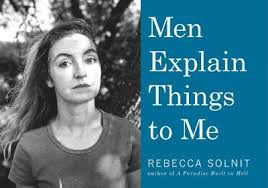
When I read this account in Rebecca Solnit’s much praised book I was initially horrified, soon followed by incredulous. According to Solnit’s essay, written in 2013, ‘…one of three Native American women will be raped, and on the reservations 88% of those rapes are by non-Native men who know tribal governments can’t prosecute them.’ I didn’t doubt the figures, given the economic deprivation and alcoholism found on Native American reservations. But the idea that there’s some governmental loophole that makes rape legal didn’t seem right. I did some research.

In 2013, Solnit was right to say one in three Native American women were raped in their lifetimes. Solnit was also roughly accurate as I found figures between 86% and 87% for the times these rapes occurred on the reservations by non-Native men. But it’s not completely true that non-Native men couldn’t be prosecuted.  It’s more complicated than that. Since 1978, tribes lost the right to arrest non-Indians who commit crimes on their lands. If the victim and the perpetrator were non-Native, the case would be handled at the county or state level. If the victim was Native American and the perpetrator non-Native, only a federal officer could make the arrest and the case held at the federal level. With these complications, fewer cases were being reported and prosecuted. Around the time Solnit was writing her essay, some 65% of reported rapes on reservations were not prosecuted, according to the US Justice Department. Rebecca Solnit

Certainly, the limited powers of the tribes’ authority, along with the possibility that the victim might not have known if her attacker were Native or not, made it easier for non-Native predators to commit their crimes. With this in mind, Solnit makes an astute point following on from the statistics when she says, ‘So much for rape as crimes of passion – these are crimes of calculation and opportunism.’

After years of petitioning legislators by women’s and human rights groups in America, the laws were finally changed in 2015. Native American tribes are now allowed to persecute crimes against women in their own courts, even if the perpetrator is non-Native.

I wish I could end this reportage here. But I can’t. It’s been two years since these federal laws changed, yet little has changed for Native American women. According to the National Congress of American Indians (NCAI), only 13 of the 562 federally recognised tribes have become ‘compliant’ with these new federal regulations. This is largely because tribes have to include non-Natives on their juries in such cases. That is difficult logistically, culturally and financially.

Underneath all of the legal wrangling lies the real problem. Sexual violence is still mostly experienced by women – the perpetrators nearly always men. Cultural change is desperately needed in Native and non-Native communities alike.

#MeToo – The Rally

Although I’ve been to my share of women’s marches and rallies over the years, I never would have thought that I would go to one dedicated to stopping violence against women. It’s not that this isn’t a worthy cause – of course it is. But I had come to believe that violence and sexual harassment against women wouldn’t be taken seriously enough for women to even attempt such a demonstration. Nor did I think enough women would speak up, especially in recent years when the label ‘feminist,’ supposedly a bad thing, is so readily attached to women who publicly recount their experiences.

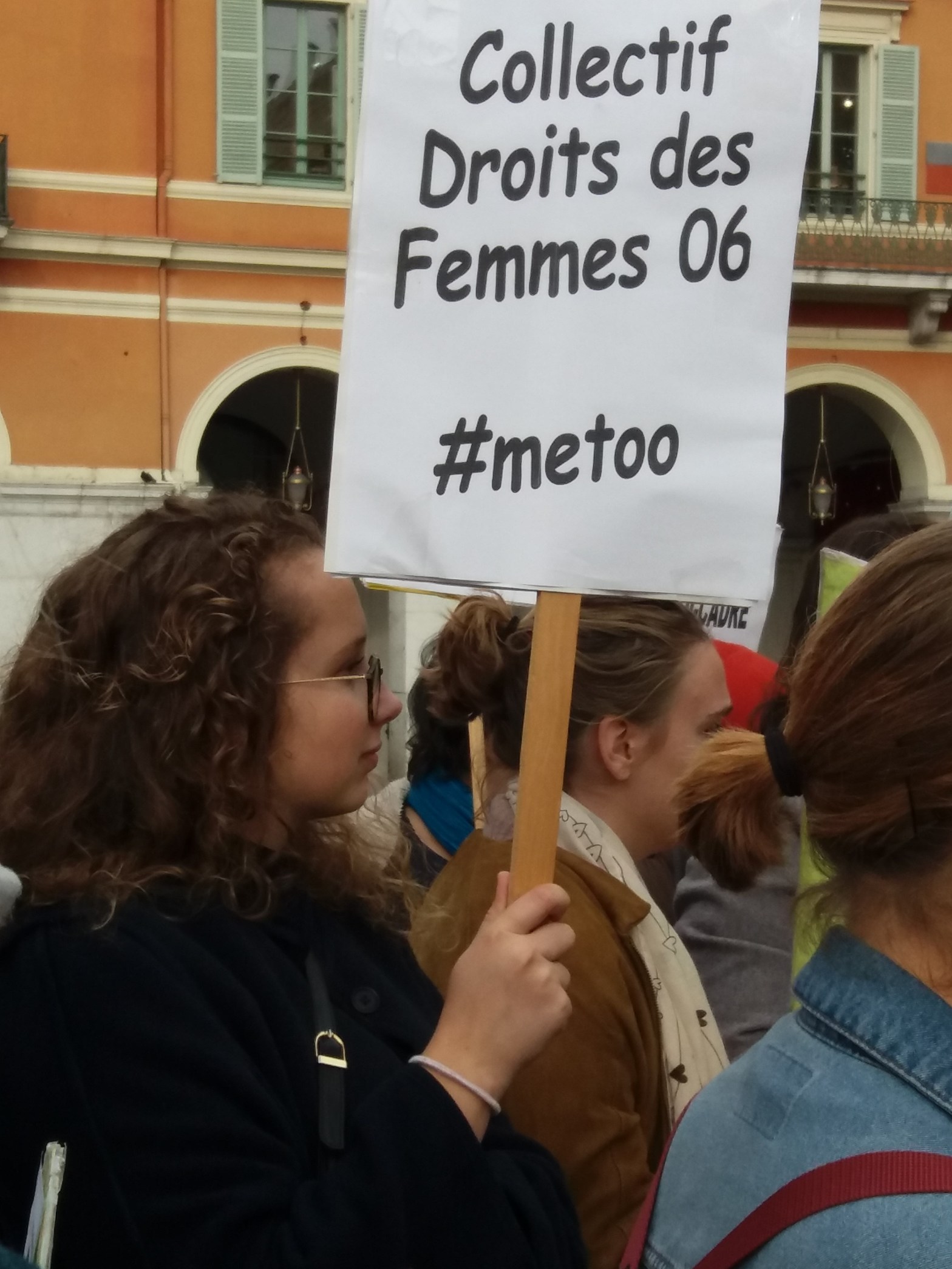
In the 90s, there were marches in major cities, mostly in America, to ‘Take Back the Night.’ Those were admirable, but aimed at the stranger and the gangs on the streets targeting women. The bigger picture is more personal and disturbing.  At the rally yesterday in Nice, one of thousands held across the world, the French numbers were bandied about on signs – last year, 109 women were killed at the hands of their partners; of the roughly 200 reported cases of attempted homicide in the same year, three quarters of the victims were women; and 48,000 rapes occur every year.

How can any civilised society allow this to happen? I won’t go into the history of patriarchy here, but the patriarchy we live in has normalised violence against women. It’s been pointed out by many that the term domestic violence in English is a prime example of this normalisation, where deadly assault has been reduced to something akin to a family squabble. It’s no better in French, where such crimes are called drame famille and crime passionnel – both sounding like the content of soap operas.metoorally3

The rally was more than the statistics. It was a place where women stepped up to the microphone in the middle of Place Massena on a busy Saturday afternoon to tell their stories of rape, continued sexual harassment, sexual aggression and verbal intimidation. Their attackers were strangers, neighbours, fathers, brothers, partners, doctors, dentists and co-workers. Violence against women takes many forms. I’m glad we’re finally speaking up about it and supporting each other. While the laws and public awareness are gradually changing, sometimes I’m fearful of another backlash against feminism that could undo all of this. But ever the optimist, at other times I’m more hopeful, knowing full well that such societal changes don’t come easily.


A flying visit to Le Petit Prince

The first time I read The Little Prince I was twelve and naturally read it in English. This was when pop psychology ruled my thinking, and I saw the book as a fictionalised dialogue between the author, Antoine de Saint-Exupery, and his inner child.  I recently reread this novella, this time in French, which gave it a different flavour in my mind – more intellectual and whimsical at the same time. With this reading, I’m more struck by what it says about human nature in broader political contexts than with the personal and psychological. From here it was easy to see how it reflects the age we’re living in now.

Early in the story, the little prince asks a stranded aviator to draw him a sheep. After a couple of awkward attempts, the aviator draws a picture of a box with some holes in it and tells the prince the sheep is in the box. The prince accepts this and their friendship is cemented. In the present day, I’ll call this image the current British government, who received the picture of the box from the Leave campaign. I don’t think I need to explain this metaphor in any great detail. Any sensible person knows that the box is filled with the likes of a well-funded NHS, a robust economy and a lucrative trade deal with the remaining EU. The air holes are there to make this world seem real, a place where people live and breathe.

Another passage reflects pertinently in our age of the internet. The little prince climbs up to the top of a mountain and calls out to see if anyone is there. All he gets is an echo, which he mistakes for conversation.

The story also has plenty of characters suited for today’s headlines – an illogical king who claims he controls the movement of the starts, a vain man who craves attention, but whose vanity keeps him isolated, and a geographer who draws maps, but never leaves his own desk to experience the world he has helped to construct. I don’t think I need to mention the true life characters by name.

I’ve met people who reread Le Petit Prince every few years or once a decade. I don’t think I’ll join either of those clubs. Having read it once as a child going through puberty and now in my middle-age, my next appointment with this book could be in my very-old age. Who knows what metaphors, insights, ideas this little literary gem will conjure up then.

Petit Prince 2

Brexit, Trump and W.B. Yeats

Yeats’ ‘The Second Coming’ has had a revival over the past year or so. With reactions to Brexit and Trump, the poem was quoted more in 2016 than in the total of the previous 30 years. (Wall Street Journal and Factiva).


Now here we are in 2017. So far, Brexit has unleashed a rise in hate crimes, economic uncertainty and feelings of general incomprehension in the UK as ‘things fall apart’ and as we watch as ‘the centre cannot hold.’ In Trump’s America, a ‘blood-dimmed tide’ is both present and inevitable as mass shootings are condoned and conflicts overseas are rekindled with heated rhetoric.

But what is to come of all of this? I revisit the poem:

The Second Coming

Turning and turning in the widening gyre
The falcon cannot hear the falconer;
Things fall apart; the centre cannot hold;
Mere anarchy is loosed upon the world,
The blood-dimmed tide is loosed, and everywhere
The ceremony of innocence is drowned;
The best lack all conviction, while the worst
Are full of passionate intensity.

Surely some revelation is at hand;
Surely the Second Coming is at hand.
The Second Coming! Hardly are those words out
When a vast image out of Spiritus Mundi
Troubles my sight: a waste of desert sand;
A shape with lion body and the head of a man,
A gaze blank and pitiless as the sun,
Is moving its slow thighs, while all about it
Wind shadows of the indignant desert birds.

The darkness drops again but now I know
That twenty centuries of stony sleep
Were vexed to nightmare by a rocking cradle,
And what rough beast, its hour come round at last,
Slouches towards Bethlehem to be born?

Written in 1919, soon after the First World War and the Russian Revolution, this work reacts to the horrors and violence of such conflicts. More importantly, it expresses apprehension over what is to come. Over the years, many have seen this poem as an accurate premonition of a second coming in the form of an anti-Christ – Adolph Hitler. As has been pointed out by many in the press, the present day holds startling parallels to pre-War Germany, with the rise of nationalistic propaganda and untruths capable of seducing millions.

Yet, I feel the need to put this into perspective. Others have alluded to this poem over the years. Joan Didion’s collection of essays Slouching Towards Bethlehem, Chinua Achebe’s Things Fall Apart and Joni Mitchell’s song ‘Night Ride Home’ are among the many works to keep this poem alive. These works were written long before Brexit and Trump and each with their own political concerns and fears at their time.  Seen collectively like this, I do wonder if the recent malaise – the far-right, the hate crimes, the nationalistic fervour – are all part of a tide that will inevitably ebb back to something perhaps different, but manageable, less worrying.

Yet, the recent surge in quoting from ‘The Second Coming’ is still significant in itself. Most of these allusions can be found in the press, where the educated, the so-called ‘urban elite,’ dwell. As recent investigative reporting and British and American government enquiries are starting to show, it was the elite class of billionaires who indirectly funded both Brexit and Trump’s presidential campaigns. Both employed social media, which spread into mainstream media, to disseminate their propaganda and untruths. The response to this has come, during these campaigns and even more now, from the true masses – the urban and educated. We are the ones seeking to understand what is going on, turning to Yeats en masse. In our bewilderment and fear, we ask if what we have witnessed is a sign of the ‘rough beast, its hour come round at last.’