
She’s been described as ‘the female Lawrence of Arabia.’ I confess that I’ve used that glib and convenient phrase myself. But it doesn’t do her the least bit of justice. One could argue that she accomplished a great deal more than T.E. Lawrence and that she had more barriers to overcome along the way.
Gertrude Bell (1868-1926) was an archaeologist, scholar, writer and a political advisor, helping to establish modern-day Iraq and the National Museum of Iraq. As a contemporary of Lawrence, she worked with him at one point in Egypt. Both were British born and both developed a love and consequently insider’s knowledge of what was then called Arabia and Persia (or even more broadly and strangely to modern ears ‘the Orient.’) While Lawrence’s Seven Pillars of Wisdom is still read by British and American forces stationed in the Middle East, Bell’s writings on Iraq and Syria are studied by military experts and scholars the world over.
I recently read the first book she wrote, Safar Nameh: Persia Pictures. It’s a journal of her travels in 1892 to what was then Persia, covering modern-day Iran and much of Turkey. She was accompanying her uncle, Sir Frank Lascelles, the British Minister to the region, which gave her access to people and places unavailable to most Westerners, especially women.
Persia Pictures shows us a travel writer at the naissance of her writing life, before she knew herself the role writing would play in her career and the mark it would leave on her legacy. She relays impressions of the landscape, the towns and villages and the people that inhabit them with a sense of wonderment – that first discovery – of a part of the world few in the West knew much about. With this is her discovery of the Persian language and some of its most revered writers – in preparation for the adventure, she became highly proficient in Persian. (At this point in her life, she was already fluent in French and had begun studying Arabic.) Among the gems of this book are her fragments of translations of the Persian poet Hafiz into English. A few years later she published her translations of The Divan of Hafiz.
Bell concludes this short volume with what can be best described as a meditation on travelling. Here, she summarises her encounters with the locals in her role as traveller: ‘Although your acquaintance may be short in hours, it is long in experience; and when you part you feel as intimate as if you had shared the same slice of bread-and-butter at your nursery and the same bottle of claret in your college hall. The vicissitudes of the road have a wonderful talent for bringing out the fine flavour of character.’
With the films Queen of the Desert and Letters from Baghdad, Bell is slowly emerging from obscurity, but still appears to be relegated to ‘women’s studies’ as opposed to the writer, scholar and historical figure that her feats deserve. Yet, the day might come when T.E. Lawrence is referred to as ‘the male Gertrude Bell.’


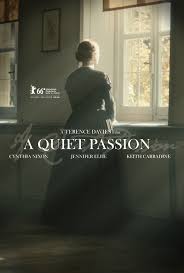 mitations thrusted upon 19th century New England life, especially for women. Although mostly a contemplative and melancholic film, humour and wit are present in a way that I felt was realistic to the poet’s life (Dickinson scholars are free to differ on this point.)
 Baldwin’s life as a civil rights activist. Director Raoul Peck takes us on a journey through the civil rights protests and public discussions on race during the 60s and 70s, with some unspoken allusions to present-day hate crimes in America. Baldwin is positioned at the centre of this sometimes-loose narrative. We watch him on television talk shows, lecturing at all-white university campuses and demurely in the crowd of some of the most iconic marches of the twentieth century. The real treat and reason for seeing this film are the sonorous tones of actor Samuel L. Jackson reading passages from Baldwin’s much-quoted works while images recapture the horrors. Although some of these quotes have been exploited on posters, coffee mugs and Facebook postings, in the context of this film they have re-found their rightful home.




 Leda narrates the story with frankness and self-reflection which are as refreshing as they are brutal. This, along with the intrigue of the plot and subplots, kept this reader engaged to the very end.
 olitically active, with the occasional dip into escapism – classic thrillers, where the technology might be less sophisticated than today’s, but at least the good guy always wins.
 Paola Trimarco