Words of 2025

As the year winds down, lexicographers promote their dictionaries with their words of the year. The one that has gotten the most attention so far is the least interesting – vibe-coding. It’s a software development that uses AI to convert natural language into computer code. It doesn’t excite me either.

The Oxford English Dictionary has announced that rage bait is its word of the year. Oxford defines this as ‘online content deliberately designed to elicit anger or outrage by being frustrating, provocative or offensive, typically posted in order to increase traffic to or engagement with a particular web page or social media content.’ It’s click bait’s ugly cousin. The first example that came to my mind was the postings of the current US president, to which we need to add to the OED definition ‘usually to distract the public from certain issues…’

Cambridge’s dictionary has given its vote to parasocial, which it defines as ‘involving or relating to a connection that someone feels between themselves and a famous person they do not know, a character in a book, film, TV series, etc., or an artificial intelligence.’ The word has been around since the 1950s, when it was used in sociopsychology though the concept is even older. Figures like George Washington and Napoleon Bonaparte were idolized by people who imagined personal bonds with them as expressed in love letters. The fandom of the early days of Hollywood sparked a whole industry based on imagined intimate relationships with the stars. I confess now that my teenage self had a one-sided relationship with David Bowie. The fact that parasocial has come into popular use in 2025 says something about the times we live in. Are things so bad that our escapism leads us to a place where fictional characters, celebrities, influencers and AI bots become our friends and lovers?

My buddy, Mr Copilot, tells me that Dictionary.com has christened ‘67’ (pronounced 6-7) their word of the year. It’s a slang expression born in TikTok, and while it doesn’t have a fixed meaning, it could mean ‘so-so’ or ‘maybe.’ It’s usually accompanied by a hand gesture – palms up alternating up and down. Like so many slang expressions, its social meaning is more important than its lexical meaning – it’s part of a private language, popular with the young and used to annoy the old. It’s working on me.

Other words that were added this year aren’t new and didn’t make ‘word of the year,’ but are interesting, nonetheless. In 2024 Carol Cadwalladr introduced and popularized the term broligarch, which entered the Cambridge Dictionary in 2025. The fact that others are using this term gives me hope in a perverse way. Broligarch encapsulates the ultra-wealthy tech figures (often male) who wield influence over politics, media and culture. Its growing use and entrance into a dictionary marks public concern – this is where the hope comes in. The broligarchs do not use it to refer to themselves. It’s used despairingly by the rest of us.

Finally, there’s tradwife, which has been around for a few years and was also added in 2025. It refers to ‘a woman who embraces traditional gender roles, especially in marriage and homemaking.’ It’s one thing to be selectively nostalgic – most nostalgia is selective – but it’s something else to desire inequality and financial dependency. My prediction – in five years from now, a couple of neologisms will enter the English lexicon – the verb distradify and the noun liberwife.

What I’ve been reading

A history book that is just that – and not historical fiction, my normal means of learning history. The Burning Earth: An Environmental History of the Last 500 Years by Sunil Amrith starts with the Age of Exploration and Empire, when European colonial expansion began reshaping global environments through mining, agriculture, and trade. The book then traces environmental disasters of the Industrial Revolution and the 20th century’s fossil fuel boom and finishes with our climate crisis. I’ve been particularly struck by this book’s approach to the slave trade. Where a more traditional history would describe the brutality, human toll, financial gains, abolitionist movement and the US Civil War, this history adds the consequences to biodiversity. One of several examples is sugar, which became an industry due to slavery across North and South America. Amrith sums this up:

“Violence on human beings accompanied a violent assault on the rest of nature. Sugar plantations had a limitless appetite for timber to fire the vats. Furnaces swallowed forests. Woods fell for pasture to feed the domestic animals that were a vital source of muscle power. Denuded hillsides threatened human settlements with mudslides after every rainfall. Sugar ruined the soil.”

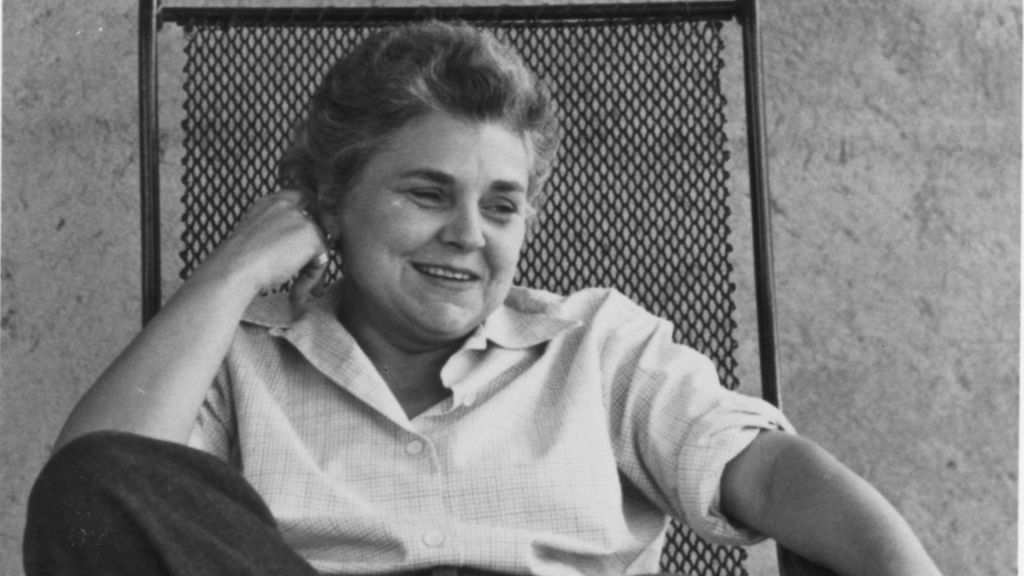
The New Yorker, celebrating its 100th anniversary, has reprinted some classics, including the poem ‘At the Fishhouses’ by Elizabeth Bishop. First published in 1947, this highly accessible poem describes a scene of an elderly fisherman untangling a net on the shore. The narrator, observing this, connects with nature and memories and reflects on the concept of knowledge. Like the comments made by Jorie Graham in the current New Yorker, I too found the ending particularly evocative in a literal and linguistic sense:

It is like what we imagine knowledge to be:

dark, salt, clear, moving, utterly free,

drawn from the cold hard mouth

of the world, derived from the rocky breasts

forever, flowing and drawn, and since

our knowledge is historical, flowing, and flown.

Elizabeth Bishop (1911-1979)

So too, are the words we create to communicate this knowledge.

Ocean awareness: an essay

Yesterday was World Oceans Day 2025, and today is the start of the 2025 UN Ocean Conference in Nice (I’m writing from Menton, further along the coast). While I cannot add to the tranche of news stories and statistics about our endangered oceans, I can offer this short essay intended to meld the personal with the spiritual and the environmental.

AMONG THE FISHES

I was not always a swimmer, and I have not always lived on the French Riviera. Being raised by a single mother, who did not want any of her children to swim, I grew up in Chicago as a non-swimmer. Over the decades, I have realized that mother operated on an axis of fear. Reprogramming my brain away from this phobia of water took years of swimming lessons, mindfulness, a patient partner and above all else the welcoming sea. Public swimming pools are not so hospitable. They are cacophonic with children, hard with brick and steel, harshly lit by fluorescent squares and taste and smell of chlorine. The sea has far more convivial sounds, textures, luminosity and chemosensory experiences.

From late spring to early autumn, the beaches of the Cote d’Azur are abuzz with talking and laughing, children playing and cafes clanking plates and hissing out espressos. Yet, as soon as I plunge into the sea, the beach sounds become muffled and dispersed. Better still, with my head underwater, a meditative silence imbues my being. Mindful, I adjust  my hearing to the gentle hum, a sense of motion. I do not know if it is from the waves or inside my head when my ears are filled with water.

From late autumn to early spring, the shoreline is less populated. The sea is temperamental, with only the odd quiet day. Mostly, it is a symphony of waves, caused by a local rainy season and the movement of currents far beyond my sight somewhere between Europe and North Africa. These waves rumble as they hit the sandy shores and splash on to the shale beaches.

The sea water is soft, embryonic. The fluidity cleanses and changes shape as it undulates and foams and slaps my face when I come up for air. It feels icy but there is no ice in February and March, and I must wear a wetsuit. The rest of the year, it is refreshingly cooler than the air temperatures.

The seafloor can be grainy with fine pebbles or soft, pillowy with sand. Yet, in some areas, it is hard with rounded slippery rocks and boulders sharp with brittle edges. This textured tapestry of supple and coarse surfaces shifts with the movement of waves, sea creatures and interlopers like me.

After a storm, the feeling of the sea is disrupted by sand floating up but never reaching the top. It must have been under the mini pebbles. Pieces of flotsam – torn shards of palm – bob on the surface. The murkiness means I cannot see any fish. I want to run it all through a filter.

A strand of pearl-like lamps along the promenade lights up the beach at night. But the sea has its own jeweled magic as stars and the moon illuminate the surface, reflecting sparkles of frothy waves. The longer I stare at the sea and the night sky, the harder it is to distinguish them. They are with their own cornucopia of living organisms symbiotically connected. At that moment, I am meditating with my eyes open and feel that I too am part of this symbiosis. I dare not swim at night in the wavy darkness, not out of fear but of not wishing to disturb the sleep of diurnal fish. Like me, they have their circadian rhythms.

I can taste the salt of the water in the corners of my lips as I am one of those swimmers who breathes out of their mouth. Taste and smell go together, a kind of synesthesia, where multiple senses are experienced at once. I taste with my nose a saltiness that is not granular like table salt but smooth. Sometimes there is a smell of fish that is in the air, but which I know comes from above the surface, far from the shore. In the distance, I see the culprit. A fishing boat with its rods and rigs crisscrossing in the air has filled its deck with sea bass and hake.

There are fish to watch, even swimming close to the shore. Three types of sea bass wiggle below me, darting away from time to time as if I, someone else or something has startled them. The most common are small white sea bass, which in certain light look silvery. That is when I get confused with anchovies, also common in the Mediterranean. In summer months I have seen black sea bass with their broad white stripes and their negative cousins, a sea bass that’s mostly white with a couple of vertical black stripes and one horizontal one along its spine-like top.

Further away from the shore, the braver swimmers are treated to swordfish and tuna, that is if the anglers are not too close. Tourists’ boats edge out further still for the dolphins arcing above the waves. But this is a double-sided coin. Overfishing, tourism and resort expansion along the coast have done their damage. The French Mediterranean is one of the most developed coastlines in the world.

Worst still is the frequency of heatwaves brought on by climate change. While the heatwaves on land understandably make for dramatic and worrying news, the marine heatwaves get less attention despite sea temperatures breaking records. Last summer, the sea temperature off the coast of Nice climbed to an unprecedented 30C. With this, underwater forests, such as the gorgonian, are starting to perish.

I have gone from being a child fearful of the sea to one who is fearing for the sea. Yet, the vastness of the coastline and my ability to swim in it throughout the year make me forgetful of these dangers, blinded by the beauty and the repetitive motions and sounds which blend me into their rhythms.

Paola Trimarco (Copyright 2025)

Surviving January

Nope, this is not a blog from a survivor of Dry January – the wine continued to flow as usual. Nor is this about winter depression – at times, a sad month but luckily without the winter blues (hard to experience in the sunny south of France). As February kicked off this weekend, I was determined to reboot and restart the year afresh. But not before a few reflections on the surreal month that just passed.

Imperia before the storm

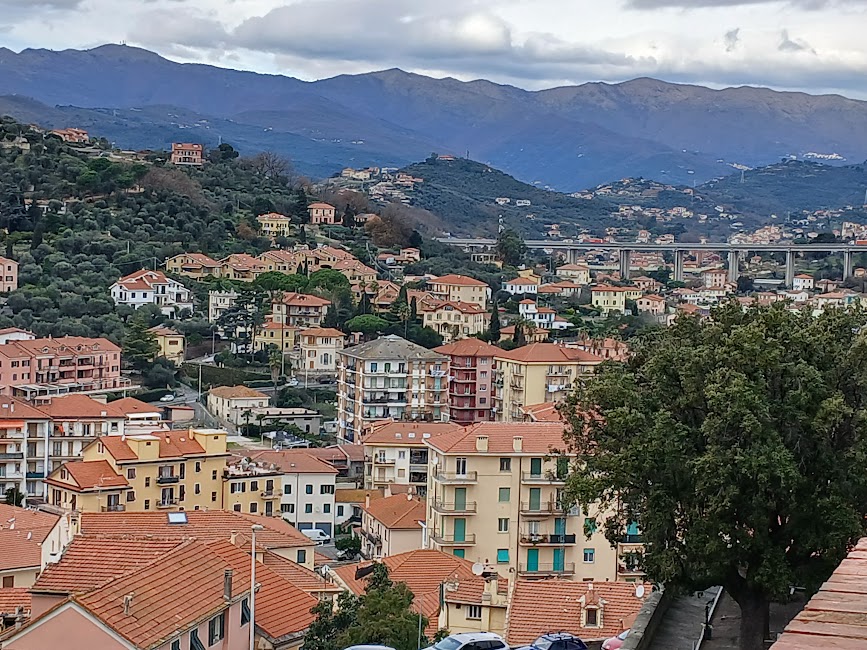
In the second week of January, we gave ourselves a three-day break in Imperia, Italy. I had told friends that this would be our reward for finishing the joyless task of painting the kitchen – including cabinets. True, but the underlying reason was to have a respite before the 47th president was inaugurated, a chance to be preoccupied with Italian language and history while enjoying coastal views and stoned-baked pizzas. I was living in these delightful moments while at the same time imagining myself looking back on them nostalgically – a time before America imploded and the world reacted. Or more immediately, a time before the barrage of news on the vitriolic, anti-environmental, anti-humanitarian, falsehood laden chaos.

Goodbye Facebook

January also marked my last month on Facebook after some fourteen years of posting holiday snaps, images of our protests marches and single-framed comics, while giving my share of thumbs and hearts. I did explain to my followers that this was a political decision against Zuckerberg, the latest technobro to become a Tr*mp enabler and his allowing for hate speech to grow and fester on the site. The reaction to this announcement was mixed. Some support, one serious critic (apparently, I should be happy to have more freedom of speech) and loads of people ignoring me. The latter grouping made me wonder how many closet Tr*mp supporters (including non-Americans) are out there.

Still Jacqueline

The third week of January marked the death of one of my oldest and closest friends. In truth, the sense of loss started a few years ago. The last time I spoke to Jacqueline was over the phone and she was in a care home in Edinburgh. A great raconteur, she told me a few stories that made me laugh, but I later realised that these stories did not involve any of our mutual friends and at no point in the conversation did she ask about my David. That is, she had forgotten who I was. Jacqueline had Alzheimer’s. Like the character in the film Still Alice, Jaqueline was an accomplished linguist and teacher. And like the character in Still Alice, played by Julianne Moore, the signs of this horrible condition had its onset in middle age – Jacqueline was barely sixty when her memory started failing her and her personality began to change. Unlike the film, the experience for Jacqueline and those who loved her could not be encapsulated in two hours. The years of slow deterioration of mental faculties, of speech, of sense of humour had laced a thread of sadness through our lives.

Due to problems scheduling planes and trains and severe weather conditions, I was unable to attend the funeral in person. Instead, on the last day of this surreal month, I watched live stream on my laptop old friends and colleagues at the crematorium reminiscing about Jacqueline and giving her a warm, heartfelt sendoff.

What I’ve been reading

I’ve been engrossed in two books that couldn’t be more different. Sam Freedman’s Failed State explains why Britian is in such a mess, going far beyond Brexit in examining the highly centralised system of government that cripples its ministers. On top of this, the powers of the judicial system, though often necessary but cumbersome, are more than ever challenging the government, making it more accountable, but even less effective. Freedman also points out that ‘the constant need to feed the media beast has led to a rapid proliferation of symbolic legislation designed not to achieve any real-world goal, but to give the impression of activity.’ Good nourishment for this news junkie.

The Overstory by Richard Powers is a book I wish I had discovered before dipping into a couple of soft-science tomes about trees. Yes, she’s harping on about trees again. The first part of this novel introduces nine characters in what I would consider to be interesting and entertaining short stories. The only connection between the stories is their characters’ experiences in one way or another with trees. In some cases, these experiences are accidental and peripheral. For other characters, a hobbyist and a researcher, trees are their raison d’etre. For the latter, I was glad that this book didn’t shy away from the science, and I could revisit words that were new to me just a couple of years ago – raceme, drupe, panicle, etc. Saving our forests brings these lives together in complex thriller-like fashion. While quotables abound in this book, I’ll just leave you with a couple. A geeky teenager concludes, ‘Humankind is deeply ill. The species won’t last long. It was an aberrant experiment. Soon the world will be returned to the healthy intelligences, the collective ones. Colonies and hives.’ Another character is struck by a ‘great truth’: ‘Trees fall with spectacular crashes. But planting is silent and growth is invisible.’

In Powers’ book, I’ve also discovered the phrase guerrilla forestry, where activists illegally plant new saplings. I recently wrote a short story that touched on this idea. Once I’ve learned more about sylviculture, don’t be surprised to find me among the forest warriors. There, I’ve rebooted my year ahead.

Journalists in the firing line

You would be forgiven if you assumed that this blog is about intrepid war reporters donning padded vests and helmets. Instead, I’m looking at another type of journalist. The marking of World Press Freedom Day last month brought to my attention the targeting and suppression of environmental journalists.

UNESCO reports that since 2010 at least 44 journalists investigating environmental issues were killed, with only five resulting in convictions. UNESCO also observed the growing number of journalists and news outlets reporting on environmental issues that have been the victims of targeted violence, online harassment, detention and legal attacks. Just looking at Afghanistan, according to the Committee to Protect Journalists, since 2004 more environmental journalists have been killed there than those who died covering the country’s military conflicts.

To no surprise the top issue that makes journalists targets is climate change. The power of the fossil fuel industries and their links to governments are certainly one of the driving forces behind these attacks. So too – and equally worrying – is the growing polemic around this issue that makes ordinary people, often hiding behind the anonymity of online platforms, hostile to environmental activists and journalists.

I dabbled in environmental journalism but felt a bit of a fraud because I don’t hold a degree in life sciences or environmental studies. Even though my articles were more political than scientific, I never thought I was doing anything courageous or risky by writing them. Yet, I wouldn’t want to be caught out underestimating the power of those who disagree with my views or prefer the public to be ignorant of the evidence, scientific or experienced. These days I’ve taken up the safer option of nature writing with its indirect pleas to polluters.

The importance of protecting environmental journalism is summed up on the UNESCO website:

‘The climate and biodiversity crisis are not only affecting the environment and ecosystems but also the lives of billions of people around the world. Their stories of upheaval and loss deserve to be known and shared. They are not always pretty to watch. They can even be disturbing. But it’s only by knowing that action is possible. Exposing the crisis is the first step to solving it.’

What I’ve been reading

John Boyne’s The House of Special Purpose is an enjoyable read, though lacking the depth and irony of his The Boy in the Stripe Pyjamas. The story is set in Russia at the time of the revolution and in London over the years that follow until the late twentieth century. It is I’m afraid another fictional account of the massacre of the Romanov’s and the fate of Princess Anatasia, who many believe escaped unharmed and lived under an alias for the rest of her live. Given the horrible deaths of the Romanovs, the colourful character of Rasputin and the intrigue over Anatasia, this is a story that keeps on giving. In Boyne’s version, the human story is in the foreground and makes this a worthy read even if the Romanov saga is starting to wear.

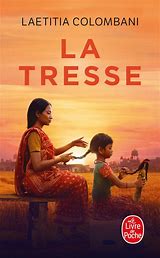
La Tresse (The Braid) by Laetitia Colombani was recommended to me by one of my French language partners. It’s a thin middlebrow book that has been enormously popular in France and now all over the world in translation. It recounts the lives of three women who, as you can guess, like the strands of a braid overlap into a single unit. How this narrative braid is formed is what keeps the pages turning. Each of the three women struggles against the hand they’ve been dealt. Smita is an untouchable in India, where she cleans the village latrines and endeavours at all costs for a different life for her daughter. Giulia lives in Italy and works at her father’s wig factory. Her troubles arise when her father falls into a coma, leaving young Giulia to discover that the family is on the verge of bankruptcy and could lose their home and factory. The third woman, Sarah, is a high-profile lawyer and single mother in Canada who is struck down by illness and the ruthlessness of her colleagues too eager to capitalise from it. These weighty topics are recounted in prose interspersed with poetry, language brimming with metaphors and motifs that gently creep up on the reader.

My non-fiction reading these days has been monopolised by newspaper and magazine commentaries on the verdict against a former US president, now a felon, who is prohibited from entering the UK to play golf on his own Scottish golf course. Reminding readers of the horrors of the Tr*mp years – including his attacks on the press – and what this verdict might yield in the not-too-distant future, worth reading are David Remnick in the New Yorker and Simon Tisdall in The Observer. Of course, both are expressing views I share.

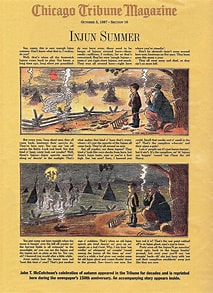
Indian Summers

As a child, I always looked forward to the Indian Summer edition of the Chicago Tribune. I don’t know what there was to look forward to as the pictures and the accompanying story was the same every year. This was cartoonist John T. McCutcheon’s ‘Injun Summer.’ Due to the use of the politically incorrect words Injun and redskin for Indian, this autumnal delight has disappeared from papers across America. Which is a shame – even as a child I knew Injun was an old dialect word or mispronunciation of Indian and that redskin was a despicable word of its time. Neither term was meant in a derogatory or malicious way in the story.

Before I get to the main point of this week’s blog, allow me a short walk down memory lane. McCutcheon’s story was first written in 1907 and harkened back to the author’s childhood in the 1870s. It features a grandfather, who speaks in a folksy Mark Twain style, with his grandson looking across an autumnal field of corn stacks. The grandfather explains the meaning of Indian Summer by playing into the child’s imagination, envisioning the corn stacks as tepees and calling up the spirits of the Indians that once lived there.

Some etymological truth underlies McCutcheon’s story. The spell of warm temperatures interrupting the autumn cooling towards winter have loose links to Native American lands. The first recorded use of Indian Summer goes back to an essay written in French in 1788, indicating that it was already used in spoken language in North America. Some speculate that the origins of the term came from the unseasonably warm conditions in autumn that were noted by Europeans in regions inhabited by Native Americans (even though it occurs throughout the Western Hemisphere). Another idea is that the term referred to a time of year when American Indians hunted.

Back to the present. This year we have experienced two Indian Summers with a heatwave – hotter than the average summer – in mid-September and a more traditional warming up of autumnal temperatures in early October. This time, I’m not feeling sentimental about these experiences or nostalgic for the Chicago Tribune of my childhood. A confused lone red damselfly has been hovering around our back garden for days. The front of the house has marigolds blooming and budding as they would in August. Two Indian Summers, with the extreme heat of first, are unsettling.

During our second Indian Summer, I was reading the latest New York Times Climate Newsletter. David Gelles reported on the increase in fossil fuel production with hundreds of new gas and oil projects having been approved in the past year. Gelles relates this to what we have all been hearing but needs to be said yet again:

‘There will be grave implications for the planet, which has already warmed by about 1.2 degrees Celsius above preindustrial levels. This year is shaping up to be the hottest on record, with record heat on land and the ocean fuelling extreme weather around the world.’

Writing about the dangers of pollution, Rachel Carson famously described a Silent Spring. I wonder if Indian Summers with their unseasonal insects and flowers are becoming Autumnal Augury.

Sensitive, Intelligent Trees – how not to popularize science writing

I warned you, one of my themes this year is trees. Having completed an online course on trees and sylviculture, I’ve turned to books on the subject.

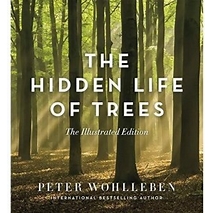
The Hidden Life of Trees by Peter Wohlleben was an international bestseller some five years ago that somehow past me by. On the back of this Wohlleben, a forester by training, has his own magazine, podcast and television show in his native Germany. Now he has a sequel volume that has been reviewed and piqued my interest. But given the rule for most film franchises – sequels are rarely as good as the original – I thought it right that I read the original first.

I’m afraid I struggled with the anthropomorphizing of trees throughout this popular book. Example: ‘The tough trees that grow on this slope are well versed in the practices of denial and can withstand far worse conditions than their colleagues who are spoiled for water.’ Denial is a complex human emotion, one that involves a great deal of reflection and conjuring of scenarios to discount one explanation over another more palpable idea. When I try to grow a new plant from a cutting and it doesn’t work, I don’t suspect the cutting of being in denial of its new situation or resisting the notion of creating new roots. It’s more likely the weather conditions weren’t ideal, the soil was too acidic, or my rooting powder was too cheap to work.

Discussing three oak trees that are next to each other, Wohlleben claims one is ‘behaving’ differently from the rest. ‘Clearly, each of the three trees decides differently. The tree on the right is a bit more anxious than the others, or to put it more positively, more sensible.’ My more prosaic explanation might involve exposure to wind or sunlight, or one of the trees being a favourite of the local canine population.

What got under my skin the most were the references to trees having the parental, often ‘motherly,’ sensibility to protect their young. This comes from an idealisation of parenthood and motherhood that doesn’t fit well with the reality of dysfunctional families or those families where love and nurturing exist, but the time and means to provide safety are lacking due to economic circumstances.

To the book’s credit, it includes fun facts about the ages of some trees – over 10,000 years old. And a few interesting factoids: Apparently, walnut trees emit a mosquito repellent; and ‘There are more life forms in a handful of forest soil than there are people on the planet.’

The book is also useful for its environment points. Bringing together the ideas of commercial forestry with industrial farming, Wohlleben notes that, ‘Thanks to selective breeding, our cultivated plants have, for the most part, lost their ability to communicate above or below ground. Isolated by their silence, they are easy prey for insect pests. That is one reason why modern agriculture uses so many pesticides.’

Reviews of the book show a divide between the professional reader-critics (e.g., The New Yorker and The Guardian) and the citizen-critics on the internet (e.g., Goodreads and Amazon). The latter praise the ‘accessibility’ and ‘delightful’ style and presentation of complex science. I’m with the professional readers who cringe to varying degrees over the simplifications, humanizing and questionable science being used to support the idea of trees having feelings and the capacity to learn. I prefer language about transmitting signals through electrons and the ways living organisms adapt to their environment. I’d like to think that with information and visual aids literally at our fingertips, science writing to generalist audiences no longer needs to rely upon fairytale scenarios or the registers of childhood language.

Paul Nash’s Cherry Orchard (1917)

My week in the heat

I haven’t been on holiday near the Equator or sitting in a sauna at some upmarket health club that I don’t belong to. The heat comes from reading and listening to climate science. Hot temperatures and hot in the sense of stoking my anger. As tomorrow is Earth Day, yet another awareness campaign, I promise I won’t mention any numbers or statistics as you will have heard enough, and I don’t think they’re very helpful. What we need is a shift in thinking. Here are some highlights that have rattled my head this week and have brought me to this conclusion.

In David Wallace-Wells’ newsletter, the environmentalist describes how critiques of the ‘catastrophic thinking’ in recent climate activism have been ‘regularly and conspicuously levelled by complacent centrists and patronizing greybeards against the alarmist fringe of the climate movement — yes, warming was happening, they acknowledged, and yes, it represented a challenge to the world’s collective status quo, but still, all of this hyperbolic talk was, let’s be honest, a bit much.’ This does an excellent job of depicting the stance of many public figures who are not climate change deniers but are not fighting for the environment either. It is as if positioning oneself in the middle of the argument, avoiding extremes, is reasonable. In this case, it’s not.

I’ve been reading Simon Sharpe’s Five Times Faster: Rethinking the Science, Economics, and Diplomacy of Climate Change, where the issue of communicating the dangers of climate change is looked at from a slightly different angle. Sharpe argues that climate scientists have been pulling their punches when presenting their findings to the public and to policy makers because these scientists have tended to talk in terms of predictions, which they are naturally cautious in making. It would be better, according to Sharpe to address the effects of climate change in terms of risk assessment – that is, looking at the worst possible scenario. He compares risk assessment in other fields to make his case. ‘What would become of a national security adviser who stormed out of a briefing on a terrorist threat complaining that it was all too depressing? Or a chief medical officer who decided not to warn political leaders of an approaching pandemic in case the bad news caused them to ‘switch off’? Obviously, such negligence is unthinkable.’ Yet, scientists, economists and politicians have skirted around risk assessment in the context of climate change. My blood boils thinking about it.

I took a break from these commentaries on catastrophic thinking and parlance only to find this item in the New York Times: ‘India is among the most vulnerable countries to human-caused climate change. And its poorest people are at the greatest risk…. This week, many parts of India were under heat wave alerts. Schools and colleges were closed in most parts of West Bengal state.’ Over to EuroNews, where there were stories around the fact that 2022 had the warmest summer on record across Europe. There was no escaping it.

Finally, returning to Simon Sharpe as he has the right words to describe what’s been going on in my head this week. He writes, ‘Thinking about climate change risks can be emotionally draining. You might feel you’ve heard enough by this point. There are increasing reports of climate change scientists and activists needing psychological support to cope with the strains of constantly staring into the abyss, trying to tell people about it, and witnessing the utter inadequacy of our collective response.’ Am I an activist, or an ordinary news junkie, needing psychological support? Perhaps not yet, but I did find writing this blog therapeutic.

Five Vignettes About Trees

1.

I attended Joyce Kilmer Elementary School in Chicago, where the first line of Kilmer’s best-known poem was painted in old-worldly script above the stage of the auditorium: ‘I think that I shall never see a poem as lovely as a tree.’ The metaphor still works for me, but the rhymed couplets throughout the poem (I will spare you) edge close to doggerel. Thankfully, loads of other poems about trees have been published. I’ve recently discovered the French-Canadian poet Hélène Dorion, whose collection ‘Mes forêts,’ as the title suggests, features trees. Here’s a sample:

Trees bite into the soil
their bodies parched
in the cold of their roots
gaunt shadows bodies
pressed together
we hear the song
of fracture and desire
body like the tide going out
pale boat
lost in its night

body of love and storm
given over to the earth
that it licks as if
it were a wall to pierce through

  • Hélène Dorion (Translated by Susanna Lang)

2.

With talk of today being the Spring Equinox in the marginalia of the news, I was reminded of St Joseph’s Day. It’s the day before the equinox, but nevertheless it was for me as a child the Italo-American version of St Patrick’s Day. It was customary to wear red. In Italy, it’s also celebrated by gorging on a zeppola, a custard-filled pastry with cherries on top – the cherries represent the buds on the trees in spring.

3.

At the start of the year, I enrolled in another MOOC intended for French undergraduates to help me expand my French vocabulary. The course, entitled ‘Les Arbes,’ was about the biology of trees and their contribution to the Earth’s biodiversity. Once again, learning scientific French highlighted the paucity of my scientific English. Many of the words I looked up in French were the same or close to it in English.

4.

In Cambridgeshire where I live, a furore has erupted over new plans led by the county council to build a busway (a bus-only road) from a new 6000-home development to the town of Cambridge. Building such a road will involve cutting down 1,000 trees. The majority of these arboreal victims are in the Coton Orchard, one of the UK’s largest and oldest orchards, with a unique ecosystem that cannot be mitigated with planting new trees elsewhere. This is part of a pattern in Britain, where the mass felling of trees has been carried out in the interest of road building. In 2018, despite two years of protests from residents in Sheffield, the city council allowed for the felling of some 17,500 trees. It later turned out that the justification for this was based on misunderstandings of an environmental survey coupled with misinforming the public.

I’m not just being sentimental about trees – all trees everywhere. Trees are also a crop that provide wood for furniture and pulp for toilet paper, among other things. Some trees also need to be cut down due to disease or public health reasons. The destruction of trees in our parks and towns is a different matter altogether. With the loss of these trees, the bird and insect populations, already in catastrophic decline, suffer greatly. To this, it’s necessary to add negative effects of such barbarous acts on the human population, both in terms of our physical health (such as the quality of the air that we breathe) and psychological health (where studies have shown improvements in emotional well-being with the introduction of sylvan spaces).

5.

Every year, I buy an artsy calendar to add some colour and visual creativity to my home office in Ely. It’s also a place to jot down writing deadlines, meetings and health club activities – things that are on my phone calendar as well but are sometimes forgotten when my head is in the comfort of clouds. My 2023 calendar has a tree theme. Every month displays a painting of trees by some famous, and some not so famous, European artists. Looking at these photos of paintings everyday – these meadows, these tree-lined shores, these shaded forests – gives my days a natural sense of calm and beauty. Since according to a French professor lecturing on the MOOC, there are over 60,000 species of trees, every year could have a tree theme, a different tree calendar, and in the remainder of my lifetime, I still will have only scratched the surface.

Above: Emmanuel Gondouin, La Forêt, 1912
Feature image: Henri Charles Manguin, Les oliviers à Cavalière,  1905

An Alternative Valentine’s Day

No cards. No flowers. No chocolates. No boozy dinner at an upmarket restaurant. Today, we celebrated Valentine’s in a different way.

Since Christmas my David and I have been doing the green thing of not giving each other cards. Over the years, we have exchanged cards for birthdays, anniversaries and all the big holidays. We saved these in our personal filing cabinets, most of David’s to me have been transferred to a plastic storage box with other paper-based memorabilia and my writings that pre-dated internet clouds. We both know full well that in our senile dotage, these overpriced cardboard confectioneries are going to the recycle bin, which then goes to the overflowing waste management centre, where currently less than 60% of recyclables are recycled.

Recent years have also seen us both clean up the clutter around us, and 2022, after my milestone birthday, became the year to cease card-giving and consequently, card storage. No jokey Christmas greetings or 25th wedding anniversary of rhyming sentiments written by strangers. Instead, we wished each other happy Christmas and anniversary and washed down special meals with good wine. Chink.

As with Christmas cards, there is also an historical case against exchanging Valentine’s Day cards and gifts. A little internet research (okay, not peer-reviewed) reveals that St Valentine of Rome was added to the calendar of saints by Pope Galesius in 496 even though he was martyred in 296 for performing weddings for soldiers who were not permitted to marry. This lovers’ day did not see the exchange of cards and gifts until the 19th century with the industrial revolution. Like so many customs, the festive day had become commercialised, a chance to sell mass-produced cards, sweets and flowers. We’re not so much breaking with tradition as we are fighting consumerism.

Within this Hallmark-free zone we celebrated Valentine’s Day by going to a pub in our town of Ely, partaking in the two meals for £25 lunchtime special. Yet, stingy doesn’t mean we are devoid of sentimentality. While waiting for our meals, we talked about this blog and my wish to end it on a love poem that isn’t soppy. Without hesitation, David said, ‘”An Arundel Tomb” by Philip Larkin.’

Side by side, their faces blurred,   

The earl and countess lie in stone,   

Their proper habits vaguely shown   

As jointed armour, stiffened pleat,   

And that faint hint of the absurd—   

The little dogs under their feet.

Such plainness of the pre-baroque    

Hardly involves the eye, until

It meets his left-hand gauntlet, still   

Clasped empty in the other; and   

One sees, with a sharp tender shock,   

His hand withdrawn, holding her hand.

They would not think to lie so long.   

Such faithfulness in effigy

Was just a detail friends would see:

A sculptor’s sweet commissioned grace   

Thrown off in helping to prolong   

The Latin names around the base.

They would not guess how early in

Their supine stationary voyage

The air would change to soundless damage,   

Turn the old tenantry away;

How soon succeeding eyes begin

To look, not read. Rigidly they

Persisted, linked, through lengths and breadths   

Of time. Snow fell, undated. Light

Each summer thronged the glass. A bright   

Litter of birdcalls strewed the same

Bone-riddled ground. And up the paths   

The endless altered people came,

Washing at their identity.   

Now, helpless in the hollow of   

An unarmorial age, a trough

Of smoke in slow suspended skeins   

Above their scrap of history,   

Only an attitude remains:

Time has transfigured them into   

Untruth. The stone fidelity

They hardly meant has come to be   

Their final blazon, and to prove   

Our almost-instinct almost true:   

What will survive of us is love.

  • Philip Larkin (from The Poetry Foundation.org)

Have a happy eco-friendly anti-consumerist Valentine’s Day.

The Arundel tomb that Larkin was referring to. You can just see the couple handing hands.

Thrutopia

Move aside dystopian literature and make way for thrutopian tales that give hope without the silliness of sugar-coated utopias. In recent years, I’ve been reading about this call to arms to establish a new genre of literature. The word has its origins in the idea of going ‘thru’ from one place to another.

In 2017, writing for the Huffington Post, environmental campaigner Rupert Read made the case that a thrutopia could get us through the climate crisis. In sum, his argument was that we need ‘artistic or philosophical vision’ for the future that dealt with the harsh realities without being dystopic and without the blind optimism of utopia. He explains:

‘Thrutopias would be about how to get from here to there, where ‘there’ is far far away in time. How to live and love and vision and carve out a future, through pressed times that will endure. The climate crisis is going to be a long emergency, probably lasting hundreds of years. It is useless to fantasise a shining sheer escape from it to utopia. But it’s similarly useless, dangerously defeatist, to wallow around in dystopias. We need ways of seeing, understanding, inhabiting, creating what will be needed for the very long haul.’

While I agree with the general idea, I don’t think I’d call dystopic literature ‘dangerously defeatist.’ I’m thinking Atwood’s The Handmaid’s Tale, which was first in the 80s and more recently thanks to the TV series, a warning of a world controlled by religious extremists. Ishiguro’s Never Let Me Go and Cormac McCarthy’s The Road are likewise more realistic than defeatist, but with the reader knowing that they have elements of make-believe. The real sense of defeatism emerges when reading commentaries in the media about the irreversible damage brought on by the climate crisis at a time when a world leader of dubious sanity is threatening to use nuclear arms.

This new thrutopic-like genre was also proposed by novelist Ben Okri, writing in The Guardian around the time of Cop26. Like Read, Okri calls exclaims, ‘We have to find a new art and a new psychology to penetrate the apathy and the denial that are preventing us making the changes that are inevitable if our world is to survive.’ Like Read, he criticises dystopias and utopias, opting for a realism that gives us hope.

Taking thrutopic literature a step further, this summer Mslexia, in an article penned by novelist Manda Scott, offered a primer on the topic, giving advice and workshop ideas for writers wishing to try their hand at this new genre. Years ago, I dabbled in psychological science fiction, and the idea of creating a thrutopic story had me wondering. Yes, I could give it a try. Why not?

Then I read ‘The Secret Source,’ a short story by Ben Orki in The New Yorker. It’s set in the not-too-distant future where the world is trapped in the water crisis and cruel, cynical governments conserve drinking water by poisoning its minions. Dark reading from the writer who espoused ‘hope.’ I confess, I enjoyed this deliciously dystopic tale, perhaps for the same reason that I find villains are often more interesting than heroes. That is, I’m hedging towards thrutopia in philosophy if I can sink my teeth into the occasional dystopic story.

According to Read, the philosophy of thrutopia can be simply stated: ‘Don’t defer your dreams. We need those dreams now. Experience the present as paradisiacal, and change it where it isn’t, and then we might just get through.’ That sounds fine to me.

Illustration by Holly Warburton, purloined from The New Yorker.