Preparing for Winter

This weekend, we turn the clocks back. Ten days later, the US has its presidential election. These two events are bumping into each other in my brain’s anxiety lobe.

My David anticipates the clocks going back with a sense of dread. He pulls faces – the emoji with his eyes squinted, a tongue half out. David suffers from SAD (seasonal affective disorder), which is at its worse when we find ourselves in England in the winter months. I’m not so affected by the onset of winter. This is because I grew up in Chicago, where winter meant snowmen, ice skating, mittens drying on the radiator while our hands cradled cups of hot chocolate. That’s not to say I haven’t experienced that greyscale world of depression, but my occasional bouts of it have not been linked to the seasons of shorter days. They’re simply not linked to anything. Nevertheless, sharing a life together, David’s clouds of SAD cover my head as well.

Psychologist Kari Leibowitz has observed that contrary to popular belief, people who live in Scandinavian countries do not have high rates of SAD. Their prevalence of the winter blues is among the lowest in Western countries. This is because Scandinavians embrace the winter months with outdoor festivals, activities and sports and indoor candlelight gatherings with friends and family. That is, our moods and feelings towards winter have a lot to do with our mindsets (as this former Chicagoan knows). Leibowitz explains:

‘…we might have a mindset that winter is limiting or that it is full of opportunity, dreadful or delightful. We conflate the objective circumstances – that winter is cold, dark and wet – with subjective things, like it being gloomy, boring and depressing, when you could just as easily make the case that it is cosy, magical and restorative.’ (from an interview in The Observer )

Leibowitz makes a good point, not only for the onset of winter, but for anything. Our mindsets can predispose us to how we experience situations and events. In this vein, while David is dreading the 26th of October, I’m fearing the 6th of November. Yes, the US election is on the 5th, but given the time difference, the results won’t trickle in until the following day here in Europe. I’m not looking forward to learning that either America will soon have the MAGA version of fascism or that Harris has won, and the Tr*mp/Musk ticket reacts with inciting riots and cyber-pandemonium. Both could ripple  disastrously across the States (another civil war is no longer the stuff of dystopic fiction) and across the world in ways ranging from the environmental to the geopolitical. Of course, logic tells me that other scenarios might occur – American politics is never short on surprises. But that’s not found in the anxiety lobe.

Taking Leibowitz’s advice, I’ve suggested to David that he ‘resets his mindset’ for the weeks we’re in the UK after the clocks go back and before we migrate to France for the winter, starting with evenings of candlelight to soften the mood. We are also planning nights at the cinema, concerts and book talks, along with socialising at our local pubs.

As for resetting my own mindset, my version of candlelight is found in meditation and practicing mindfulness as each new disturbing situation emerges from America. In seeking the ‘delightful,’ to use Leibowitz’s word, I can look forward to the social and political satire in the months and years ahead.

What I’ve been reading

The last two novels I’ve read do not use quotation marks when characters are speaking. This meant careful reading at times to distinguish thoughts from dialogue, but in both cases this style of writing was effective. The first was Sandrine Collette’s On Était des Loups (avail. in English), a dark novel about a hunter who lives in the wilderness with his wife and child until the wife is brutally killed by a bear. He reacts by setting  out on a journey through the mountains and forests with his son in order to find a more appropriate home for the boy, the five-year-old he barely knows and didn’t want in the first place. Both live in the haze of trauma and grief left from the bear attack and deal with it in their own contrasting ways. Like the winter months, light moments can be found flickering in the gloom through character study interwoven with nature writing. A strangely life-affirming novel.

By sheer coincidence on my part, Paul Auster’s Baumgartner is also about a man whose wife had a premature death. When the story starts, he’s nearing retirement, and his wife has been dead for a decade. Set in the town of Princeton, Baumgartner is a professor of phenomenology who encounters falling in love again and incidences, such as falling down the stairs, against the backdrop of the loss of his wife. Without quotation marks getting in the way, the descriptive narrative, blends in beautifully with Baumgartner’s philosophical and mundane thoughts.

Edmund de Waal’s The Hare with the Amber Eyes is an absorbing account of the British ceramicist’s family history, traced through the ownership of Japanese figurines, called netsuke. These objects were brought to Europe by art collector Charles Ephrussi of the well-known banking family. Years later, he gave the 200 plus netsuke as a wedding gift to his cousin in Vienna, who later had her money and possessions confiscated by the Nazis. De Waal’s descriptions of the acts of antisemitism are chilling. Luckily, while Nazi soldiers occupied the family home, a housekeeper saved the tiny figurines by hiding them in her mattress. Eventually, they’re returned to the Ephrussi’s and inherited by de Waal. This work has inspired me to read more biographies about artists. De Waal mentions the works and lives of Impressionists and Post-Impressionists linked to his family, including Berthe Morisot, whose paintings and drawings I saw  recently at an exhibition in Nice. I’m now reading a biography of her by Dominique Bona. There’s something about the connected world of artists and writers in France at the end of the 19th century and into the early twentieth that makes me wish I lived at that time (though not as a woman).
Indian Summers

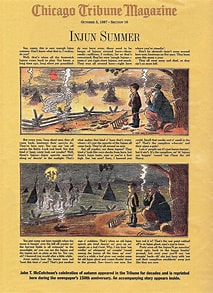
As a child, I always looked forward to the Indian Summer edition of the Chicago Tribune. I don’t know what there was to look forward to as the pictures and the accompanying story was the same every year. This was cartoonist John T. McCutcheon’s ‘Injun Summer.’ Due to the use of the politically incorrect words Injun and redskin for Indian, this autumnal delight has disappeared from papers across America. Which is a shame – even as a child I knew Injun was an old dialect word or mispronunciation of Indian and that redskin was a despicable word of its time. Neither term was meant in a derogatory or malicious way in the story.

Before I get to the main point of this week’s blog, allow me a short walk down memory lane. McCutcheon’s story was first written in 1907 and harkened back to the author’s childhood in the 1870s. It features a grandfather, who speaks in a folksy Mark Twain style, with his grandson looking across an autumnal field of corn stacks. The grandfather explains the meaning of Indian Summer by playing into the child’s imagination, envisioning the corn stacks as tepees and calling up the spirits of the Indians that once lived there.

Some etymological truth underlies McCutcheon’s story. The spell of warm temperatures interrupting the autumn cooling towards winter have loose links to Native American lands. The first recorded use of Indian Summer goes back to an essay written in French in 1788, indicating that it was already used in spoken language in North America. Some speculate that the origins of the term came from the unseasonably warm conditions in autumn that were noted by Europeans in regions inhabited by Native Americans (even though it occurs throughout the Western Hemisphere). Another idea is that the term referred to a time of year when American Indians hunted.

Back to the present. This year we have experienced two Indian Summers with a heatwave – hotter than the average summer – in mid-September and a more traditional warming up of autumnal temperatures in early October. This time, I’m not feeling sentimental about these experiences or nostalgic for the Chicago Tribune of my childhood. A confused lone red damselfly has been hovering around our back garden for days. The front of the house has marigolds blooming and budding as they would in August. Two Indian Summers, with the extreme heat of first, are unsettling.

During our second Indian Summer, I was reading the latest New York Times Climate Newsletter. David Gelles reported on the increase in fossil fuel production with hundreds of new gas and oil projects having been approved in the past year. Gelles relates this to what we have all been hearing but needs to be said yet again:

‘There will be grave implications for the planet, which has already warmed by about 1.2 degrees Celsius above preindustrial levels. This year is shaping up to be the hottest on record, with record heat on land and the ocean fuelling extreme weather around the world.’

Writing about the dangers of pollution, Rachel Carson famously described a Silent Spring. I wonder if Indian Summers with their unseasonal insects and flowers are becoming Autumnal Augury.

Divine Decadence

Every five years or so, I watch it again. I never seem to tire of it. Each viewing is like the pencil scratching on a door frame that indicate a child growing.

When Cabaret first came out, I was a ten-year-old, self-proclaimed connoisseur of 40s and 50s movie musicals. In those days, I liked Cabaret for its burlesque sketches and music, inspired by the rhythms of Kurt Weill’s Threepenny Opera. I was old enough to understand bisexuality and I knew about World War II, though perhaps both in superficial ways. Those plotlines were distractions from the cabaret performances. I so wanted to be in an adult world where people could sing and dance in a Bob Fosse style with slouched shoulders.

A few years later, this became a film about open sexuality and debauchery, the lifeblood of any teenager. I had discovered David Bowie and glam rock. Women having sex with men who are just friends and men having sex with each other were exciting and liberating after the constraints of a Disney childhood. Though set in the 30s, Cabaret’s sexual triangle of Sally, Brian and Max, seemed of the moment. As for the pop-rock of my teens, Cabaret may not have been of that musical genre, but Sally Bowles’ green-painted finger nails, men in make-up and cross-dressing fitted well into that milieu. The film, like my daydreams and aspirations, was in the words of Sally, ‘divine decadence.’

As an older teen starting university, I came across Christopher Isherwood’s 1939 novel Goodbye to Berlin. In both novel and film Sally is flamboyant and self-absorbed. But in the novel she’s British and doesn’t have a very good singing voice – certainly, no Liza Minnelli – nor does she have a sexual relationship with Brian, who is only interested in men. The first adaptation of the original novel was actually a stage play version in 1951, I Am a Camera by John Van Druten, followed by the stage musical in 1966 called Cabaret, written by Joe Masteroff. I could understand an obligation to a musical-loving audience to have more than a mediocre voice leading the story. But somewhere between the stage play and the musical, Brian was given a bout of heterosexuality. My beloved musical, the main form of my childhood entertainment, had let me down. Unlike theatre and pop culture, the musical was still promoting the world of boy-meets-girl. I had to reconcile myself with the novel and the film being two different sources of pleasure – something I would do the rest of my life with any film adaptation.

At university I encountered my first arthouse film and those became my new cinematic addiction. With its montages juxtaposing violence with musical glee, its tableau-like pan shots and subtle moments of foreshadowing, Cabaret in my reckoning was a film d’auteur that went mainstream. I still feel that way today, even if the awe of discovery has evaporated.

While I grew up in the anti-establishment 60s, critical of the US government and the Vietnam War, the Second World War was still regarded as an indisputable holy war – bad guys and good guys clearly delineated. In the Kit Kat Club, the world isn’t so black and white. The Nazis, Hitler and the Jews are all equally the butt of jokes. Younger, I saw this as part of the amusement of the film, but by my early thirties, Cabaret, full of political and social contradictions and nuance became a revisionist history.  

In mid-life, I find myself watching Cabaret with a sense of nostalgia for the 1970s. Though it was set in the 1930s, I saw it through the lens of the 1970s – a film that could include a woman having an abortion without being about the moral rights or wrongs of abortion. During the 1980s, the US went backwards. With President Reagan and The Moral Majority, abortion rights became highly politicized and still are today. That ten-year-old staring at the large screen in the 70s naively thought she was living in a society that was becoming more liberal with time.

After so many viewings, I don’t need to watch the film to think about it. Today, I’m thinking about one of the most iconic scenes of the film. Travelling by car, Max and Brian stop for a drink at a traditional biergarten. A young man in Nazi uniform starts singing ‘tomorrow belongs to me.’ Soon he is joined by the other beer garden patrons, except for one old man. The young people sing robustly, full of enthusiasm. To a modern film audience, knowing about the war that follows, this scene is poignant and chilling.

It’s hard to watch Cabaret today without thinking about the rise of the far right in countries like the US and Britain. I see myself like the old man in the beer garden, bewildered and out of sorts with it all.

My ’68 (or forgetting 2018)

Instead of saying good-bye to 2018, I thought I’d do what people have been doing throughout the year and have a look back at 1968. But on my own terms. Since I was born on the cusp of the baby-boomer generation, I hadn’t developed the hormones to appreciate the summer of love. Nor can I share the memory of hearing the Beatles White Album when it first came out, talk about John and Yoko nude having been filtered from my ears. Uprisings in Prague and Paris had to wait for me to discover arthouse films decades later. Martin Luther King’s final speech is a second-hand recollection created from grainy footage, a cracking soundtrack. Yet, for all these missed experiences, 1968 was a pivotal year in my life.

A typical Chicago deep freeze ushered in the New Year and kept us indoors with the television, fighting over what to watch with such ironically limited choice in those days. I’d escape the arguments by visiting my grandmother’s apartment, the unit above ours. Grandmother preferred radio to television and was always baking something sweet. Her apartment had white walls and ceilings, a white carpet running throughout – no shoes allowed – and cream soft furnishing. For all the lightness this color scheme brought in, a sense of sadness brought on by my grandfather’s death some months earlier filled the rooms with darkness.

Joy returned to our lives in the early spring. Most of the black snow, soiled by the city’s pollution, had melted and the maples were starting to bud. My grandmother had baked a devil’s food cake, a dark chocolate sponge with thin white icing. We were celebrating that night, marking the date on our mental calendars for future years. My parents’ divorce had been finalized and my mother and grandmother saw it as a day to be commemorated. Not a private clicking of glasses with a sense of relief that a legal ordeal was over. This was louder, cheerier and more public with all seven children involved in overeating and joking. My mother’s laughter like a song floated over the long dining table. I can’t remember what was said that evening, aside from hearing the word divorce being bandied around. I don’t recall my older siblings appearing upset or unhappy with this twisted display of victory. With hindsight, I’m certain the older children, a few in their teens, were angry and saddened but dared not show it.

I was too young to realize how sick and inappropriate this divorce party was. While these off-color festivities became less exuberant over the years, fading away by the time I was in high school, the residue stayed with me for decades. My social self had been born. Marriage was a form of imprisonment and divorce was women’s emancipation.

Within a month of this inaugural divorce party, Martin Luther King had been assassinated. My world suddenly stretched beyond our apartment, my grandmother’s apartment and our Chicago neighborhood. Downtown and the south side of the city became battle grounds for three days of riots, watched by my family on our black-and-white Zenith television. On one of these afternoons during the riots, I sat combing Barbie’s hair and staring out our first-floor window when I saw a large khaki vehicle roll down our residential street. I remember seeing a couple of soldiers with their helmets on – the characters from the news were now outside our building and in my life. Only it looked like the news about Vietnam and not the riots. I must have briefly entertained the idea that Vietnam was being fought on American soil, in the middle of the country. I would later learn that the National Guard had been called in, some 11,000 soldiers, alongside 10,000 Chicago policemen.

So strong was this true-life moment that I wrote about it in my early teens, when I had learned the word juxtaposition.  I described the army tank – or was it a truck? Childhood memories are not always the most reliable. The khaki vehicle, its soldiers, its rumbling wheels and roaring engine against the narrow street of parked cars created a juxtaposition. And like any juxtaposition, it created a meaning greater than the sum of its parts. For the six-year-old child with the Barbie doll, it was the first experience of sensing fear brought on by government authorities, government agents in the form of soldiers.

The drama of the riots tumbled into the last days of school before the summer break. The late afternoon sun streaked into our living room and I had parked myself in front of the television to watch The Flintstones. My mother, in her paisley housedress, appearing large and formidable, had entered just as the ads came on.  A brief announcement about the news coming up at six droned as it did to my ears in those days. Anything that wasn’t comedy or cartoon sounded like a monotone din.  The news was about Robert F. Kennedy. His death in hospital had been confirmed. He had been shot just after midnight at the Ambassador Hotel in Los Angeles soon after winning the California primary elections.

Within seconds my mother’s eyes and cheeks glowed with wetness. It was the first time I saw her cry. I didn’t think she was capable of such a weak, babyish thing. I hadn’t seen her cry over the death of her stepfather (the only grandfather I ever knew), or over anything to do with her marriage ending. I struggled to understand it. I wondered if she had a crush on this Kennedy person, this man with foppish hair, large ears and a row of teeth too big for his mouth.

My mother wasn’t the only one crying that afternoon for a man she had never met. I saw that too on the black-and-grey news. Men as well as women wiping the tears from their faces, talked about RFK and JFK and Martin Luther King all in the same breath.  I was starting to put pieces together. This grieving over the loss of a famous person was part of something bigger and people were afraid of an uncertain future when the present and immediate past was so unpredictable and fierce.

In the last days of summer, just a week before school was to start, riots erupted again in Chicago – this time at the Democratic Party National Convention.  I watched television with my mother and grandmother, seeing cars alight and hippies and police batting at each other. My siblings joined us, squeezing into the sofa, finding space on the floor – all except for my eldest brother. He returned home in the small hours of the next morning, smelling of smoke as he passed my bedroom door, his pony-tail disheveled, a rip in his jeans. I assumed he was in the riots but was too afraid to ask.

Later that morning, my mother berated my brother for taking risks and being out past the curfew. In my childhood, we always had a curfew and could be stopped by police if we were out past ten – midnight for older kids. But these riots brought about a special curfew and no one was allowed on the streets after sunset. A city in lockdown.

The autumn was all about school and being in the first grade, the first time I spent all day at school. I liked being around other children who were not my siblings and adults who were not my parents or grandmother. But I didn’t like the air-raid drills, the fear of the Soviets attacking America from the sky. We masked our terror with laughter – and people we didn’t like were called commies.

One night in November of that year, the news interrupted our family viewing of The Beverly Hillbillies with images of a stand-off on the tarmac of JFK Airport. A Pan Am jet had been hijacked by guerrillas and was going to Cuba. My brother with the pony tail scratched his armpits and made gorilla noises until a sister explained to me that animals had not broken out of a zoo. Vietnam wasn’t the only place under siege.

The year ended on a high note as everyone was talking about the Apollo 8 mission, with men actually inside a space capsule orbiting the moon. We were all drinking Tang like the astronauts. It wouldn’t be long now before they would be walking on the surface that we knew was not made out of cheese.

It was Francis Xavier who said, “Give me a child until he is seven and I will give you the man.” As 1968 came into my sixth year, it played a part in the making of this woman. But gratefully, perspectives change with hindsight and memories can be altered with time.

To Autumn

No political metaphors here. I just wanted to say something about my favourite season. There have been many great poems in English about autumn, its imagery well exploited. Even though its symbolism has found its way into idiom – the autumn of our lives – I’m still moved by it.

Perhaps there is some nostalgia at work here. I first read Henry Wadsworth Longfellow’s famous poem in primary school and remember the experience largely because it was autumn at the time. It is favourite season by far. It brought words to the images I saw outside the classroom window:

Thou comest, Autumn, heralded by the rain,

With banners, by great gales incessant fanned.

At the same time it fed my escapist’s fantasies, adding scenes and aromas of a rural idyll far removed from anything I had seen in Chicago:

Thy steps are by the farmer’s prayers attended;
Like flames upon an altar shine the sheaves;
And, following thee, in thy ovation splendid,
Thine almoner, the wind, scatters the golden leaves!

At secondary school, I discovered Keats’ often quoted ‘Ode To Autumn’ (‘Season of mists and mellow fruitfulness…’) and a glut of other writers taking up the subject – Edna St Vincent Malay, Carl Sandburg, William Blake, Katherine Mansfield, to name a few.

Contemporary poets have also borrowed from this season, either as a subject in itself or as a leitmotif. But these works appear far and few between. Is it that urban landscapes have replaced rural ones for the majority of the world’s population? Or do we comment about it more visually with computers? Instead of poetry, my Facebook friends and I have often posted photos of our gardens or nearby countryside and city parks in the autumn months.

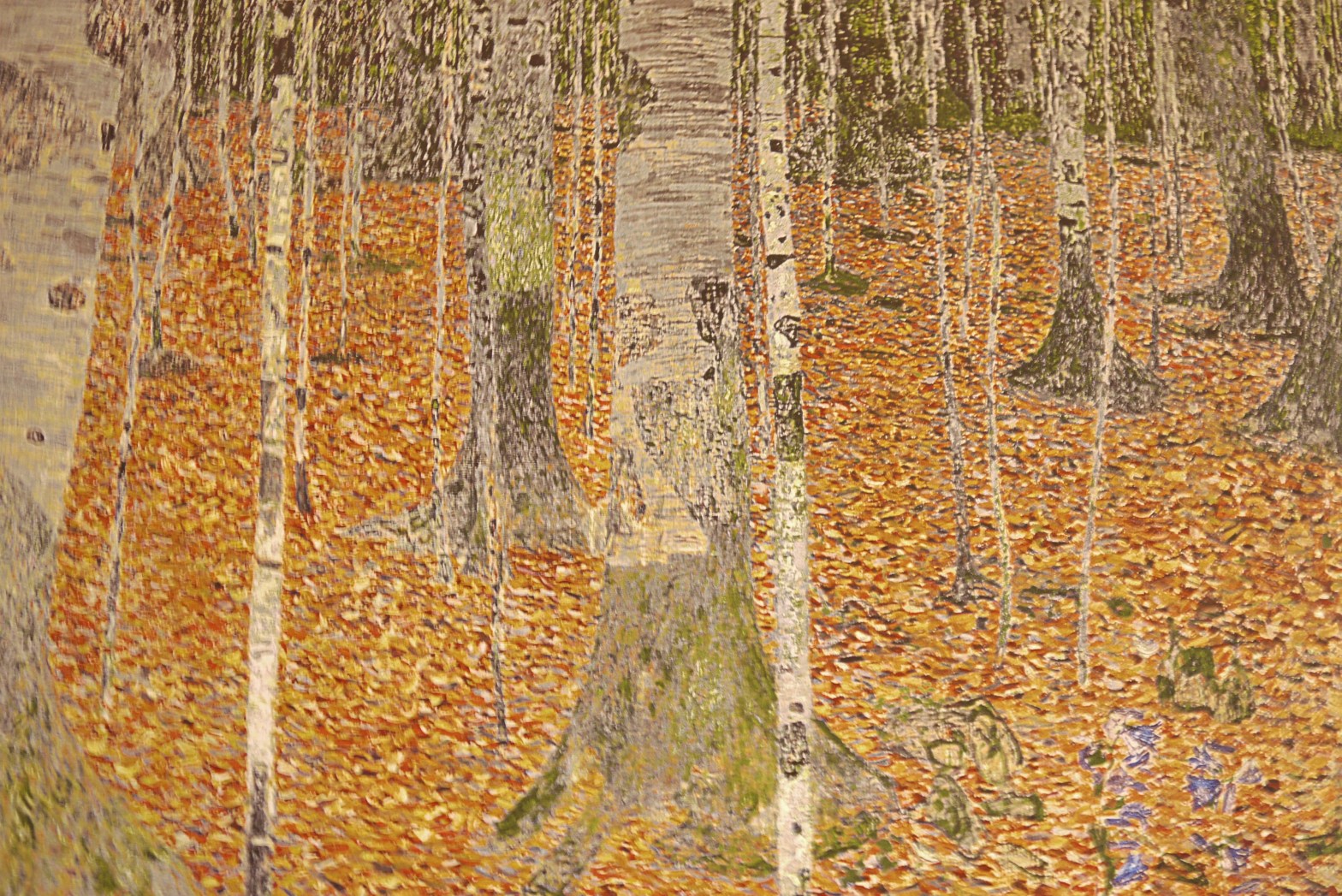
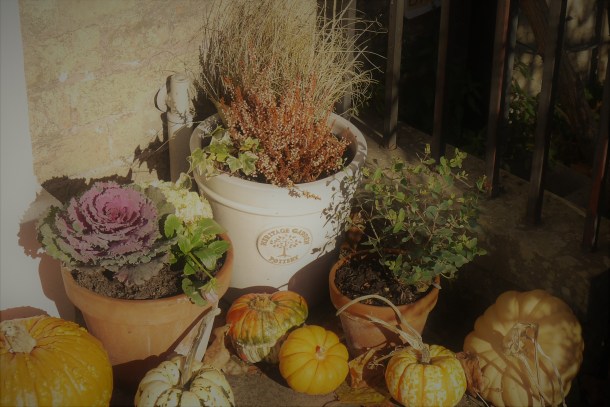
As a short-story writer, I pay my respects to the season by having the occasional character slip on wet leaves or take in the bright red-brown spectrum of colours or inhale the scents of dried lawns and wood-burning fireplaces. As I can’t paint or draw, here I reproduce Klimt’s The Beech Forest, alongside my photos of Ely at this time year. But whatever I do, I fear it pales next to the real thing. As with my childhood, autumn still provides escape, only now I take these meditative moments to allow my brain a rest from the toxic illiberal world we live in – political, but not a metaphor.

Autumn 2018-1.JPGAutumn 2018-5

#SchoolShootings

I asked my Facebook friends that I grew up with in Chicago if they remember having fears about mass shootings when we were at school in the 60s and 70s. Like me, they didn’t. Mass shootings at schools were unimaginable.

These friends did however remind me that there were a couple of bomb threats at our grammar school. This was around the time of the Vietnam War and soon after, when radical social movements were placing bombs in busy public places and government buildings. These bomb threats were taken seriously and we all responded to the fire alarm, forming pairs as we hurried out to the playground and baseball diamonds. No bombs were ever found – another hoax inspired by stories in the news.

Aside from the bomb threats, school for my classmates and me was a place of safety – though perhaps more so for the girls than the boys. I’ve learned through this little Facebook chatter that in highschool the boys had to deal with other boys acting tough and gangs picking fights at school sports events.

Our fears of crime and violence came from the world outside of school. We couldn’t go out by ourselves at night. Even a pairing of females felt their lives were at risk after sunset. During my childhood I knew of three teenage girls who were raped on the streets by strangers. A couple of others were attacked at knifepoint, but managed to escape thanks to the help of passers-by. I too had an incident of being followed by a man who had first approached me with his dick hanging out. (Another #metoo.) I hurried passed him and turned the corner. As I neared our building, I saw an apartment with a light on and waved and yelled out as if I saw someone I knew. The creep ran off.

It may not have been halcyon days, but it didn’t include mass shootings. We were, after all, before Columbine. That seems to have been the first. There’s an excellent article on this chain reaction written by the always brilliant Malcom Gladwell.

schoolshooting 2

I don’t think this problem is going to go away in the current mind-set that is sweeping America – especially with its NRA-funded think tanks and politicians. I am, once again, grateful that I’ve emigrated away from the US. Britain and France have their problems, but they don’t allow them to have assault weapons. I’m also grateful at times like these, on the back draft of a recent shooting, not to be in America, embroiled in the polemic. From Europe, I’ll stick to the occasional Twitter and Facebook postings – thumbs up to anyone who points out that this is utter madness – and the reminiscences of my former classmates – thanks for sharing, guys.

Diversity- an American Childhood

I grew up in Rogers Park, Chicago in the 60s and 70s. My childhood was post-civil-rights movement and pre-multiculturalism. My parents’ generation had labels for the neighbourhood. The west side of Rogers Park was still ‘predominately Jewish’ and therefore white. The east side, where we lived was ‘changing.’ In East Rogers Park, there still were many Jewish families, some Russian, others German. Other groupings to describe the east side weren’t based on religion, but on the countries their parents and grandparents came from. We had the Italians, the Irish, the Poles and the Puerto Ricans. Sprinkled among these were some Chinese and African-Americans (we used the word ‘blacks’).

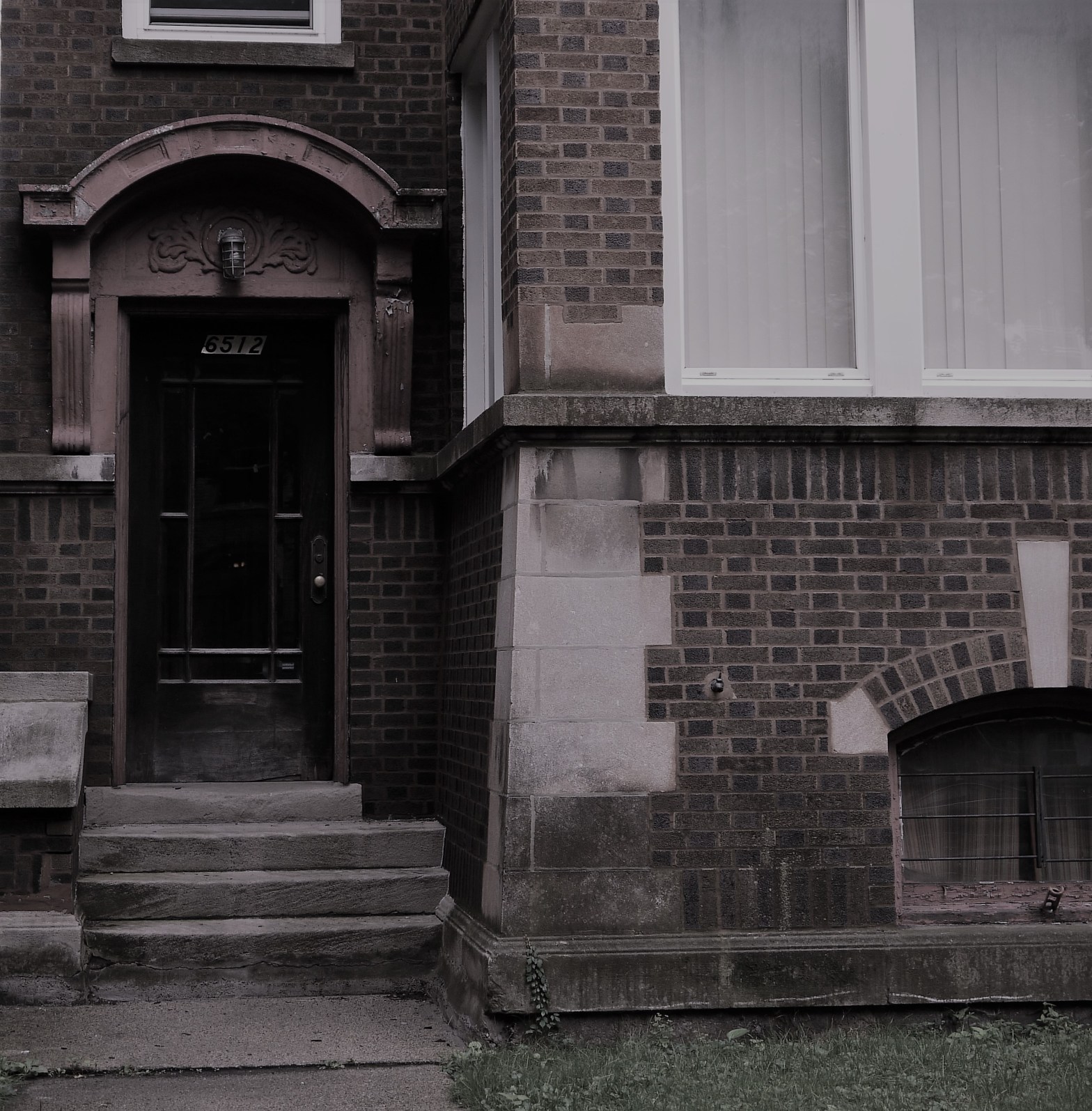
If you had asked me when I was living there, how I would describe my neighbourhood, I wouldn’t have used any of these labels. I would have said that it was a ‘cool’ neighbourhood because it had a lot of movie theatres, public parks and shops and restaurants. I would have also mentioned that it was a mix of three-storey apartment buildings and red-brick houses and that it ran along the lake front. I would have located this neighbourhood in terms of its train stations, the elevated line that runs from Loyola to Howard Street.

This isn’t to say that I was unaware of religious and ethnic divides or the prejudices that come with it. The grandparents of a couple of my school friends still had numbers tattooed on their arms from the Nazi concentrations camps. And there were plenty of jokes – the Italian, the Irishman and the Pole go into a bar… At high school, students segregated themselves in the cafeteria with blacks and Puerto Ricans having their own tables, while the whites were mixed in together. In my memory, at the white tables we didn’t make disparaging or racist remarks about kids at the other tables – that would have been ‘uncool’ and ‘racist’ – words no one wanted to be called. And ‘immigration’ was never a topic. Back in ouchicago-2011-001-2r classes and more importantly on our sports teams and clubs, students from different backgrounds played, worked and joked together.

I don’t wish to turn back the clock to my childhood in the ‘changing’ neighbourhood as it came with its own problems – among them, the tensions between the generations on issues of race and ethnicity. I know America has changed since then. To what extent is hard to say, living in Europe as I do. The current wave of fascism in Trump’s America was introduced through democratically-held elections, while at the same time it’s being fought both in the media and on the streets by what appears to be a majority. Perhaps America is ever-changing and perhaps that comes with democracy. I am worried that it’s becoming, to use a word from my youth, uncool.