Flemish (not so) Primitives

My taste in art has long been mostly modern – 20th century, some late 19th – Klimt, Matisse, Cezanne, O’Keeffe, Picasso, Kandinsky. But this recent trip to Bruges has turned that on its head. As luck would have it, the night before we left we happened upon the start of a new BBC4 series, The Renaissance Unchained, written and hosted by art critic and professional eccentric  Waldemar Januszczak. The first episode was about the so-called Flemish Primitives of the 15th century, for Januszczak the place where the Renaissance started – that is, not in Italy as has long been believed. (Still available on BBC iplayer, with some clips on YouTube.)

Waldemar, as we call him at home, made a good case for these paintings to be regarded as not so ‘primitive’ but instead as true masterworks. In one segment, he focussed on Jan van Eyck’s Madonna and Child with Canon Joris van der Paele, pointing out the detail that could make the viewer easily distinguish the textures of fur, velvet and lace. Although van Eyck was not the first to use oil, he is credited with having perfected oil painting techniques, mixing powdered colours with egg whites to come up with a concoction that spread more thinly and allowed for a greater variety of colours. These Flemish artists are also noted for breaking away from strictly religious themes and painting the everyday lives of real people.FlemishPainting-5.jpg

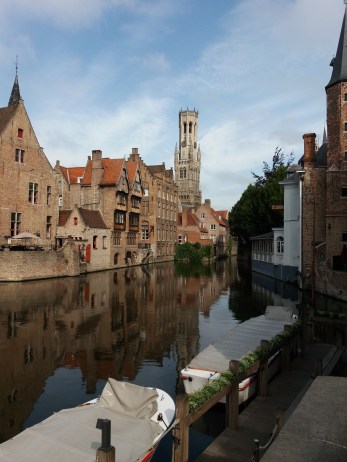
Some thirty-six hours after watching this programme, there I was at the Groeninge Museum studying this work for myself. Staring at the way the bristles in the carpet opened up over the steps in this magnificent painting, its complexity and visual subtlety transcended me to that place where creativity hinges on spirituality.

At the same time it made me feel ashamed of myself for having scoffed the Renaissance painters for so long. While I can appreciate the craftsmanship of Da Vinci, Botticelli and their ilk, I had tired of Madonnas and their pontificating children and tended to lump Renaissance paintings into a category of over-commercialised art. What’s the old expression – a little bit of knowledge is a dangerous thing? Mea culpa. I’ve now become an unofficial member of the van Eyck unofficial fan club. I’m also cultivating an appreciation for other artists of this early part of the Renaissance, having seen works at the Groeninge by Memling, Bouts and van der Goes.

While in Bruges, somewhere reading placards in a museum, I discovered an interesting take on the term ‘Flemish Primitives.’ It was FlemishPainting-2derived from the French premier, meaning that these FlemishPainting-3artists were the ‘first’ of
their sort.  If true, it’s a shame that this meaning has been lost.


The Ms Thing

Last week saw the death of Sheila Michaels, the woman credited with ‘introducing the honorific Ms into common parlance,’ according to the NYT obit.

While it might be ‘common parlance’ in the United States, it still hasn’t completely caught on here in the United Kingdom.

Virtually any time I give my name to a stranger, whether it be a builder, a ticket office clerk, shop keeper, whatever, I am asked ‘Is that Miss or Mrs.?’ This question in itself divides the UK from the US, where people often don’t use title at all, just the person’s name. Here in England, when I respond with ‘Ms’ I’m typically looked at with a baffled expression. Sometimes the person tries again, as if my accent either made my response incomprehensible or my brain too small to understand that Ms was not one of the options. One time, a Cambridgeshire garage owner even asked me what it meant. I had to explain that Ms is for women whether they are married or not, like what Mr is for men.

But most of the time, the linguistically constipated stranger ignores what I’ve just said, looks at my hand, sees the wedding ring and writes down ‘Mrs.’ Problem – I’m not Mrs Trimarco – that was my mother, or some other woman who married a Mr. Trimarco in generations before mine. Like so many women, I chose not to change my name when I got married. Not only do I object to the symbolism that I become my husband’s goods and chattels upon marriage, but having been published under my birth name makes any name change professional suicide – not to mention downright messy. For those of you who say that it’s easier for the woman to change her name if she has children, I say wake up. With all the stepparents, foster parents and other guardians with different surnames to their little ones these days, people’s expectations have changed.MS-2

I haven’t yet run into an equivalent for Ms in other languages, but there are countries that either no longer or never have used titles to distinguish married women from unmarried ones. These include, surprisingly, Iran and South Korea, two countries with notorious track records for the oppression and ill-treatment of women. Moreover, in both Iran and South Korea a woman keeps her surname after marriage. Having said that, one Korean woman once told me that a woman kept her maiden name so as to not confuse the family tree in a country where ancestor worship is paramount. Her interpretation on all of this was that women didn’t count in the tracing of family trees, that they were mere conduits of babies, not important enough to have their names passed on.

In some South American countries, a woman becomes a signora, but her surname stays the same. When she has children, part of her surname, usually a double-barrelled one like Sanchez-Perez, goes to her children. The other half of the children’s double-barrelled names comes from their fathers.

So, what’s the problem with Britain? Maybe people here resist the title because they’re used to Miss or Mrs, or as one shopkeeper once told me ‘it’s only for feminists’ (as if that were a bad thing). Are things all that bad on this score here? Well, just a couple of years ago, I felt a glimmer of hope when I went to the opticians and was given a form to complete that gave me the options Miss, Mrs, Ms, Dr, Mr. I happily circled Ms. I turned in my completed form to the receptionist, who looked at it carefully and said, ‘Is that Miss or Mrs?’

Fast-forward to a few days ago. I was at Homebase getting a quote for our bathroom refurbishments when the bathroom designer, sitting at her computer, was filling in my contact details. A dropbox for titles came down with Mr, Miss, Mrs, Ms, Dr etc. as she asked me my title. Seeing the options, I said, ‘Well, Ms or Dr, either is fine.’ She looked at the ring on my hand and said, ‘But you are a Mrs, aren’t you?’ It was clear that that was her preferred option, a world she understood.

I replied, ‘But I’m not Mrs Trimarco. My husband isn’t Mr Trimarco. I didn’t change my name when I got married.’

Her expression was too plain for me to tell if she was an anti-feminist, repulsed by the title, or simply confused. Finally, she said, ‘Okay, let’s use Dr then.’

Gertrude Bell in Persia

She’s been described as ‘the female Lawrence of Arabia.’ I confess that I’ve used that glib and convenient phrase myself. But it doesn’t do her the least bit of justice.  One could argue that she accomplished a great deal more than T.E. Lawrence and that she had more barriers to overcome along the way.

Gertrude Bell (1868-1926) was an archaeologist, scholar, writer and a political advisor, helping to establish modern-day Iraq and the National Museum of Iraq. As a contemporary of Lawrence, she worked with him at one point in Egypt. Both were British born and both developed a love and consequently insider’s knowledge of what was then called Arabia and Persia (or even more broadly and strangely to modern ears ‘the Orient.’) While Lawrence’s Seven Pillars of Wisdom is still read by British and American forces stationed in the Middle East, Bell’s writings on Iraq and Syria are studied by military experts and scholars the world over.

I recently read the first book she wrote, Safar Nameh: Persia Pictures.  It’s a journal of her travels in 1892 to what was then Persia, covering modern-day Iran and much of Turkey. She was accompanying her uncle, Sir Frank Lascelles, the British Minister to the region, which gave her access to people and places unavailable to most Westerners, especially women.Gertrude bell

Persia Pictures shows us a travel writer at the naissance of her writing life, before she knew herself the role writing would play in her career and the mark it would leave on her legacy. She relays impressions of the landscape, the towns and villages and the people that inhabit them with a sense of wonderment – that first discovery – of a part of the world few in the West knew much about. With this is her discovery of the Persian language and some of its most revered writers – in preparation for the adventure, she became highly proficient in Persian. (At this point in her life, she was already fluent in French and had begun studying Arabic.) Among the gems of this book are her fragments of translations of the Persian poet Hafiz into English. A few years later she published her translations of The Divan of Hafiz.

Bell concludes this short volume with what can be best described as a meditation on travelling. Here, she summarises her encounters with the locals in her role as traveller: ‘Although your acquaintance may be short in hours, it is long in experience; and when you part you feel as intimate as if you had shared the same slice of bread-and-butter at your nursery and the same bottle of claret in your college hall. The vicissitudes of the road have a wonderful talent for bringing out the fine flavour of character.’

With the films Queen of the Desert and Letters from Baghdad, Bell is slowly emerging from obscurity, but still appears to be relegated to ‘women’s studies’ as opposed to the writer, scholar and historical figure that her feats deserve. Yet, the day might come when T.E. Lawrence is referred to as ‘the male Gertrude Bell.’

Still Fighting

It’s easy to give up on politics and politicians. In a sense, that’s what has already happened. Around this time last year, many people in Britain, fed up with austerity measures and unemployment, decided not to engage in politics. They didn’t listen to cogent arguments or evidence. Instead they joined a movement of emotions and voted to leave the EU. Likewise, in America people, fed up with grid-locked legislation and the paralysis of their personal finances, also decided not to engage in politics. They either joined a similar movement of emotions or they didn’t vote at all. The result, as we all know, was Trump. I don’t mean to oversimplify these events – we all know that racism and sexism play their parts as well.

As a consequence of these electoral debacles, many people have been energised into political action. Online protests, petitions, marches, rallies and media-generated debates have erupted on a scale not experienced in my lifetime. But now the wind seems to be changing. Following the recent UK General Election, where a hard-Brexit government lost its majority, there is talk from politicians and in the media of a much toned-down Brexit, possibly keeping the UK in the single market and/or the customs union (among other things).

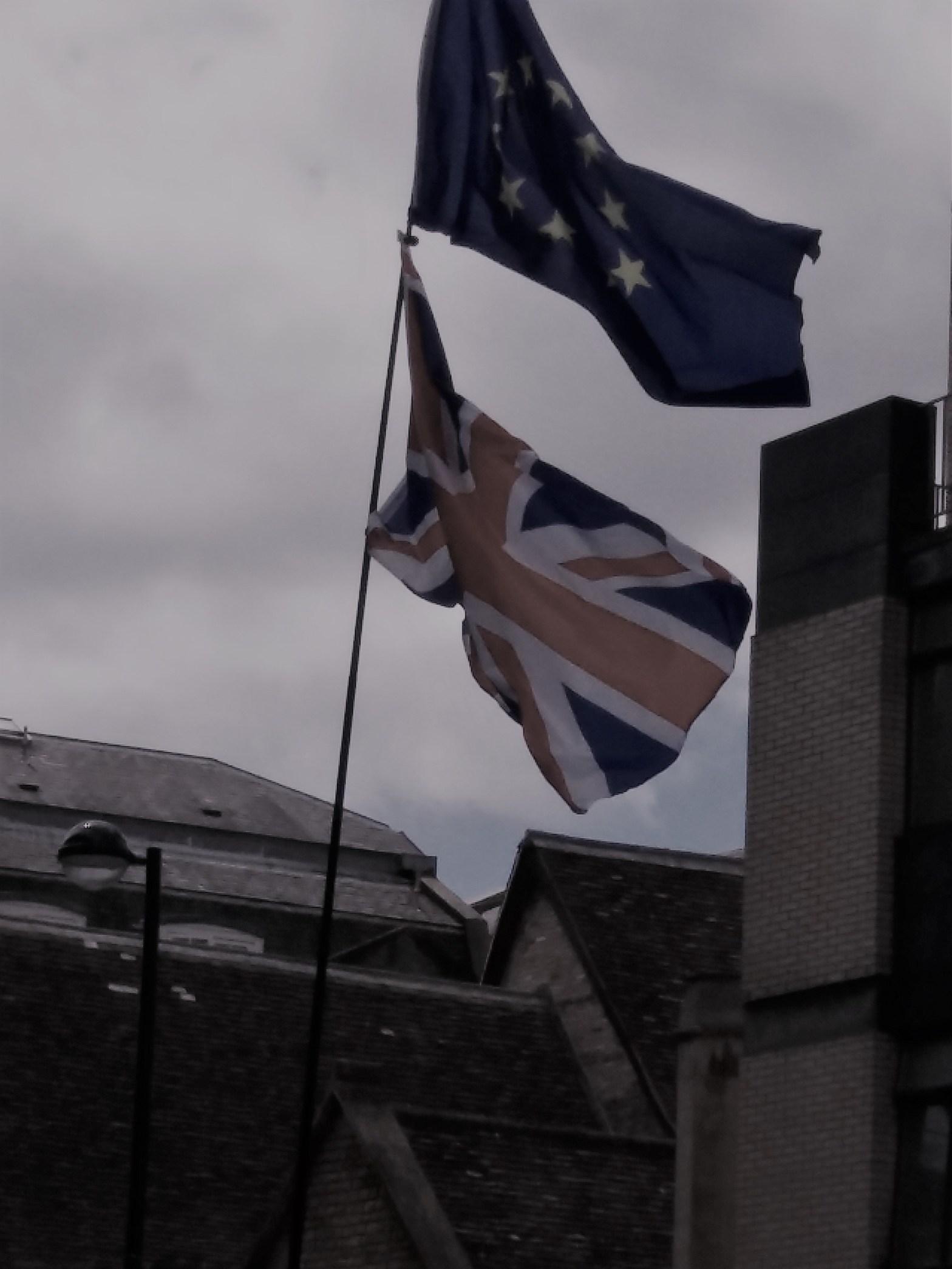
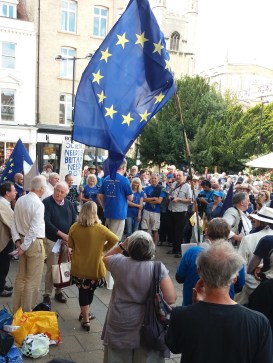
I went to a Pro-EU rally this past weekend, marking the one-year anniversary of the vote to leave the EU. It pains me to report that this rally was poorly attended.  Maybe some 300 people were there.  I wonder if this slight change in the air, this post-election awareness, has made people complacent. Do they believe that it will all work out for the best? That a hard Brexit or the economic downturn from any type of Brexit will never happen?  If they aren’t complacent in their thoughts, perhaps people were suffering from a bit of protest-march fatigue or were simply enjoying the beautiful weather that sunny Saturday afternoon.Cambridge 2nd march 1.jpg

As for me, I’m still in the fight. For those out there who don’t know me, on a personal level I don’t have much of a fighting spirit. I’ll argue to a point, but as soon as I realise that I’m overpowered or that my opposition is mentally/psychologically ill, I back off. I realise that there is no point wasting energy or keeping myself in a victim position. Of course, it’s easy to feel overpowered by political movements and governments. But then I remind myself that I’m empowered as a taxpayer and a voter and that participating in protests is a step out of the victim position. Wasting energy? I don’t think so. But I have to admit that it can be tiring. The opposition knows this too. I think it’s important that they (the Brexit and Trump supporters) do not wear us down.


Leadership – Part 1

The results of last week’s General Election in the UK leaving us with a hung parliament are in large part the result of a paucity of leadership in the main political parties. Jeremy Corbyn, though credited with running a good campaign, still did not get the most votes.  He has spurred divisions in his party and regularly vacillates on his and his party’s position on Brexit – the central issue of the election and Britain’s economic future. Nicola Sturgeon and Theresa May have both blatantly placed party politics above the people they represent. Sturgeon’s threats of another Scottish referendum while Scotland is failing under the weight of its own economic and social problems are hardly inspiring. May tried to sell herself as leader of the nation in a muddled campaign that never addressed the welfare of the nation or how Brexit was going to be realised and implemented or what it would mean for individuals and their communities. The LibDem’s Tim Farron, who has done the right thing by stepping down, committed the classic error of not leading by example – he may have voted in favour of gay rights and reproductive rights for women, but doesn’t personally support these rights and actively supports a church that condemns them.

This has left me wondering about what makes a good leader. People often point to Churchill as an example of a great leader. He may have been a very good leader, taking his people through difficult times. But he was the man for the moment and one who got wrapped up in the cult of his own celebrity. Napolean’s leadership has left historians divided for centuries, and I won’t go into all of that here – note the title, this is a topic I’ll return to. My point here is that it’s hard to find a so-called great leader who wasn’t at the same time highly flawed as a leader.Leadership 1C

As I write this piece, news and analysis are unfolding about the causes of the Grenfell Tower fire. Among the analyses was this comment in this morning’s Guardian editorial:  ‘Leadership requires courage, imagination and empathy.’ The article goes on to point out how May has failed as a leader in the aftermath of the tragedy. This too is an example of the idea of good leadership being apparent by its absence.

One of the most important books that I’ve ever read and one that I dip into from time to time is John Heider’s The Tao of Leadership, an adaptation of Lao Tzu’s teachings. Though published in 1985, I first read it in the early 90s when I was in a miserable job situation which ended so nastily, it put my academic career on hold for years. I soon realised that this book’s true value is in being not so much about leadership, but being about living in harmony with others. It made me understand the failings of the leaders around me and to see myself as a leader in my own ways. In brief, leadership is a role that we all play at different points in our lives. It’s not exclusive to the manager, the director, the team leader – leadership is about service to others.

With this in mind, I close on a quote from Heider which PM May and other political leaders could benefit from:

The wise leader is like water. Consider water: water cleanses and refreshes all creatures without distinction and without judgment; water freely and fearlessly goes deep beneath the surface of things; water is fluid and responsive; water follows the law freely. Consider the leader: the leader works in any setting without complaint, with any person or issue that comes on the floor; the leader acts so that all will benefit and serves well regardless of the rate of pay; the leader speaks simply and honestly and intervenes in order to shed light and create harmony. From watching the movements of water, the leader has learned that in action, timing is everything. Like water, the leader is yielding. Because the leader does not push, the group does not resent or resist.’

Leadership 1B

Tautology is Tautology

PM Theresa May does like her tautologies. First it was ‘Brexit means Brexit’ and now ‘Enough is enough.’ In semantics such expressions are treated as p →p. In pragmatics, where context comes in, it’s p →p ~>p (that is, saying p →p implies something greater than just p). But I can’t say this is the case with May’s use of this rhetorical device.

‘Brexit means Brexit’ was rightly criticised by many as being weak and uninformative as the public didn’t (and still don’t) know what Brexit means. In the months following this confusing declaration, the May government has hinted at a Brexit that would take the UK out of the single market altogether – the one thing that most of the country, including a portion who voted to leave the EU, don’t want. What else does Brexit mean? Leaving the EU will affect a large range of statutes and issues, which still haven’t been addressed by Theresa May. ‘Brexit means Brexit’ has become a blanket  to hide either the indecision and incompetence of those working on the Brexit project or to hide plans that would be unpopular with the electorate. Time will tell.

When I first heard May spouting out ‘Enough is enough’ in the aftermath of the latest terrorist attack to besiege the UK, I had a personal recollection of the last time I heard someone say that to me. It was actually in an email, so I hadn’t heard it, but I had heard the writer’s voice in my head. Without going into the unpleasant details of the long email thread, I was being attacked by someone with emotional and learning disabilities, who – being a relative – I felt obliged to respond to. My efforts to defend myself and clear the air were met with even more hostility and false accusations. My emails became shorter and shorter, saying that I wasn’t going to engage in this type of communication. And then it came – ‘Enough is enough!’ I was being scolded. The person who had scolded me had run out of things to say when she saw that I wasn’t sparring with her. I fear that Theresa May has reduced herself to this. Like my reaction to the relative scolding me, I find it amusing and a sign of weakness.

Have tautologies ever worked? First of all, I should say that I’m thinking of tautologies in the strictest sense. I’m excluding expressions such as Yogi Berra’s infamous ‘This is like déjà vu all over again.’ I would call that a redundant expression used by an inept speaker. For some, Hamlet’s  ‘I’m reading words, words, words’ is also a tautology – for me, it’s repetition that effectively avoids and mocks Polonius.  Yogi Berra is not saying ‘déjà vu is déjà vu’ and Hamlet is not saying ‘words mean words.’ With that aside, here are a couple of notable examples of tautologies that do work.  Sometimes I find myself saying  ‘It is what it is,’ perhaps much to others’ annoyance.  For me, it’s a polite way of saying that you can’t change the situation so stop trying.

And finally, there is ‘love is love.’ It was just about to become worn out, having been  the name of a Culture Club song and appearing on cheery posters, etc, when it was rescued by LGBT activists. This soft approach reminds those who are against gay rights that it all boils down to love. What kind of monster would be against that or argue with that? Of course, the monsters still exist, but the vast majority of people have come to accept gay rights. This has proved itself a meaningful and worthwhile tautology.

Faulks – Where My Heart Used to Beat

I loved, loved, loved Birdsong, Sebastian Faulks’ novel about the horrors of the First World War that managed a complex love story at the same time. Where My Heart Used to Beat is also a meditation on the experience of war, but with a look at the lingering psychological damages many years after. Less of a war story than Birdsong, this novel’s protagonist, Robert, is also less likeable. He’s a medical doctor specialising in psychiatry who’s melancholic and unable to form meaningful relationships. At the start, he thinks and leads the reader to think that this emotional paralysis is due to the heartbreak he experienced while on leave in Italy. But as the story progresses, he finds himself undergoing a sort of talk therapy that makes him revisit his battle field experiences and to some extent those of his father, who died fighting in WWI. With this, his malaise takes on a new perspective and is part of a larger re-evaluation of the his life.S Faulkes

The narrative structure relays these events in ways that make this a page-turner and keeps Faulks on the ‘popular fiction’ bookshelves. But Robert is a self-made scholar whose interests in the classics and philosophy, set alongside the burgeoning field of psychology, make this a deeper, more literary read. In these ways, it stands up to Birdsong, but for me, didn’t have quite the emotional impact as this earlier work. And there were a couple of minor technical flaws in Where My Heart Used to Beat surprisingly not picked up by the literary editor.  But for Faulks’ fans, a worthwhile read. all the same..

Revisiting Emily Dickinson

Occasionally the screensaver on my Kindle pops up with the dour face of Emily Dickinson. She has become one of the most recognisable faces in American literature. Yet, only recently has her life been transferred to the screen with Terence Davies’ A Quiet Passion.  The film d’auteur has its tableau moments, which slows down the pace and might not appeal to some viewers. But I found this fitting with the nature of Dickinson’s poetry – her elliptical language could cause images to freeze in the air. I liked too that the film contained sharp, intelligent dialogue in keeping with the dialogic style of many of Dickinson’s poems.  At the same time, these dialogues – many between Emily and her sister – remind audiences of the social liEmily D 2mitations thrusted upon 19th century New England life, especially for women. Although mostly a contemplative and melancholic film, humour and wit are present in a way that I felt was realistic to the poet’s life (Dickinson scholars are free to differ on this point.)

I’m also grateful to this film for reminding me that Dickinson wrote some poems about the US Civil War. We tend to think of Walt Whitman as the Civil War poet and of war poetry as being a male preserve.  But here is a Dickinson sampling:

(582)

Inconceivably solemn!
Things go gay
Pierce — by the very Press
Of Imagery —

Their far Parades — order on the eye
With a mute Pomp —
A pleading Pageantry —

Flags, are a brave sight —
But no true Eye
Ever went by One —
Steadily —

Music’s triumphant —
But the fine Ear
Winces with delight
Are Drums too near —

Since I was a teenager, I’ve liked Dickinson’s work, though I confess that there was a lot I didn’t understand younger. I think her writing and people’s understanding of it has been more helped by cognitive poetics (and other areas of literary stylistics) than by traditional literary criticism with its focus on biography, religion and history. Cognitive stylistics has shown how Dickinson manipulates grammar and word-choice to create different worlds that wrangle with, among other things, ontological questions. Here, I’m thinking mainly of the scholarship of Margaret Freeman, who gives a wonderful analysis of one of my favourite Dickinson poems:

A Spider sewed at Night

Without a Light

Upon an Arc of White

If Ruff it was of Dame

Or Shroud of Gnome

Himself himself inform.

Of Immortality

His Strategy Was Physiognomy.

(J 1138, lines 1-6; ms)

I think it’s time to return to this poet and see how I get on with her language and wisdom in my middle age.

Patriarchy and Harari

In Y.N. Harari’s book Sapiens, the bestselling author addresses the question ‘What’s so good about men?’ That is, why is patriarchy the dominant form of political and social rule across the world and existing in societies that had no previous contact with one another?Sapiens

In answering this, he rightly points to the flaws in the three leading theories on patriarchy.  The most common theory, that men have more physical power than women, is criticised by noting that women are ‘generally more resistant to hunger, disease and fatigue than men,’ and history has shown us that those with more physical power tend to do more of the manual labour and that social and political power don’t require physical strength. The theory that men have come to dominate women because they are biologically more aggressive is also debunked by considering the fact that wars aren’t won by aggression alone. Many of the great world leaders, such as Julius Caesar, have been successful because of their ‘mildness and clemency.’ Here Harari also points out that if stereotypes are anything to go by, women are deemed to be better ‘manipulators and appeasers’ than men which you would think would make them more powerful in society. The other explanation that Harari mentions is the idea that over time male genes have become more ambitious and competitive while female genes have developed to become more submissive and dependent in order for her to raise children. It’s easy to punch holes in this one as certainly women could be dependent on other women, just borrowing men for their seeds. And there’s the fact that many aspects of raising children can be shared with men.

After all of this debating, Harari disappoints by simply saying that ‘we have no good answer.’ He goes on to acknowledge how women’s roles in Western society in particular have changed dramatically over the last century and claims to find it ‘bewildering’ that patriarchy continues.Women vote

This surprised me given his lengthy section on the Industrial Revolution. Certainly that has had an impact on women’s rights and roles. He seems to avoid the obvious, that the physical power theory held sway for some centuries, but that as our lives became less physically demanding, the playing field between men and women has levelled more. Leaving us with ‘why patriarchy still exists at all?’ What Harari fails to consider in this context (though he talks about it elsewhere) is the power of religious and social institutions, well established before the Industrial Revolution, that have put into place the ideas of male supremacy. Conservatism is a powerful tool . We’ve seen this play out over the past year in Britain and America, where people voted in favour of a time gone by. Women’s equality is another victim of this establishmentarian and illiberal thinking. Nothing ‘bewildering’ about these points.

Local Elections

It’s taken me a week, but I think I have recovered from the mini-depression left behind by the local elections here in South East Cambridgeshire. I credit my recovery largely to the power of satire – thank you, Have I Got News for You. And I must acknowledge the Trump administration, although they are not aiming to be satirical, they have certainly achieved it over the past week with the firing of FBI Director James Comey – a tin-pot dictator fires the man who is leading an incriminating investigation against him and claims that it’s because of the way the man treated the dictator’s rival which brought him to power in the first place. (But as I write this Trump has now contradicted his spokespeople by saying that it was the ‘Russian thing.’)

Our local elections this time around proved the stuff of satire by showing us once again how human beings do stupid things at the ballot box. Not so funny – and hence a week of the blues – has been the nastiness and spreading of false information that has marked this particular campaign.  It reminds me of J.K. Rowlings’ The Casual Vacancy, where a parish council seat suddenly becomes vacant and the private wars and backstabbing begin.Labour window
Tory poster

Here in Ely, a group which calls itself ‘Progressives’ advertised itself as an alliance of progressive political parties, made up of Labour, Liberal Democrats and Greens. They even sent out social media postings showing a diagram of red, yellow and green stick people coming together to defeat the blue stick people, also known as Conservatives.

I clicked on their link expecting to see them supporting the Liberal Democrat in my ward for County Council. Much to my horror, they were telling people to vote Labour. Then I looked at other wards, and saw that the recommendations were either Labour or the Greens. No sign of the Liberal Democrats. This seemed odd to me as the Lib-Dems either won or came in second to the Conservatives in these local wards as long as I could remember.

I left a comment: What you are saying on your website doesn’t look anything like this diagram. Why can’t the LibDems have a win?

Response: We had been working with all 3 progressive parties for about 18 months but the local LibDem party decided [to] pull out last autumn. We’re hoping they will re-engage with us in the future.

Me: So you are only advising voters to vote Labour or Green? That doesn’t seem right. Especially in Ely where LibDems are more likely to beat Tories.

Other comments came flooding in with arguments and counterarguments. The most telling was when someone said ‘You’d rather attack the Lib Dems than genuinely try to defeat the Tories.’ The response was a ‘Yes.’

A few weeks later, the local elections were held. For Ely North, the Conservatives won with 49.3% of the votes, the Lib-Dems had 35.4% and Labour 15.3%. In Ely South, the Conservatives won with 46.1%, the Lib-Dems had 38.7% and Labour 15.2%. For both wards, these were high results for Labour compared with previous elections. If about 60% of their votes went to the Lib-Dems in the spirit of an alliance, the Conservatives would have lost. Clearly, divided we fall.