Indian Summers

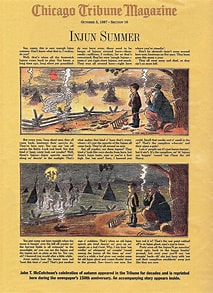
As a child, I always looked forward to the Indian Summer edition of the Chicago Tribune. I don’t know what there was to look forward to as the pictures and the accompanying story was the same every year. This was cartoonist John T. McCutcheon’s ‘Injun Summer.’ Due to the use of the politically incorrect words Injun and redskin for Indian, this autumnal delight has disappeared from papers across America. Which is a shame – even as a child I knew Injun was an old dialect word or mispronunciation of Indian and that redskin was a despicable word of its time. Neither term was meant in a derogatory or malicious way in the story.

Before I get to the main point of this week’s blog, allow me a short walk down memory lane. McCutcheon’s story was first written in 1907 and harkened back to the author’s childhood in the 1870s. It features a grandfather, who speaks in a folksy Mark Twain style, with his grandson looking across an autumnal field of corn stacks. The grandfather explains the meaning of Indian Summer by playing into the child’s imagination, envisioning the corn stacks as tepees and calling up the spirits of the Indians that once lived there.

Some etymological truth underlies McCutcheon’s story. The spell of warm temperatures interrupting the autumn cooling towards winter have loose links to Native American lands. The first recorded use of Indian Summer goes back to an essay written in French in 1788, indicating that it was already used in spoken language in North America. Some speculate that the origins of the term came from the unseasonably warm conditions in autumn that were noted by Europeans in regions inhabited by Native Americans (even though it occurs throughout the Western Hemisphere). Another idea is that the term referred to a time of year when American Indians hunted.

Back to the present. This year we have experienced two Indian Summers with a heatwave – hotter than the average summer – in mid-September and a more traditional warming up of autumnal temperatures in early October. This time, I’m not feeling sentimental about these experiences or nostalgic for the Chicago Tribune of my childhood. A confused lone red damselfly has been hovering around our back garden for days. The front of the house has marigolds blooming and budding as they would in August. Two Indian Summers, with the extreme heat of first, are unsettling.

During our second Indian Summer, I was reading the latest New York Times Climate Newsletter. David Gelles reported on the increase in fossil fuel production with hundreds of new gas and oil projects having been approved in the past year. Gelles relates this to what we have all been hearing but needs to be said yet again:

‘There will be grave implications for the planet, which has already warmed by about 1.2 degrees Celsius above preindustrial levels. This year is shaping up to be the hottest on record, with record heat on land and the ocean fuelling extreme weather around the world.’

Writing about the dangers of pollution, Rachel Carson famously described a Silent Spring. I wonder if Indian Summers with their unseasonal insects and flowers are becoming Autumnal Augury.

A print-only newspaper misses the point

County Highway is a new American newspaper with a retro-19th century look that is only available in paper copy and is determined to never go online. Like papers of times gone by, it’s a broadsheet with six tightly packed small-print columns across a page. Just the thought of it makes my eyes ache.

The editors describe their ethos:

‘Some of us fear the spectre of an incipient totalitarianism emerging from our laptops and iPhones. Some of us are simply allergic to conformity and brand-names. What we share in common is a revulsion at the smugness, sterility, and shitty aesthetics of the culture being forced upon us by monopoly tech platforms and corporate media, and a desire to make something better. We encourage you to think of our publication as a kind of hand-made alternative to the undifferentiated blob of electronic “content” that you scroll through every morning, most of which is produced by robots.’

This quote comes from their website, the same website where I found links to their Instagram and X/Twitter accounts.

Contradictions aside, I appreciate the spirit of this. It’s true that a lot of online content follows trends, is highly commercialised and is controlled by a handful of tech giants. But this is not a new phenomenon brought on by the internet or digital technology. Not too long ago, television was run by a few large companies and the government. These channels were and many still are beholden to advertisers or to the government of the day. Words like ‘smugness, sterility, and shitty aesthetics’ could easily apply to the box. Online news and social media are just another version of this with the added advantages of interactivity and citizens’ journalism – though some would say these are the worst features on online news. Discuss.

Most of my news comes from reading my phone or laptop. I tend to go directly to news outlets, and I particularly like the moving images from embedded video clips. I also listen to news on radio, podcasts and television. While I don’t have any hankering for thin inky pages, in the UK my Sunday mornings wouldn’t be right without the paper version of The Observer. In France, it’s the Saturday edition of Le Monde. These traditions today involve having the phone on at the same time – checking sources, looking up the odd word and adding reviewed books to my Amazon Wishlist. I accept that we live in a time where paper and screen co-exist.

Furthermore, County Highway, do you really think most digital news content is produced by robots? AI might be able to produce passable news copy, but only from texts written by humans through the conduits of human experience.

My final criticism – why harken back to the style of news from two centuries ago? Aside from being difficult on the eyes, it was colourless and rarely had photos. I suspect nostalgia is at work here. To quote Milan Kundera ‘The Greek word for “return” is nostos. Algos means “suffering.” So, nostalgia is the suffering caused by an unappeased yearning to return.’

SNA – Some New Abbreviations?

Abbreviations are nothing new. They’re found in Ancient Greek, Latin and medieval writings. According to the New York Times, the earliest known abbreviation in printed English is from an 1844 article: SPQR, for the Latin Senatus Populusque Romanus (The Senate and the People of Rome). This quasi-initialism appeared in The Christian’s Monthly Magazine and Universal Review that could have called itself the CMMUR.

What got me thinking about abbreviations was the announcement this week from The Merriam-Webster English Dictionary that they have added 690 new words since the start of the year. I haven’t read through the full list – I do have a life. From those I have seen, a large number are initialisms and acronyms, which MWED (sorry, couldn’t resist) lump together under the label ‘abbreviations.’ Okay, I’ll play along.

Quite a few of these abbreviations have their likely origins in text messaging (SMS- it’s inescapable) and social media, where speed is of the essence and character numbers are sometimes restricted. A few examples with MWED’s definitions:

ngl abbreviation, informal not gonna lie; not going to lie.

TFW abbreviation, informal that feeling when – used especially on social media or in text messages to introduce a relatable scenario or an image that evokes a specific feeling.

TTYL abbreviation, informal talk to you later.

I’m assuming some of these are lower case while others are uppercase because that’s how they’re being used. Seeing the MWED using gonna is novel and destroys my writing teacher’s mantra about not writing exactly how you speak.

Then there’s GOATED – apparently all caps. It started its slang life as GOAT – the greatest of all time. I’ve seen this pop up on social media, which tells me it’s not just a young person’s expression given the grown-ups I follow online. The word has now acquired an adjective form to denote ‘something or someone who is considered to be the greatest of all time.’ Though linguistically interesting, I find this rather cringeworthy, reminding me of the hyperbolic language spouted by populists.

Other abbreviations on the new word list come from official channels, such as the US government, who have replaced UFOs with UAPs. Here’s MWED’s wordy definition:

unidentified aerial phenomenon (a mysterious flying object in the sky that is sometimes assumed to be a spaceship from another planet); also: unidentified anomalous phenomenon (a mysterious phenomenon, especially an unidentified aerial phenomenon, that is sometimes assumed to be a spaceship from another planet).

I suspect this is an exercise in rebranding, intended to give an air of legitimacy to government-led investigations into what I still call UFOs.

Once again, the addition of words to our dictionaries reflects the age we live in. More on this topic later, I’m sure.

Adieu Carras, Nice

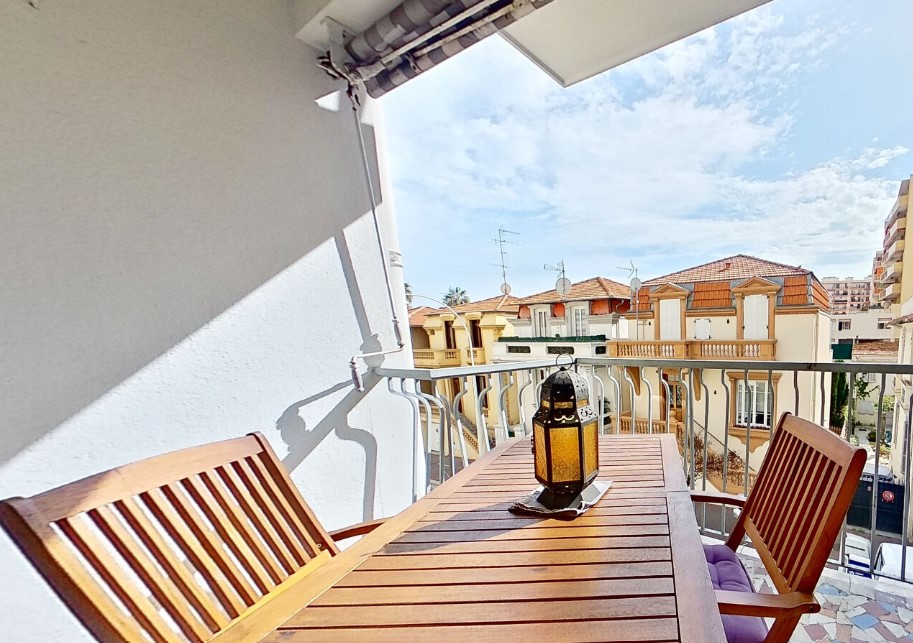
Aside from the odd immoveable rawlplug, the walls are bare. The cardboard boxes, stacked unevenly like a toddler’s set of blocks, wait for the movers to take them away. After nearly 14 years, I’m saying goodbye to our Nice apartment in the neighbourhood of Carras. But I’m not saying goodbye to all of Nice as we’ll be just up the coast in Menton. I’m imagining regular trips, about 35 minutes by train, to visit friends, go to museums and have boozy lunches with the Nice chapter of the Society of Authors.

So long, Carras. What will I remember of you? The busy streets bustle with cars, motorbikes and a menagerie of people, walking and talking, children skipping. The sea breeze shifts the exhaust smells, blending them with fragrances from the bakery, the pizza bar and the patisseries.

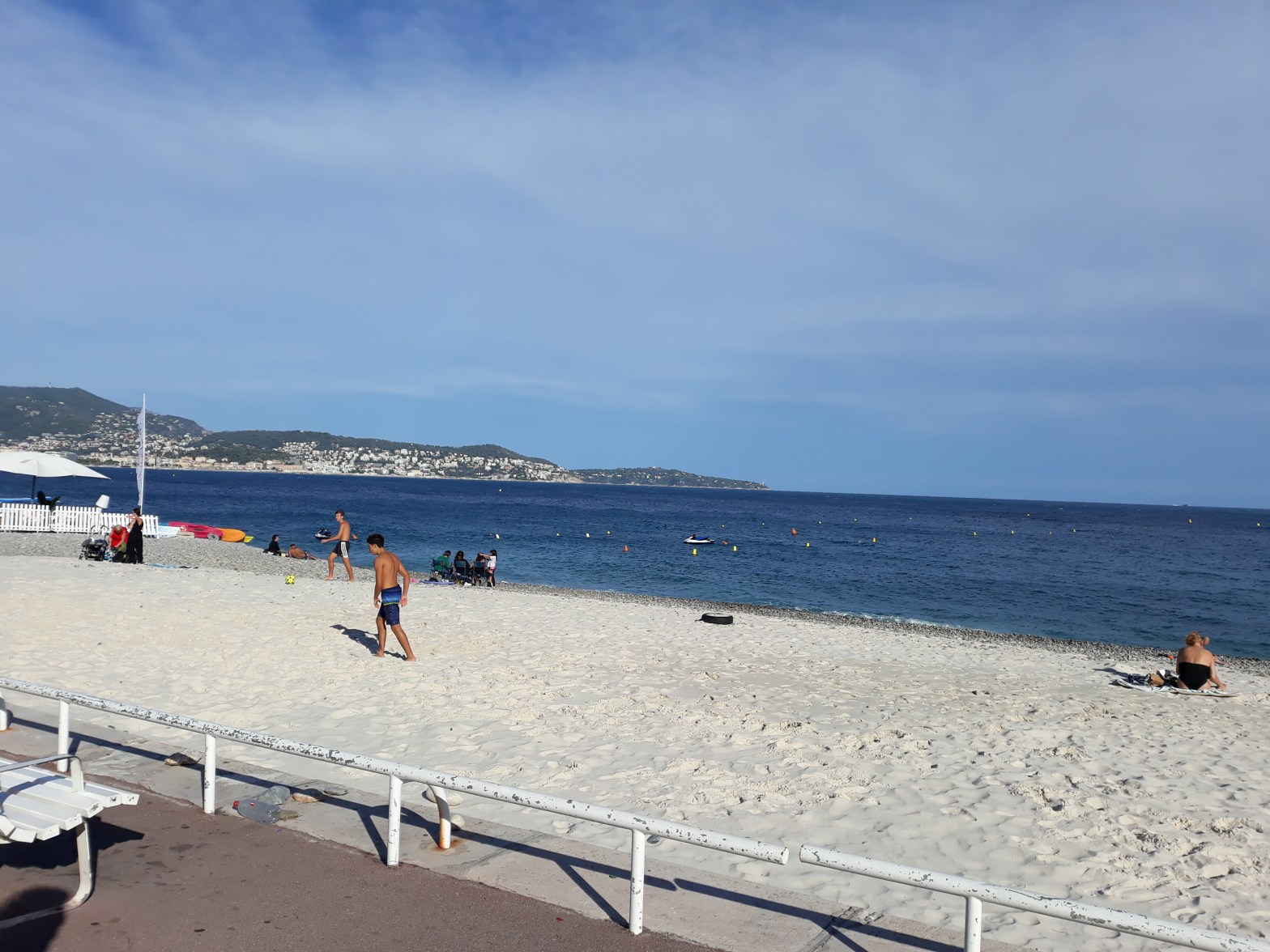
This part of the Promenade des Anglais will stay with me too. Unlike central Nice, replete with tourists and often supporters of football teams (as the city hosts international matches and championships), Carras beach is about local people. Women in abayas and burkinis can be found meters away from the topless French and Italian sunworshippers.

While I won’t miss this little apartment, I will miss the idea that for so long it was a place friends and family could stay. As I’m not a name dropper, I’ll just say that the apartment has been a creative getaway for writers and artists. I suspect I’ll feel this sense of connection with those who stayed here for years to come even if we have lost contact.

I wrote last week about a sense of place in literature. Now I’m thinking about a sense of place in one’s life. Carras has been a place in the background perhaps because it’s been a second home and the scenery to my learning about living in France. Carras has been there but hasn’t defined me or shaped my identity – an acquaintance as opposed to a friend to which I whisper a simple adieu.

A Sense of Place

I submitted my story only a day before the deadline. I don’t like running so close to the edge, but I’ve been busy with moving house in France. The story is for a literary magazine with an upcoming issue on the theme of place. Of course, place is everywhere, and every story takes place somewhere. Bringing place into the foreground is, I assume, what the editors meant by calling it a theme.

My story is set in India and is about a young woman who is somewhere on the spectrum (as we say these days). The treatment of animals (a contrary mix of despise and adoration) and of the poor (a mix of tolerance and alienation) makes this Western woman realise something about herself. I don’t know if I have succeeded in keeping place in the foreground. My main character has stolen the scene, and I suspect the editors will put my story into the neuro-diversity box either for another issue or for the overflowing rejection bin.

All of this has me thinking about place in fiction writing. I recall a playwright once explaining to fellow writers that he treated place as if it were a character. Place shouldn’t just be wallpaper. Whether it’s developing characters or causing certain actions to occur, place needs to play a meaningful role in the story.

In a book I just finished reading, The Paper Palace by Miranda Cowley Heller, the author does a particularly good job of using place as if it were a character. A New York family’s summer home is referred to as the paper palace. It is a tranquil, beautiful place that draws the family together and is where two key events occur. One event is a traumatic childhood experience, which triggers a tragic death and more painful memories. The other is a secret romantic relationship, which creates the main conflict of the story and a decision for the protagonist to grapple with until the very end. The summer home is feared and desired, and most importantly is unavoidable for the main characters.

While working on my short story and reading the Heller book, I’ve been reflecting on my sense of place in Nice, where David and I have had a second home for nearly 14 years. At one time, Nice was our escape from British winters. Now, it has become an escape from British life post-Brexit. As it has also become a place to spend more of my retirement (if writers every really retire), we’re looking for a larger apartment, a quieter city and a location closer to Italy for weekend jaunts. And thus, we’re apartment shopping in Menton. I trust that once we have left Nice, it, like India, will be a place I can write about from the vantage point of memories. Having said that, I’m reminded of a quote attributed to Benjamin Disraeli: ‘Like all great travellers, I have seen more than I remember and remember more than I have seen.’

Learning Languages in the Digiverse

Whether it’s a Duolingo lesson or an encounter with Google Translate, there’s no doubt technology has changed the way we learn languages. John McWhorter, resident linguist at the New York Times, recognizing this trend, praises the serviceable way that AI is offering translations across hundreds of language combinations.

McWhorter rightly asks the question – what about spoken language?

The rise of instant speech translator apps has been a big boost to learning languages. I’ve been using foreign language dictionaries on my phone for the past decade, and all of these have a speech component. This is great for the pronunciation of words and phrases, but it’s a far cry from a conversational tool. Language learners have to seek out situations to use these expressions in the appropriate contexts. This language learner has sometimes landed on her face trying it. I remind myself that we learn from our mistakes, especially those of the embarrassing variety.

Having said that, speech translator and dictionary apps have come a long way in recent years thanks to corpus linguistics digitally collecting and tagging words and their collocates from natural language. AI adds a layer to this, predicting text strings based on usage. But as I found in my experiments with AI for writing, where academia and eloquence take a back seat, algorithms generate a strange spoken language clearly influenced by social media content. For example, to help me with colloquialism in spoken Italian and French, I’ve started using DuoCards, a flashcard app that also gives sample sentences. Apparently butin in French is slang for buttocks, roughly translated by the AI driven app as booty. Remember Shake Your Booty from the 70s? It’s had a resurgence as a popular meme. I’m left wondering if butin is dated slang in French. I think I’ll stick with the anatomically correct fesses if someone’s backside gets into a conversation.

McWhorter gives his verdict on using AI translators for spoken language: ‘I don’t think these tools will ever render learning foreign languages completely obsolete. Real conversation in the flowing nuances of casual speech cannot be rendered by a program, at least not in a way that would convey full humanity.’

As someone with four language partners on the go, I agree wholeheartedly. To this I add that blogs with their informal registers are also full of these nuances of speech, and that includes made up language. I’ve used the word digiverse in my title. You won’t find it in dictionaries, and Word has annoyingly underlined it in red. But it is a completely usable portmanteau word. I know you know what I mean. Will a bot ever communicate like this?

John McWhorter. A far better linguist than William Safire, who had the language column in the NYT for decades.

Spider Women

Why is Spiderman a cool superhero when spider women are calculating villains or seductresses?

I’ve been reading Lady Brenda Hale’s memoir Spider Woman: A Life – by the former President of the Supreme Court. The reference to spider woman is a marketing ploy to remind the public that Lady Hale, wearing a spider brooch, was the president of the supreme court who ruled that PM Boris Johnson’s Prorogation of Parliament, effectively seizing debate on the Brexit Withdrawal Agreement, was unlawful. That is, the Supreme Court caught Johnson out, saying that his political manoeuvrings were illegal and that he had misinformed (or lied) to the Queen when he told her it was legal. The metaphor was obvious. Lady Hale was the spider woman whose legal web ensnared Johnson, who was the fly or other small annoying insect. 

Hale’s memoir doesn’t portray her as a perfect human being, but nor is she a villainous or calculating character. Seduction never enters the narrative. Quite the opposite – like so many women in the professions, she worked hard and under the haze of imposture syndrome. Being fascinated with history and the role of constitutional law in forming of the British government, she knew she wanted to study law. Hale gained a place at Cambridge when male students outnumbered females six to one.

Noticing the lack of women attorneys and barristers in the Family Court, this spider woman went into family law early in her career. She makes this observation:

“… it seemed to me that I had spent most of my time oppressing women, specifically mothers: sending them back around the world to the country from which they had escaped, bringing their children with them without permission; or taking their children away from them and into the care of the local authority, often to be adopted later; or making them encourage and facilitate their reluctant children’s visits to their fathers. Justified oppression, maybe, but oppression certainly.”

Some spider qualities perhaps, but too cerebral and reflexive to be a superhero.

Other spider women have emerged from performance art (often of the cabaret variety), fantasy erotica and literature. ‘The Tale of the Spiderwoman’ comes to mind. This poem by Merlie M. Alunan anthropomorphises the spider and seems to turn her into a woman:

…I myself daily grow smaller and smaller until

almost invisible. Fuzz on my skin, my eyes

multiply a hundredfold in this darkness

and split the light in thousand prisms—

and now I can see what’s before and after.

I become light as air, my sweetness distils

to fatal potency. I practice a patience

vaster than ten worlds. I wait…

When your shadow crosses my door,

please enter without fear.

But remember not to ask where I’d been

or what had fed me in this empty room

curtained with fine webs of silk.

Ignore the seethe of all my memories.

Come, take my hand.

I am human at your touch.

 (Full poem at http://poieinkaiprattein.org/poetry/merlie-m-alunan/tale-of-the-spiderwoman—poems-by-merlie-m-alunan/)

Of course, I cannot think about spider women without mentioning one of my favourite novels of all time, Manuel Puig’s The Kiss of the Spider Woman. Molina, in prison for corrupting a minor, asks Valentin, the political prisoner, for a kiss before he is paroled. Valentin in turn asks Molina if he’s afraid that he’ll turn into a panther woman – we know that the panther woman kills when she is kissed. But Valentin explains he isn’t the panther woman, but he is the spider woman. The meaning of the spider woman is left metaphorical, ambiguous and multi-layered.

So too is the answer to the question I started with.

Writing about and with our senses

In her book Sentient: What Animals Reveal About Our Senses, Jackie Higgins quotes from Leonardo Da Vinci who observed that the typical person ‘looks without seeing, listens without hearing, touches without feeling, eats without tasting . . . [and] inhales without awareness of odour or fragrance.’ When it comes to using our senses, Higgins concurs that ‘We are guilty of underappreciating – and underestimating.’

Higgins’ book is chocked with fascinating facts and anecdotes about animal and human senses, presented in accessible language that at the same time is not shy to use scientific terms. By senses, the author is not considering only the five senses delineated by Aristotle, but others that have since been examined, such as the senses of balance, pain, time and space.

I learned among other things that octopuses are covered with tactile sensors. Higgins cites studies showing how octopuses can use their heightened sense of touch to navigate mazes, dismantle Lego sets and even open childproof caps that leave us adults flummoxed. Other sea creatures can see colours that humans cannot, and some humans are so colour blind they experience the world in greyscale. The legendary speed of the cheetah is explained through recent studies of their acute sense of balance. This idea is explored further through experiments with athletes and dancers.

Along with these fun factoids, I also came away from this book thinking about the ways writers exploit the senses in creative writing. This is a well-worn topic in writers’ workshops and in those ubiquitous how-to books on writing. I won’t disagree with any of it. To transport the reader into an unknown place through words alone involves attention to all the senses and not just that of sight – visual description tends to be overdone and over-adjectived by novice writers.

This week I’ve been reading Black Dahlia and White Rose, a collection of short stories by Joyce Carol Oates. In ‘Spotted Hyenas: A Romance’ Oates employs the sense of smell in a few noteworthy ways. First, she uses smell to create fear and intrigue. A middle-aged woman, Mariana, thinks there’s a male intruder in her home and when he disappears all that is left is an animal scent. A few days later, the man reappears and seems to be half man, half animal. He enters a room filled with books. After he disappears for a second time, Mariana finds a book sticking out from a shelf – ‘The paperback Origin of Species was still warm, as if the furry man had been breathing on it. There was a smell—a distinct, acrid, animal smell…’. Mariana later realises (or strongly believes) that the man is someone she knew in her student days. The sense of smell becomes integral to the developing plot as the realisation triggers a flashback into an earlier life, full of dreams unfulfilled. This leads to a reunion at a pungent hyena habitat and this gem, when she first encounters her old classmate: ‘He stared bluntly at her and leaned close. Mariana could smell his breath—a meaty, earthy smell—a faint under-smell of decay like something overripe.’

If Da Vinci and Higgins are accurate about humans not appreciating their senses, perhaps writers and artists are needed to remind us of the copious world our senses can produce.

Joyce Carol Oates (again, I am a fan).

Replacing Twitter

Yes, I’m still referring to it as Twitter and not by its new name of X, a desperate rebranding by man-child Elon Musk. Afterall, some symbol formerly known as Prince is still called Prince today.

Nomenclature aside, soon after Musk purchased and destroyed Twitter, I joined the exodus to Mastodon. Several months later, bored rigid with Mastodon, I decided to close that account as well. I haven’t been tempted to migrate over to the recently launched Threads. I already have Facebook, WhatsApp and a mothballed Instagram account. I don’t wish to be owned by the ethically dubious Meta.

I’m starting to wonder why I need to continue with any massive social media platform like Twitter. Most of the accounts I followed belong to news outlets, political groups or organisations. Mostly I liked and retweeted within my bubble of like-minded acquaintances and strangers while ignoring the occasional hostilities of Brexiteers. Were these worthwhile ‘conversations’?

Cal Newport, who lectures in computer science at Georgetown University, argues that we don’t need a new Twitter. Newport calls Twitter at its best: ‘a global conversation platform on which everyone can gather to make sense of ideas and events, or, failing that, at least identify some strangely entertaining memes.’ Agreed. But at its worst, Twitter has been a victim of its own selection bias, which places popular and fast-spreading tweets ahead of others for users to see. Newport explains that with Twitter’s selection bias system of promoting some tweets over others, ‘the more aggressive messages are more likely to succeed in catching the attention of a sufficient number of retweeters to drive viral expansion…The result is a Faustian bargain for our networked era: trusting the wisdom of crowds to identify what’s interesting can create an intensely compelling stream of shared content, but this content is likely to arrive drenched in rancour.’ Indeed, that is the main drawback of Twitter, and it was made worse by Musk inviting hatemongering influencers back to the platform.

Newport also notes the flipside of this – on Twitter, breaking news can spread quickly. That for me was part of the appeal of the platform, a sense of having a finger on the pulse of the latest happenings in the UK and abroad. It was feeding this news junkie’s habit. Of course, other ways of getting up to the minute news can be had through apps and newsletters. Newport’s article came to my attention from a New Yorker newsletter sent to my email inbox.

Getting news in these Twitter or non-Twitter ways is rather passive and spectator-like. For want of conversation within like-minded groups, I joined a few Facebook groups, but they either don’t have much activity or are ennuidated with minutia of personal stories. I have however found a digital home of sorts on LinkedIn. I reopened my account with them after a five-year break to bring in some new writing and editing business. Surprisingly, LinkedIn has morphed into a network that goes beyond the curriculum vitae. Yes, identity on LinkedIn still revolves around careers, but I have found news sources and political action groups and organizations. When I post something or repost something, I can receive various reactions and occasionally a comment. A mini conversation forms. Unlike Twitter, I haven’t witnessed any rage or nastiness. I suspect this could have something to do with the politeness of writing professionals in the format of LinkedIn. I know, writers have been involved in cantankerous verbal sparring on Twitter and long before the internet through newsprint, television and by any means available.

Newport ends up dismissing the mega-platforms like Twitter and Threads that try to play the role of being a global town square, ‘aggregating as many of its potential connections as possible into a single service.’ Instead, Newport recognises the value of ‘small groups that gather in their own bespoke corners of cyberspace.’ This includes conversation threads of niche and hobbyist websites, podcasts and email newsletters. To this, I add finding stimulating conversations in the comments that follow digital news stories.

I agree too with Newport’s conclusions and borrow them for my own: ‘To make the online experience less hostile, we don’t need ever-more complicated algorithms deployed by ever-larger platforms. It’s enough to instead return to a conception of digital interaction that occurs on a much more human scale.’

One of my LinkedIn images.

Some thoughts on dialogue in prose

Douglas Stuart’s Shuggie Bain and Barbara Kingsolver’s The Bean Trees have been among my summer reads. The two novels are studies of poverty and familial relationships.  Shuggie Bain is a coming-of-age story set in the council estates of Glasgow spanning ten years of the 80s to early 90s, while in The Bean Trees, a quasi-road story, a young woman in a beat-up car drives from Kentucky to Arizona over several months creating a new life for herself.

While I found both stories engaging and interesting in the worlds they inhabited, their handling of dialogue made Shuggie Bain the better read. This is despite losing its pace about three-quarters in. The Bean Trees, Kingsolver’s first novel, is tightly constructed and held its pace, but occasionally the dialogue fell flat as it appeared to try too hard to sound like the way people speak. Let’s be honest – in everyday speech, people wear out idioms and exhaust popular expressions. It’s part of the interpersonal function of language (for you M.A.K. Halliday fans). That is, we speak in familiar, tried and tested, language to connect with people.

In Shuggie Bain, the dialogue worked – which I wouldn’t have expected from a novel containing the Glaswegian dialect. Despite having lived in Edinburgh for five years and regularly visiting Scotland ever since, I still stretch my ears to understand Glaswegian. Perhaps Stuart knows this.  He’s allowed the narrative prose to do much of the work, leaving the dialogue gently sprinkled throughout the text.

A writer’s confession – my true love is scriptwriting. While I’m not writing scripts these days and might not ever return to it (a topic for another blog), I have learned some useful lessons from writing in a medium where dialogue does the heavy lifting. Allow me to enter the imperative mode. First, don’t bother trying to replicate everyday speech all the time. As mentioned, it can be dull on the page and duller still when coming out of the mouth actors, unconvinced themselves. Aim for dialogue that sounds natural, but devoid of the mundane parlance of everyday life. Second, use subtext. Characters don’t need to explain their thoughts. In fact, their dialogue is strongest when they say one thing to mean something else or to do something that is not obvious from the literal meanings of their words.

Okay, I’ve left the classroom and the imperatives behind.

P. G. Wodehouse was masterful at dialogue.  Nothing sagged in his characters’ speeches, using language more colourful than quotidian conversation. Where a character from The Bean Trees would say something like ‘he thinks he’s the cat’s pyjamas,’ Wodehouse’s Aunt Dahlia huffs out ‘Your uncle Tom thinks he’s the cat’s nightwear.’ As for Jeeves, everyone’s favourite butler provides understated commentary and suggestions to his master that are loaded with subtext. In this example from Right Ho, Jeeves, the text leading up to this tells us that Bertie is confused about a woman’s intentions, and Jeeves offers, ‘Feminine psychology is admittedly odd, sir. The poet Pope…’

‘Never mind about the poet Pope, Jeeves.’

‘No, sir.’

‘There are times when one wants to hear all about the poet Pope and times when one doesn’t.’

‘Very true, sir.’

From this snippet, the reader knows that Bertie is irritable and won’t listen to considered advice, and that Jeeves, due to his station, is going to play along.

There are loads of other great prose writers who command the dialogue in their works, but on a Saturday afternoon in August, Wodehouse was the first to come to mind.