A Renaissance person and a polymath went into a bar…

People say Renaissance man – and my spellcheck has just scolded me for not being ‘inclusive,’ telling me that I should be using ‘person.’ Yet, if you search online for a renaissance person, all you get are Renaissance men. Even worse, if you look up Renaissance woman, images appear of women painted by men of the Renaissance, followed by various articles on the lifestyles of European women who lived during the 15th and 16th centuries. No surprise that the online definitions of Renaissance man are steeped in the ideals and sexist language of that time. From Encyclopaedia Britanica:

‘Renaissance man, an ideal that developed in Renaissance Italy from the notion expressed by one of its most-accomplished representatives, Leon Battista Alberti (1404–72), that “a man can do all things if he will.” The ideal embodied the basic tenets of Renaissance humanism, which considered man the centre of the universe, limitless in his capacities for development, and led to the notion that men should try to embrace all knowledge and develop their own capacities as fully as possible.’

In other definitions these capacities specify physical strength and artistic ability. I wonder if Renaissance man has been replaced by polymath – a fine word though it might lack the gravitas of the Renaissance person. The difference being that a polymath is a person of wide knowledge and learning who’s not required to excel in arts or sports. The word polymath didn’t come along until the early 17th century at a time of burgeoning sciences and an affinity for Latin and Greek. It’s derived from the Greek polys, meaning many, and mendh, meaning to learn.

What brought me to this subject of humans who excel is different fields was the recent discovery that the 19th century chemist Sir Humphry Davy was also secretly a prolific poet even though, unknown to most people, only a couple of his poems were published in his lifetime. It turns out his scientific journals were sprinkled with his verse. In the popular press, this idea that a scientist can also be literary seems to come as something of a shock. Is this the result of the specialist world we live in? Or is there some provincial side, a kind of lazy thinking going on? That is, it’s easier to put people into one box than the many boxes most of us inhabit whether we are accomplished or not.

The Observer quotes Sharon Ruston of Lancaster University commenting on Sir Humphry Davy’s journals: “He’s writing about nitrous oxide or galvanism. But then there are lines of poetry as well. These two things are happening simultaneously for him. He is trying to figure out what the world is and how to understand the world.” In this light, it’s not surprising that thoughts about chemistry and poetry were intertwined. So much of the sciences and technologies use the language of metaphors to explain how things work.

Incidentally, a search for women polymaths was more successful than that for Renaissance women. The obvious candidates included the composer, philosopher and abbess Hildegard of Bingen and Florence Nightingale (a statistician as well as a nurse). The not so obvious candidates from the pop-culturally biased world of algorithms were Michelle Obama and Taylor Swift.

What I’ve been reading…

Over the festive season, I read a couple of excellent novels that both revolve around a strong bond between a brother and sister. Ann Patchett’s The Dutch House is an entertaining and thoughtful family saga that questions the importance of the homestead and of family possessions. Yuri Herrera’s short novel, Signs Preceding the End of the World, is about a young Mexican woman who crosses the US border to bring her brother back home. While both books are well-written, Herrera’s lyrical style and Dantesque narrative journey left more of an impression.

Winding down my year of blogging

My writing goal at the start of 2023 was to write a blog every week. I’ve done it – well, nearly. According to my WordPress stats, this final blog of 2023 will be my 51st of the year. I managed to stretch the meaning of a week to 8 days here, nine days there, while changing my posting date from Friday to Monday to get more hits, ending up a week behind. In France, however, a ‘good week’ means 10 to 12 days if you’re a builder or government worker. By that calculation, and since I spent half of 2023 in France, I have over-blogged this year.

WordPress also informs me that these blogs have totalled nearly 30,000 words, a solid novella length. But that’s an unfair comparison as blogs belong to a type of creative non-fiction. Or at least they can be. I appreciate the often-quoted Dr Ian Sussman who said, ‘Blogging is not writing. It’s graffiti with punctuation.’ To paraphrase Sussman, blogging can also be long-winded, soft-sell advertising.

My blogs have been neither the swear-laden ranting of graffiti or promotional writing being masked as information. Blogging, as a creative exercise, has given me the chance to author pieces about items in the news without falling into reportage and to write about books without following the standard book review format, often combining books together under sociocultural or environmental themes. Speaking of the latter, looking back on this year’s blog, I’m surprised that I didn’t write more about the environment, aside from three pieces around this year being my year of trees. I suspect this is because I now subscribe to David Wallace-Wells’s brilliant newsletter that covers environmental topics I would otherwise write about and at more length.

These blogs are creative too as no one assigns me the topics. Even with writing every week, I usually have too many ideas bouncing around my head to write about and have had to quickly choose one before the weekly deadline has caught up with me.

I’ve enjoyed the creative side of blogging. It’s what has kept me going with it. George Eliot called her creative life, her ‘higher life – a life that is young and grows, though in my other life I’m getting old and decaying.’ Too true. But there’s only so much creativity and time to go around and this blogging year has taken away from other creative writing. I’ve noticed less journalling and only two new essays and one short story for the entire year. Having said that, I won’t be too hard on myself as I managed two academic articles and a book review, along with a couple of editing jobs. (Self pats her back.)

So, what’s the writing goal for 2024? To paraphrase John Updike, I plan to rewrite, rewrite and rewrite my fourth unpublished novel, the focus this coming year being on quality instead of quantity. As for this blog, it’ll continue to be my public notebook, but not likely in weekly instalments – once every fortnight or so.

I wish you all a creative and joyful 2024.

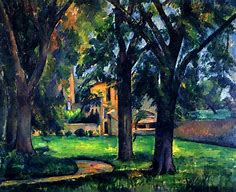
To conclude my year of trees, Paul Cezanne’s Chestnut Tree and Farm (1885)

The Pauline Boty Coincidence

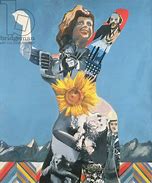
I first came across the artist Pauline Boty in Ali Smith’s Autumn, where the protagonist, Elisabeth, is working on her PhD in art history and discovers Boty’s work. She is so struck by the artist’s quirky paintings, popular in their time but now obscure, that she changes her thesis topic rather late in the game to Pauline Boty.

Elisabeth describes Boty’s paintings and collages as joyous, inventive and bold. Traits not allowed for women artists in the 1960s. As Smith’s book reminds us, when Pauline Boty attended the Royal College of Arts, there weren’t even toilets for women students. Naturally, this piqued my interest, and I found online a cache of Boty’s works, most depicting the personalities and popular culture of the 60s. Several sources refer to her as one of the greatest British female artists of the 20th century. She’s also credited as a founding member of the British Pop Art Movement. On top of that, Boty enjoyed a brief career as an actor in film and television and as a radio presenter. So, how did this celebrity artist pass me by?

In Autumn, Elisabeth thinks Boty’s present day obscurity is owed to her being female and the fact that she had a short life, dying of cancer at the age of 28. Yet, her legacy includes some 50 paintings, hundreds of drawings and several stained glasses – one of which can be found at the Stained Glass Museum of Ely Cathedral – that’s a five-minute walk from my house!

But that’s not the coincidence I started this with. About two weeks ago, when I was three quarters into Smith’s novel that refers to Boty’s life and work, my Sunday paper had an article about a new Boty exhibition at the Gazelli Art House in London. An artist I had never heard of is suddenly coming at me from different angles. I don’t see much in this coincidence. It’s not a calling to become an art historian or that I must have a special connection to Boty. Life is too random to think that way, but I enjoyed the coincidence all the same. It put a magnifying glass on this experience of discovery.

Of course, the article mentioned that Boty has been forgotten and how popular and outrageous she was during her brief lifetime. According to Rob Walker of The Observer, this exhibition will introduce Boty to a new generation. Maybe so, but will this woman artist enjoy the posthumous recognition of other modern artists who died young? Aubrey Beardsley and Jackson Pollock come to mind.

When Elisabeth tells another character that her thesis is about Pauline Boty, she soon finds herself explaining Boty’s brushes with fame after her death: ‘Ignored. Lost. Rediscovered years later. Then ignored. Lost. Rediscovered again years later. Then ignored. Lost. Rediscovered ad infinitum.’

It appears I have jumped into one of these cycles.

e.e. cummings at bedtime

Poet Ishion Hutchinson recently described e.e. cummings as ‘a great gateway drug’ to give to a young person who’s disinterested in poetry. Agreed. I discovered cummings (who rebelliously always spelled his name in lowercase) when I was thirteen. Every few years since, I pick up a cummings collection and dip in, soon becoming immersed, amused and sometimes baffled (but enjoying the challenge– dear reader, you know me by now).

Finding myself between novels, I’ve had cummings’s 73 Poems on the bedside table all week. This was the poet’s last collection, published in 1963, a year after his sudden death from a stroke.  The poems are all short and make for good bedtime reading, unlike T. S. Eliot’s ‘The Wasteland’ that kept me up and gave me stressful dreams (lesson learned). 73 Poems is an eclectic collection that is hard to sum up – joyous, reflective and yearning are words that come to mind.

Hutchinson explained that cummings is a great gateway drug because ‘he has a sharp ear for the inner music of language.’ This is true. Even the poems that break spacing rules and look odd sliding down a page, when read have rhythm and phrasing that rolls lyrically off the tongue.

What I particularly like about cummings is the way he creates words by working with morphemes or bringing together words into unusual (or nonsensical) collocations. Some examples from 73 Poems, without the line breaks as this blog is already irritating Word’s automated editor:

  • of all things under our blonder than blondest star…
  • …these more than eyes restroll and stroll some never deepening beach locked in foreverish time’s tide at poise…
  • …and (stealing towards the blissful pair) skilfully wafted over themselves this implacable unthing…

Reading these lines again, I feel cummings is winking us.

With cummings at my bedside, I can replace the prayer of my early childhood (the ‘now I lay me down to sleep’) with this version:

Poem 44

Now i lay (with everywhere around)

me (that great dim sound

of rain; and of always and of nowhere) and

what a greatly welcoming darkness –

now i lay me down (in a most steep

more than music) feeling that sunlight is

(life and day are) only loaned; whereas

night is given (night and death and the rain

are given; and given is how beautifully snow)

now i lay me down to dream of (nothing

i or any somebody or you

can begin to begin to imagine)

something that nobody may keep.

now i lay me down to dream of Spring

Good night, dear reader.

Digital Fictions and other Ephemeral Writings

About a dozen years ago I was teaching a course on analysing digital texts, those texts that can only be read on computers and that used the affordances of computer technology in their production.  The course included hypertext fiction, digital poetry and novels using adobe flash interface to tell their stories with words, images and music. Fascinating stuff.

I recall one of my luddite colleagues making an off-handed comment about the texts on my syllabus just being fads of technology and not real ‘literature.’ I admitted that there was some truth to that in the sense that technologies develop and change so quickly, other ways of writing creatively using new digital platforms are likely to come along. I shocked my colleague even more by saying that my course was likely to become superfluous in the coming years as digital texts become more common and would be studied alongside print books as part of courses on literature and critical studies. (That was me talking in a world that is ruthlessly territorial when it comes to who teaches what. I was always an odd fit in academia.)

In a recent interview, the British Library’s curator of digital publications, Giuilia Carla Rossi, noted that many ‘born-digital’ works, like the ones on my old course, are structurally and technically more complex than the pdfs and e-books we use today. These older publications – by that, I mean even eight years old – relied on the software and hardware they were designed for. With changes in computer technology, these works are no longer accessible. Painfully, that has been the case for a couple of the digital poems I used in my book Digital Textuality. These innovative multimodal poems were produced on Adobe Flash, which was discontinued in 2020.

Other texts analysed in my book have been rescued by digital archivists. The much-praised Patchwork Girl by Shelley Jackson first appeared in 2001 as a floppy disc (remember those?) with embedded specialist software. This hypertext fiction, where you can choose different paths to reading it, is a wonderful retelling of Frankenstein with a female monster. To read this work when I was teaching it, a CD driver was required. How many of us have computers with CD drivers in them these days? Luckily, thanks to digital archivists, Patchwork Girl is now available online as a download. This is because it was a seminal work in hypertext fiction. Other lesser-known works in this sub-genre have evaporated.

My prediction spoken to my colleague turned out to be too true, and many digital texts are now just texts. Digital Textuality only had one edition. But I don’t mind. Firstly, I managed to get a few articles and book chapters published on the back of this book. Secondly, these digital works and studies about them are not all that different from the many stage plays out there that are never recorded, and their scripts never published. As a former playwright, I’ve grown to accept that. Plays and their performances are re-experienced in our memories. Perhaps that makes me less clingy when it comes to digital texts and the short shelf life of my writing about them.

As I was taking a break from putting together this blog, I happen to read John Naughton’s latest column in The Observer, where he has coincidently taken up a similar topic. Naughton points out that we shouldn’t assume our stored digital data is going to be around forever. Not only is the technology changing in ways that make our digital artefacts inaccessible, but the companies that store these artefacts could go out of business, taking our data with them. WordPress, the platform for this blog, recognises the concern among its bloggers that our work might not last in perpetuity and has offered us a solution. For a fee of $38,000 WordPress will secure ‘your online legacy’ for 100 years.

Dear Reader, I’m afraid you’re going to have to treat this blog, like so many digital texts, as a fleeting thing, a mere transient writing of the moment.

Reading around the war in Gaza

With all the news coverage of the situation in Israel, I hadn’t planned to read any books on the topic any time soon. When taking in such horrible and complex news, I tend to mix reportage with commentary, newsprint with television and podcasts, trying to make sense of it and to distinguish between factoids and misinformation. All the while, I’m too aware that the unfolding humanitarian crisis is being presented in ways intended to tug on heartstrings and stir up anger. I thought I was getting close to my news saturation point with this war.

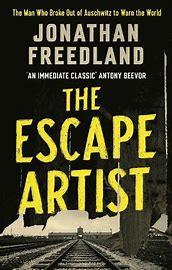
But then, I realised that two books I happen to be reading these days are related to this conflict. Both books draw from personal accounts of well-known and documented events of the twentieth century. One is The Escape Artist: The Man Who Broke Out of Auschwitz to Warn the World by Jonathan Freedland, a non-fiction book I mentioned earlier this year, having first heard the author talk about it in an interview. The other book, Le Pays des Autres (The Country of Others), is Leila Slimani’s reimagining of the lives of her French grandmother, Mathilde, and Moroccan grandfather, Amine, who settled in his native Morocco post-WWII during the fight for independence from France.

These stories overlap during the Second World War, presented in Slimani’s book in flashbacks of Amine fighting for the French colonisers when he met and fell in love with Mathilde. The Middle East as we know it today was geopolitically constructed by western powers of the past two centuries through force and exploitation. In the aftermath of WWII, Muslim cultures revolting against the West and their allies reverberated across North African to the eastern Mediterranean. As Slimani taps into this resentment and deep-seated hatred of the French in post-war Morocco, it’s hard to not make parallels with the contemporaneous creation of the state of Israel and the consequences of years of deadly conflicts.

The first half of The Escape Artist is set in Auschwitz during the war while the mass murder of Jews was taking place and follows the story of Walter, a Slovakian Jew, who was deported to a labour camp at the age of 18 and miraculously escaped two years later with a fellow Slovakian prisoner. These escapees kept mental records and described what they witnessed in forensic detail to Jewish leaders in Slovakia. The second half of the book recounts the difficulties in getting governments across the world to act on this Auschwitz Report before thousands more were killed, and the story continues with Walter’s troubled personal and political life after the war. Such events related to the war have been referred to throughout this most recent war in Israel.

Both books present the complexities of ethic bias and hatred, highlighting the sense of otherness with an awareness of inexplicable contradictions. Even though Amine has married a French woman and appears to harbour a secret esteem for the French, he becomes violent with rage when he learns that his sister is having a relationship with a Frenchman. By taking the narrative to the years following Walter’s escape, Freedland’s book covers the stories of Jewish leaders who collaborated with the Nazis to save their own families and who after the war – with nothing to personally gain – became character witnesses for Nazis that were put on trial. When the current Israeli conflict is looked back on, I suspect we’ll find similar sentiments and anomalies.

While I hadn’t intended on reading any more about the Gaza conflict beyond the daily news reports and their commentaries, it seems I have. This makes me even more aware of colonialism and the Second World War being as much about the present as they are about the past.

My Week in Anger

‘She’s gone,’ David said to me this morning as I was unpacking the groceries. I knew who he meant. Several days ago the British Home Secretary Suella Braverman had made more of her notorious offensive, divisive and ill-informed comments. This time, her targets were the pro-Palestinian, also known as pro-ceasefire,  protesters who were planning a march in London on the same day as the Remembrance Day ceremonial at the Cenotaph (for USians – this is Veterans Day and every year, there’s a marching band and a minute of silence at 11.00 around the memorial). Braverman referred to the protest as a ‘hate march,’ strangely comparing it to ‘terrorists’ marches’ once seen in Northern Ireland. The Metropolitan Police had already authorised the march to take place, to which Braverman added that the police were playing favourites. Clearly, she’s borrowing from the Tr*mp handbook.  First of all, logistics – the Armistice minute of silence was to be held far from the peace march, which was heading towards the US Embassy clear on the other side of London.  Braverman was using populist-style misinformation to create an enemy. Secondly, as Home Secretary, Braverman should not be criticising an institution (the MET) which is part of the government. That too is what populists do – make the state an enemy of the people.

Some five days have passed since her comments were published in an article she authored for The Times. While Braverman’s words received a lot of condemnation, they also sparked far-right counter protesters to show up at the march.  The few arrests made were mostly of the far-right counter protesters who were spewing out hate and acting violently. Finally, this morning the Prime Minister has sacked his Home Secretary. ‘Yessss,’ I said to David with a fist pump. Braverman’s gone. A reason to rejoice? Not really. I recall Boris Johnson having to resign as a disastrous Foreign Secretary only to come back as an even worse Prime Minister.

Is anger a wasted emotion? I grew up thinking that it was pointless, and as a female I was criticised any time I displayed so much as an ounce of it. These days I think that some anger is useful. It ignites people into action against the many wrongs in our societies, such as protesting against the military-led humanitarian crisis in Gaza.

Another source of anger in recent days has come from the latest polling in America. We’ve all known for a while that Tr*mp is the likely Republican nominee, but now it looks like he stands a fair chance of being president again. I don’t have to spell out what this could mean. I’m angry at Americans who have fallen for this cult figure and at the media for giving him excessive airtime and column inches. I’m angry too at Americans who despise the orange man, know that he is unfit for public office, but vote for him because they’ve always voted Republican.

Underneath anger one often finds fear. Some of the anger I feel towards the likes of Braverman, Tr*mp and their ilk is because I see them as dangerous. The right wing of the Conservative party seems hell bent on destroying some of our democratic institutions – our membership in the EU, the courts, the police and the civil service. Tr*mp and co have attacked the FBI,CIA, Justice Department and other offices of government that, though flawed, keep democracies functioning.

I’ve just learned that Suella Braverman’s replacement is James Cleverly, who was Foreign Secretary. The new Foreign Secretary is the former PM David Cameron, the same PM who engineered the European Referendum that gave us Brexit and who departed in disgrace. Since Cameron is no longer an elected member of the House of Commons, he has obtained this position through being a member of the House of Lords. That is, King Charles has just made him a Baron. Last week’s tragedy has become this week’s farce.

Writing – from teenage journal to adult essay

In 1977, Kahlil Gibran was cool. The artist, poet and philosopher was well-suited to 60s and 70s America. Best known as the author of The Prophet, Gibran’s words appeared on posters of serene landscapes, sunrises and out-of-focus lovers. Some posters included his drawings, reminiscent of William Blake, also popular at the time. Quoting Gibran was in fashion for the lecture circuit of peddlers of consciousness – creative consciousness, spiritual consciousness, universal conscious – everything was consciousness. This was the background that  Christmastime of 1976, when my teenage self purchased the 1977 Kahlil Gibran Diary. Every other page had a quote from the famous poet alongside a blank page for me to write in daily. I’ve held onto this Gibran Diary all these years though I would call it a journal these days.  It’s been stored in various locations in America, shipped across the Atlantic and stowed away and moved to various locations across Britain. Many pages are yellowed and it holds a slightly dusty mildew odour.

Today, living in what I suppose is the last third of my life, I’ve started re-examining the first two-thirds and mining my early journals for writing material. Opening this 1977 book for the first time since I was writing in it, I was hit in the face by my naïve teenage musings – obsessed with sex and death – and dreams of a grown-up life. Worse still, I came up against my own poor writing. I mean this in two senses of the word writing. My penmanship was painful to read with letters crunched together for most words with others stretched out as if taking a breather from my nervous hand. While my school report cards shined with top marks, the teacher’s comments inevitably included something about my illegible handwriting. For the other sense of writing, I was creative and could devise little narratives with quirky characters, using humour and descriptive imagery, but hopeless with the mechanics of writing. I wrote as I spoke in fragmented sentences – or their painful cousin, the run on sentence with a string of dependent clauses. I pretentiously employed erudite terms, often hitting the wrong tone or leaving my reader bemused. It’s easy to say this and analyse it now, but I do feel some mortification on behalf of my younger self.

Mediated by the journal, this conversation with teen me has brought back those formative years, the role of new age spirituality in a life riddled with family dysfunction. I wonder to what extent I was a product of that time period in American social history. Many political and social aspects of the mid 1970s escaped my notice then, being preoccupied with family and school life and most frighteningly with what was happening to my body. The Kahlil Gibran quotes, by the way, may have been read, but I rarely commented on them or used them to inspire my own writing. I’ve realised that if I’m to convert these writings into an essay, I can’t trust the limited memories or understandings of a teenager. Adding a political and sociocultural context to my young life gives me a chance to share my adult knowledge and build on it at the same time. What is the point of a writing project that I can’t learn anything from?

Okay, I’ve written about it – now if I can only get back to writing it.

How Grammar Might Influence the World We See

Have you ever wondered if speaking a different language could change the way you perceive the world? It’s a fascinating question that has captivated linguists and researchers for decades. While many have assumed that our thoughts and feelings are by and large universal, emerging research suggests that the language we speak can significantly influence the way we see the world, creating differences for speakers of different languages.

The idea that language can shape our perception of the world is not a new one. It’s often associated with the Sapir-Whorf hypothesis, which claims that the structure and vocabulary of a language can determine or at least influence the way its speakers think and perceive reality. The Sapir-Whorf examples using Native American languages have been discredited over the years. Yet, growing evidence supports the idea that language can indeed mould our thoughts and experiences.

One of the most intriguing studies exploring the relationship between language and perception comes from research conducted on the Aboriginal language of Murrinhpatha in Australia, reported in the current issue of Scientific American. Murrinhpatha has free word order, where subjects, verbs and objects can occur in any position in a sentence. In the study, Murrinhpatha and English speakers were shown the same image of a woman. Monitoring the eye movements of the participants revealed that English speakers focused first on the woman, then on what she was doing (perhaps looking at her hands) and finally on other features in the background. This reflects the tendency in English to have the subject first in the sentence followed by the verb and then adverbial phrases that describe the circumstance or background. Murrinhpatha speakers had faster eye movements that darted around the images, often taking in the background features first and then the foreground and back and forth again. The linguists involved suggest this could be the result of free word order.

While it doesn’t prove that language completely determines thought, it suggests that different languages can indeed shape the way their speakers experience the world around them.

This article also mentions something that has been troubling me for a while. So much of linguistics research and the resulting textbooks have come from scholars of the English language and to a lesser extend from similar Romance and Germanic languages. Most of the work that has followed in Chomsky’s footsteps in their obsession for universal properties of language and language processing has been based on a group that represents less than 5 percent of the total number of world languages. As the psycholinguist Evan Kidd put it, ‘The search for universals took place in only one corner of the language universe.’

As I write this, I’m working on an editing job for a Chinese post-graduate student who is trying to apply Chomskian principles and their descendants to Chinese grammar. While the student (and I as an editor) struggle with this assignment, I often wonder how different this would be if Chinese scholars developed generative grammars first before Chomsky.

Back to the beautiful diversity of language, Scientific American has this to say about the work conducted by the recent study: ‘…each language represents a unique expression of the human experience and contains irreplaceable knowledge about the planet and people, holding within it the traces of thousands of speakers past. Each language also presents an opportunity to explore the dynamic interplay between a speaker’s mind and the structures of language.’

To listen to Murrinhpatha, check this out.

Talking Terrorism

Are Hamas terrorists? The BBC and its presenters have taken a lot of flack this week for not saying so. The BBC does report, however, that the US and Britain have classified Hamas as a ‘terrorist organisation.’ But nearly everyone reporting in the media, including the BBC, agrees that the acts of the weekend of 7 October that were committed by Hamas were terrorist acts. This begs the question: Can you commit terrorist acts and not be a terrorist?

Of course, you can if you are a government at war. We have seen this most recently with the Russian invasion of Ukraine. Just this week, the United Nations published the findings of its investigation into Russian aggression in Ukraine showing that ‘Russian authorities have committed the war crimes of wilful killing, torture, rape and other sexual violence and the deportation of children to the Russian Federation.’ The same atrocities committed by a non-governmental body would be referred to as terrorism.

Writing in Prospect this week, Conor Gearty, an expert in human rights law, takes the position that Hamas is ‘too governmental’ to be called a terrorist group. Gearty explains:

‘Hamas are not, however, a straightforward terrorist group, senselessly violent though these attacks may have been. They won the most recent election held across Palestine, in 2006, and have been in control of Gaza since 2007. Hamas may be called a terrorist group but if so, they are a very governmental sort of terrorist. This authority in Gaza gives them more options than mere violence, and though Israel and its supporters may wish it to be so, their violence does not appear (in the past at least) to have destroyed their wider support in the community. Here they more resemble Hezbollah, Haganah (from Israel’s own “terrorist” past), the South African ANC and the IRA than they do al-Qaeda or the Red Army Faction from 1970s Germany.’

Others agree that Hamas should not be called terrorists, but for a different reason altogether. Referring to Hamas as terrorists can be viewed as anti-muslim (my spell check has this as anti-muslimism). In so many contexts, the word terrorist has been weaponised.

Plenty of people would object to these opinions, saying to not call Hamas a terrorist organisation is antisemitic. I found examples of this in the comments to Gearty’s article. Taking a different stance outside of religion, I’ve heard politicians and pundits in recent days arguing that calling Hamas terrorists is a way of distinguishing Hamas from the innocent Palestinians caught in the crossfire or deliberately being used as human shields.

Pointing out differences in the uses of words and their connotations isn’t just an academic exercise. Words matter. I appreciate that the BBC is trying to show its objectivity in reporting these events, but this is near impossible given the long history of wars and talk of genocide and hate coming from all corners.

I’m afraid that in the weeks and months ahead, atrocities are going to be committed on both sides of this conflict whether they are called terrorism or war crimes.

The controversial and horrific air attack on a hospital in Gaza.