#SchoolShootings

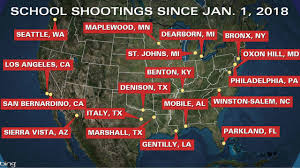
I asked my Facebook friends that I grew up with in Chicago if they remember having fears about mass shootings when we were at school in the 60s and 70s. Like me, they didn’t. Mass shootings at schools were unimaginable.

These friends did however remind me that there were a couple of bomb threats at our grammar school. This was around the time of the Vietnam War and soon after, when radical social movements were placing bombs in busy public places and government buildings. These bomb threats were taken seriously and we all responded to the fire alarm, forming pairs as we hurried out to the playground and baseball diamonds. No bombs were ever found – another hoax inspired by stories in the news.

Aside from the bomb threats, school for my classmates and me was a place of safety – though perhaps more so for the girls than the boys. I’ve learned through this little Facebook chatter that in highschool the boys had to deal with other boys acting tough and gangs picking fights at school sports events.

Our fears of crime and violence came from the world outside of school. We couldn’t go out by ourselves at night. Even a pairing of females felt their lives were at risk after sunset. During my childhood I knew of three teenage girls who were raped on the streets by strangers. A couple of others were attacked at knifepoint, but managed to escape thanks to the help of passers-by. I too had an incident of being followed by a man who had first approached me with his dick hanging out. (Another #metoo.) I hurried passed him and turned the corner. As I neared our building, I saw an apartment with a light on and waved and yelled out as if I saw someone I knew. The creep ran off.

It may not have been halcyon days, but it didn’t include mass shootings. We were, after all, before Columbine. That seems to have been the first. There’s an excellent article on this chain reaction written by the always brilliant Malcom Gladwell.

schoolshooting 2

I don’t think this problem is going to go away in the current mind-set that is sweeping America – especially with its NRA-funded think tanks and politicians. I am, once again, grateful that I’ve emigrated away from the US. Britain and France have their problems, but they don’t allow them to have assault weapons. I’m also grateful at times like these, on the back draft of a recent shooting, not to be in America, embroiled in the polemic. From Europe, I’ll stick to the occasional Twitter and Facebook postings – thumbs up to anyone who points out that this is utter madness – and the reminiscences of my former classmates – thanks for sharing, guys.

Essay: The Heiress

At a hospital in New York she was in a third-floor room that had its number changed to make it harder for people to find her. On the door of this room was a plaque bearing the name Harriet Chase – an alias and a lame one at that – a female name with the same initials.

Hugette Clark’s 5th Avenue apartment covered the entirety of the eighth floor and contained 42 rooms. She also owned a castle in Connecticut on 52 acres of land and a house in California that overlooked the Pacific. For decades, she lived cut off from most of the outside world in her New York apartment with these other homes remaining empty, though well-maintained.

By the time she was thirty, Clark was already worth half a billion dollars. That wealth had been inherited from her father, a copper mining and railway tycoon. He had other children with his first wife and remarried in his 60s, siring Hugette when he was 67 and half deaf. The grandchildren and great-grandchildren of these half-siblings were the reasons for her hospital-room anonymity – they were all after her money.

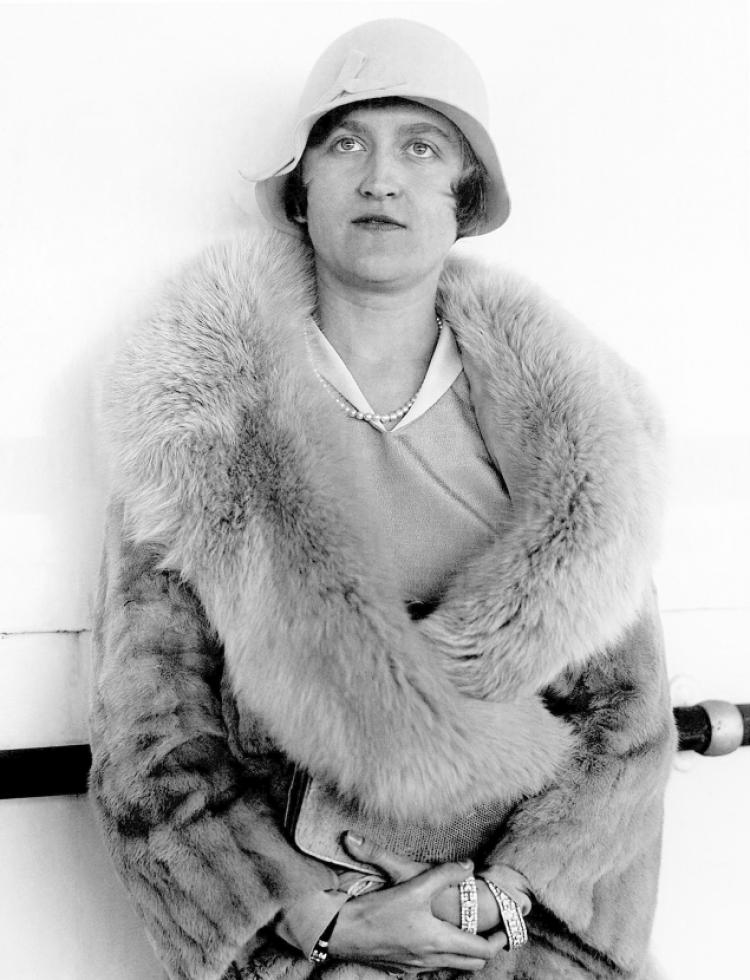
In 1930, Hugette Clark posed for a photograph, wearing a mink coat. Her hands are partially folded in front of her, one grasping a jewel-studded bracelet. She’s wearing a rounded hat that women wore in those days, a silken flower sewn into one side. Her lips, darkened by lipstick, are closed into a gentle smile while her eyes are gazing up in a posed fashion. Soon after the picture was taken, she cut herself off from much of her family and friends and no longer went out in public. There were only a few photographs of her to survive, this was her last, her death mask – a parting gesture for the curious.

She wasn’t a total recluse though, having a few close friends who remained at her side. Among them was her secretary, Suzanne, who claimed that Hugette’s closest friends were actually her dolls. The heiress had a collection of antique dolls that she fussed over, with her servants washing and ironing the little doll clothes. These, her surrogate children, were at her hospital bedside.

Hugette Clark died in May 2011 at the age of 104. She didn’t write any books, nor was she an actor or politician. With only one photo of her left, she hasn’t given the world much of herself. Yet, since her death, stories about her fill a peripheral space in the internet, generating a kind of celebrity that Clark herself would have shunned.  Her legacy has been her lifestyle – her living in isolation, her eccentricity and above all else, her wealth. The size and value of her properties, the cost of her furnishings, jewellery and her dolls speak to our envy and avarice. If she were equally isolated and eccentric, but poor, she probably would have passed without our notice.

Clegg’s How to Stop Brexit

Based on the reviews, I almost didn’t want to read it – it would have been too painful. When Nick Clegg’s book How to Stop Brexit first came out, the media focused on Clegg’s advising people to join the Labour Party. As this isn’t what one would expect from a former leader of the Liberal Democrats, it made for attention-grabbing headlines and news-straps.  Finally, I braced myself and read the book – and saw his remarks in the context they deserve. What he actually does is first to acknowledge that Britain is well and truly a two-party country at the moment and that it in within the two main parties that Brexit could be stopped. By joining Labour or the Conservatives (he says that too), a voter will have more opportunities to effect change in those parties, bearing in mind that both parties are internally divided between Leavers and Remainers. Clegg isn’t asking anyone to leave the Liberal Democrats. Instead he’s appealing to those who are inclined towards Labour or the Conservatives to join those parties and become more involved in their Brexit positions. This is especially the case for the Labour-inclined as this is the current party of opposition – well, at least they’re supposed to be. Joining the Conservatives is less helpful as most of the Conservatives MPs who voted Remain have been whipped into line to follow the disastrous path towards Brexit.

Clegg also makes a good point by reminding us that in 2004, when the EU expanded by including countries from the former Soviet Union, the pre-existing EU countries had a choice about whether and how to receive immigrants from these new EU-member states. Only the UK, Ireland and Sweden had an open-door policy. Other countries, such as France and Germany, imposed restrictions on the number of immigrants and the employment sectors they could work in. In other words, for those pro-Leavers for whom immigration from the EU has clearly been an issue, we cannot blame the EU for choices that we made. Of course, I, like Nick Clegg, think that these were good choices, filling in sectors of our workforce – on top of the many ways British life has been enriched by these other cultures.Clegg book 2

Other points in the book were ones that any Pro-Europe activist has heard before.  A bit of preaching to the choir, though I did enjoy Clegg’s turn of phrase: ‘The battalion of greying Conservative MPs you have never heard of, the shady financiers of the Brexit elite, the loopy rantings of Paul Dacre… all of these people fought  relentlessly for Brexit, over many years, long before the term ‘Brexit’ had even been invented.’

Another quote that made me nod in agreement and wish I had said it in my little blog: ‘By choosing the hardest of Brexits, by attacking them [remain voters] as “citizens of nowhere,” Theresa May made the extraordinary choice to de-legitimise and ignore the millions of people who voted for a different future.’ It was indeed extraordinary and angering as such remarks cut against the structure of our democracy, implying that we have a winner-take-all approach to elections. I’m surprised that more people haven’t caught out Theresa May on this.

Of course, I recommend this book but given its bold title, I fear that the only people who will take me up on this recommendation are those Pro-Europe activists who don’t need to read it.


A Couple of Books About Tr**p

Now that the buzz around Michael Wolff’s Fire and Fury is starting to fade – being side-lined by the Commander-in Chief’s latest verbal tantrum – I’m taking a step back and looking at a couple of recent books about the most shambolic US presidency in living memory.

Based on reading excerpts of Wolff’s book in the press and skimming and reading sections from the online-bootlegged copy that’s floating around, I can say that there were few surprises. White House pundits have been reporting for months on the president’s eating habits, idiosyncrasies, aversion to books, toddler-like attention span and lapsing memory. The power in this book rests not so much in its confirmation that this president is unfit for office – the world is witnessing this in a near-daily basis – but in the quotes from Steve Bannon. Trump’s former Chief Strategist, involved in both the presidential campaign and the early months of the presidency, describes Trump’s campaign as having a ‘treasonous’ meeting with Russian officials. This is significant. The FBI’s Russian investigation is moving closer to Trump while at the same time looking into the White House cover up, culminating in the firing of FBI Director James Comey. The FBI Director’s dismissal is also described by Bannon as a concerted effort to ‘get him’ led by Jared Kushner. These are serious allegations that could be part of Trump’s undoing if the Republicans lose their majority in Congress after the 2018 mid-term elections. (The other part might come from the international community.)fire and fury

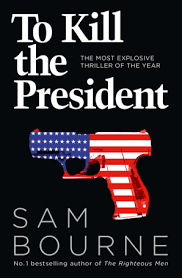
Having said all of that, the better book of recent months on the subject of Trump is the one that doesn’t even mention him by name. Sam Bourne’s fictional account of how Washington insiders cope with a narcissistic, racist and misogynistic US president is by far more interesting and informative. To Kill The President might be fictional, but it relies on knowing the workings of the US government and its laws. The premise is a simple one and one that has been in many of our imaginations for over a year now – what if the US president is insulted by North Korea leader and decides to teach him a lesson by ordering a nuclear attack? In this story he’s stopped for the time being by White House staff and Pentagon officials who trick him into thinking the North Koreans have apologised. Given that, legally speaking, the president could order such an attack without congressional approval, this event triggers concerns about the president’s mental instability. Once it’s realised that getting rid of the president based on mental health is constitutionally difficult to pull off, an assassination is planned. The story uses all of the plot twists and devices that one would expect of a thriller – a murder, a cover-up, secret codes and blackmail. Like a popular thriller, the writing is straight forward and not the stuff of literary fiction. But it’s nonetheless enjoyable for its satirical humour that edges close to the reality we find ourselves in during the era of Trump.

Bourne’s book is full of many quotable remarks from these insider characters.  I’ll close with this one, which comes from Mac, the president’s Chief Strategist and staunch ally (a fictional Bannon perhaps):

These liberals soiling their Depends undergarments about truth. They never stop! Always going on about facts and evidence and all of that shit, even when they have the biggest possible dataset showing them – proving to them – that the American people do not give a rat’s ass about any of it.

The ‘dataset’ that he refers to is the election – the votes that won the presidency.

A Few Things I’ve Learned in 2017

I’m not a fan of listacles, so do forgive. As these are not in any particular order of importance, this might not even be a true list.

One thing I’ve learned is that giving someone the benefit of the doubt is not always wise. I had briefly entertained the notion in early 2017 that Trump’s minders would cool down his twitter tantrums and hate-spewed rhetoric. Boy, was I wrong.

Related to that, though perhaps more to the debacle called Brexit, I’ve learned more about being a political activist. Attending marches and rallies is the easy part. The hard part is staying informed in the age of the post-truth – I’m regularly checking sources. The other hard part is trying to use logic and reason in the face of stubborn, illogical adversity. I’ve learned to continue to advance my argument – there’s always the chance that my opponent will walk away and think about what I’ve said later on. Of course, there’s also the likelihood that nothing I say will make a difference if someone has been brainwashed by the Brexit cult – or some other political cult bent on vituperation.

I also discovered this year that I’m likely to be histamine intolerant – there’s no known test for it. As a result of this knowledge though, I made several small changes to my diet and I now no longer suffer daily with blocked sinus, headaches or bloodshot eyes. The lesson learned emerges from the fact that a few times over the years pharmacists and doctors have vaguely suggested allergies, but, with the exception of spring flowers that make most everyone sniffle and sneeze, I was reluctant to accept this possibility. Had I taken on board these ideas, I might have found out sooner about my intolerance for certain foods. Before 2017, I didn’t want to see myself as someone who had allergies or couldn’t eat this or that because of intolerances – someone who might be a hypochondriac or simply self-absorbed.  A strange sort of projection of the ego – but there you go – I’m over it. Lesson learned.

And finally, there are those things that I’ve re-learned. I know I’ve learned these things in the past, but awareness of them now feels new as if learning them for the first time. Perhaps this comes from the memory wiring in my brain. One of these re-learns is the lesson of learning languages. It doesn’t get any easier. The bar just gets raised higher. Another relearn comes from my life as a writer. I’m constantly learning about my craft which is necessary to being a writer. I’ve known this for years, but sometimes it just seems to hit me with awe.

So, as dreadful as the world has been with its Trump and Brexit supporters, its climate change deniers, its wars, its femicide and mass killings, the capacity to learn has helped to make it bearable. Another year is ending, another to look forward to.

Rape on the Reservation

When I read this account in Rebecca Solnit’s much praised book I was initially horrified, soon followed by incredulous. According to Solnit’s essay, written in 2013, ‘…one of three Native American women will be raped, and on the reservations 88% of those rapes are by non-Native men who know tribal governments can’t prosecute them.’ I didn’t doubt the figures, given the economic deprivation and alcoholism found on Native American reservations. But the idea that there’s some governmental loophole that makes rape legal didn’t seem right. I did some research.

In 2013, Solnit was right to say one in three Native American women were raped in their lifetimes. Solnit was also roughly accurate as I found figures between 86% and 87% for the times these rapes occurred on the reservations by non-Native men. But it’s not completely true that non-Native men couldn’t be prosecuted.  It’s more complicated than that. Since 1978, tribes lost the right to arrest non-Indians who commit crimes on their lands. If the victim and the perpetrator were non-Native, the case would be handled at the county or state level. If the victim was Native American and the perpetrator non-Native, only a federal officer could make the arrest and the case held at the federal level. With these complications, fewer cases were being reported and prosecuted. Around the time Solnit was writing her essay, some 65% of reported rapes on reservations were not prosecuted, according to the US Justice Department. Rebecca Solnit

Certainly, the limited powers of the tribes’ authority, along with the possibility that the victim might not have known if her attacker were Native or not, made it easier for non-Native predators to commit their crimes. With this in mind, Solnit makes an astute point following on from the statistics when she says, ‘So much for rape as crimes of passion – these are crimes of calculation and opportunism.’

After years of petitioning legislators by women’s and human rights groups in America, the laws were finally changed in 2015. Native American tribes are now allowed to persecute crimes against women in their own courts, even if the perpetrator is non-Native.

I wish I could end this reportage here. But I can’t. It’s been two years since these federal laws changed, yet little has changed for Native American women. According to the National Congress of American Indians (NCAI), only 13 of the 562 federally recognised tribes have become ‘compliant’ with these new federal regulations. This is largely because tribes have to include non-Natives on their juries in such cases. That is difficult logistically, culturally and financially.

Underneath all of the legal wrangling lies the real problem. Sexual violence is still mostly experienced by women – the perpetrators nearly always men. Cultural change is desperately needed in Native and non-Native communities alike.

Allende’s The Japanese Lover – another mistitled book

Book promoters must believe romance and chick lit sells better than stories about families affected by war and human trafficking. The Japanese lover in Isabel Allende’s novel is really a character of a subplot that draws other characters (not the lovers) together and as a loose commentary about interracial relationships in post-war America. The romantic elements play second fiddle to a story that starts with Jewish immigrants fleeing Hitler’s Europe and continues with a Japanese family in California sent to an internment camp. These elements run alongside a more modern story of immigration from poverty in Moldovia only to face slavery and child abuse in America. Embedded in both stories are romantic relationships, but two of which are not truly romantic – an unrequited love and a marriage of convenience.

The novel should have been entitled Lark House as that’s the name of the free-spirited and eccentric residential home that brings together the two stories and their main characters. Alma is one of Lark House’s more independent residents. A painter and designer from a wealthy family who was brought to America as a child to escape the war in Europe, at the end of her life, she meets Irina, a young care worker. While Irina struggles to come to terms with the abuse of her past, she befriends Seth, Alma’s grandson. The young friends piece together Alma’s mysterious past, uncovering the older woman’s affair with Ichimei, the son of her family’s gardener.Allende 1

While Allende weaves these plots together seamlessly, her prose isn’t remarkable. At times, the omnipotent narrator is so distance from the characters and their physical surroundings, some passages read like journalistic reportage. That aside, it still was a good read and often hard to put down.

#MeToo – The Rally

Although I’ve been to my share of women’s marches and rallies over the years, I never would have thought that I would go to one dedicated to stopping violence against women. It’s not that this isn’t a worthy cause – of course it is. But I had come to believe that violence and sexual harassment against women wouldn’t be taken seriously enough for women to even attempt such a demonstration. Nor did I think enough women would speak up, especially in recent years when the label ‘feminist,’ supposedly a bad thing, is so readily attached to women who publicly recount their experiences.

In the 90s, there were marches in major cities, mostly in America, to ‘Take Back the Night.’ Those were admirable, but aimed at the stranger and the gangs on the streets targeting women. The bigger picture is more personal and disturbing.  At the rally yesterday in Nice, one of thousands held across the world, the French numbers were bandied about on signs – last year, 109 women were killed at the hands of their partners; of the roughly 200 reported cases of attempted homicide in the same year, three quarters of the victims were women; and 48,000 rapes occur every year.

How can any civilised society allow this to happen? I won’t go into the history of patriarchy here, but the patriarchy we live in has normalised violence against women. It’s been pointed out by many that the term domestic violence in English is a prime example of this normalisation, where deadly assault has been reduced to something akin to a family squabble. It’s no better in French, where such crimes are called drame famille and crime passionnel – both sounding like the content of soap operas.metoorally3

The rally was more than the statistics. It was a place where women stepped up to the microphone in the middle of Place Massena on a busy Saturday afternoon to tell their stories of rape, continued sexual harassment, sexual aggression and verbal intimidation. Their attackers were strangers, neighbours, fathers, brothers, partners, doctors, dentists and co-workers. Violence against women takes many forms. I’m glad we’re finally speaking up about it and supporting each other. While the laws and public awareness are gradually changing, sometimes I’m fearful of another backlash against feminism that could undo all of this. But ever the optimist, at other times I’m more hopeful, knowing full well that such societal changes don’t come easily.


A flying visit to Le Petit Prince

The first time I read The Little Prince I was twelve and naturally read it in English. This was when pop psychology ruled my thinking, and I saw the book as a fictionalised dialogue between the author, Antoine de Saint-Exupery, and his inner child.  I recently reread this novella, this time in French, which gave it a different flavour in my mind – more intellectual and whimsical at the same time. With this reading, I’m more struck by what it says about human nature in broader political contexts than with the personal and psychological. From here it was easy to see how it reflects the age we’re living in now.

Early in the story, the little prince asks a stranded aviator to draw him a sheep. After a couple of awkward attempts, the aviator draws a picture of a box with some holes in it and tells the prince the sheep is in the box. The prince accepts this and their friendship is cemented. In the present day, I’ll call this image the current British government, who received the picture of the box from the Leave campaign. I don’t think I need to explain this metaphor in any great detail. Any sensible person knows that the box is filled with the likes of a well-funded NHS, a robust economy and a lucrative trade deal with the remaining EU. The air holes are there to make this world seem real, a place where people live and breathe.

Another passage reflects pertinently in our age of the internet. The little prince climbs up to the top of a mountain and calls out to see if anyone is there. All he gets is an echo, which he mistakes for conversation.

The story also has plenty of characters suited for today’s headlines – an illogical king who claims he controls the movement of the starts, a vain man who craves attention, but whose vanity keeps him isolated, and a geographer who draws maps, but never leaves his own desk to experience the world he has helped to construct. I don’t think I need to mention the true life characters by name.

I’ve met people who reread Le Petit Prince every few years or once a decade. I don’t think I’ll join either of those clubs. Having read it once as a child going through puberty and now in my middle-age, my next appointment with this book could be in my very-old age. Who knows what metaphors, insights, ideas this little literary gem will conjure up then.

Petit Prince 2