Lemons and Oranges: Coping, or not, with the new world order

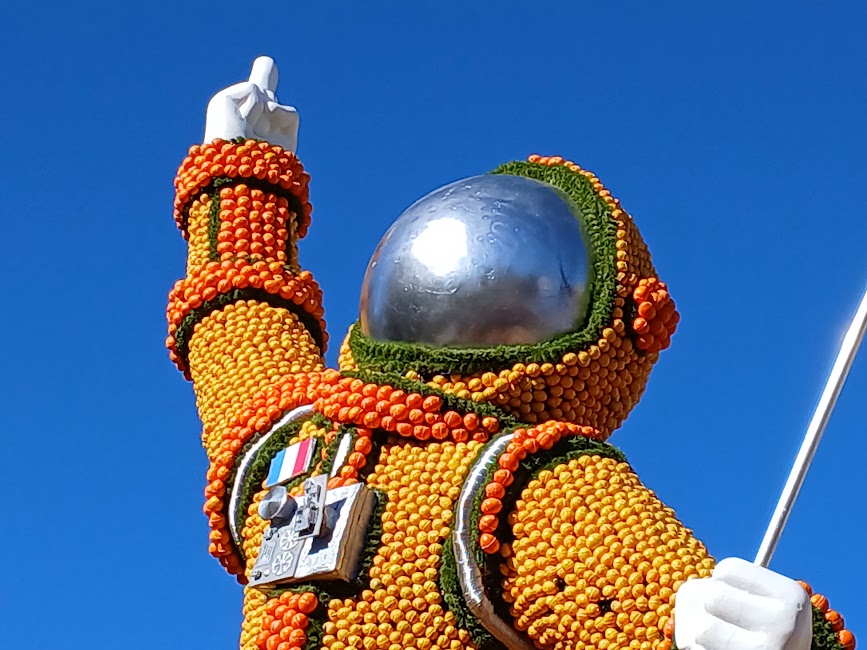
The nursery rhyme goes ‘Oranges and lemons, say the bells of St Clements.’ But in Menton, France, lemons come first. With the annual lemon festival kicking off last weekend, the city’s central garden is decorated with large figures made of lemons and oranges. This year’s theme is outer space, featuring an astronaut (French, of course), spaceships and aliens while lively parades bring traffic to a halt.

I’m aware that I’m enjoying this traditional fete more this year than in previous years. I don’t think this has anything to do with rockets, space beings and sparkling dancers. This has been about partaking in a tradition and allowing myself to be entertained, passive and receptive. I wonder if this is escapism, pretending that life goes on as normal despite what is happening in America, despite the consequences that have us here in Europe shaken and nervously waiting for the next move by our world leaders.

On the one hand, I’m buying into normalcy bias. Carole Cadwalladr explains in her blog what this means: ‘There is an inability to process, accept and confront the dangerous new reality we are in and to focus on the big picture and the pivot of history that’s occurred in the last two weeks.’ She was criticising the New York Times for not reporting on the coup of the tech billionaires that has taken over the White House. She has a point. Cadwalladr’s conclusion offers some hope: ‘It’s a coup. And the international order is collapsing. We aren’t helpless but we need to cycle through the denial part to get to the bit where we start fighting back and take immediate steps to protect ourselves.’

My other hand is not in denial and is all too aware of the history-making events of the past ten days. While the streets of Menton were filled with tourists and shops promoting all things lemon, the US president was slinging cruel and falsely based insults at Volodymyr Zelenski that sounded like they were written by Putin and full of warped narratives. Worse still, this current US government is engaged in so-called ‘peace talks’ where neither the Ukrainians nor the EU have been invited. (This reminds me of the adage that I heard again this week – if you’re not at the table, your on the menu.) Such actions shift the balance of power, making more fragile the international organisations set up to protect democracies and their citizens. This is where another bias comes in – recency bias, where we tend to think of recent events as being far worse than anything in the past. I’m clearly experiencing this and wondering if we are on the brink of WWIII, coupled with financial collapse resulting from trumpanomics.

I’ve run out of hands to refer to, and so, I’m back to contemplating citrus fruit and festivals to get  through the winter months, traditions that go back to medieval times as we are living in a world not too different. If I put both hands together, I can pray.

What I’ve been reading

As The New Yorker is celebrating its centenary, I renewed by subscription – for a while at least. Every few years I take advantage of some special offer and subscribe for three to six months. This 100th anniversary edition is a real treat. For me, the highlights have been two brilliant essays and a surprising poem. Tara Westover, author of Educated – a powerful memoir about growing up in a deeply religious and anti-education family – writes on being estranged from her parents and how a friend tried to lend her his mother. Being estranged from most of my dysfunctional family, I can identify with Westover’s need to feel connected despite all that has happened and despite the patent benefits of estrangement. The other essay appealed to my science nerdiness. Dhruv Khullar provides a sobering account of why it’s going to be difficult, if not impossible, for humans to live on any planet or space station outside the earth’s orbit – basically, it will make us ill. Really ill.

The poem comes from Robert Frost and is surprisingly not a reprint from a New Yorker of decades ago. This is from a recent discovery of an unpublished poem entitled ‘Nothing New.’ It has been authenticated by scholars, including Jay Parini, who writing for The New Yorker, puts the poem into the context of other works by Frost. Parini comments that ‘Frost’s unique gift was to write poems that burn a hole in your brain. You never forget his best lines. They stick with you—and they change your life.’  So true. I still remember lines from Frost that I learned in primary school.

Hence, I’ll conclude with reprinting the poem here. I’m sure other Frost fans and societies have already posted this all over social media, and well they should, especially in times like these, wintery in both season and perspective.

Nothing New

(Amherst 1918)

One moment when the dust to-day

Against my face was turned to spray,

I dreamed the winter dream again

I dreamed when I was young at play,

Yet strangely not more sad than then—

Nothing new—

Though I am further upon my way

The same dream again.

—Robert Frost (1874-1963)
Paul Theroux at 80

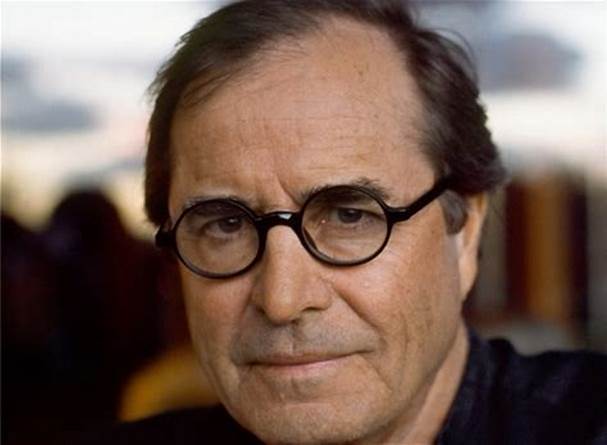
Time has folded up on me again with Paul Theroux celebrating his 80th birthday last weekend – surely, he can’t possibly be 80. The writer marked the occasion with an engaging essay in The New Yorker reflecting on his professional life, drawing on the personal and adding in a few points of literary criticism.  (Facing Ka‘ena Point: On Turning Eighty | The New Yorker). Theroux has long been a writer I can relate to as if we came from the same place and time – which his birthday and this current essay remind me we haven’t. Theroux grew up in a small town in Massachusetts in the 40s and 50s, a far cry from Chicago in the 60s and 70s. I probably share more experiences with Theroux’s sons, the documentary filmmakers Louis and Marcel in both life’s timelines and being more British than American.

We also couldn’t be more different when it comes to how we work as writers. In this New Yorker essay, he notes: ‘My method has not changed: still the first draft in longhand, to slow me down and make me concentrate, and then I copy it by hand, and finally I type it.’ Being a keyboard and screen aficionado, I can’t read this without feel bewildered and anxious.

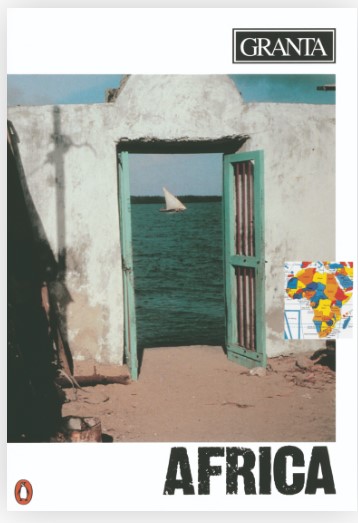
I confess, I’ve only read one of Paul Theroux’s novels, The Mosquito Coast, and a few of his short stories. My secret friendship with Theroux comes from reading his essays about his travels and his family, revealing how he has developed psychologically over the years. In Granta 48, he wrote wryly about his time in Malawi working for the Peace Corps and living in a leper colony. I read it in the early 90s and still remember details from it today. Although my experiences as a traveller and someone who has lived in different countries isn’t as dramatic as that, thankfully, there is camaraderie in being the outsider, bringing humour to the most stressful of situations and reinventing yourself along the way.

Years later, Theroux again writing in Granta described large families: ‘The words “big family” have the same ring for me as “savage tribe”, and I now know that every big family is savage in its own way.’ This rings true with my own experience, and I still have a few scars. We both are one of seven children, Theroux in the middle and I the runt of the litter. In the current New Yorker piece, looking over his 80 years, he brings this up again, but from a different angle. Theroux and I escaped our large families by leaving home early, fending for ourselves, ‘living by my [or our] wits.’ I know exactly what he means when he writes about moving far away from family and saying, ‘I didn’t know the word “individuation,” the process of separation by which one gains a sense of self.’ If my life had a title or heading (I still don’t know what it would be), the sub-header would include this idea of individuation.

Many happy returns, PT, from another PT. 

Democracy at its best/worst

The editors of the Daily Telegraph ended the year with a commentary about Brexit – no surprise there. The UK’s vote to leave the EU was the big story for Britain in 2016. While it’s also no surprise that the Telegraph editors believe that this is a good thing, they did manage to surprise and irritate me with their closing remarks: “In 2016, we saw British democracy functioning at its best. It must be protected for future generations to enjoy.”

Really? Was that democracy at its best? In 2016, the British people saw what a mess democracy can be. Many asked, ‘If we have democratically-elected members of parliament, why do we have to have a referendum in the first place?’ The answer to this for many has been simply ‘democracy.’ Others of us with a working memory will point out how the referendum decision came about when PM David Cameron was trying to appease the hard right of his party and not lose votes to UKIP – in other words, it was a politically-motivated abuse of democracy.

Putting that aside, let’s treat the referendum vote as an exercise in democracy. This exercise didn’t show ‘democracy functioning’ as much as it showed a dysfunctional democracy. Part of this dysfunction could be seen in the belief in lies and misinformation that democracy does not protect us from. Nor does democracy guarantee that people won’t vote from positions of racism or xenophobia. The referendum campaigns exploited this, along with the freedom of speech that democracy supports. Filling the air with vitriol, this exercise in democracy brought out the worst in many people, leaving families and whole communities divided. It also led to the murder of MP Jo Cox, an act that has come to epitomise the extreme views of the hate-fuelled debates.uk-eu-flag

I don’t understand how any thinking person, whether they voted to leave or remain in the EU, could possibly claim that this was democracy at its best.

Equally irksome is the Telegraph comment about democracy needing to be ‘protected.’ I think we all know that this is a reference to those who want to overturn Brexit or have a soft Brexit. These people have been accused of being ‘undemocratic’ by some of our politicians and by many in the gutter press. Wanting to correct the error that is Brexit, or wanting to have a partial departure from the EU is hardly undemocratic. On this latter point, given the simplistic in/out nature of the referendum, where issues such as EEA membership or soft Brexits were never an option, continuing the debate is a necessity.

For those of you who regularly follow my blog or my Twitter account, you’re probably wondering why someone who retweets from The New European, The Guardian and The New Yorker would even bother with a right-winged paper like The Daily Telegraph. Two reasons: one, their Saturday paper has an excellent puzzle section – two codewords, three crosswords and various number puzzles for my better half; reason two, I think it’s healthy to consider the views of others that are different from my own, especially if the writing is intelligent. Needless to say, the Telegraph editors have failed this time to demonstrate that intelligence. Instead, they have chosen to appeal to the same emotive fervour which replaced reason during the referendum campaign. So, my closing remarks come from the US journalist Bill Moyers, who once said, ‘The quality of democracy and the quality of journalism are deeply twined.’