
Aside from having a form of the word cultural, what do these words have in common: cultural competence, cultural heritage, cultural differences, culturally appropriate, cultural relevance, cultural sensitivity, culturally responsive and sociocultural? Answer: These are words the Tr*mp administration has ordered government agencies to remove from all their documents and websites. Some more amusing and just plain weird examples can be found on this banned word list (such as autism, belong, fluoride and marijuana). But as a sociolinguist – and a human being – I’m bothered and perplexed by these cultural words being treated with such scorn.
Firstly, defining culture as a set of ideas and norms belonging to a societal or national group, culture and things cultural are innately part of being human and terms that we use to describe these aspects of our humanity. In other words, language and culture are intertwined – a language emerges from a culture with shared concepts and experiences – and the flipside – a culture is expressed in its language(s). The writer Rita Mae Brown summed it up when she said, ‘Language is the road map of a culture. It tells you where its people come from and where they are going.’ How could we ban cultural anything from our language?
On a more practical matter, many of these banned cultural terms are used by scholars and teachers as part of their disciplines. Some of my own research has been in heritage languages, where words like cultural heritage and sociocultural regularly crop up. Only the other day, I was speaking to a friend who teaches English to immigrants in Australia, and she used the term cultural competence. By banning the official use these words, the MAGA government is defunding language and teaching programmes and research, not to mention all the government-funded museums and arts and music programmes which rightly operate in a multicultural framework.
Among the monstrous acts carried out by the US president, this blatant and hypocritical censorship – this is from the administration that claimed the woke are denying us our freedom of speech – might seem small potatoes. Yet, it taps into something far more sinister if we consider areas outside of sociolinguistics. The ban on some of the other cultural words – cultural difference, cultural sensitivity and culturally responsive – are clearly targeting hiring policies and workplace training programmes in diversity. Since the variety of peoples in America are not going to lose or want to relinquish their cultural heritages, such policing of language condones discrimination and division among employees. Sadly, we know from history that this mindset has a tendency of spreading, these days with the unsafeguarded assistance of social media. One has to wonder what the ultimate goal is. Perhaps MAGA is simply striving for a monoculture (if such a thing were possible) and wearing its bigotry as a badge of honour.
What I’ve been reading
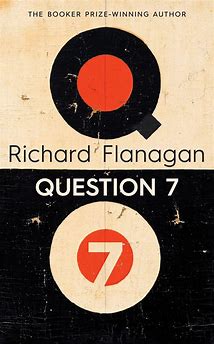
Occasionally a book comes along that I don’t want to end. Australian writer Richard Flanagan’s Question 7 is a memoir combined with history and sociocultural (!) commentary rolled into one. Beautifully crafted with anecdotes and personal insights, the memoir parts focus on the author’s father and his relationship with him, culminating with the author’s own near-death experience. Flanagan’s father was a prisoner of war at a slave camp in Japan when the bomb was dropped on Hiroshima. The author intersperses this story with an historical account of some of the nuclear physicists who created the atomic bomb, in particular Hungarian American Leo Szilard and with the true-life love story between Rebecca West and H.G. Wells. The dots between Szilard and Wells are connected by Szilard devotion to Wells’s 1914 novel The World Set Free, which describes a world at war where atomic energy is used to make deadly explosives. Szilard, whom to my shame I only knew through the Oppenheimer movie, was best known for discovering nuclear chain reactions and later for his activism against nuclear arms. He was also an amateur biologist and environmentalist.
Since Flanagan made several references to H.G. Wells’s The World Set Free, I thought I should give this prophetic book a go. Written as a ‘science romance’ as these SF books were called, it’s quite different from the writing of contemporary novelists. Telling outweighs showing, and the poor reader is a good 10% into the book before the first character appears. But to his credit, the writer doesn’t tell and show the same events, and the prose at the sentence and paragraph level is tight. That is, the novel is more historically interesting from a post-modernist’s perspective than it is enjoyable to read.
I came away from these past couple of weeks speculating about SF written today of a future where multiculturalism has been outlawed – hard to imagine, but people once felt this way about the worlds depicted by H.G. Wells.
 Paola Trimarco