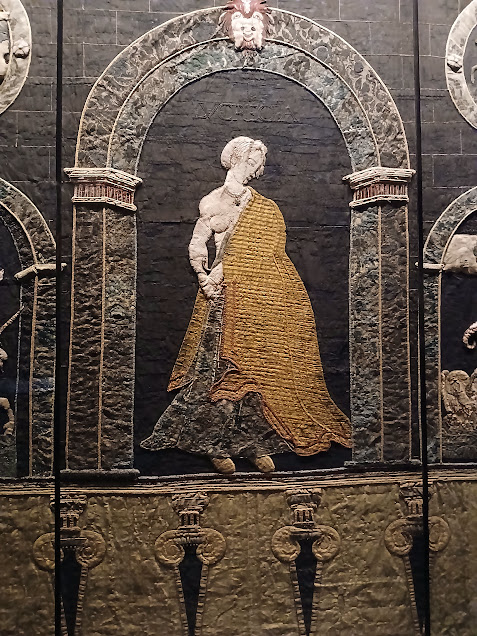
One of the big news stories for the French and English this past week has been the French loan of the Bayeux Tapestry to the British Museum, while the British are loaning out items from Sutton Hoo to a museum in Normandy. This cultural swap is a momentous event. After more than 900 years, the 11th‑century embroidery depicting the Norman Conquest has returned to Britain, where it was made in the 1070s, most likely in Canterbury.
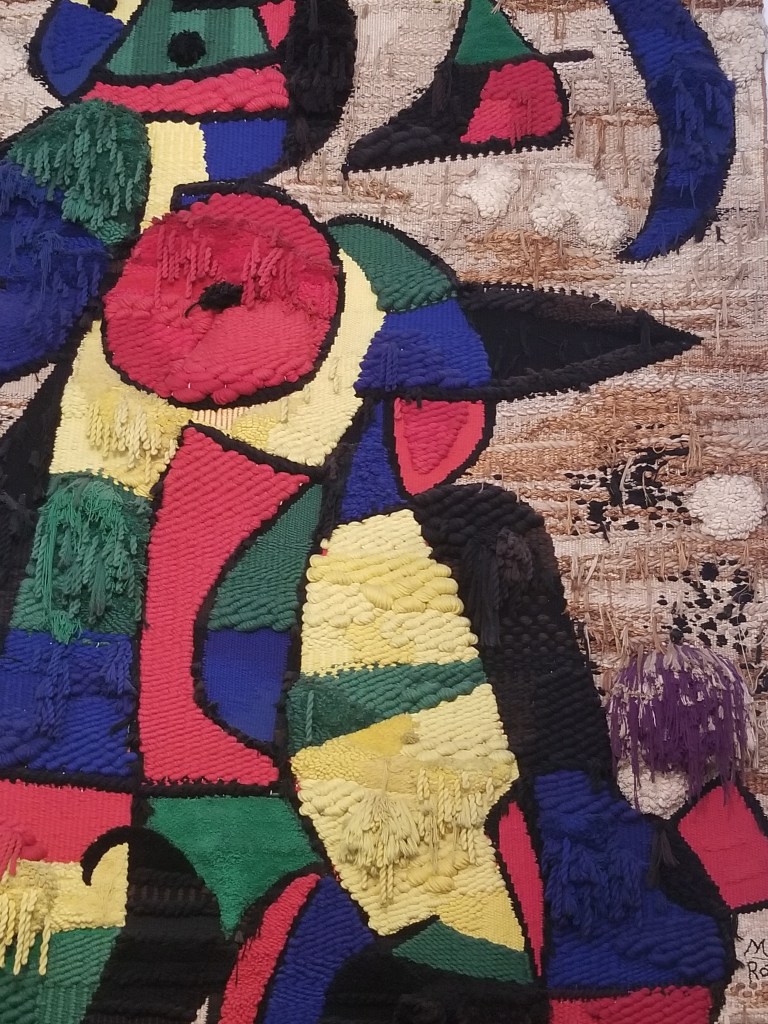
I’ve long held a soft spot for tapestries, whether hundreds of years old or modern works, like the Joan Miro/Josep Royo Tapestries in Barcelona. There’s something compelling about art made of woven textures – the collaboration of many artisans, the interplay of colour and fibre, the way these pieces carry stories both literal and symbolic. Tapestries can be historical documents, fictional narratives, heraldic statements, or simply sources of warmth and decoration.
I’m surprised more research hasn’t been done on storytelling in tapestry. Research on tapestries is limited and tends to appear in cultural history for generalists, early modern literature and Renaissance art history, rather than in narratology journals. From a narrative perspective, most tapestries I’ve seen depict a main story – biblical, mythology or historical – alongside other mini-narratives, some that appear completely unrelated to the main story. I even found this in portraiture tapestries. Non-linear multi-layered narratives existed long before the modernist and hypertext fiction.
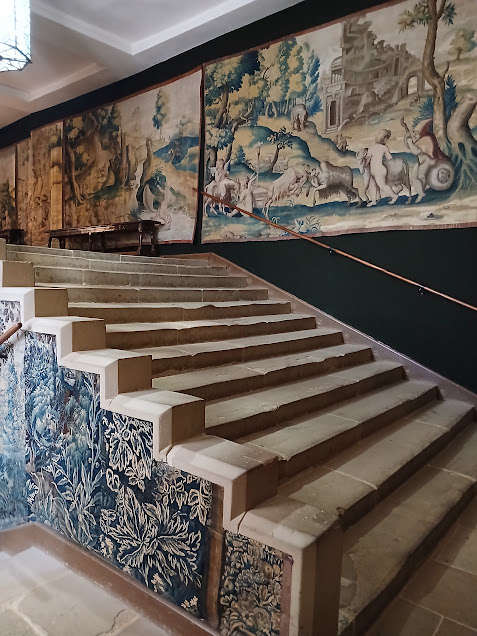
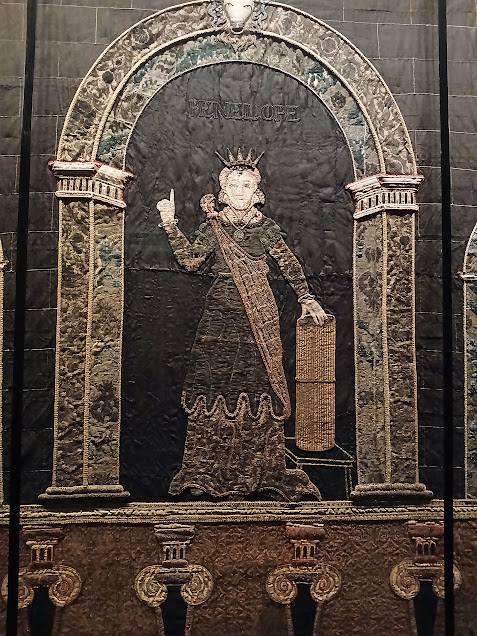
While the transportation of the Bayeaux tapestry to British was making headlines, David and I were in Derbyshire, England visiting Hardwick Hall, home to one of Europe’s largest and most renowned private collections of tapestries and textiles. This ‘country house’ – more of a chateau in my lexicon – is a testament to Elizabethan architecture and artistry. The house was built during the 1580s and 1590s and first furnished by Elizabeth Hardwick (better known as Bess of Hardwick). This noblewoman married four times, becoming richer and more influential with each union. She didn’t start collecting tapestries, however, until late in life when she needed to cover the many walls of this not very modest country house. According to surviving receipts, she had quite a shopping spree in 1592, when she bought – mostly second hand – hundreds of tapestries that are still hanging in the house today. She also worked on these textiles herself, sewing her coat-of-arms and initials into these pre-owned works. Admirable recycling, yes, but also a reminder of how easily art becomes a vehicle for displaying wealth and status. Beautiful and awe‑inspiring all the same.
What I’ve been reading
I’ve been engrossed in Gisele Pelicot’s memoir Et la joie de vivre, literally translated as: And the joy of living. In its English version it’s: A Hymn to Life: Shame Has to Change Sides. I suspect the English version reminds potential readers that this was the case where a woman, who was drugged by her husband and repeatedly raped by other men, chose to waive her anonymity. I prefer the French version, which assumes familiarity with the case and gives us a title full of irony. This memoir, co-authored by the novelist Judith Perrignon, is powerful for its mix of subtle and stark depictions of the often-ironic discoveries Gisele and her family endured. While press coverage of the story rightly pointed out that the victim was an intelligent middle-class woman, they gave the impression that she ‘became’ a feminist because of what had happened to her. This book paints a more complex picture of a woman who was never subservient and often the breadwinner while raising three children.
While reading this, a similar story surfaced in the British press of another woman drugged by her husband and raped by other men. This case was uncovered through police searches of the dark web into videos where the woman appears unconscious and likely drugged. This investigative approach has grown partly in response to the Pelicot case. Yet in Britain, the victim has chosen to remain anonymous – and because her husband’s identity would reveal hers, he remains anonymous too. Perhaps the Pelicot case hasn’t been a total watershed moment – the sense of shame remains misplaced on the victim.
On the lighter side – and in English – I’ve enjoyed a middlebrow romp through Clare Chambers’s Shy Creatures. Set in the 60s with flashbacks – and well-plotted backstories – to the 1930s-50s, it follows the complicated life of Helen, an art therapist working at a psychiatric hospital. At the centre of this is the discovery of William, a mute in his thirties who had been secretly living with his aunts, shut away from the outside world. Naturally, he becomes a patient at the hospital, where it is discovered that he is extremely shy and artistically talented. There is of course a backstory to explain why he was hidden away – but this blog is a no-spoiler zone. The plotting and reveals sometimes made me feel as though I were watching a television mini‑series, but the characters and shifting attitudes toward psychiatry kept me reading. The real payoff comes in the acknowledgements, where Chambers explains that William was inspired by a real man found living in squalor and unseen by neighbours for some 25 years in the early 1950s. She moved the story to the 60s, a more interesting period for psychiatry and society as a whole. Okay for a summer read.