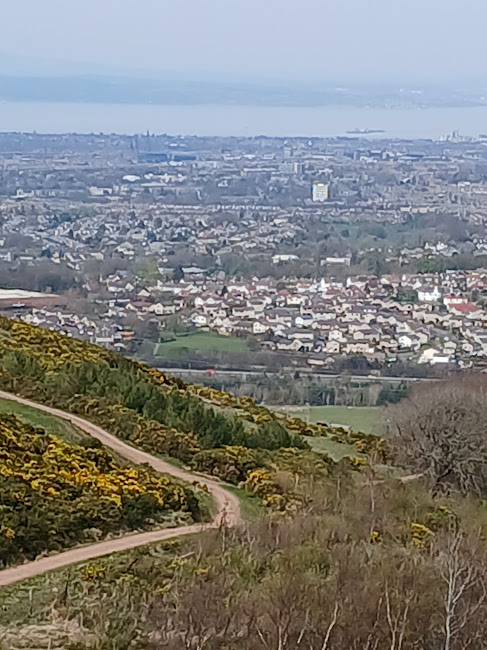
I’ve taken the train between Peterborough and Edinburgh countless times over the past 40 years. The hilly landscape, the rugged coastline and the familiar stations – York, Darlington, Newcastle – have become comfortably familiar. The world has hardly changed when viewed from picture windows, often at speed creating glimpses and filmic montages. Yet, of course, the world and I have changed. Forty years ago, I was a bewildered student punching above my weight in theoretical and then applied linguistics, finding solace in Scottish poetry and working on my first unpublished novel – my first stab at untangling my dysfunctional childhood by reimagining the early life of my maternal grandmother.
I shook off those memories by filling the four-hour journey with some fiction (a The New Yorker short story) and some nonfiction (Le Monde) and listening to a few podcasts (Lincoln Project, and The News Agents). Between these entertainments my mind wandered back to a time when Thatcher was Prime Minister and Reagan was President and how they were perceived as deviously competent and dangerously bumbling, respectively. Pulling into Waverly Station, I thought that while I still disagree with their views, both world leaders would appear dignified and professional today.
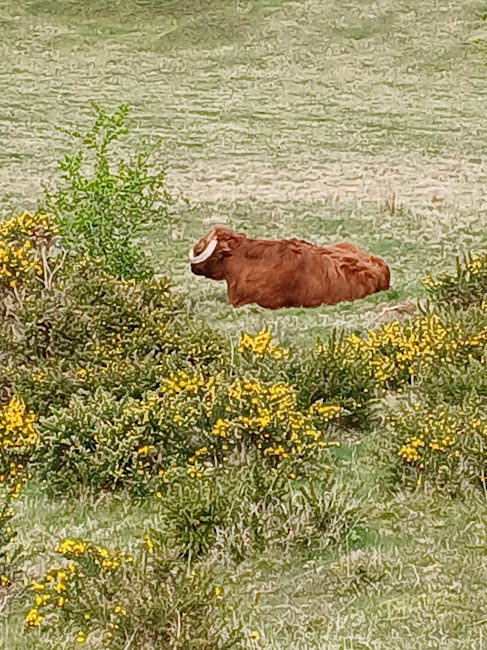
The train journey back reflected on the immediate past. My weekend in Edinburgh had focused on seeing an old friend, whom I hadn’t seen in five years thanks to the Covid lockdowns and mental health issues keeping her indoors, alone and unsociable. We talked through the weekend, confirming we were both in the bubble of centre-left opinion and trying to cope with the barrage of news coming from fascist America – a term that is becoming normalised – without being depressed and despondent. We also talked about our psychological well-being and what we do to take care of ourselves – meditation, exercise and variations of CBT. Between reading articles in The Sunday Observer, my return journey reflected on all of these conversations, along with images from our walk through a corner of the Pentlands, where I used a pair of walking sticks to navigate the grassy and gravelly terrain of inclines and where we saw Highland Cows in the wild, grazing just a few yards away appearing bored. The conductor reminds passengers that the buffet car is in ‘Coach G – G as in golf.’ So Scottish.
As the train pulled into Ely Station, having a sense of satisfaction for reconnecting with my old friend, I jumped into future thoughts – my friend’s recommended books and Italian television to explore and the banality of what I was going to eat for dinner.
What I’ve been reading
The Dalai Lama’s Cat by David Michie is an amusing tale from the perspective of the eponymous cat. This feline narrator is given the human qualities of communication and some abstract understanding for the reader’s benefit but is otherwise catlike. The cat, who goes by several names, describes what it is like being with the Dalai Lama, a life of celebrity and diplomacy sandwiched between hours of daily meditation and practices of compassion. When the Dalai Lama is away, the cat interacts with members of the household and a want-to-be American Buddhist who runs a local café for spiritual tourists. With each of these encounters, lessons in Buddhism emerge. While a bit episodic, there are still some gems to be found. Example, Buddha is quoted (I know, quotes like this are always dodgy as Buddha put nothing to writing that has survived): ‘The thought manifests as the word; the word manifests as the deed; the deed develops into habit; and the habit hardens into character. So, watch the thought and its ways with care.’ Whatever its true source, it’s a reminder of the power of the mind to create good or ill.

For something more literary and profound in its own way is Michael Cunningham’s Day. I loved The Hours, Cunningham’s modern-day retelling of Virginia Woolf’s Mrs Dalloway that wove Woolf’s life into the storytelling. I’m embarrassed that it has taken me so long to read another Cunningham book. Day came out last year to rave reviews and quickly found its way to my wish list and eventually my public library account. The story takes place on single and separate days spaced a year apart. In the intervening months, a couple separates, Covid upends everyone’s lives, and the wife’s brother has a midlife reassessment, changing careers and winding up stuck during the pandemic in Iceland. Although these events keep the pages turning, the real joy of the story lies in its sociopsychological intrigue. The brother, who is openly gay, has been ‘in love’ with his brother-in-law for years. Note the quotation marks – there’s nothing sexual or even romantic about the relationship. It’s a deep sense of love, for which our culture and therefore language doesn’t have a word. Beyond familial love, to call it a ‘bromance’ – a term more used sarcastically these days – would be an insult to the genuine depth of emotion. Another sociopsychological concept in this novel involves creating a fake identity online presumably for fun. But in time, it is clear to the reader that this alter-ego serves a personal psychological purpose.


 Paola Trimarco