Brexit without the politics

I’ve lost track of all of the group meetings, political rallies, panel discussions and public talks I’ve attended on the subject of Brexit since the referendum. Inevitably, the names Johnson, May, Davis, Farage, Corbyn and Cable come up, as do the words soft and hard Brexit. Then, a few weeks ago, I went to a panel discussion about business in the East Anglia region after the referendum.  With this panel, most of these names of politicos didn’t come up at all. Nor were the ideas of a soft or hard Brexit bandied about. Why not? Because there were no politicians, political activists or journalists on the panel.

Without the politics, the business leaders in the region talked about what they were doing to deal with the problems they currently face as a result of the referendum. One businessman, who owns some fifty farms and food production facilities in Europe, including East Anglia, described how his local business has suffered. Fifty percent of his workforce is seasonal and most of them are from Eastern Europe. Thanks to the post-referendum spike in hate crimes, especially those targeting Eastern Europeans, this farm owner is having serious difficulties hiring seasonal workers. His solution has been to move part of his operation to Poland and Senegal.

Another speaker was there to give advice about how to go global and reach outside of the EU. He wasn’t talking about expansion, but survival. In this, he was positive about the prospects, saying that businesses could go global ‘without difficulty.’

A couple of other panellists came to the discussion as legal experts, one in dealing with the EU and the other in international trade. They both agreed on two things. One was that the current uncertainty about how we are leaving the EU was damaging business.  The other was that the government – any government in this situation – would struggle to cope with the actual matter of leaving the EU. It’s been decades since the UK was involved in trade and legal negotiations like this – we simply don’t have the appropriate staff or experience.

In recent months the occasional story has surfaced in the news about finance companies and banks in London moving part or all of their offices to Paris and Frankfurt. So too have articles appeared in the national press about UK high-tech firms relocating to Romania. Of course, such solutions are taking jobs and business revenues out of the UK. We don’t know if this is part of a transition phase before we become a different kind of country – a smaller, more marginal country. Or if this is the catalyst to reverse Brexit altogether. Either way, it’s dealing with the present and helping businesses and those who run and work for them to stay alive.

It’s taken me three weeks to get around to writing this blog. Three weeks with these ideas hovering in the back of my mind. Clearly, my thinking has been challenged. It’s like looking at a building when it’s up close or seeing it from an aeroplane. The same building can look vastly different. Since June 2016, I’ve been approaching the Brexit problem as a political activist, with all the meetings, rallies and talks. Now I’m starting to wonder – even though politics got us into this mess, it might not be the way out. I’m not saying that we give up on our politicians altogether – they’re a necessary evil and they do hold power.  But when it comes to some of the problems that Brexit is causing, it’s worth considering solutions and non-political approaches offered by businesses and other organisations.

EastAnglia farm2
Aerial shot of farms and villages in East Anglia.

Ely for Europe

Our little group – only little because Ely is little – was formed following the Referendum vote on 23 June 2016. I agreed sometime last year to become the group’s co-chair, thinking that when elections came up I would take a casual step backward and watch as others clamoured for the position. That didn’t happen. I’m still co-chair. But in truth, I don’t mind as we have evolved into a group that’s actually getting things done.

In the early months of our existence, we spent much of our time together grumbling about how the Leave campaign won the vote and consoling each other as if we had been victims of a train crash. Our activities then had to do with keeping each other informed, writing to our MP and attending the protest marches around the triggering of Article 50.

Soon after, we were wrapped up in local elections. This made it difficult for our cross-party group to meet and discuss issues without members gritting their teeth at each other, the odd gibe slipping out. Overlapping with that, in terms of campaigns, was the general election. That too made meetings difficult, but as it was more or less an election about Brexit, we were able to come together on that and deal with the many tasks of being an official organisation – we have a constitution and a presence on Facebook, Twitter and in the local events magazine, along with links to national anti-Brexit organisations.

Now that a lot of our admin tasks are out of the way and we’re into our second year, we continue to attend rallies against Brexit, write to our MP and hand out flyers and leaflets at market stalls. More importantly, we acknowledge that there are different points of view – those that want to stop Brexit before it officially happens and those who are resigned to it happening, but want to limit its damage. While those aims might sound negative or reactionary, the positive sides are still there and are in our name – we want to keep our ties to the rest of Europe, share in its cultures, ideas and languages, and to welcome its citizens, who, like us, are citizens of the world.

Still Fighting

It’s easy to give up on politics and politicians. In a sense, that’s what has already happened. Around this time last year, many people in Britain, fed up with austerity measures and unemployment, decided not to engage in politics. They didn’t listen to cogent arguments or evidence. Instead they joined a movement of emotions and voted to leave the EU. Likewise, in America people, fed up with grid-locked legislation and the paralysis of their personal finances, also decided not to engage in politics. They either joined a similar movement of emotions or they didn’t vote at all. The result, as we all know, was Trump. I don’t mean to oversimplify these events – we all know that racism and sexism play their parts as well.

As a consequence of these electoral debacles, many people have been energised into political action. Online protests, petitions, marches, rallies and media-generated debates have erupted on a scale not experienced in my lifetime. But now the wind seems to be changing. Following the recent UK General Election, where a hard-Brexit government lost its majority, there is talk from politicians and in the media of a much toned-down Brexit, possibly keeping the UK in the single market and/or the customs union (among other things).

I went to a Pro-EU rally this past weekend, marking the one-year anniversary of the vote to leave the EU. It pains me to report that this rally was poorly attended.  Maybe some 300 people were there.  I wonder if this slight change in the air, this post-election awareness, has made people complacent. Do they believe that it will all work out for the best? That a hard Brexit or the economic downturn from any type of Brexit will never happen?  If they aren’t complacent in their thoughts, perhaps people were suffering from a bit of protest-march fatigue or were simply enjoying the beautiful weather that sunny Saturday afternoon.Cambridge 2nd march 1.jpg

As for me, I’m still in the fight. For those out there who don’t know me, on a personal level I don’t have much of a fighting spirit. I’ll argue to a point, but as soon as I realise that I’m overpowered or that my opposition is mentally/psychologically ill, I back off. I realise that there is no point wasting energy or keeping myself in a victim position. Of course, it’s easy to feel overpowered by political movements and governments. But then I remind myself that I’m empowered as a taxpayer and a voter and that participating in protests is a step out of the victim position. Wasting energy? I don’t think so. But I have to admit that it can be tiring. The opposition knows this too. I think it’s important that they (the Brexit and Trump supporters) do not wear us down.


Leadership – Part 1

The results of last week’s General Election in the UK leaving us with a hung parliament are in large part the result of a paucity of leadership in the main political parties. Jeremy Corbyn, though credited with running a good campaign, still did not get the most votes.  He has spurred divisions in his party and regularly vacillates on his and his party’s position on Brexit – the central issue of the election and Britain’s economic future. Nicola Sturgeon and Theresa May have both blatantly placed party politics above the people they represent. Sturgeon’s threats of another Scottish referendum while Scotland is failing under the weight of its own economic and social problems are hardly inspiring. May tried to sell herself as leader of the nation in a muddled campaign that never addressed the welfare of the nation or how Brexit was going to be realised and implemented or what it would mean for individuals and their communities. The LibDem’s Tim Farron, who has done the right thing by stepping down, committed the classic error of not leading by example – he may have voted in favour of gay rights and reproductive rights for women, but doesn’t personally support these rights and actively supports a church that condemns them.

This has left me wondering about what makes a good leader. People often point to Churchill as an example of a great leader. He may have been a very good leader, taking his people through difficult times. But he was the man for the moment and one who got wrapped up in the cult of his own celebrity. Napolean’s leadership has left historians divided for centuries, and I won’t go into all of that here – note the title, this is a topic I’ll return to. My point here is that it’s hard to find a so-called great leader who wasn’t at the same time highly flawed as a leader.Leadership 1C

As I write this piece, news and analysis are unfolding about the causes of the Grenfell Tower fire. Among the analyses was this comment in this morning’s Guardian editorial:  ‘Leadership requires courage, imagination and empathy.’ The article goes on to point out how May has failed as a leader in the aftermath of the tragedy. This too is an example of the idea of good leadership being apparent by its absence.

One of the most important books that I’ve ever read and one that I dip into from time to time is John Heider’s The Tao of Leadership, an adaptation of Lao Tzu’s teachings. Though published in 1985, I first read it in the early 90s when I was in a miserable job situation which ended so nastily, it put my academic career on hold for years. I soon realised that this book’s true value is in being not so much about leadership, but being about living in harmony with others. It made me understand the failings of the leaders around me and to see myself as a leader in my own ways. In brief, leadership is a role that we all play at different points in our lives. It’s not exclusive to the manager, the director, the team leader – leadership is about service to others.

With this in mind, I close on a quote from Heider which PM May and other political leaders could benefit from:

The wise leader is like water. Consider water: water cleanses and refreshes all creatures without distinction and without judgment; water freely and fearlessly goes deep beneath the surface of things; water is fluid and responsive; water follows the law freely. Consider the leader: the leader works in any setting without complaint, with any person or issue that comes on the floor; the leader acts so that all will benefit and serves well regardless of the rate of pay; the leader speaks simply and honestly and intervenes in order to shed light and create harmony. From watching the movements of water, the leader has learned that in action, timing is everything. Like water, the leader is yielding. Because the leader does not push, the group does not resent or resist.’

Leadership 1B

Tautology is Tautology

PM Theresa May does like her tautologies. First it was ‘Brexit means Brexit’ and now ‘Enough is enough.’ In semantics such expressions are treated as p →p. In pragmatics, where context comes in, it’s p →p ~>p (that is, saying p →p implies something greater than just p). But I can’t say this is the case with May’s use of this rhetorical device.

‘Brexit means Brexit’ was rightly criticised by many as being weak and uninformative as the public didn’t (and still don’t) know what Brexit means. In the months following this confusing declaration, the May government has hinted at a Brexit that would take the UK out of the single market altogether – the one thing that most of the country, including a portion who voted to leave the EU, don’t want. What else does Brexit mean? Leaving the EU will affect a large range of statutes and issues, which still haven’t been addressed by Theresa May. ‘Brexit means Brexit’ has become a blanket  to hide either the indecision and incompetence of those working on the Brexit project or to hide plans that would be unpopular with the electorate. Time will tell.

When I first heard May spouting out ‘Enough is enough’ in the aftermath of the latest terrorist attack to besiege the UK, I had a personal recollection of the last time I heard someone say that to me. It was actually in an email, so I hadn’t heard it, but I had heard the writer’s voice in my head. Without going into the unpleasant details of the long email thread, I was being attacked by someone with emotional and learning disabilities, who – being a relative – I felt obliged to respond to. My efforts to defend myself and clear the air were met with even more hostility and false accusations. My emails became shorter and shorter, saying that I wasn’t going to engage in this type of communication. And then it came – ‘Enough is enough!’ I was being scolded. The person who had scolded me had run out of things to say when she saw that I wasn’t sparring with her. I fear that Theresa May has reduced herself to this. Like my reaction to the relative scolding me, I find it amusing and a sign of weakness.

Have tautologies ever worked? First of all, I should say that I’m thinking of tautologies in the strictest sense. I’m excluding expressions such as Yogi Berra’s infamous ‘This is like déjà vu all over again.’ I would call that a redundant expression used by an inept speaker. For some, Hamlet’s  ‘I’m reading words, words, words’ is also a tautology – for me, it’s repetition that effectively avoids and mocks Polonius.  Yogi Berra is not saying ‘déjà vu is déjà vu’ and Hamlet is not saying ‘words mean words.’ With that aside, here are a couple of notable examples of tautologies that do work.  Sometimes I find myself saying  ‘It is what it is,’ perhaps much to others’ annoyance.  For me, it’s a polite way of saying that you can’t change the situation so stop trying.

And finally, there is ‘love is love.’ It was just about to become worn out, having been  the name of a Culture Club song and appearing on cheery posters, etc, when it was rescued by LGBT activists. This soft approach reminds those who are against gay rights that it all boils down to love. What kind of monster would be against that or argue with that? Of course, the monsters still exist, but the vast majority of people have come to accept gay rights. This has proved itself a meaningful and worthwhile tautology.

‘The Will of the People’?

Since the Brexit vote, the phrase ‘the will of the people’ has been used not only by Brexiters, but more alarmingly by some of those who voted to remain in the EU. These people clearly have problems with basic maths. Only 37% of the electorate voted for the UK to leave the EU. Hardly the will of the people. If we looked to those who bothered to vote on 23rd June, then we can say that 54% of those voters were in favour of leaving the EU. A majority, yes, but still, not deserving of the nomenclature ‘the people.’ Moreover, this vote was on a simple in/out referendum. There are people who voted to leave the EU on the promise that the UK would remain in the single market. Others voted to leave on the promise of increased funding for our beleaguered National Health Service. Given the government’s insistence on a hard Brexit and the admissions that the NHS will not benefit from this process, the strength of the 54% vote is diminishing. It is less and less about ‘the people.’

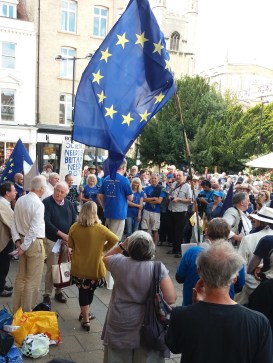
So, why would anyone who voted to remain start using the phrase ‘the will of the people’? Those who immediately come to mind are Conservative politicians. At the parliamentary level, they’re standing behind their leaders, afraid perhaps to break ranks or just nurturing their own careers. But when this ‘will of the people’ phrase came up last night at a Mayoral Hustings in Ely, that was a more perplexing matter. The mayoral position covers Cambridgeshire, including Peterborough. Both Cambridge and Ely voted to remain, while Peterborough and the surrounding areas (Fenland) voted to leave. Yet, a few of the participants, including James Palmer, a Conservative Councillor, and the moderator, used the phrase ‘the will of the people’ as if it was the reason to support Brexit. No one else on stage objected to it or felt that it needed to be qualified.  Part of this could have been due to the limited time allocated to speakers. But I’m concerned that part of this shyness or perhaps compliance with such phrasing had to do with fear.ELy Cathedral hustings

Many of those who voted Brexit haven’t stopped campaigning. They’re all over the internet. Some are bullying. Their lapdogs are the tabloid press, whose barks persist and protect this angry mob. They can be scary. The normalising of the phrase ‘the will of the people’ by those who supported remaining in Europe for me is just another sign that the bullies have won. I remind myself and have perhaps said too often for those around me that Brexiters won the vote on the day, they haven’t won the argument.

Grey Wednesday

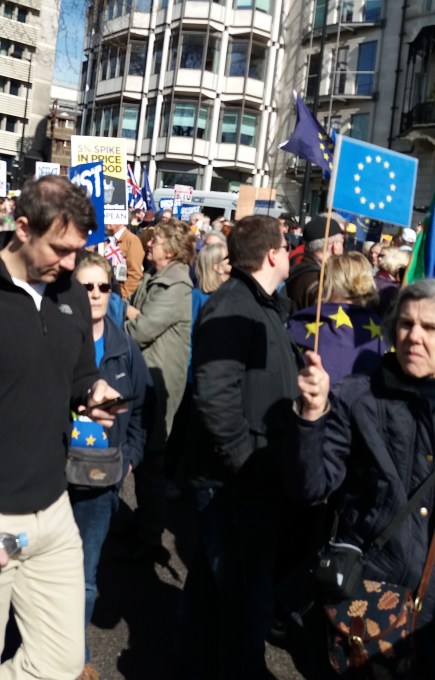
Some people are calling today ‘Black Wednesday’ as it’s the day Britain officially notifies Brussels of its intent to leave the EU. I was one of those people. But then, at an Ely for Europe meeting last week, when I suggested marking the day by wearing black, I was met with opposition. Nearly everyone else at our long pub table wanted to be positive about this. For them it was the start of the battle, a sense that at last things are happening. A valid point, but I still don’t see it as a cause for celebration. Nor am I convinced that there aren’t black days and months ahead.
After considering the matter, I’m settling for a grey Wednesday. I’m not saying that I feel neuLondon March 2017.jpgtral about this – somewhere between joyful white and mournful black. I’m using grey in the sense of unclear and murky. The extent to which we can retain useful ties to the EU are unknown and untested. Likewise, Britain’s relationship to the rest of the world, especially in the age of Trump and Putin, are beyond speculation. Most important of all, grey represents the storm cloud over Britain, a country left divided and angry over this referendum.

In my echo chamber

If I’ve learned one thing from the Brexit vote and the ascent of Trump, it’s that inside social media I live in my own echo chamber. Both events took me by surprise. While the mainstream media showed support from all sides in these contests, in Facebook and Twitter, I was seeing overwhelming support for remaining in the EU and strong arguments and jokes against Trump – though divided between supporting Saunders and Clinton.

Of course, in Facebook my ‘friends’ are mostly my former students and colleagues, fellow writers and a few friends who really are friends, in the sense of the word before Facebook. It is no surprise that educated and liberal would define this select group. On top of that, my Facebook interactions have been infiltrated by Mark Zuckerberg’s algorithms, sending me postings from people and organisations which are not my friends, but are clearly like-minded – but sadly, not always accurate – I’ve stopped waiting for the ‘child-rape’ charges to be pressed against Trump.

Twitter is another matter. I started my Twitter account when I was still working in academia fulltime and used it as a way of furthering my own research. As a writer, I also follow other writers, certain publishing houses and publications, etc. In other words, I’ve been following loads of people I don’t know personally. Yet, many of these strangers were touting the same views as I was when it came to the Brexit and Trump. We retweet and like each other’s tweets. It could be argued that these people were indirectly hand-picked because they were likely to share the same views – after all, they’re academics or in creative fields.

Since the Brexit vote, in order to keep sane and to participate in the fight against a hard Brexit, I have deliberately started following political organisations, e.g. the Lib-Dems and Open Britain, for the latest news and information on protest marches and petitions. Hence, reinforcing the walls of my online echo chamber.

Offline, while my choice of friends keeps me contently among the like-minded, I also find myself in situations with people who are my political polar-opposites. In Nice, for instance, the expat community sometimes has me face-to-face with regular readers of The Daily Telegraph, which openly backed Brexit. Such encounters challenge me to show up prepared with statistics and references. I do my best, though probably to little or no effect.

At least with Trump’s win my online and offline worlds are not so different. I have not had to come face-to-face with any Trump supporter – I don’t know what I would say to one if I did. It would be like confronting someone who has joined a cult – they have chosen to believe the unbelievable and they are clearly nurturing a need that places them beyond reason.

Yet, my offline world – and my online world outside of social media – with news programmes and newspapers, keep me informed about what others are thinking – the polemics of the debates. The walls of my echo chamber might be strong, but they do have windows.

Democracy at its best/worst

The editors of the Daily Telegraph ended the year with a commentary about Brexit – no surprise there. The UK’s vote to leave the EU was the big story for Britain in 2016. While it’s also no surprise that the Telegraph editors believe that this is a good thing, they did manage to surprise and irritate me with their closing remarks: “In 2016, we saw British democracy functioning at its best. It must be protected for future generations to enjoy.”

Really? Was that democracy at its best? In 2016, the British people saw what a mess democracy can be. Many asked, ‘If we have democratically-elected members of parliament, why do we have to have a referendum in the first place?’ The answer to this for many has been simply ‘democracy.’ Others of us with a working memory will point out how the referendum decision came about when PM David Cameron was trying to appease the hard right of his party and not lose votes to UKIP – in other words, it was a politically-motivated abuse of democracy.

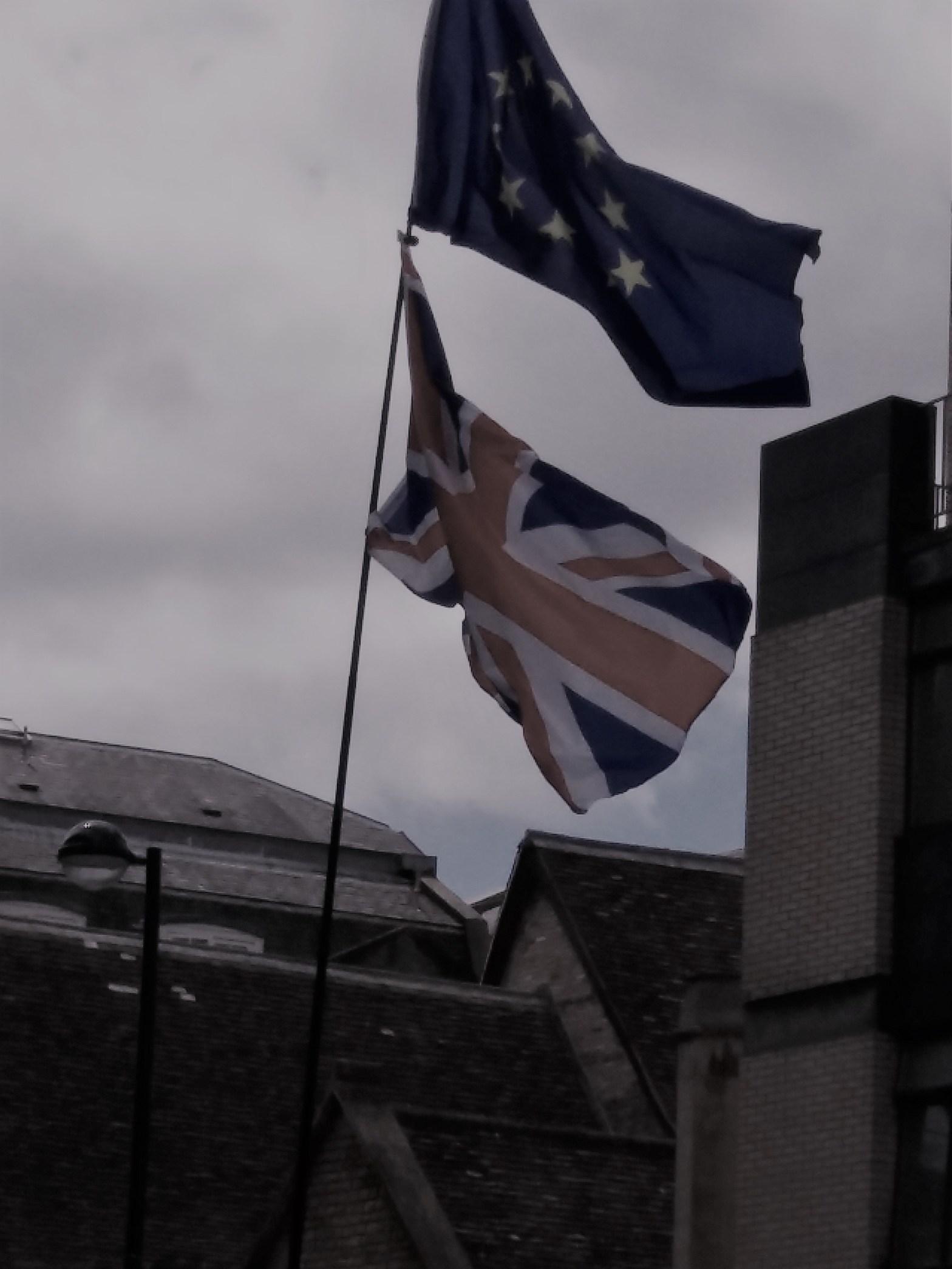
Putting that aside, let’s treat the referendum vote as an exercise in democracy. This exercise didn’t show ‘democracy functioning’ as much as it showed a dysfunctional democracy. Part of this dysfunction could be seen in the belief in lies and misinformation that democracy does not protect us from. Nor does democracy guarantee that people won’t vote from positions of racism or xenophobia. The referendum campaigns exploited this, along with the freedom of speech that democracy supports. Filling the air with vitriol, this exercise in democracy brought out the worst in many people, leaving families and whole communities divided. It also led to the murder of MP Jo Cox, an act that has come to epitomise the extreme views of the hate-fuelled debates.uk-eu-flag

I don’t understand how any thinking person, whether they voted to leave or remain in the EU, could possibly claim that this was democracy at its best.

Equally irksome is the Telegraph comment about democracy needing to be ‘protected.’ I think we all know that this is a reference to those who want to overturn Brexit or have a soft Brexit. These people have been accused of being ‘undemocratic’ by some of our politicians and by many in the gutter press. Wanting to correct the error that is Brexit, or wanting to have a partial departure from the EU is hardly undemocratic. On this latter point, given the simplistic in/out nature of the referendum, where issues such as EEA membership or soft Brexits were never an option, continuing the debate is a necessity.

For those of you who regularly follow my blog or my Twitter account, you’re probably wondering why someone who retweets from The New European, The Guardian and The New Yorker would even bother with a right-winged paper like The Daily Telegraph. Two reasons: one, their Saturday paper has an excellent puzzle section – two codewords, three crosswords and various number puzzles for my better half; reason two, I think it’s healthy to consider the views of others that are different from my own, especially if the writing is intelligent. Needless to say, the Telegraph editors have failed this time to demonstrate that intelligence. Instead, they have chosen to appeal to the same emotive fervour which replaced reason during the referendum campaign. So, my closing remarks come from the US journalist Bill Moyers, who once said, ‘The quality of democracy and the quality of journalism are deeply twined.’

2016: Looking for the Good in Good Riddance

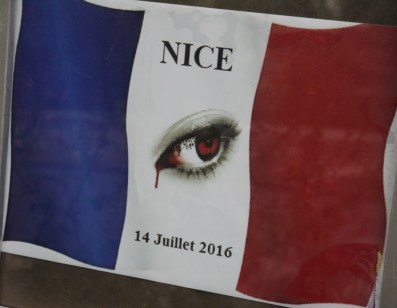
Does any more need to be said about what an awful year 2016 has been? In brief – Syria, Bowie, Brexit, Trump, attacks on Nice, Orlando, Brussels… 2016-12-25 11.12.11.jpgFor Syria, Brexit and Trump, there are lists of hideous events and poisonous rhetoric that have helped to make 2016 notorious even before it’s ended. Finding the good in such a year is not only challenging, but necessary. The alternative would be to shut down and sulk, permitting the bad things to fester and grow worse in the mind’s eye.

As for the positive side, for a start there was the election of Sadiq Khan, London’s first Muslim mayor; women in Saudi Arabia finally got the right to vote; and a solar-powered plane circumnavigated the world. Other good things to happen in 2016 have come from the world of sport. Leicester City football club won the Premier League, having started the season with odds of 5000-1. There was Team GB’s fabulous performance in the Summer Olympics. And on the other side of the Atlantic, the Chicago Cubs won the World Series – a feat they hadn’t done since 1908.

Other good things have emerged out of the many horrible and sad events to happen in 2016. The attack on Nice, my second home, has brought about feelings of solidarity with my neighbours and acquaintances. The shock and sadness of David Bowie’s death similarly connected me with other fans and people whose younger selves had also been transformed and liberated by his creativity. Following the Brexit vote, I have joined several organisations to stay informed and to protest against the economically stupid and xenophobic trail left behind – I have never signed so many petitions and written to so many political representatives as I have in the past six months. Again, there is the sense of unity which is comforting, but to this I must add the satisfaction of doing something political and participating in the bigger debate.

While the political is personal, there is the smaller concentric circle of my personal life. In 2016, David and I went to America to visit friends and I was reunited with a friend I hadn’t seen in 34 years. I also visited my father’s grave for the first tim2016-12-25-11-16-33e – a sad, but fulfilling experience. Back in England and France, we have enjoyed good health and the company of friends and family, interspersed with reading, writing, playing golf and going to cinemas, concerts, galleries etc. Life has been full and satisfying, even under the cloud of this annus horribilis.

Let’s hope for a better 2017.