
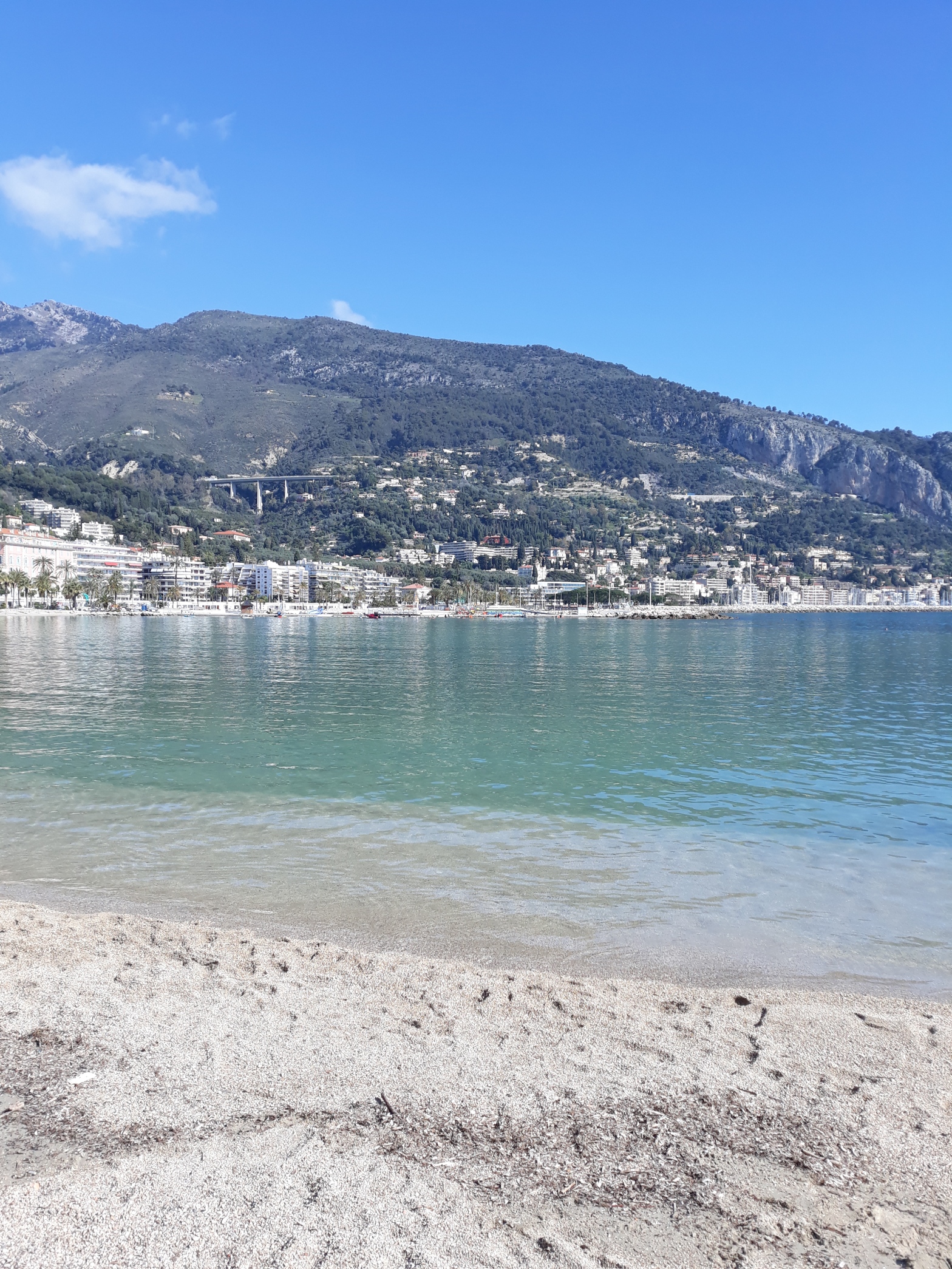
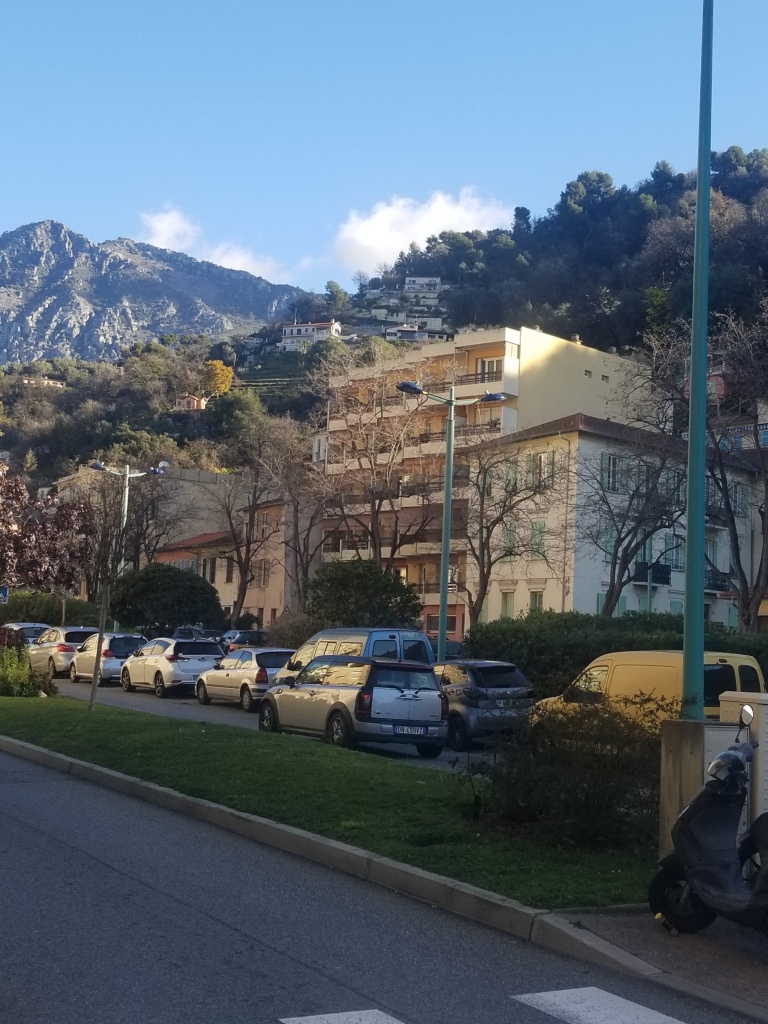
We have a splendid view from our Menton balconies. Not the sea view on the postcards, ours is a view of some trees immediately opposite us and the homes across the road, apartment buildings on the main street and above them villas nestled in an arboreous hill, though I call them the mountains – we are after all at the foot of the Alpes. At the top of the hill, I can see a rounded wall, reminiscent of medieval fortifications, and alongside it some other small pale-yellow building mostly blocked from view by trees. I can just discern a bell tower.
Thanks to Google Maps and Wikipedia, I learned that I was looking at a former monastery with a pale-yellow chapel. The Monastere de l’Annonciade goes back to the times of the city of Podium Pini in the eleventh century, though only used as a monastery between 1866-1999. In 2000, it was bought by an order of nuns who renovated it and opened the chapel to the public.
Taking the path with fewer steps up (only 434 steep thigh stretchers), I used a seventeenth century short cut called le chemin du Rosaire. Walking, I thought about the past lives that once went up the wide stairs clearly intended for horses and mules. Just before reaching the monastery grounds, I stopped to catch my breath and could look down through the budding trees and see the city streets below – one that I thought was my street, with its row of yellow and cream buildings, its parked cars and trees. But I wonder if it was the same street as it looked so different from what I thought it was. Had I gotten turned around along the twisted path?
At the top, the tight world of winding steps enclosed by villas and patches of forest had ended and a wide sky with feathery clouds and mountain tops in the distance lay open before me. The hill was a hill after all and not mountainous in the neighbourhood of real mountains. The chapel was sweet in its simple boxy exterior and austere interior, nothing like the ornate, heavily baroque churches and basilica in the town below.
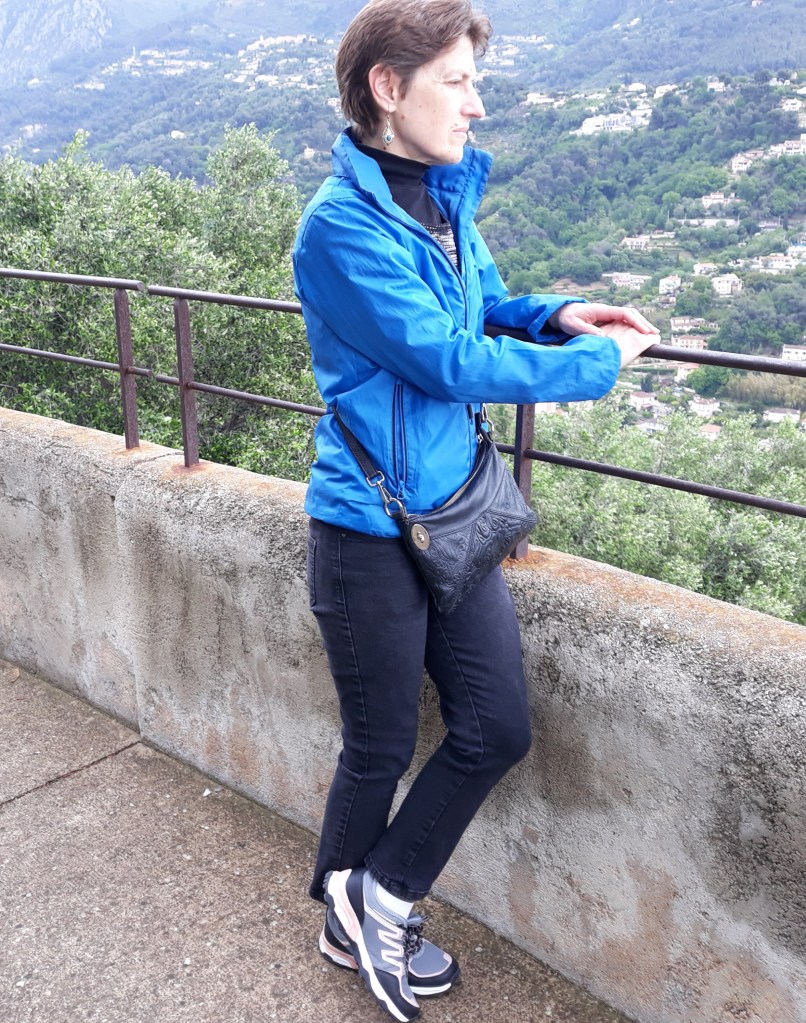
The stone wall that looked like a fortress when viewed from our balcony, at eye level wasn’t not so tall, a metre at the most. I could easily lean over the stone wall and see the streets below. Our street was immediately recognisable as was our apartment building. Staring a little longer our one-bedroom apartment came into view thanks to recognising our dark blue sheets hanging on a drying rack. Our art works and soft furnishings hidden inside – the apartment was a utilitarian unit of a rabbit warren. From the hilltop the building was a tiny part of a large Lego village with a partial terracotta rooftop I hadn’t realised existed.

With a change in perspective, the monastery up close was different from what I had imagined it from below, and the apartment had altered its appearance when looked at from above. Both monastery and apartment building had transformed in character. One became less foreboding, the other diminished in its importance.
For writers, perspective has two meanings. On the one hand, it’s about tone and the author’s relationship to the subject and characters. On the other hand, perspective is about point of view, the narrative voice of first, second or third person, with variations on third person (an all-knowing narrator, a limited one, etc). The day that I took this little jaunt to the top of the hill, I had been for a few weeks working on a short story, in which an elderly woman has dementia. Her world view is often situated in the past as a young woman. It’s only when someone tells her that she is ‘confused’ that the spell is broken, and she quickly changes her thoughts to something else, unaware of her muddled state. I was writing the story from her perspective using a third person narration, and even though it wasn’t her voice, the focalisation was on her and at times as if a voice in her head speaking back at her. I love writing in this style as it always reminds me of my first encounter with it in James Joyce’s The Dubliners.
During the walks up and back down, I must have had the main character somewhere in my mind. Walking is a writer’s tool next to none, and Wordsworth was known to walk some ten miles a day on average. When I returned from the hill and was on flat land, I suddenly decided to write another version of the story from the perspective of the person who tells her she’s confused. This other character deals with the old woman’s state of mind as if speaking to a child. His inner voice is comic and sarcastic. And so, I persevere.
What I’ve been reading
For nonfiction, The Bells of Old Tokyo: Meditations on Time and a City by Anna Sherman has made for good bedtime reading because it can be read in small segments. I like the premise of the book – to examine Japanese culture and history through its famous bells and the stories surrounding them. The writing is fine and absorbing at times, but when it comes to travelogues and other travel-based nonfiction, I’ve been spoiled by Bruce Chatwin.
I nearly gave up on Wandering Souls by Cecile Pin as I found myself reading yet another story about refugees and their harrowing experiences of escape from terror followed by their arduous attempts at assimilation in unwelcoming countries. This is a story of Vietnamese boat people fleeing soon after US troops pulled out. What kept me going was the texture of the writing. One of the narrators is a child ghost while other narrators come from the family that has survived. In some sections, the story is continued by a newspaper report as a narrator with a more detached tone. These different perspectives enriched the story, making it something else, something outside of this subgenre of fiction.
To close, I’ve been reading brilliant tributes to short story virtuoso Alice Munro. RIP.









 Paola Trimarco