
In brief – a good thriller, but not a very good novel. It had all the page-turning qualities of a competent thriller, even though I suspected I knew whodunit about two thirds of the way in. Paula Hawkins’ novel is well written, a crisp prose with believable characters. But it is only just a thriller and as such at times I felt as if I were reading a detailed treatment of a screenplay. While that’s all fine for the thriller genre, this book doesn’t extend beyond that. In contrast, the Stieg Larsson books made for good thrillers and good novels. They explored social ills in Sweden, such as violence against women, while giving its readers thriller plotlines. So too with Gillian Flynn’s Gone Girl, which combined thriller with social satire. Once again, I’m left wondering what all the fuss is about.
Category Archives: Uncategorized
The Colour of Milk
A deceptively simple book, The Colour of Milk is a story about a poor farm girl in the mid-19th century. Mary is sent away to earn money for her family working as a carer to the vicar’s invalid wife. There Mary learns to read and write. In the meantime her sister, still working on the farm, becomes pregnant by the vicar’s son, who escapes responsibility – and gets away with it. After the vicar’s wife dies, Mary experiences abuse. The treatment of women and the poor serves as the backdrop to this tale about empowerment. While the story might not be the most original, it is a worthwhile read just for the voice and lively expression of the first person narrator.
Essay: Matthew
Everything is an illusion. We live in the world of illusions. – Matthew
During my childhood, my mother was a devotee of self-proclaimed psychics and mystics like Uri Geller. She was part of the New Age movement in the seventies that saw signs in coincidences and spoke to spirits over Ouija boards. In this environment, it’s no surprise that I actually believed that I was psychic. A typical child, I was intuitive and good at guessing and saw things that adults missed because they were too busy looking. Whenever I had a psychic moment I would share it with my mother and she would beam with pride.
When I was twelve, my mother befriended Carla, a spiritual medium who lived in our neighbourhood in Chicago. On summer afternoons when I was off from school, my mother would suggest visiting Carla, in part because she had air-conditioning and we didn’t. I would have lemonade, my mother and Carla iced tea. We would talk about the latest films, pop music and the way clothes’ styles were changing. All of a sudden our chatter was interrupted – Carla’s voice would drop two octaves as her spirit guide, John, spoke through her. He used biblical language and advised us in ways that sounded to me suspiciously like the horoscope pages. ‘Worry not about the future for it is full of mystery. It is best to wait for things to come.’ That was one of John’s pearls of wisdom. My mother would nod profusely and thank John for talking to us. John would leave and Carla would go limp like a ragdoll and get back her energy with another iced tea and chocolate donut.
While I was out with friends, my mother would visit Carla on her own. I always learned about these meetings afterwards and, even though I had my doubts about John, I felt excluded. I was at that age where I needed to belong to one group or another.
By the end of that summer, I countered Carla’s John with Matthew – a name chosen to fit my mother’s Christian-spirituality phase. I would get an idea from one of her books or from a self-help coach on daytime television and attribute it to my spirit guide Matthew. Once he said, “The peoples of the world will have peace when they find inner peace.” And another time it was “All things are beautiful in themselves,” purloined from Kahlil Gibran. But I couldn’t bring myself to put on a fake baritone voice. I didn’t need to. Anytime I quoted Matthew, I became my mother’s best friend – mission accomplished.
Unlike my early childhood with psychic moments, I never believed that I was or could ever become a spiritual medium. By this time, Uri Geller had been debunked on national television when he couldn’t divine where objects were hidden or bend any spoons. And in sitcoms and films, the psychic charlatan became a stock character set up for mockery.
Within a year, I had grown up to appreciate my own friends more and the need to belong less. Feeling guilty for taking advantage of my mother’s gullibility, I gently phased Matthew out. I would tell her that I simply hadn’t heard from him as if he were an old friend who didn’t keep in touch.
Years later when I was in my thirties, visiting my mother, she asked if I was still psychic, like I was as a child. I explained that I was still intuitive and good at guessing, but that I didn’t see those things as psychic anymore – and there were plenty of times when my feelings and hunches proved terribly inaccurate.
I could tell that my response disappointed her.
“Have you heard from Matthew?”
“No,” was all I said.
Until the end of her life, my mother still consulted psychics and mystics – and believed her daughter once channelled a spirit named Matthew.
Sun-Mi Hwang’s Hen

The Hen Who Dreamed She Could Fly is a delightful little book by Korean writer Sun-Mi Hwang. It tells the story of a hen who’s fed up with laying 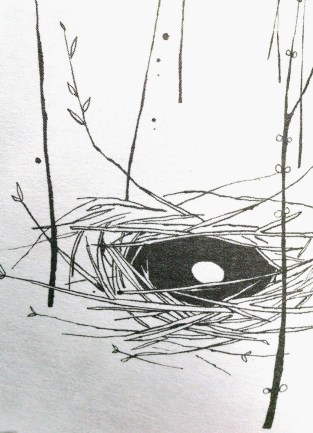 eggs on demand and wants to raise a chick of her own. But when she manages to escape the coop, she can no longer lay eggs. She happens upon an egg without its mother and lays on that until it hatches only to discover that it’s a duckling. This metaphorical tale raises issues about surrogacy, motherhood, tolerance and independence. Perhaps a chick-lit version (no pun intended) of Animal Farm, it packs a punch with its directness and use of animals who are all too human. With illustrations by Japanese artist Nomoco, this little gem is best read in its paper version.
Reading Elena Ferrante
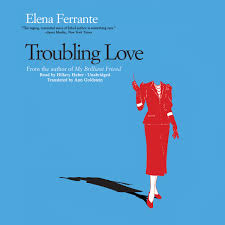
I’ve finally read my first Ferrante book. There’s been a buzz around her work over the past few years since she’s been translated into English by Ann Goldstein. I thought I’d start small by reading her near-novella, Troubling Love. To call it a mystery story wouldn’t do it justice. It’s more of a psychological tale set in Napolitano Italy. What makes this a worthwhile read is the tension and pacing set by the first person narration. Delia is middle-aged and her mother has just died under strange circumstances. In unravelling this mystery, Delia has to face unsavoury characters from her past and come to terms with her own childhood lies. The writing is as bold as the protagonist, who deals with her period erupting and staining a pair of panties, a clumsy sexual encounter and revelations of a fetishlike nature. The linguist in me also liked the attention given to the use of dialect by the narrator, who observes how speaking dialect is something of her childhood and is the language used in anger. Speaking of language, that thump you heard was Grandma Trimarco turning over in her grave when I confessed to having to read this in English.
Marching for Europe

Saturday I attended my first protest march in over twenty years. In a few words, it was in support of staying in the single market and remaining an inclusive society. In Cambridge some 400 people made up the trail of marchers. That might not seem like a lot, but it’s early days yet. This was one of those ‘gathering of the troops’ march and rally. Now that parliament has reconvened, I suspect future marches will be more focused on one issue or another concerning how we leave the EU – if that really happens. Speculations abound.
I came away from this activity thinking about a few things. First, there was the cross-party spirit of the event. The speakers at the rally included not only the Green Party and the Liberal Democrats, no surprises there, but also politicians from Labour and the Conservatives. The idea of leaving Europe effects so many people in so many ways. Working across parties is an aspect of being in the grown-up world, away from the club-house mentally of the zealot, of the closed-minded.
The march also gave me more face-to-face encounters with people who support Brexit. One man barked at us, ‘It’s over – go home!’ Is it over? Our government doesn’t seem to think so. Since the Brexit camp left us with no plan and a campaign based on twisted facts and some downright lies, how the UK actually leaves the EU is still up for grabs. Another person, an elderly woman, pointed her fingers at a few of us and said, ‘I’m from the North and we’re poor up there!’ This is just another example of the protest voting that happened on 23rd June. Yes, the divide in wealth between the North and South of England is something to be unhappy about – but why is that the fault of the European Union? What about our own governments over the last three decades? Before I had a chance to question this woman, she, like the uppity man, was gone. That to me sums up much of the Brexit campaign – single utterances or catch phrases without discussion, without debate.
These hecklers were few. As we walked with our banners, signs and EU flags through the windy streets of central Cambridge, we were greeted mostly by applause and thumbs-up gestures. When we stopped to wait for street lights or for some of our number to catch up, we were the subject of mobile phone photographs – dozens of them. There is something immensely comforting about feeling that your views are generally shared. Of course, it’s more complicated than that.
After a few casual discussions with my fellow marchers, I returned to Ely with a sense of dismay as well. There seemed to be strong agreement that the Liberal Democrats were the only party in total support of remaining in the EU and their speaker at the rally, Julian Huppert, was the best received and most inspiring. Yet – and here comes the disappointing part – some of my fellow marchers raised the point that the Lib Dems have the right message, but cannot speak to ‘ordinary people.’ One person said to me ‘They need to tone it down – keep it simple.’ I would argue that the simplicity of the referendum debate is what made it more about emotions and less adherent to facts and gave us the disasterous outcome we are now living under. It might take a generation, but perhaps we should flip this argument and raise the education and understanding of ‘ordinary people.’
33

We sat on a bench outside The Cutter taking in the view of the River Great Ouse that flows through Ely. David had a light lager – a chilled rose for me, which David doesn’t understand. Between the weeping willows we could see the old train bridge, its beams forming a series of Xs. The occasional commuter or freight train whizzed or chugged along. As one freight train started to come through, perhaps I suspected that it was going to be a long one – I started counting the containers as they went passed a certain point. Maersk, Hanjin, another Maersk, several unnamed – or too far to see with middle-aged eyes – Italia and a few more Hanjin and Maersk before it was all over. Thirty-three containers transported the stuffs of the world through our little town that evening.
Nice – One Month Later

Makeshift memorials along the Promenade des Anglais make real and enduring the terrorist attack of Bastille Day. A very public way of mourning. A mourning among strangers and mostly by strangers to the dead. The first batches of flowers, candles and children’s toys as I walked towards the centre of the city were not to mark where people have died, but were across the road from Lenval Children’s Hospital, where some of the injured, later dead, were received. About a block away were flowers and tributes to the attack’s first victim, Fatma, a Muslim woman.


Another block along the Promenade, tourists were looking solemnly upon the monument to the memory of the Pieds-Noirs (1830-1962), which now appears as a fresh gravestone, loaded with flowers, candles, flags, messages, marking the place where other lives ended in horror. The tricolour candle has been burned down into a lava-like heap. I continued walking and found the word paix (peace) beautifully drawn on to the pavement, but some twenty yards ahead I saw a pack of five national police pacing among the joggers, tourists, beach combers, cyclists and walkers. As most of the victims were killed on the small stretch of road that had been pedestrianised that night for the festivities, those memorials have been moved to the pavement of the Promenade, a deeply moving messy multilingual display of remembrance.
To equal the sadness was the joy in finding people alive and well. The couple that runs our local newsagent, our favourite waitress at Wayne’s Bar, the bartenders at the Radisson Blu, the cashiers at the supermarkets – these people whom we know, but don’t know personally, threads in the fabric of our lives – are all survivors.
We walk along the Promenade every day that we are in Nice, simply to get from our apartment to other parts of the city. This past week, we walked the full length of the Prom – seven kilometres – twice. The second time, we continued on to the top of the chateau and looked down upon our resilient city, where life continues.
Go Set a Watchman
Avoidance has made me a bit late coming to this sequel of the Harper Lee classic To Kill a Mockingbird. From reading reviews when the book first came out, I feared that it wouldn’t be as good as Mockingbird – it isn’t – and that Atticus Finch turns into a racist – he does. But I wanted to read it simply to be back in that world from the viewpoint of Scout Finch – always fiesty and true to herself. The story is about Scout as a grown-up returning to Alabama for a visit and discovering that race relations have changed for the worse. Most of the people around her, including Atticus and her old boyfriend Hank are against the NAACP and the equal empowerment of black people. Scout is revolted and puts up a good fight and in the end learns to accept that she could still love people that she st rongly disagrees with and that she shouldn’t run away from them. While Scout is the symapthetic protagonist here, I wasn’t completely taken in by her. She says that all people are equal, but she also believes that blacks are intellectually inferior and says that she wouldn’t date a black man. It made for some uncomfortable reading, but I pressed on in order to hear Atticus defend himself, which he does in a heated exchange with Scout – there are a few of these issue-focused arguments in the book, reminding me of two-hander political plays. What Atticus displays is a reasoned use of logic to justify his racism (which isn’t of the KKK variety, but racist nonetheless). But his logic only works if the premises about African-Americans were true, and most modern day readers would say they are not. This is one of these stories that needs to be placed in its social-historical context to be enjoyed. In the end, at least it hints that we are all fallible and subject to weak reasoning.
Hybrid Essay: The To Do List
Walk/WO √
As it seemed dry with a few clouds, I decided to walk instead of Work Out. I did the one where I cut through the meadows behind Ely Cathedral, through Jubilee Gardens and then along the River Ouse. Meadows – rabbits and horses. Gardens – man walking two dogs, no poo-clean-up bags, clouds built up. River – one jogger, two dog walkers, six cows, swans, greylags, snow geese, rain. Pedometer reading: 8,640 steps!
Don’t forget recyclables! √
That is, paper and plastic. Paper from my office, plastic from the kitchen.
French
Later. Not awake enough. I know, a little bit each day. That’s all it takes.
Meditate √
As a young teen, I was trained in Transcendental Meditation. I thought it was cool, having my own mantra, phasing out without reefer, forgetting puberty. By the time I was in my twenties, I started to wonder if it was doing me any good at all – I was nervous, unhappy, stressed. Sometimes I would get stressed about being too stressed to meditate. And some days, a ‘good’ meditation left me feeling sad later. One day, I stumbled across an article about meditation being bad for you – too much of an emotional rollercoaster. I left meditation to people living in the 60s – okay for The Beatles, but not for me. I don’t know why, but I took up meditation again some ten years later. Perhaps it was simply to control my brain from looping negative thoughts about negative characters in my life – the sort of people I can’t shake out. Buddhism this time. With mindfulness I count my breaths in groups of ten and then start again. A lot of time is spent during the sessions trying to clear my mind – getting from one to ten is often difficult, interrupted and started again and again. Perhaps this act of trying is more what mediation is – at least for people like me. (I wonder if monks in Tibet have this problem.) But now, I always feel better after my meditation. Strange that I have to put it on my list, but if it’s not here I forget.
Return DVD √
Everyone said that The Revenant was a big screen film. Okay, beautiful scenery, lots of trees, but a man being mulled by a bear – a 20-inch screen is fine by me. It’s just a revenge tale after all. My younger self would have been more gripped by all of this, but my older self predicted where the story was going and switched off a few times. Maybe it was the wine that night – a heavy red shiraz. Sometimes concentration is difficult and sleepiness sets in before 10 o’clock. But if I make it past the lag, I’m good until midnight, only to see a wretched-looking Leonardo DiCaprio stare into the distance.
French
Later.
Food Shopping √
- salad stuff (check use-by dates)
- yoghurt (Greek, full fat)
- cheese for risotto
- nuts
- snack bars
- Shredded Wheat Bite-Sized
- wine
Write √
Do I really have to tell myself to do this? I don’t remind myself to eat lunch or drink three cups of tea each day or shower and put on clean clothes. I’ve been writing stories and essays since I was a teenager. Later, it was stage plays – a lot of fun, but actors can be demanding. Now back to short stories and articles – that pay. It’s what I do. Perhaps putting it on my To Do list guarantees a check mark. And that makes me feel good. A sense of accomplishment for the day, with good days being all checks. But of course, writing is more than that. It’s a way of discovering the self by trying to communicate in a way that strangers reading my work will understand – finding the expression, describing the image that others can relate to. In my first draft I write something in a way that I would understand. At the second draft I imagine my audience. Through the drafts I see my private life, my own idiosyncratic thought patterns – a reminder of every person’s unique experience of life. Today, a blog entry about terrorism, another rewrite of an article due by the end of the week, a hybrid essay based on a To Do list.
Clean √
Bathroom today. I don’t mean a quick clean, relying on cleansers to do all the work and leave the room smelling lemony and cleaner than it really is. I mean, the dust along the top of the tiles and the lime scale stains on the shower nozzle. It took me all of 30 minutes.
French √
Passé composé and conjunctions – 10 minutes online before dinner.
Then computer off. A glass of wine while I compose tomorrow’s To Do list

