Deconstructing Ciao Bella Ciao Ciao Ciao

I first learned and instantaneously joined in singing the chorus of Ciao Bella Ciao Ciao Ciao a couple of years ago at a fundraiser for Ukrainian refugees. Despite the lyrics resembling the passé Italian ‘cat call’ once hurled at women, I quickly realised its true nature: a protest song. It’s about a country under invasion, with a narrator who would rather die than surrender, asking the supporters (the partigiani) to take him or her away. At least, that’s the gist of the early verses. The dead body is to be buried in the beautiful mountains of the beloved country, where flowers will grow above the grave. The song ends with a rambunctious cry for freedom.

This is the 1940s version, widely interpreted as being anti-fascist even though there is no mention of fascists or Mussolini. I see the goodbye my beautiful, goodbye, bye bye as a farewell to the country and the days of freedom. Putin’s sending troops into Ukraine is an invasion of a sovereign nation. Those were my thoughts – nothing to do with fascism – as I sang the chorus in the gardens of a church in Cambridge decked in the now familiar blue and yellow flags. We were calling for freedom and showing support for the people of Ukraine.

Since the 1960s the song has become a generic protest anthem across the world. It’s been used to defend workers’ rights, object to taxes, protest oppression, and rally against war. It’s another form of We Shall Overcome. In this way, the song has returned to its 19th-century origins in the rice fields of northern Italy. In that version, the lyrics describe insufferable working conditions and a boss who beats the workers with a stick. They, too, would rather be dead, and the song also ends with a wish for freedom.

The song has recently been dragged into the headlines with the assassination of the far-right influencer Charlie Kirk. Bullet casings from the assassin’s gun were reported to have the words Ciao Bella Ciao Ciao Ciao engraved on them. If my language is hedged and my tone a bit sceptical, it’s because the US president and others of that ilk started blaming the ‘radical left’ and ‘antifa’ before a suspect had even been identified, returning the song to being anti-fascist. That narrative sounded a bit too convenient – and out of touch. Now that a suspect is in custody, we have learned that he was raised in a conservative Mormon household. His parents are registered Republican voters, and he registered as an Independent. So far, nothing has suggested he belonged to a left-wing organization – or to any political organisation.

The accused is an individual with mental health issues who was also in a gay relationship with a partner who was transitioning. This individual may have been offended by the well-documented attacks from Mr Kirk against gays and transpeople . Living in America, this mentally ill individual had easy access to a gun – an issue that is not being debated this time around.

Seeing the shooter as an individual and not necessarily influenced by the left, it’s worth noting that the 22-year-old alleged assassin was an avid gamer. In the world of video games ‘ciao bella, ciao ciao ciao’ holds several meanings, including ‘see you,’ ‘I got you – bye bye’ and ‘I’m tired of this.’ The casings also had a few abbreviations used by gamers that middle-aged journalists are still trying to decipher.

I doubt we’ll ever know the true motivations of the assassin. His actions were unquestionably wrong and sadly are likely to be replicated by others given the heated and polarized times we live in.

On the less violent and more measured side of protest, we still have the right to sing Ciao Bella Ciao Ciao Ciao. If you want this infectious song in your head, complete with lyrics, I recommend BELLA CIAO: VERSIONE PARTIGIANA E DELLE MONDINE (Canzone Originale + Testo).

What I’ve been reading

Crime fiction that’s not really of the genre. These two novels were intended to be late summer escapism from the horrors of the world news, but neither Colson Whitehead’s Crook Manifesto or Olivier Norek’s Entre Deux Mondes (Between Two Worlds) could keep my mind from the bigger social problems of racism and anti-immigration positions.

Crook Manifesto is set in 1970s New York, with its notorious crime problems and seediness and follows on from Whitehead’s Harlem Shuffle – which I hadn’t read. For me, this book worked fine on its own as it uses dark humour and elements of crime drama to weave a story about a criminal who had gone straight but was then dragged back into the underworld. It’s full of social commentary on race, poverty and crime and made me strangely nostalgic for 70s America, with societal divisions that seem innocuous by today’s MAGA and social media-fuelled standards.

The Norek novel doesn’t have the laughs or the comfort of reader hindsight that Whitehead’s book has. It’s a crime thriller set in the Jungle, the notorious refugee camp in Calais, France. It follows two police officers – Adam, a  refugee fleeing Syria and his job in Assad’s military police, and Bastion, a French lieutenant newly assigned to the Jungle. This gripping tale is complex and heart wrenching, with a high body count – definitely not a light read for the nightstand.

Today’s Inbox – or WTF is happening to America?

Still surfacing from a deep night’s sleep, I checked my inbox to find an email from the US Social Security Administration. The subject header read: ‘Social Security Applauds Passage of Legislation Providing Historic Tax Relief for Seniors.’ That woke me up quickly.

This is an agency of the US government that used to communicate, like other government agencies, in dry non-partisan language. It gets worse in the body of the email:

‘The bill ensures that nearly 90% of Social Security beneficiaries will no longer pay federal income taxes on their benefits, providing meaningful and immediate relief to seniors who have spent a lifetime contributing to our nation’s economy. “This is a historic step forward for America’s seniors,” said Social Security Commissioner Frank Bisignano. “For nearly 90 years, Social Security has been a cornerstone of economic security for older Americans. By significantly reducing the tax burden on benefits, this legislation reaffirms President Trump’s promise to protect Social Security and helps ensure that seniors can better enjoy the retirement they’ve earned.”’

Since when do civil servants (as we call them in the UK) publicly praise the policies of any president or prime minister? Worse still – to allude to political campaign promises? Short answer – when that civil servant is Frank Bisignano, former CEO of Fiserv (a payment processing enterprise), a staunch Republican and one of the richest people in America. Tr*mp appointed him Commissioner of the SSA soon after retaking office in January of this year (yes, it’s not even 6 months yet).

This being from the SSA, the email got away with not mentioning how America’s most vulnerable would have their financial support lacerated. Medicaid in under another government agency: the Centers for Medicare and Medicaid Services (CMS). I’m waiting for their email to all US citizens and suspect I’m going to have a long wait.

The next email I opened also had a thing or two to say about the One Big Beautiful Bill – I hate even writing in this hyperbolic language. But it’s clever to use the propagandist parlance in legislation so that, like it or not, we all start sounding like MAGA morons.

From Robert Reich:

‘It is a disgrace. It takes more than $1 trillion out of Medicaid — leaving about 12 million Americans without insurance by 2034 — and slashes Food Stamps, to give a giant tax cut to wealthy Americans. It establishes an anti-immigrant police state in America, replete with a standing army of ICE agents and a gulag of detention facilities that transform ICE into the most heavily funded law enforcement agency in the government.’

Reich continues by recounting how moderate Republicans were bullied by the president’s threats and insults, mostly via X and Truth Social.

I retreated from my emails and opened the Le Monde app. One of their top stories covered OBBB – they’ve avoided both the English language and the embarrassing phrase by abbreviating it. They’ve also taken a more objective tone and have expressed all the above – it’s a bill that reduces taxes on the better-off, funds anti-immigration policing and leaves America’s most needy worse off, and that the US president attacked members of his own party to get it passed.  Even the purring beauty of the French language doesn’t help to make this more palatable.

What I’ve been reading

Helen Dunmore’s award-winning novel A Spell of Winter has provided the perfect escape from the horrors of American politics. Firstly, the story starts far away from modern America in England soon before the first World War and continues to a few years after the war. Cathy and Rob are siblings living with their grandfather and a servant in an old manor house. The children had been abandoned by their mother and witnessed their father’s declining health in a mental sanitorium. The children grow into teenagers, and their co-dependent relationship becomes incestual and later deadly. The story explores the power of class, of loss and of family. Secondly, the articulateness and sensitivity of the writing made this often disturbing and sad tale – some call it gothic – a delight to read. A snippet from Dunmore’s book: “The past was not something we could live in, because it had nothing to do with life. It was something we lugged about, as heavy as a sack of rotting apples.” 

Quite different from the vulgar vernacular and semantic satiation coming out of Washington these days.

Finding humour in uncomfortable spaces

I follow Robert Reich, the former Secretary of Labour under Clinton, on Substack. With his constitutional expertise, Reich has been pointing out the authoritarianism and fascism being perpetrated by the MAGA White House. But this isn’t just a grand whinge. Reich also reminds readers of the powers we, especially Americans living in America, have for fighting these assaults on democracy using the courts, protesting in the streets and through boycotting anything Tesla. And there have been some victories. Most importantly, while the messages are serious and often alarming, Reich injects some levity with his weekly caption competition, where he provides the drawings and gives readers the chance to create and find humour even in the grimmest of times.

From Robert Reich’s Substack

Okay, you’re thinking it’s easy to laugh at the ridiculousness of the actions and claims spouting out of MAGA. Jon Stewart, SNL and other satirists across the globe are having a field day. True, but still necessary for the soul. Having said that, I’m concerned that while humour is always good medicine, I think we shouldn’t forget the malaise. I don’t wish to be caught off guard, being entertained as world economies collapse and America spirals in fascism.

What I’ve been reading

A serious moment, but I’ll get back to humour.

My growing fandom of Leila Slimani continues with finally reading her first novel, Dans le jardin de l’ogre (In the Ogre’s Garden, available in English). It’s a hard-hitting and thought-provoking story about a female sex addict. Some reviewers of the book have used the word nymphomaniac, but I’m resisting that as nympho is often used lightly in a fun way, and there is little that is amusing about the life of this protagonist. Adele is a journalist married to a surgeon with whom she has had a child. Despite the appearances of midclass normalcy, Adele is in constant need of sexual gratification outside her marriage. It’s a tale of addiction and the solitude that comes with living a double life.

When I tackled this same subject some years ago, I chose to do it in a short story. Reading Slimani has made me wonder if this was the right format as I didn’t give myself room to work in the character’s backstory or develop the topic from different angles as Slimani does. The other difference in our approaches is that I decided to navigate this uncomfortable space by using some gentle humour, but in a way that doesn’t laugh at the protagonist. Addiction is serious business – ‘Every addiction starts with pain and ends with pain’ (Eckart Tolle). I ended up with two versions – a 3,000-word short story and with this flash fiction version that stops before the sex begins (sorry, reader).

LAUREN ON TOUR

She saw her name on a piece of cardboard, the letters in black marker. The woman holding the sign was in her mid-twenties, about the same age as Lauren but taller and bigger, with tanned muscular legs, bulging in cut-off shorts. As Lauren approached her, the woman exposed a toothy grin that looked like a horse neighing. “Hi, I’m Debbie.” She had an American accent. “Welcome to Korea. Is that all your stuff?”

Lauren’s voice was raspy from the flight, but she managed a “Hello. Yeah.”

“Great.” Debbie was too perky for Lauren at that moment.

Outside the terminal, the air was heavy with humidity. A driver from the college was waiting for them – a bit old, Lauren thought, but a possibility. Too bad her body smelled like stale bread and her hair felt greasy and flat. He bowed and averted his gaze as he speedily loaded the suitcases into the van.

Leaving Incheon Airport Lauren’s thoughts jumped around – Debbie and the driver – the bright lights from shops whizzing past – an image of a Korean man, not too muscular, with slender fingers, his eyes would be full of hesitation and awe – the grey high-rises of Seoul in the distance.

Debbie broke the silence and played the role of tour guide, speaking at times with great authority. Though the American had only been there a year herself, she was armed with statistics – population of Seoul, nearly 11 million. Lauren sometimes responded with “yeah,” and other times with “really,” until finally she was forced into answering some questions. She explained where her village was in relation to London, the only place in England where Debbie had been. Lauren avoided any mention her of family, but not wanting to appear unsociable, she explained that she was still fairly new to English teaching. Of course, she did not mention her real reason for being there.

“That’s cool. I mean, don’t sweat it. Lots of people here are teaching English and they have degrees in history or things like that.” Debbie spoke most of the time as if rushing to catch a bus.

Lauren raised her brows to show interest, but in her mind, she was being kissed on her legs.

 “This place is cool,” Debbie said, brushing back brunette strands with her fingers. “But hey, it’s not exactly Harvard.”

Lauren just smiled. She returned to her own thoughts, wondering why Debbie was teaching in Korea. Was it all about the money – the tax-free income? Or was Debbie also operating under fabricated pretenses, living a double life?

The American took a swig of bottled water and said, “Yeah, I think you’ll like it here. They treat us well and like, hey, I’m here to help you. Not only am I your roommate – we’re sharing this great apartment – you have the bigger bedroom – and I’m also your mentor at the college.”

Sharing an apartment? Lauren felt as though she had fallen off a diving board and landed hard on her back. Her plans, her months of research, her fantasies – all gone in a flash. No female flat mate would put up with her.

Debbie’s eyes grew wide. “Oh, shit. They told you that you were going to have an apartment to yourself, huh?”

Lauren nodded.

“Yeah, they can be shitty on things like that.” Debbie took another gulp of water. She paused to check Lauren’s reaction, which was still a blank stare. “It’ll be fine, really.”

The next morning wasn’t the next morning, but the next afternoon. Lauren had woken up wildly alert in a strange bed in an unfamiliar room of bare white walls.

When she stepped out of the bathroom into the living room, she noted the linoleum floors and bright tubes of light along the ceiling. She started to think of ways that she could at least make her own bedroom cozy and sensual, a place to melt into a dark silk-covered mattress.

“Hey, Lauren, I’m in here,” Debbie called out from the kitchen.

The familiar aroma of coffee greeted her. Debbie stood at the cooker in baggy trousers with a halter top, exposing a fleshy chest, her feet in bright red flip-flops with matching toenails.

“Okay,” Debbie said, serving fried eggs and placing herself in charge once again. “So, like, you’ve slept for what? Some 12 hours?” Before Lauren could answer, Debbie continued, “Now you need to stay awake until midnight. Trust me. I know my jetlag.” She looked at her watch. “At twenty hundred hours, we go to Itaewon for serious clubbing and alcoholic beverages to be administered at regular intervals.”

Lauren chuckled, amused by Debbie’s delivery.

“At twenty-three hundred hours, you shall take melatonin and then I, being the best roommate in Seoul, shall tuck you into bed no later than zero hundred hours, otherwise known as midnight.”

“Aye, aye,” Lauren played along.

She finished her breakfast and went to her room to unpack. While separating work clothes from play clothes – lacy underwear, corsets – she thought about her research. Korean men and men from neighboring Asian countries could be found in the backrooms of discos and karaoke bars. For the Asian man, she – Lauren, the freckled Western woman – would be the exotic attraction. It would be easy – she wouldn’t charge them anything. She wanted to shock her American roomie. She wanted to say, “You know, women can be sex tourists too.”

  • Paola Trimarco (Copyright 2015)

Cultural words in the time of MAGA

Aside from having a form of the word cultural, what do these words have in common: cultural competence, cultural heritage, cultural differences, culturally appropriate, cultural relevance, cultural sensitivity, culturally responsive and sociocultural? Answer: These are words the Tr*mp administration has ordered government agencies to remove from all their documents and websites. Some more amusing and just plain weird examples can be found on this banned word list (such as autism, belong, fluoride and marijuana). But as a sociolinguist – and a human being – I’m bothered and perplexed by these cultural words being treated with such scorn.

Firstly, defining culture as a set of ideas and norms belonging to a societal or national group, culture and things cultural are innately part of being human and terms that we use to describe these aspects of our humanity. In other words, language and culture are intertwined – a language emerges from a culture with shared concepts and experiences – and the flipside – a culture is expressed in its language(s). The writer Rita Mae Brown summed it up when she said, ‘Language is the road map of a culture. It tells you where its people come from and where they are going.’ How could we ban cultural anything from our language?

On a more practical matter, many of these banned cultural terms are used by scholars and teachers as part of their disciplines. Some of my own research has been in heritage languages, where words like cultural heritage and sociocultural regularly crop up. Only the other day, I was speaking to a friend who teaches English to immigrants in Australia, and she used the term cultural competence. By banning the official use these words, the MAGA government is defunding language and teaching programmes and research, not to mention all the government-funded museums and arts and music programmes which rightly operate in a multicultural framework.

Among the monstrous acts carried out by the US president, this blatant and hypocritical censorship – this is from the administration that claimed the woke are denying us our freedom of speech – might seem small potatoes. Yet, it taps into something far more sinister if we consider areas outside of sociolinguistics. The ban on some of the other cultural words – cultural difference, cultural sensitivity and culturally responsive – are clearly targeting hiring policies and workplace training programmes in diversity. Since the variety of peoples in America are not going to lose or want to relinquish their cultural heritages, such policing of language condones discrimination and division among employees. Sadly, we know from history that this mindset has a tendency of spreading, these days with the unsafeguarded assistance of social media. One has to wonder what the ultimate goal is. Perhaps MAGA is simply striving for a monoculture (if such a thing were possible) and wearing its bigotry as a badge of honour.

What I’ve been reading

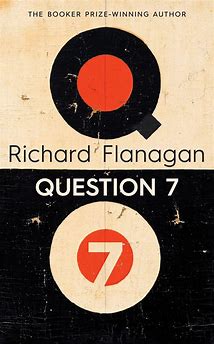
Occasionally a book comes along that I don’t want to end. Australian writer Richard Flanagan’s Question 7 is a memoir combined with history and sociocultural (!) commentary rolled into one. Beautifully crafted with anecdotes and personal insights, the memoir parts focus on the author’s father and his relationship with him, culminating with the author’s own near-death experience. Flanagan’s father was a prisoner of war at a slave camp in Japan when the bomb was dropped on Hiroshima. The author intersperses this story with an historical account of some of the nuclear physicists who created the atomic bomb, in particular Hungarian American Leo Szilard and with the true-life love story between Rebecca West and H.G. Wells. The dots between Szilard and Wells are connected by Szilard devotion to Wells’s 1914 novel The World Set Free, which describes a world at war where atomic energy is used to make deadly explosives. Szilard, whom to my shame I only knew through the Oppenheimer movie, was best known for discovering nuclear chain reactions and later for his activism against nuclear arms. He was also an amateur biologist and environmentalist.

Since Flanagan made several references to H.G. Wells’s The World Set Free, I thought I should give this prophetic book a go. Written as a ‘science romance’ as these SF books were called, it’s quite different from the writing of contemporary novelists. Telling outweighs showing, and the poor reader is a good 10% into the book before the first character appears. But to his credit, the writer doesn’t tell and show the same events, and the prose at the sentence and paragraph level is tight. That is, the novel is more historically interesting from a post-modernist’s perspective than it is enjoyable to read.

I came away from these past couple of weeks speculating about SF written today of a future where multiculturalism has been outlawed – hard to imagine, but people once felt this way about the worlds depicted by H.G. Wells.

Train Journeys are always non-linear

I’ve taken the train between Peterborough and Edinburgh countless times over the past 40 years. The hilly landscape, the rugged coastline and the familiar stations – York, Darlington, Newcastle – have become comfortably familiar. The world has hardly changed when viewed from picture windows, often at speed creating glimpses and filmic montages. Yet, of course, the world and I have changed. Forty years ago, I was a bewildered student punching above my weight in theoretical and then applied linguistics, finding solace in Scottish poetry and working on my first unpublished novel – my first stab at untangling my dysfunctional childhood by reimagining the early life of my maternal grandmother.

I shook off those memories by filling the four-hour journey with some fiction (a The New Yorker short story) and some nonfiction (Le Monde) and listening to a few podcasts (Lincoln Project, and The News Agents). Between these entertainments my mind wandered back to a time when Thatcher was Prime Minister and Reagan was President and how they were perceived as deviously competent and dangerously bumbling, respectively. Pulling into Waverly Station, I thought that while I still disagree with their views, both world leaders would appear dignified and professional today.

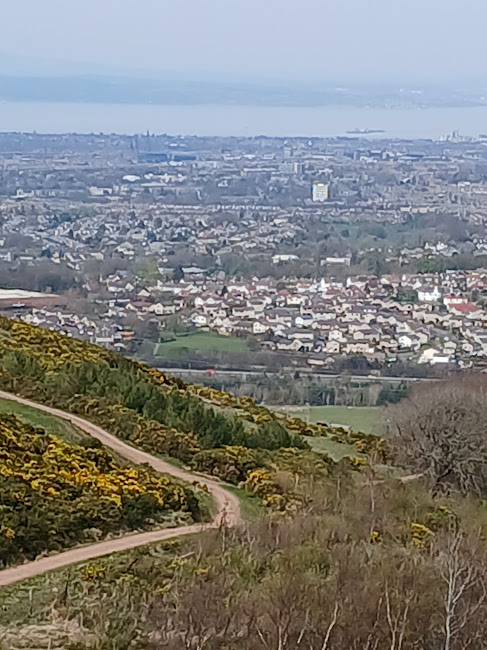
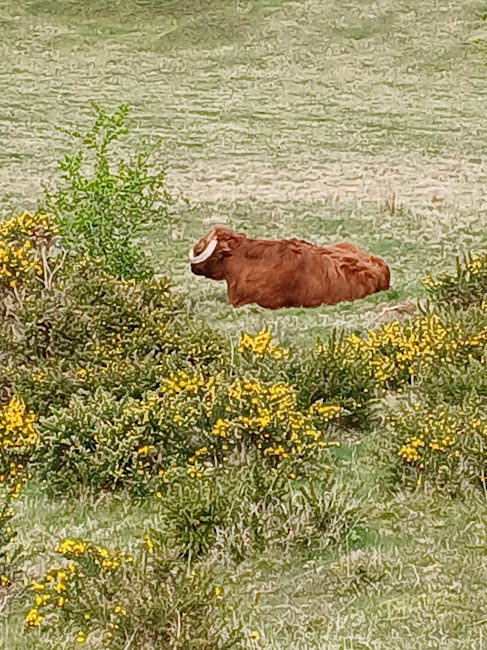
The train journey back reflected on the immediate past. My weekend in Edinburgh had focused on seeing an old friend, whom I hadn’t seen in five years thanks to the Covid lockdowns and mental health issues keeping her indoors, alone and unsociable. We talked through the weekend, confirming we were both in the bubble of centre-left opinion and trying to cope with the barrage of news coming from fascist America – a term that is becoming normalised – without being depressed and despondent. We also talked about our psychological well-being and what we do to take care of ourselves – meditation, exercise and variations of CBT. Between reading articles in The Sunday Observer, my return journey reflected on all of these conversations, along with images from our walk through a corner of the Pentlands, where I used a pair of walking sticks to navigate the grassy and gravelly terrain of inclines and where we saw Highland Cows in the wild, grazing just a few yards away appearing bored. The conductor reminds passengers that the buffet car is in ‘Coach G – G as in golf.’ So Scottish.

As the train pulled into Ely Station, having a sense of satisfaction for reconnecting with my old friend, I jumped into future thoughts – my friend’s recommended books and Italian television to explore and the banality of what I was going to eat for dinner.

What I’ve been reading

The Dalai Lama’s Cat by David Michie is an amusing tale from the perspective of the eponymous cat. This feline narrator is given the human qualities of communication and some abstract understanding for the reader’s benefit but is otherwise catlike. The cat, who goes by several names, describes what it is like being with the Dalai Lama, a life of celebrity and diplomacy sandwiched between hours of daily meditation and practices of compassion. When the Dalai Lama is away, the cat interacts with members of the household and a want-to-be American Buddhist who runs a local café for spiritual tourists. With each of these encounters, lessons in Buddhism emerge. While a bit episodic, there are still some gems to be found. Example, Buddha is quoted (I know, quotes like this are always dodgy as Buddha put nothing to writing that has survived): ‘The thought manifests as the word; the word manifests as the deed; the deed develops into habit; and the habit hardens into character. So, watch the thought and its ways with care.’ Whatever its true source, it’s a reminder of the power of the mind to create good or ill.

For something more literary and profound in its own way is Michael Cunningham’s Day. I loved The Hours, Cunningham’s modern-day retelling of Virginia Woolf’s Mrs Dalloway that wove Woolf’s life into the storytelling. I’m embarrassed that it has taken me so long to read another Cunningham book. Day came out last year to rave reviews and quickly found its way to my wish list and eventually my public library account. The story takes place on single and separate days spaced a year apart. In the intervening months, a couple separates, Covid upends everyone’s lives, and the wife’s brother has a midlife reassessment, changing careers and winding up stuck during the pandemic in Iceland. Although these events keep the pages turning, the real joy of the story lies in its sociopsychological intrigue. The brother, who is openly gay, has been ‘in love’ with his brother-in-law for years. Note the quotation marks – there’s nothing sexual or even romantic about the relationship. It’s a deep sense of love, for which our culture and therefore language doesn’t have a word. Beyond familial love, to call it a ‘bromance’ – a term more used sarcastically these days – would be an insult to the genuine depth of emotion. Another sociopsychological concept in this novel involves creating a fake identity online presumably for fun. But in time, it is clear to the reader that this alter-ego serves a personal psychological purpose.

Tremors, quakes and talking with Americans

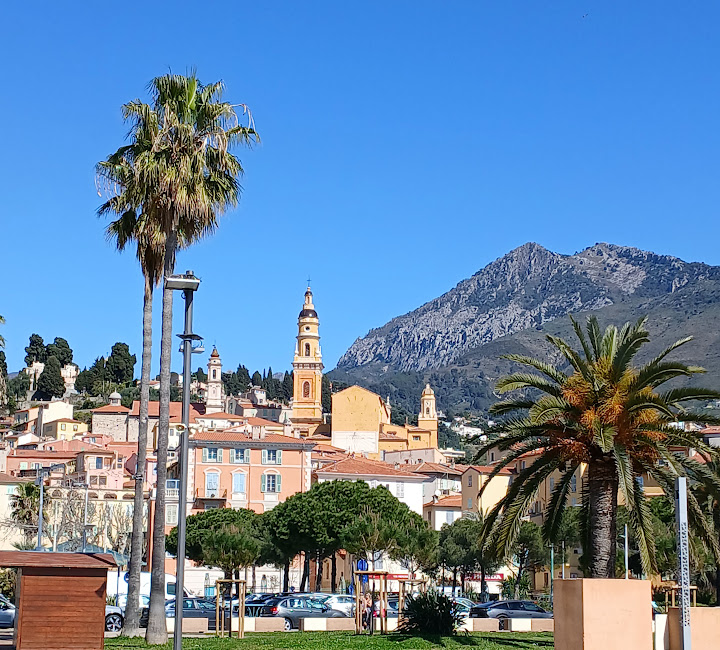
Last week, Nice experienced an earthquake. A 4.1 on the seismometer, it wasn’t dramatic, more of a mini quake that nonetheless managed to scar some apartment walls with cracks. Fortunately, no injuries, no fatalities. Here in Menton, some 30 kilometres away, we were having an apéro with friends on the seventh floor of the Méditerranée Hotel when I felt the floor beneath me shake and shift. We looked at each other and David said, ‘I think it’s a tremor.’ But by the time he got that out it petered into a gentle vibration and then stopped. Unnerving for this earthquake novice, I felt my heart racing while I sat still waiting for the next wobble and wondered how much worse this was going to get. Another tremor quivered in Menton a few hours later. But it was so minor, it went unnoticed in our first-floor apartment, where the sound-space continuum is regularly jolted by a stomping child next door and the rubbish collection just below our balcony.

The south of France is not California or Japan and is not known for its seismic activity, but it does experience a few minor earthquakes each year due to its proximity to tectonic plate boundaries. As I write this, more harrowing stories are emerging from Myanmar following its 7.7 earthquake, which put my experience and western privilege into perspective.

All of this has made me think about the sensation of being on firm ground one minute and then being shifted and jiggled around the next by forces well beyond my control. This triggers thoughts of another kind of tremor, a sensation that is equally jarring  and taps into my feeling of fright and bewilderment. What Tr*mp is doing to America and the world is an earth tremor for some, a damaging earthquake for most of us and for others a deadly catastrophe – the latter is no exaggeration, considering the lives already lost to cuts in USAID and America’s withdrawal from WHO.

The disaster that is the current US administration overwhelms me with bloggable topics. Rather than pick one subject, for now what I offer are personal observations and mental recordings of conversations held with Americas who are not politicians or journalists.

Here in France, I’ve met an American woman who came here at the start of the year. As she explains it, ‘I just left and now I’m looking for someplace to live.’  She didn’t merely throw a dart at a map and decide on Menton. She has friends here that she stayed with until she could find an apartment to rent. Now she’s in that apartment looking for an apartment to buy. Conversations with her are about the property market, French bureaucracy and getting French residency. When someone brings up the situation in America, a lost and angry expression comes over her. She’s reluctant to talk beyond the generalised phrases – ‘it’s awful,’ ‘it’s scary,’ and ‘I’ve escaped.’

Others, still living in America are more willing to talk to anyone who will listen. Forever the scriptwriter, I hear their turns of phrase in my head days later – a kind of ear worm from the furious and isolated. Here’s a prosy poem of what that worm’s been chanting:

Cult, cult. When did they get so stupid? Our generation were the lucky ones. Those Trumplicans – my neighbour – my husband – my old friend. I still can’t believe people would vote for this again – yeah, Covid response – Capitol riots – BS about the election results. They’re hurting now. Oh, no they’re not. Cult, cult. People have been pickled. President Musk. Young men with masculinity poisoning. If we could leave, we would. And they think I need psychological help. What will happen to our schools? Our healthcare, our air, our universities, our freedoms, our farms? Who can speak? You cannot speak to the cult, cult.

What I’ve been reading

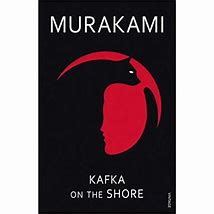
Haruki Murakami’s 600 pager Kafka on the Shore has been delighting and mesmerizing my reading time for the past four weeks. A slower reading pace than usual as I’ve tackled it in French – so that’s Kafka sur le Rivage. Since the original was written in Japanese, I figured I’d be reading something in translation anyhow. If I reduce the novel to its bones, it’s a coming-of-age story melted into a post-war saga of love and loss up to the present day, with a mysterious murder, via magical realism. But it’s so much more than these plot descriptors because of the way it tells its stories through metaphors and strange happenings – talking cats, a rainstorm of mackerel and a backstory involving a group of children who fall into temporary comas on a school trip in the final days of WWII – their malady lays suspicion on the American military presence. The characters express themselves with an awareness of Greek tragedies, modern and classical music and a sophisticated blend of philosophy and psychology.

I’ve also been enjoying my subscription to The New Yorker, in particular the essays and analysis on the rolling news of events brought on by you-know-who. My favourite of these has been an essay by Hillary Clinton about Signalgate and the current administration’s version of ‘diplomacy’ (note the quote marks). The title says it all: This Is Just Dumb  With experience and eloquence, another American grapples with the shaking ground beneath us all.

Lemons and Oranges: Coping, or not, with the new world order

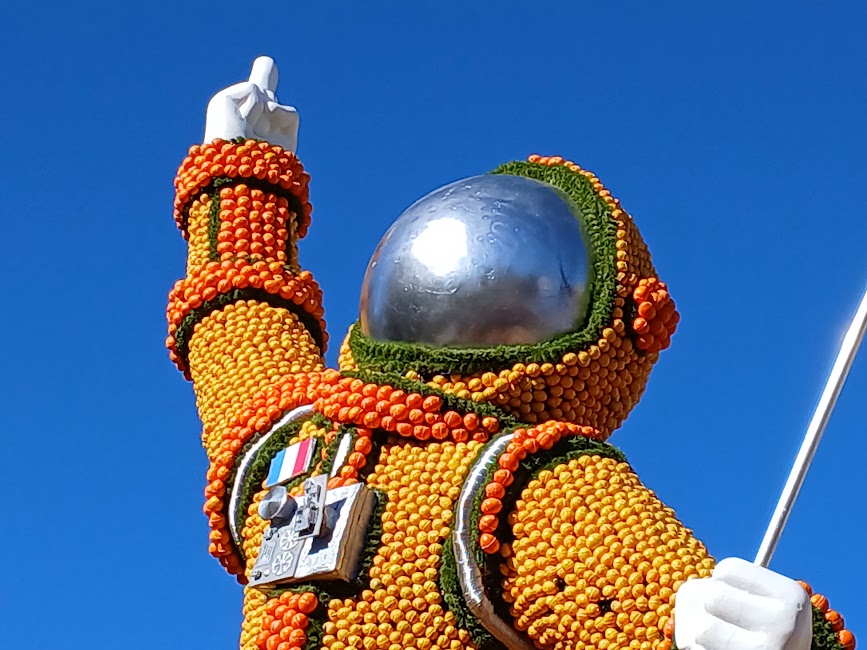
The nursery rhyme goes ‘Oranges and lemons, say the bells of St Clements.’ But in Menton, France, lemons come first. With the annual lemon festival kicking off last weekend, the city’s central garden is decorated with large figures made of lemons and oranges. This year’s theme is outer space, featuring an astronaut (French, of course), spaceships and aliens while lively parades bring traffic to a halt.

I’m aware that I’m enjoying this traditional fete more this year than in previous years. I don’t think this has anything to do with rockets, space beings and sparkling dancers. This has been about partaking in a tradition and allowing myself to be entertained, passive and receptive. I wonder if this is escapism, pretending that life goes on as normal despite what is happening in America, despite the consequences that have us here in Europe shaken and nervously waiting for the next move by our world leaders.

On the one hand, I’m buying into normalcy bias. Carole Cadwalladr explains in her blog what this means: ‘There is an inability to process, accept and confront the dangerous new reality we are in and to focus on the big picture and the pivot of history that’s occurred in the last two weeks.’ She was criticising the New York Times for not reporting on the coup of the tech billionaires that has taken over the White House. She has a point. Cadwalladr’s conclusion offers some hope: ‘It’s a coup. And the international order is collapsing. We aren’t helpless but we need to cycle through the denial part to get to the bit where we start fighting back and take immediate steps to protect ourselves.’

My other hand is not in denial and is all too aware of the history-making events of the past ten days. While the streets of Menton were filled with tourists and shops promoting all things lemon, the US president was slinging cruel and falsely based insults at Volodymyr Zelenski that sounded like they were written by Putin and full of warped narratives. Worse still, this current US government is engaged in so-called ‘peace talks’ where neither the Ukrainians nor the EU have been invited. (This reminds me of the adage that I heard again this week – if you’re not at the table, your on the menu.) Such actions shift the balance of power, making more fragile the international organisations set up to protect democracies and their citizens. This is where another bias comes in – recency bias, where we tend to think of recent events as being far worse than anything in the past. I’m clearly experiencing this and wondering if we are on the brink of WWIII, coupled with financial collapse resulting from trumpanomics.

I’ve run out of hands to refer to, and so, I’m back to contemplating citrus fruit and festivals to get  through the winter months, traditions that go back to medieval times as we are living in a world not too different. If I put both hands together, I can pray.

What I’ve been reading

As The New Yorker is celebrating its centenary, I renewed by subscription – for a while at least. Every few years I take advantage of some special offer and subscribe for three to six months. This 100th anniversary edition is a real treat. For me, the highlights have been two brilliant essays and a surprising poem. Tara Westover, author of Educated – a powerful memoir about growing up in a deeply religious and anti-education family – writes on being estranged from her parents and how a friend tried to lend her his mother. Being estranged from most of my dysfunctional family, I can identify with Westover’s need to feel connected despite all that has happened and despite the patent benefits of estrangement. The other essay appealed to my science nerdiness. Dhruv Khullar provides a sobering account of why it’s going to be difficult, if not impossible, for humans to live on any planet or space station outside the earth’s orbit – basically, it will make us ill. Really ill.

The poem comes from Robert Frost and is surprisingly not a reprint from a New Yorker of decades ago. This is from a recent discovery of an unpublished poem entitled ‘Nothing New.’ It has been authenticated by scholars, including Jay Parini, who writing for The New Yorker, puts the poem into the context of other works by Frost. Parini comments that ‘Frost’s unique gift was to write poems that burn a hole in your brain. You never forget his best lines. They stick with you—and they change your life.’  So true. I still remember lines from Frost that I learned in primary school.

Hence, I’ll conclude with reprinting the poem here. I’m sure other Frost fans and societies have already posted this all over social media, and well they should, especially in times like these, wintery in both season and perspective.

Nothing New

(Amherst 1918)

One moment when the dust to-day

Against my face was turned to spray,

I dreamed the winter dream again

I dreamed when I was young at play,

Yet strangely not more sad than then—

Nothing new—

Though I am further upon my way

The same dream again.

—Robert Frost (1874-1963)

My 2024 in review without lists

Regular readers know that I’m not a fan of the listacle – those articles that list the best of or worst of or top 10 etc. They’re click bait and often poor examples of writing. By copping out of the type of commentary or critical review that threads an argument,  they offer mere snapshots brimming with clichés. With this hanging over my head for what I shouldn’t do, I’m reviewing 2024 under a few categories.

My year as a verbivore

Yes, I used to refer to myself as a logophile, but I’ve decided to use verbivore instead despite Word underlining it in red. This word was coined by the writer Michael Chabon in 2007 when talking about his love of words.

I’m afraid 2024 hasn’t been good year for verbivores thanks largely to the many national elections taking place all over the world and where politicians have overused words, such as woke, to the point that it can mean the opposite of their original meaning – or simply have no meaning at all aside from being something to despise. I’m also somewhat miffed that words like demure and mindful have gained new meanings thanks to the verbal grasping of social media influencers. Both words are being used to mean low-key and subtle in fashion and style.

The OED ranked brain rot as the word of the year, one that I never used even once. Apparently, it has come out of the Instagram/TikTok generation’s feeling after scrolling through dozens of posts. It can also refer to the low-quality content found on the internet that I do my best to avoid – a challenge when trying to find vegetarian recipes on Pinterest and having to skirt around videos of cats stuck in jars.

While I don’t go around recording myself, I’ll bet that my most used word during this year was incredible. In part, I’ve picked this up from the French who frequently use incroyable. When the worst president in US history (according to historians) gets re-elected after doing and saying so many things that individually should have made him unelectable, that’s incredible. On a more positive note, given my first-hand experience dealing with builders, plumbers and electricians in the South of France, I  thought it incredible that Notre Dame Cathedral was renovated after the catastrophic fire in just over five years.

My year as a reader

This year has been dominated by two writers as in recent weeks I found myself reading yet  another Robert Harris novel, my third this year, and another Amelie Nothomb foray into autofiction, my second for 2024.

After hearing Harris speak about his latest book, Precipice, in Ely a couple of months ago, I delved into this thriller which begins at the onset of WWI. It’s an historical period I’m strangely fond of and the story recounts the true-life affair between Prime Minister Herbert Henry Asquith and the socialite Venetia Stanley. Asquith’s casualness towards national security is mind-boggling  as his teenage-boy infatuation led him to share with Venetia everything from Cabinet debates to classified documents coming from his wartime generals. Though not as complex or informative as Harris’s Pompeii or as intriguing as his Conclave, Precipice is still an entertaining and interesting book.

Taking advantage of the public library in Menton, I’ve just finished Amelie Nothomb’s La Nostalgie Heureuse (avail in English). The narrator’s view on the world is as quirky as ever and expressed with her usual dry wit. In this story, she’s already a well-known writer living in Paris, who returns to Japan to participate in a documentary about her early life. Key to this is an anxiety-provoking reunion with a man she nearly married some twenty years earlier. A noteworthy aside – she (fictional narrator and real-life author) had written about the relationship in one of her earlier books and when the ex-fiancé is asked by the documentary maker how he felt about that book, he said that he enjoyed it as a ‘work of fiction.’ This is when the narrator realises that her truth could be other people’s fiction – a wink to the reader of this autofiction.

Throughout the year, I have also made it a point to read writers that are highly praised in the literary press that I have never read. Earlier in the year it was Paul Auster and Antonio Scurati and in recent weeks Carson McCullers. I finally read The Heart is a Lonely Hunter, which most people know from the 1968 film. Set in a small town in Georgia during the Great Depression, the story recounts the lives of several characters who are connected by their work and family circumstances. Their sense of isolation is explored against a backdrop of poverty and racism, with a nuanced struggle with homosexuality. The weaving of the stories reminded me of a typical Robert Altman film – very enjoyable despite the grim subject matter.

On the non-fiction side, this year I’ve continued my nerdy interests in bees and trees, trying to find texts for non-specialists that aren’t too scientifically dry or too jokingly flippant. While I’ve also read some excellent biographies and memoirs, the most thought-provoking and impassioned nonfiction  I’ve experienced this year has been in the opinion pages of the New York Times, The Observer (UK) and Le Monde. They serve as reminders that despite populist voting trends, humanity still exists.

My year as a writer

I started out this year with two writing goals. One was to return to novel #4 and give it a thorough rewrite. While I didn’t produce a full rewrite, I have rewritten about half of it and have made notes for the other half. This task was interrupted by an avalanche of editing assignments that came my way in October and lasted until December. The other writing goal was to simply send out either one short story or one essay every month. I did manage to send out 12 stories/essays this year, but without the monthly regularity – there were a couple of inactive months and a couple bubbling with creativity. Five rejections have been taken on the chin (three were competitions after all) and I await 7 replies.

In the second half of the year, my writing took on a more therapeutic purpose – maybe my way of dealing with complex PTSD. For the first time I’m writing about unpleasant childhood memories and with the creative process taking over, I’m fictionalising certain characters and subplots. I’ve been experimenting with the ‘I-narrator’ by taking on the role of persons other than myself, trying to revisit these episodes from others’ points of view. I seemed to have tapped into something as the work I’ve shown readers so far has been extremely well-received in ways unusual for my early drafts.

My year as a human

Being a linguist, reader and writer are all a part of being a human, but I am aware too that there are other identities of my humanity, such as a friend, spouse, sibling, neighbour, citizen etc. For me, all these roles fill one stratum of physical living in all its sociocultural and psychological dimensions. In this stratum, 2024 has been about witnessing climate change, and then climate change denial by some and inaction by others, along with the public discourse of hate that substantial portions of the population engage with, making me feel like an outlier. I know I’m not alone in this, but I no longer inhabit a space in the norm range.

Another stratum of my humanity exists, but I grapple to explain even to myself. The word spiritual has been stretched and abused by religious and anti-religious alike to the point that I avoid using it. Perhaps this stratum covers all things incorporeal, including abstract thought. This year has made me more aware of this disembodied beingness, if awareness is all I have for now. And so, I continue to practice mindfulness (in the pre-2024 sense of the word – nothing to do with fashionable clothes).

Thank you, readers, for your comments and emoji reactions over the year. I wish you all peace and joy for 2025.

Gisele Pelicot, my choice for Person of the Year

It’s Misogyny and Greed, Stupid

I was going to write about newsworthy adjectives that have cropped up these last two weeks with phrases like crazy-strange campaign speeches and unnatural disasters. But given the elections results from America, I can only think of two words and they’re nouns – misogyny and greed. Others are free to add the word racism – I respect that argument but feel less strongly about it at the moment.

We all witnessed Tr*mp’s violent-strewn attacks against his women adversaries. We know that this former president proudly stacked the courts with anti-choice conservative judges and was found guilty of sexual assault. Most frightfully, only last week he exclaimed that he was ‘going to protect women whether they wanted it or not,’ a paraphrase of the arguments in favour of women wearing burkas. And then there was the ‘bro’ vote – young men who engage in toxic masculinity and spend too much time in the cesspool of social media’s misinformation and conspiracy theories – supporting their orange idol.

As for greed, I’ve heard too many people wearing MAGA hats explain that they were voting for a ‘businessman.’ One told an interviewer ‘I wanna be rich like him.’ Others say that the economy was better during Tr*mp’s term in office. Yes, inflation was lower back then, but inflation, especially food and petrol prices, has been felt all over the world thanks to the Russian-Ukraine war. It wasn’t the result of Biden’s economic policies. Furthermore, unemployment in the US is lower now than it was during Tr*mp Mark I, and more jobs were created during Biden’s four years than in Tr*mp’s. So, it’s not ‘the economy, stupid’ (sorry if this is becoming clichéd). It’s greed. This doesn’t apply universally to the working poor in America who have genuine reasons to be aggrieved, but they are mistaken if they think tax breaks on the wealthy will lift them out of poverty.

I’m working on this blog when there’s a knock at my front door. A man and woman in their fifties smile at me.

Woman: Hello. Are you concerned about leadership and the leaders in our world?

Me: Sorry, not today. I don’t mean to be rude, but really, I’m in no mood. It’s a sad day.

Woman: Actually, we’re here to talk to you about Jesus…

I cut her off. Me: Well, many Jesus-lovers just voted a tyrant back into the White House.

The man bats his eyes in confusion.

Woman: Oh, I understand completely. I have friends in America…

Me: Goodbye.

I close the door on the opportunistic Jehovah’s Witnesses and return to my blog.

These are the highlights of my election post-mortem. The full clinical report includes the double standards applied by the media, the Democrats not having primaries post-Biden, gerrymandering electoral districts and indeed, racism.

Following the post-mortem, there’s a burial. I feel as though I’m in mourning. Perhaps that’s the best way to deal with this. From a Buddhist perspective, mourning has limited value. It’s okay as an initial reaction, but then awareness of the present, being mindful needs to take over. That’s where I’m aiming to be soon.

Preparing for Winter

This weekend, we turn the clocks back. Ten days later, the US has its presidential election. These two events are bumping into each other in my brain’s anxiety lobe.

My David anticipates the clocks going back with a sense of dread. He pulls faces – the emoji with his eyes squinted, a tongue half out. David suffers from SAD (seasonal affective disorder), which is at its worse when we find ourselves in England in the winter months. I’m not so affected by the onset of winter. This is because I grew up in Chicago, where winter meant snowmen, ice skating, mittens drying on the radiator while our hands cradled cups of hot chocolate. That’s not to say I haven’t experienced that greyscale world of depression, but my occasional bouts of it have not been linked to the seasons of shorter days. They’re simply not linked to anything. Nevertheless, sharing a life together, David’s clouds of SAD cover my head as well.

Psychologist Kari Leibowitz has observed that contrary to popular belief, people who live in Scandinavian countries do not have high rates of SAD. Their prevalence of the winter blues is among the lowest in Western countries. This is because Scandinavians embrace the winter months with outdoor festivals, activities and sports and indoor candlelight gatherings with friends and family. That is, our moods and feelings towards winter have a lot to do with our mindsets (as this former Chicagoan knows). Leibowitz explains:

‘…we might have a mindset that winter is limiting or that it is full of opportunity, dreadful or delightful. We conflate the objective circumstances – that winter is cold, dark and wet – with subjective things, like it being gloomy, boring and depressing, when you could just as easily make the case that it is cosy, magical and restorative.’ (from an interview in The Observer )

Leibowitz makes a good point, not only for the onset of winter, but for anything. Our mindsets can predispose us to how we experience situations and events. In this vein, while David is dreading the 26th of October, I’m fearing the 6th of November. Yes, the US election is on the 5th, but given the time difference, the results won’t trickle in until the following day here in Europe. I’m not looking forward to learning that either America will soon have the MAGA version of fascism or that Harris has won, and the Tr*mp/Musk ticket reacts with inciting riots and cyber-pandemonium. Both could ripple  disastrously across the States (another civil war is no longer the stuff of dystopic fiction) and across the world in ways ranging from the environmental to the geopolitical. Of course, logic tells me that other scenarios might occur – American politics is never short on surprises. But that’s not found in the anxiety lobe.

Taking Leibowitz’s advice, I’ve suggested to David that he ‘resets his mindset’ for the weeks we’re in the UK after the clocks go back and before we migrate to France for the winter, starting with evenings of candlelight to soften the mood. We are also planning nights at the cinema, concerts and book talks, along with socialising at our local pubs.

As for resetting my own mindset, my version of candlelight is found in meditation and practicing mindfulness as each new disturbing situation emerges from America. In seeking the ‘delightful,’ to use Leibowitz’s word, I can look forward to the social and political satire in the months and years ahead.

What I’ve been reading

The last two novels I’ve read do not use quotation marks when characters are speaking. This meant careful reading at times to distinguish thoughts from dialogue, but in both cases this style of writing was effective. The first was Sandrine Collette’s On Était des Loups (avail. in English), a dark novel about a hunter who lives in the wilderness with his wife and child until the wife is brutally killed by a bear. He reacts by setting  out on a journey through the mountains and forests with his son in order to find a more appropriate home for the boy, the five-year-old he barely knows and didn’t want in the first place. Both live in the haze of trauma and grief left from the bear attack and deal with it in their own contrasting ways. Like the winter months, light moments can be found flickering in the gloom through character study interwoven with nature writing. A strangely life-affirming novel.

By sheer coincidence on my part, Paul Auster’s Baumgartner is also about a man whose wife had a premature death. When the story starts, he’s nearing retirement, and his wife has been dead for a decade. Set in the town of Princeton, Baumgartner is a professor of phenomenology who encounters falling in love again and incidences, such as falling down the stairs, against the backdrop of the loss of his wife. Without quotation marks getting in the way, the descriptive narrative, blends in beautifully with Baumgartner’s philosophical and mundane thoughts.

Edmund de Waal’s The Hare with the Amber Eyes is an absorbing account of the British ceramicist’s family history, traced through the ownership of Japanese figurines, called netsuke. These objects were brought to Europe by art collector Charles Ephrussi of the well-known banking family. Years later, he gave the 200 plus netsuke as a wedding gift to his cousin in Vienna, who later had her money and possessions confiscated by the Nazis. De Waal’s descriptions of the acts of antisemitism are chilling. Luckily, while Nazi soldiers occupied the family home, a housekeeper saved the tiny figurines by hiding them in her mattress. Eventually, they’re returned to the Ephrussi’s and inherited by de Waal. This work has inspired me to read more biographies about artists. De Waal mentions the works and lives of Impressionists and Post-Impressionists linked to his family, including Berthe Morisot, whose paintings and drawings I saw  recently at an exhibition in Nice. I’m now reading a biography of her by Dominique Bona. There’s something about the connected world of artists and writers in France at the end of the 19th century and into the early twentieth that makes me wish I lived at that time (though not as a woman).