
Occasionally the screensaver on my Kindle pops up with the dour face of Emily Dickinson. She has become one of the most recognisable faces in American literature. Yet, only recently has her life been transferred to the screen with Terence Davies’ A Quiet Passion. The film d’auteur has its tableau moments, which slows down the pace and might not appeal to some viewers. But I found this fitting with the nature of Dickinson’s poetry – her elliptical language could cause images to freeze in the air. I liked too that the film contained sharp, intelligent dialogue in keeping with the dialogic style of many of Dickinson’s poems. At the same time, these dialogues – many between Emily and her sister – remind audiences of the social li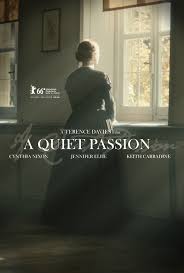 mitations thrusted upon 19th century New England life, especially for women. Although mostly a contemplative and melancholic film, humour and wit are present in a way that I felt was realistic to the poet’s life (Dickinson scholars are free to differ on this point.)
I’m also grateful to this film for reminding me that Dickinson wrote some poems about the US Civil War. We tend to think of Walt Whitman as the Civil War poet and of war poetry as being a male preserve. But here is a Dickinson sampling:
(582)
Inconceivably solemn!
Things go gay
Pierce — by the very Press
Of Imagery —
Their far Parades — order on the eye
With a mute Pomp —
A pleading Pageantry —
Flags, are a brave sight —
But no true Eye
Ever went by One —
Steadily —
Music’s triumphant —
But the fine Ear
Winces with delight
Are Drums too near —
Since I was a teenager, I’ve liked Dickinson’s work, though I confess that there was a lot I didn’t understand younger. I think her writing and people’s understanding of it has been more helped by cognitive poetics (and other areas of literary stylistics) than by traditional literary criticism with its focus on biography, religion and history. Cognitive stylistics has shown how Dickinson manipulates grammar and word-choice to create different worlds that wrangle with, among other things, ontological questions. Here, I’m thinking mainly of the scholarship of Margaret Freeman, who gives a wonderful analysis of one of my favourite Dickinson poems:
A Spider sewed at Night
Without a Light
Upon an Arc of White
If Ruff it was of Dame
Or Shroud of Gnome
Himself himself inform.
Of Immortality
His Strategy Was Physiognomy.
(J 1138, lines 1-6; ms)
I think it’s time to return to this poet and see how I get on with her language and wisdom in my middle age.

 Baldwin’s life as a civil rights activist. Director Raoul Peck takes us on a journey through the civil rights protests and public discussions on race during the 60s and 70s, with some unspoken allusions to present-day hate crimes in America. Baldwin is positioned at the centre of this sometimes-loose narrative. We watch him on television talk shows, lecturing at all-white university campuses and demurely in the crowd of some of the most iconic marches of the twentieth century. The real treat and reason for seeing this film are the sonorous tones of actor Samuel L. Jackson reading passages from Baldwin’s much-quoted works while images recapture the horrors. Although some of these quotes have been exploited on posters, coffee mugs and Facebook postings, in the context of this film they have re-found their rightful home.
 Paola Trimarco