Nope, this is not a blog from a survivor of Dry January – the wine continued to flow as usual. Nor is this about winter depression – at times, a sad month but luckily without the winter blues (hard to experience in the sunny south of France). As February kicked off this weekend, I was determined to reboot and restart the year afresh. But not before a few reflections on the surreal month that just passed.
Imperia before the storm
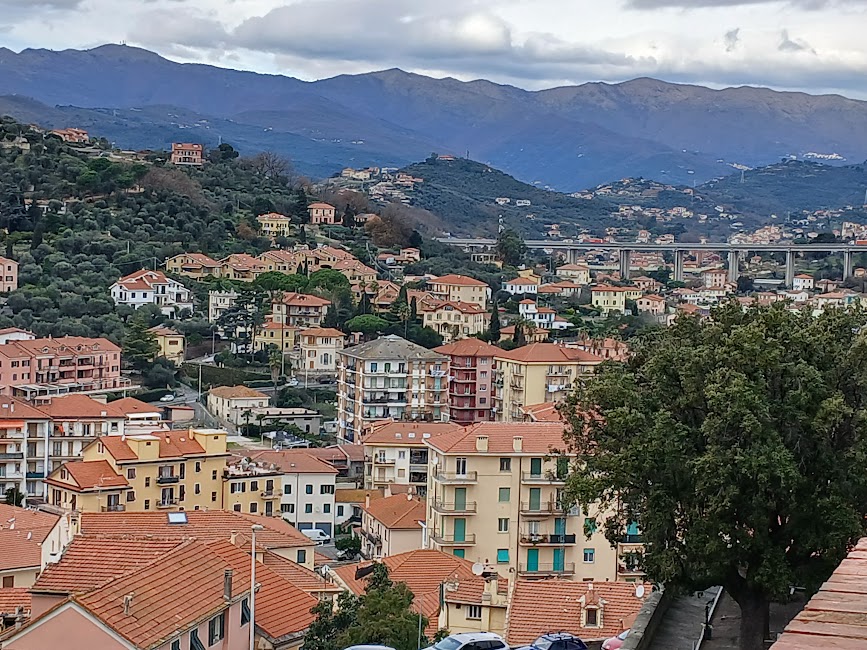
In the second week of January, we gave ourselves a three-day break in Imperia, Italy. I had told friends that this would be our reward for finishing the joyless task of painting the kitchen – including cabinets. True, but the underlying reason was to have a respite before the 47th president was inaugurated, a chance to be preoccupied with Italian language and history while enjoying coastal views and stoned-baked pizzas. I was living in these delightful moments while at the same time imagining myself looking back on them nostalgically – a time before America imploded and the world reacted. Or more immediately, a time before the barrage of news on the vitriolic, anti-environmental, anti-humanitarian, falsehood laden chaos.
Goodbye Facebook
January also marked my last month on Facebook after some fourteen years of posting holiday snaps, images of our protests marches and single-framed comics, while giving my share of thumbs and hearts. I did explain to my followers that this was a political decision against Zuckerberg, the latest technobro to become a Tr*mp enabler and his allowing for hate speech to grow and fester on the site. The reaction to this announcement was mixed. Some support, one serious critic (apparently, I should be happy to have more freedom of speech) and loads of people ignoring me. The latter grouping made me wonder how many closet Tr*mp supporters (including non-Americans) are out there.
Still Jacqueline
The third week of January marked the death of one of my oldest and closest friends. In truth, the sense of loss started a few years ago. The last time I spoke to Jacqueline was over the phone and she was in a care home in Edinburgh. A great raconteur, she told me a few stories that made me laugh, but I later realised that these stories did not involve any of our mutual friends and at no point in the conversation did she ask about my David. That is, she had forgotten who I was. Jacqueline had Alzheimer’s. Like the character in the film Still Alice, Jaqueline was an accomplished linguist and teacher. And like the character in Still Alice, played by Julianne Moore, the signs of this horrible condition had its onset in middle age – Jacqueline was barely sixty when her memory started failing her and her personality began to change. Unlike the film, the experience for Jacqueline and those who loved her could not be encapsulated in two hours. The years of slow deterioration of mental faculties, of speech, of sense of humour had laced a thread of sadness through our lives.
Due to problems scheduling planes and trains and severe weather conditions, I was unable to attend the funeral in person. Instead, on the last day of this surreal month, I watched live stream on my laptop old friends and colleagues at the crematorium reminiscing about Jacqueline and giving her a warm, heartfelt sendoff.
What I’ve been reading
I’ve been engrossed in two books that couldn’t be more different. Sam Freedman’s Failed State explains why Britian is in such a mess, going far beyond Brexit in examining the highly centralised system of government that cripples its ministers. On top of this, the powers of the judicial system, though often necessary but cumbersome, are more than ever challenging the government, making it more accountable, but even less effective. Freedman also points out that ‘the constant need to feed the media beast has led to a rapid proliferation of symbolic legislation designed not to achieve any real-world goal, but to give the impression of activity.’ Good nourishment for this news junkie.
The Overstory by Richard Powers is a book I wish I had discovered before dipping into a couple of soft-science tomes about trees. Yes, she’s harping on about trees again. The first part of this novel introduces nine characters in what I would consider to be interesting and entertaining short stories. The only connection between the stories is their characters’ experiences in one way or another with trees. In some cases, these experiences are accidental and peripheral. For other characters, a hobbyist and a researcher, trees are their raison d’etre. For the latter, I was glad that this book didn’t shy away from the science, and I could revisit words that were new to me just a couple of years ago – raceme, drupe, panicle, etc. Saving our forests brings these lives together in complex thriller-like fashion. While quotables abound in this book, I’ll just leave you with a couple. A geeky teenager concludes, ‘Humankind is deeply ill. The species won’t last long. It was an aberrant experiment. Soon the world will be returned to the healthy intelligences, the collective ones. Colonies and hives.’ Another character is struck by a ‘great truth’: ‘Trees fall with spectacular crashes. But planting is silent and growth is invisible.’

In Powers’ book, I’ve also discovered the phrase guerrilla forestry, where activists illegally plant new saplings. I recently wrote a short story that touched on this idea. Once I’ve learned more about sylviculture, don’t be surprised to find me among the forest warriors. There, I’ve rebooted my year ahead.

 Paola Trimarco