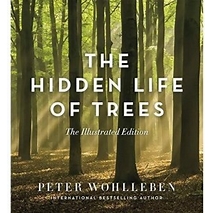
I warned you, one of my themes this year is trees. Having completed an online course on trees and sylviculture, I’ve turned to books on the subject.
The Hidden Life of Trees by Peter Wohlleben was an international bestseller some five years ago that somehow past me by. On the back of this Wohlleben, a forester by training, has his own magazine, podcast and television show in his native Germany. Now he has a sequel volume that has been reviewed and piqued my interest. But given the rule for most film franchises – sequels are rarely as good as the original – I thought it right that I read the original first.
I’m afraid I struggled with the anthropomorphizing of trees throughout this popular book. Example: ‘The tough trees that grow on this slope are well versed in the practices of denial and can withstand far worse conditions than their colleagues who are spoiled for water.’ Denial is a complex human emotion, one that involves a great deal of reflection and conjuring of scenarios to discount one explanation over another more palpable idea. When I try to grow a new plant from a cutting and it doesn’t work, I don’t suspect the cutting of being in denial of its new situation or resisting the notion of creating new roots. It’s more likely the weather conditions weren’t ideal, the soil was too acidic, or my rooting powder was too cheap to work.
Discussing three oak trees that are next to each other, Wohlleben claims one is ‘behaving’ differently from the rest. ‘Clearly, each of the three trees decides differently. The tree on the right is a bit more anxious than the others, or to put it more positively, more sensible.’ My more prosaic explanation might involve exposure to wind or sunlight, or one of the trees being a favourite of the local canine population.
What got under my skin the most were the references to trees having the parental, often ‘motherly,’ sensibility to protect their young. This comes from an idealisation of parenthood and motherhood that doesn’t fit well with the reality of dysfunctional families or those families where love and nurturing exist, but the time and means to provide safety are lacking due to economic circumstances.
To the book’s credit, it includes fun facts about the ages of some trees – over 10,000 years old. And a few interesting factoids: Apparently, walnut trees emit a mosquito repellent; and ‘There are more life forms in a handful of forest soil than there are people on the planet.’
The book is also useful for its environment points. Bringing together the ideas of commercial forestry with industrial farming, Wohlleben notes that, ‘Thanks to selective breeding, our cultivated plants have, for the most part, lost their ability to communicate above or below ground. Isolated by their silence, they are easy prey for insect pests. That is one reason why modern agriculture uses so many pesticides.’
Reviews of the book show a divide between the professional reader-critics (e.g., The New Yorker and The Guardian) and the citizen-critics on the internet (e.g., Goodreads and Amazon). The latter praise the ‘accessibility’ and ‘delightful’ style and presentation of complex science. I’m with the professional readers who cringe to varying degrees over the simplifications, humanizing and questionable science being used to support the idea of trees having feelings and the capacity to learn. I prefer language about transmitting signals through electrons and the ways living organisms adapt to their environment. I’d like to think that with information and visual aids literally at our fingertips, science writing to generalist audiences no longer needs to rely upon fairytale scenarios or the registers of childhood language.

 Paola Trimarco