
I first came across the artist Pauline Boty in Ali Smith’s Autumn, where the protagonist, Elisabeth, is working on her PhD in art history and discovers Boty’s work. She is so struck by the artist’s quirky paintings, popular in their time but now obscure, that she changes her thesis topic rather late in the game to Pauline Boty.
Elisabeth describes Boty’s paintings and collages as joyous, inventive and bold. Traits not allowed for women artists in the 1960s. As Smith’s book reminds us, when Pauline Boty attended the Royal College of Arts, there weren’t even toilets for women students. Naturally, this piqued my interest, and I found online a cache of Boty’s works, most depicting the personalities and popular culture of the 60s. Several sources refer to her as one of the greatest British female artists of the 20th century. She’s also credited as a founding member of the British Pop Art Movement. On top of that, Boty enjoyed a brief career as an actor in film and television and as a radio presenter. So, how did this celebrity artist pass me by?
In Autumn, Elisabeth thinks Boty’s present day obscurity is owed to her being female and the fact that she had a short life, dying of cancer at the age of 28. Yet, her legacy includes some 50 paintings, hundreds of drawings and several stained glasses – one of which can be found at the Stained Glass Museum of Ely Cathedral – that’s a five-minute walk from my house!
But that’s not the coincidence I started this with. About two weeks ago, when I was three quarters into Smith’s novel that refers to Boty’s life and work, my Sunday paper had an article about a new Boty exhibition at the Gazelli Art House in London. An artist I had never heard of is suddenly coming at me from different angles. I don’t see much in this coincidence. It’s not a calling to become an art historian or that I must have a special connection to Boty. Life is too random to think that way, but I enjoyed the coincidence all the same. It put a magnifying glass on this experience of discovery.
Of course, the article mentioned that Boty has been forgotten and how popular and outrageous she was during her brief lifetime. According to Rob Walker of The Observer, this exhibition will introduce Boty to a new generation. Maybe so, but will this woman artist enjoy the posthumous recognition of other modern artists who died young? Aubrey Beardsley and Jackson Pollock come to mind.
When Elisabeth tells another character that her thesis is about Pauline Boty, she soon finds herself explaining Boty’s brushes with fame after her death: ‘Ignored. Lost. Rediscovered years later. Then ignored. Lost. Rediscovered again years later. Then ignored. Lost. Rediscovered ad infinitum.’
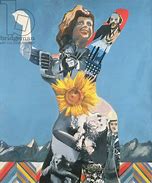
It appears I have jumped into one of these cycles.

 Paola Trimarco