Ten Days in a Woman’s Life

Ten days ago, the UK Supreme Court made a pronouncement clarifying that in Britian’s Equality Act, ‘woman’ referred only to those assigned female at birth. This in effect says that a transwoman is not legally a woman. Unsurprisingly, the trans community is furious about the decision. Women like me who have fought for women’s sex-based rights welcome the ruling and the fact that the Equality Act still protects transgender people from discrimination while it also protects people from sex-based discrimination. The difference now is that sex and gender are not being conflated. In most of our daily lives this distinction doesn’t matter, and transwomen could be referred to as women by friends and colleagues. But when legal issues or situations arise, such as safe spaces for women and competitive sports, the sex-based biological difference is acknowledged and legally acted upon. Will the debates around this continue? I wish they would, but too many people in the public eye are wary to engage in this topic, especially if they agree with any aspect of the Court’s ruling. It’s unfortunate that no ruling from the Courts or Britain’s Parliament have addressed the conflation of debate with hate speech.

Easter Weekend saw the death of a pope. The obits were lengthy and the discussion panels on his legacy tried to create a polemic over what type of pope Francis was – liberal or conservative, left-leaning, right-leaning. In every discussion and interview I heard across my three languages, this last pope lost only a small fragment of his liberal credentials when it came to the role of women in the church. The experts in religion shook off this topic as if to say, ‘What do you expect?’

Mid-week saw Trump’s team  announce government efforts to increase birth rates in America. This warped government is considering baby bonuses of $5000 to every American mother after her baby is born and classes for women in charting their menstrual cycles to increase their odds of conceiving. This pronatalist strategy is wrapped around conservative ideology about families based on marriage (as opposed to partnerships) between women and men and with the intent of having enough offspring to form a choir (okay, not their exact choice of words – it’s hard not to be sarcastic).

Speaking of controlling women’s bodies, Thursday morning, I found myself in conversation with a French language partner about the historical contradictions in Poland on the issue of legal abortions. In brief, abortions were legal during the days of the USSR when people had fewer individual freedoms. After the dissolution of the Soviet Union, in 1990 Poland’s new president Lech Walesa reestablished the country’s ties with the Catholic Church. By 1993, abortions were only legal in cases of severe abnormalities in the foetus – the woman’s mental and physical health were not taken into consideration. Today in Poland, abortions are only allowed in cases of rape, incest or if the mother’s life is in danger. Incidentally, the Soviets hadn’t been acting out of feminism or concern for women’s health. According to the Arte documentary my language partner and I watched, the Soviet government needed women in the workforce.
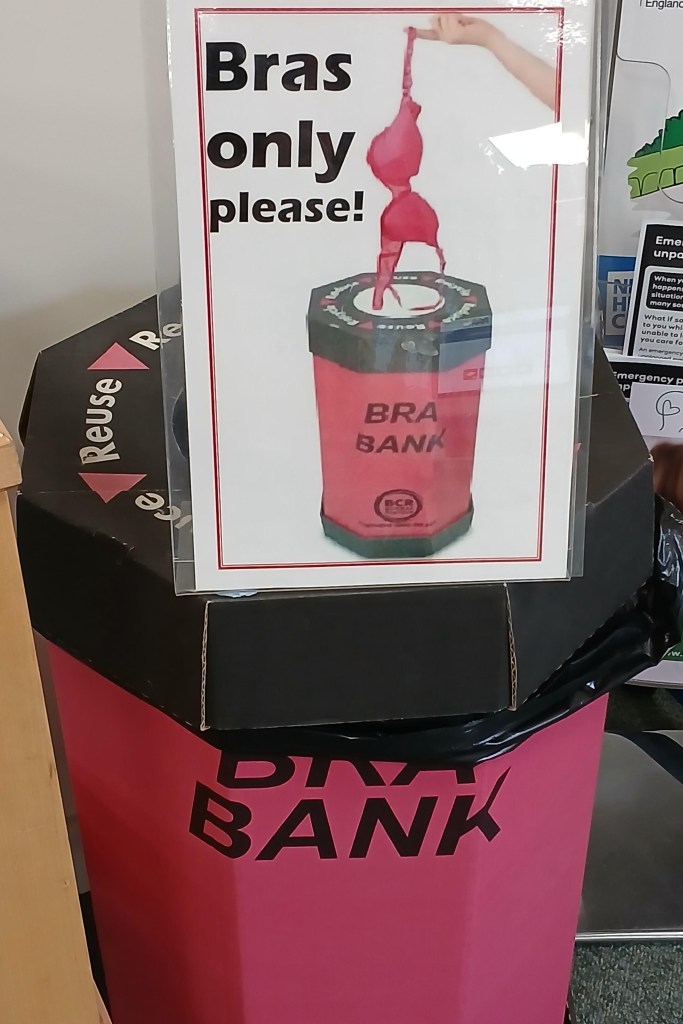
The new weekend started with a trip to the public library, where I notice a small recycle barrel partially tucked into a corner near the self-service checkout machines. Not for paper as one would expect in a library, but for bras (or brassieres as some insist on calling them). And of course, it was pink. Why in the library and why partly hidden? Several recycling bring banks, as we call them locally, are peppered across the tiny town of Ely with receptacles for used paper, glass, clothes, shoes and books. But none of them have a recycle barrel for the uniquely female undergarment. In the twenty-first century clothes associated with sexualised parts of the female body are requiring a gentle sort of censorship. At least this woman could end this 10-day cycle of womanhood with a laugh.

What I’ve been reading

I’m a huge fan of Joyce Carol Oates and have written about three of her books for The Literary Encyclopedia. Babysitter has been lauded as one of her bests, and I must agree. Be prepared – this is not a bedtime read. Like many of Oates’s work, some dark, unsettling topics are at the fore. In this case the abduction, rape and killing of children by a serial assailant make for the backdrop that disrupts the ‘pleasant valley’ white suburb of Detroit in the mid-70s. At the centre is Hannah, the wife of a wealthy businessman and mother to their two children. Bored with her passionless marriage, she is seduced by a strange man, not a part of her social circle, who engages in violent sex. One time, she ends up nearly dead. She is traumatised and cannot hide the injuries. Now clearly a victim of rape, her story exposes the sexism and racism of the time. Her story also develops in thriller style, linking to the serial child killer. Fortunately, breaks from the violence can be found in moments of poignant reflection. These lift the storytelling out of social commentary into something deeper and philosophical. When Hannah is forced to sell her grandmother’s pearls, she goes to a pawnshop and is told by the jeweller: ‘You have neglected these pearls, dear. You need to wear pearls often. You should know, pearls require human warmth, intimacy, to maintain their beauty. Their being. Spinoza said, “All things desire to persist in their being.” Pearls are not diamonds, dear. If left alone, they lose heart. They lose hope. Like all of us, they become brittle and begin to die.” At that point in the narrative, the analogy to Hannah’s life is evident.

It’s been a week and a half of sometimes frustrating but also intriguing and enriching women’s stories.

Writing about and with our senses

In her book Sentient: What Animals Reveal About Our Senses, Jackie Higgins quotes from Leonardo Da Vinci who observed that the typical person ‘looks without seeing, listens without hearing, touches without feeling, eats without tasting . . . [and] inhales without awareness of odour or fragrance.’ When it comes to using our senses, Higgins concurs that ‘We are guilty of underappreciating – and underestimating.’

Higgins’ book is chocked with fascinating facts and anecdotes about animal and human senses, presented in accessible language that at the same time is not shy to use scientific terms. By senses, the author is not considering only the five senses delineated by Aristotle, but others that have since been examined, such as the senses of balance, pain, time and space.

I learned among other things that octopuses are covered with tactile sensors. Higgins cites studies showing how octopuses can use their heightened sense of touch to navigate mazes, dismantle Lego sets and even open childproof caps that leave us adults flummoxed. Other sea creatures can see colours that humans cannot, and some humans are so colour blind they experience the world in greyscale. The legendary speed of the cheetah is explained through recent studies of their acute sense of balance. This idea is explored further through experiments with athletes and dancers.

Along with these fun factoids, I also came away from this book thinking about the ways writers exploit the senses in creative writing. This is a well-worn topic in writers’ workshops and in those ubiquitous how-to books on writing. I won’t disagree with any of it. To transport the reader into an unknown place through words alone involves attention to all the senses and not just that of sight – visual description tends to be overdone and over-adjectived by novice writers.

This week I’ve been reading Black Dahlia and White Rose, a collection of short stories by Joyce Carol Oates. In ‘Spotted Hyenas: A Romance’ Oates employs the sense of smell in a few noteworthy ways. First, she uses smell to create fear and intrigue. A middle-aged woman, Mariana, thinks there’s a male intruder in her home and when he disappears all that is left is an animal scent. A few days later, the man reappears and seems to be half man, half animal. He enters a room filled with books. After he disappears for a second time, Mariana finds a book sticking out from a shelf – ‘The paperback Origin of Species was still warm, as if the furry man had been breathing on it. There was a smell—a distinct, acrid, animal smell…’. Mariana later realises (or strongly believes) that the man is someone she knew in her student days. The sense of smell becomes integral to the developing plot as the realisation triggers a flashback into an earlier life, full of dreams unfulfilled. This leads to a reunion at a pungent hyena habitat and this gem, when she first encounters her old classmate: ‘He stared bluntly at her and leaned close. Mariana could smell his breath—a meaty, earthy smell—a faint under-smell of decay like something overripe.’

If Da Vinci and Higgins are accurate about humans not appreciating their senses, perhaps writers and artists are needed to remind us of the copious world our senses can produce.

Joyce Carol Oates (again, I am a fan).

2022 – the year of language myopia

Recent years have witnessed some bizarre verbal gymnastics with the English language. Remember ‘alternative truths,’ meaning lies, and ‘fake news’ for truthful reporting. What has struck me in recent months is the wave of dictating vocabulary choice under the guise of not offending people. Sure, political correctness did a lot of this going back to the 90s. With PC, people started using new terms to describe groups of people as these groups wanted to be described themselves. Example: ‘handicapped’ became ‘disabled.’ This was about avoiding offence. What I’m seeing these days is different, and I have to say as a linguist, rather annoying.

Stanford University, following in the footsteps of other US institutions, launched ‘The Elimination of Harmful Language Initiative.’ These are guidelines for their IT department and page creators of the university’s website. Among the gems that have been thoroughly ridiculed in the press are instructions to not talk about ‘flogging a dead horse,’ or ‘killing two birds with one stone’ since these expressions ‘normalise violence against animals.’

These list makers clearly do not know that these are idiomatic expressions, or dead metaphors. With use and overuse, the literal meanings and underlying comparisons have been lost. Flogging dead horses is merely a more colourful and colloquial way of saying that some effort or continued action is a waste of time. Training or working with horses is for most of us urban dwellers an old-worldly idea from storybooks and films. Any literalness is far removed from our lives. And does anyone really think that when someone kills two birds with one stone that any feathered creature could be in harm’s way?

I’m even more perplexed and again annoyed by this Stanford group advising its IT staff to refrain from calling themselves ‘webmasters’ because ‘historically, masters enslaved people, didn’t consider them human and didn’t allow them to express free will, so this term should generally be avoided.’ These language dictators are not acknowledging that words change their meanings over time. A ‘master,’ whether they are master chefs or master craftspeople are experts who have worked hard or mastered (to use the verb form) their disciplines. Incidentally, if people want to prescribe language used based on etymology or historical use, the word master comes from the Latin magester, which meant not only a master, but also a teacher or leader. Speaking of etymology, the word picnic is apparently offensive because of its supposed origins. Some people believe that the word ‘picnic’ came from ‘pick a N-word’ (if I were to type the N-word, even to refer to it as a lexeme, WordPress would put an offence warning on this blog). The word’s origins actually come from the French and had nothing to do with lynching or slavery, just the custom of eating together outside. Reuters did a noteworthy factcheck on this. This is not to say that picnics weren’t associated with racist lynchings in America. At their height in the early 20th century, these horrible events were community celebrations, and most were done with the full knowledge of local law enforcement.

Brandeis University has included picnic on its offensive word list to staff communicating with the public. This has rightly been mocked by among others, writer Joyce Carol Oates, who pointed out: ‘while the word “picnic” is suggested for censorship, because it evokes, in some persons, lynchings of Black persons in the US, the word “lynching” is not itself censored.’

I do wonder if these prescriptive language dictums are the result of workshops with PowerPoint slides and groups huddled around flipcharts imagining scenarios of possible offence. The results make word lists into language offences themselves.