Writing – from teenage journal to adult essay

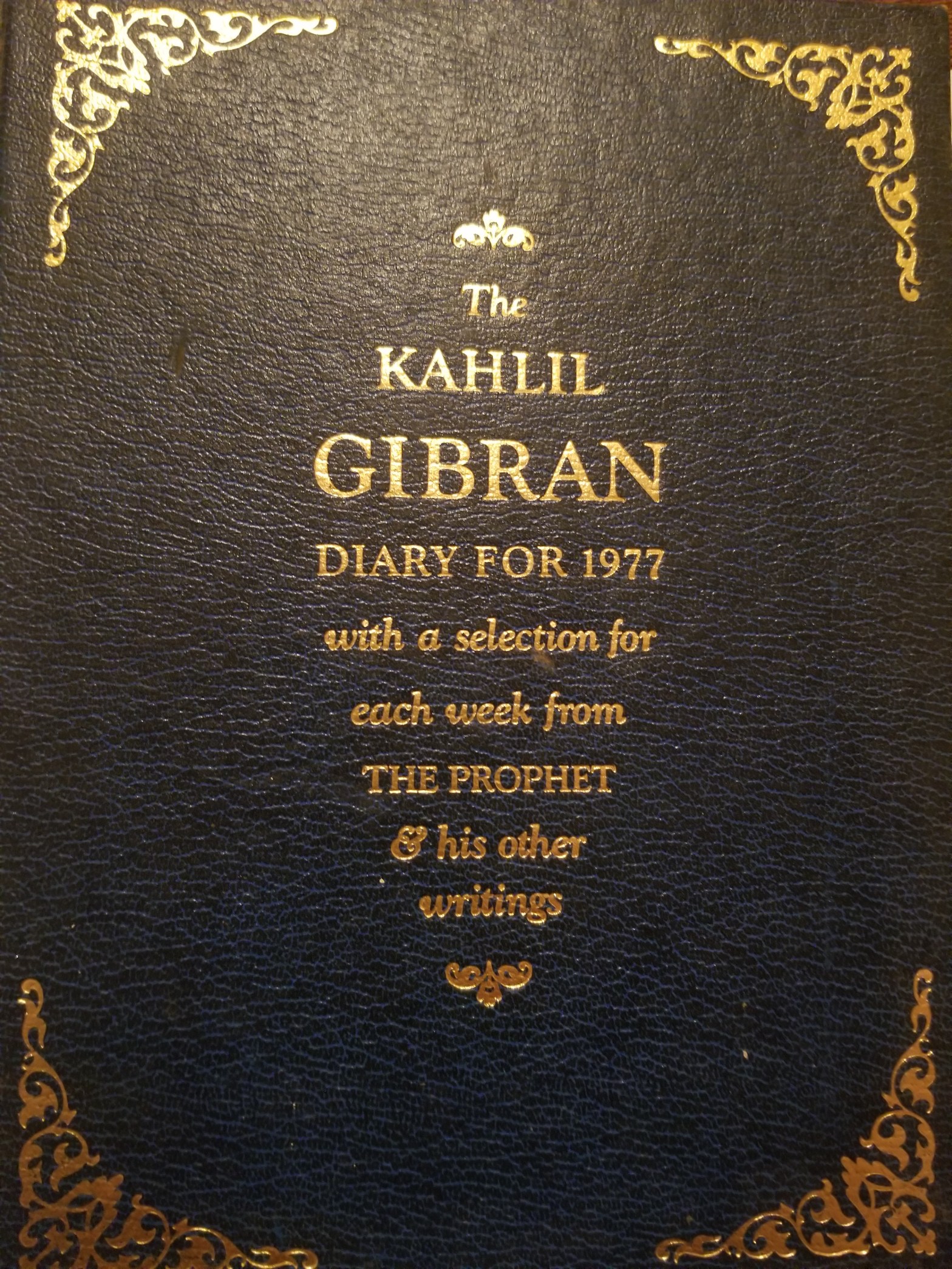
In 1977, Kahlil Gibran was cool. The artist, poet and philosopher was well-suited to 60s and 70s America. Best known as the author of The Prophet, Gibran’s words appeared on posters of serene landscapes, sunrises and out-of-focus lovers. Some posters included his drawings, reminiscent of William Blake, also popular at the time. Quoting Gibran was in fashion for the lecture circuit of peddlers of consciousness – creative consciousness, spiritual consciousness, universal conscious – everything was consciousness. This was the background that  Christmastime of 1976, when my teenage self purchased the 1977 Kahlil Gibran Diary. Every other page had a quote from the famous poet alongside a blank page for me to write in daily. I’ve held onto this Gibran Diary all these years though I would call it a journal these days.  It’s been stored in various locations in America, shipped across the Atlantic and stowed away and moved to various locations across Britain. Many pages are yellowed and it holds a slightly dusty mildew odour.

Today, living in what I suppose is the last third of my life, I’ve started re-examining the first two-thirds and mining my early journals for writing material. Opening this 1977 book for the first time since I was writing in it, I was hit in the face by my naïve teenage musings – obsessed with sex and death – and dreams of a grown-up life. Worse still, I came up against my own poor writing. I mean this in two senses of the word writing. My penmanship was painful to read with letters crunched together for most words with others stretched out as if taking a breather from my nervous hand. While my school report cards shined with top marks, the teacher’s comments inevitably included something about my illegible handwriting. For the other sense of writing, I was creative and could devise little narratives with quirky characters, using humour and descriptive imagery, but hopeless with the mechanics of writing. I wrote as I spoke in fragmented sentences – or their painful cousin, the run on sentence with a string of dependent clauses. I pretentiously employed erudite terms, often hitting the wrong tone or leaving my reader bemused. It’s easy to say this and analyse it now, but I do feel some mortification on behalf of my younger self.

Mediated by the journal, this conversation with teen me has brought back those formative years, the role of new age spirituality in a life riddled with family dysfunction. I wonder to what extent I was a product of that time period in American social history. Many political and social aspects of the mid 1970s escaped my notice then, being preoccupied with family and school life and most frighteningly with what was happening to my body. The Kahlil Gibran quotes, by the way, may have been read, but I rarely commented on them or used them to inspire my own writing. I’ve realised that if I’m to convert these writings into an essay, I can’t trust the limited memories or understandings of a teenager. Adding a political and sociocultural context to my young life gives me a chance to share my adult knowledge and build on it at the same time. What is the point of a writing project that I can’t learn anything from?

Okay, I’ve written about it – now if I can only get back to writing it.

A Sense of Place

I submitted my story only a day before the deadline. I don’t like running so close to the edge, but I’ve been busy with moving house in France. The story is for a literary magazine with an upcoming issue on the theme of place. Of course, place is everywhere, and every story takes place somewhere. Bringing place into the foreground is, I assume, what the editors meant by calling it a theme.

My story is set in India and is about a young woman who is somewhere on the spectrum (as we say these days). The treatment of animals (a contrary mix of despise and adoration) and of the poor (a mix of tolerance and alienation) makes this Western woman realise something about herself. I don’t know if I have succeeded in keeping place in the foreground. My main character has stolen the scene, and I suspect the editors will put my story into the neuro-diversity box either for another issue or for the overflowing rejection bin.

All of this has me thinking about place in fiction writing. I recall a playwright once explaining to fellow writers that he treated place as if it were a character. Place shouldn’t just be wallpaper. Whether it’s developing characters or causing certain actions to occur, place needs to play a meaningful role in the story.

In a book I just finished reading, The Paper Palace by Miranda Cowley Heller, the author does a particularly good job of using place as if it were a character. A New York family’s summer home is referred to as the paper palace. It is a tranquil, beautiful place that draws the family together and is where two key events occur. One event is a traumatic childhood experience, which triggers a tragic death and more painful memories. The other is a secret romantic relationship, which creates the main conflict of the story and a decision for the protagonist to grapple with until the very end. The summer home is feared and desired, and most importantly is unavoidable for the main characters.

While working on my short story and reading the Heller book, I’ve been reflecting on my sense of place in Nice, where David and I have had a second home for nearly 14 years. At one time, Nice was our escape from British winters. Now, it has become an escape from British life post-Brexit. As it has also become a place to spend more of my retirement (if writers every really retire), we’re looking for a larger apartment, a quieter city and a location closer to Italy for weekend jaunts. And thus, we’re apartment shopping in Menton. I trust that once we have left Nice, it, like India, will be a place I can write about from the vantage point of memories. Having said that, I’m reminded of a quote attributed to Benjamin Disraeli: ‘Like all great travellers, I have seen more than I remember and remember more than I have seen.’

Writing about and with our senses

In her book Sentient: What Animals Reveal About Our Senses, Jackie Higgins quotes from Leonardo Da Vinci who observed that the typical person ‘looks without seeing, listens without hearing, touches without feeling, eats without tasting . . . [and] inhales without awareness of odour or fragrance.’ When it comes to using our senses, Higgins concurs that ‘We are guilty of underappreciating – and underestimating.’

Higgins’ book is chocked with fascinating facts and anecdotes about animal and human senses, presented in accessible language that at the same time is not shy to use scientific terms. By senses, the author is not considering only the five senses delineated by Aristotle, but others that have since been examined, such as the senses of balance, pain, time and space.

I learned among other things that octopuses are covered with tactile sensors. Higgins cites studies showing how octopuses can use their heightened sense of touch to navigate mazes, dismantle Lego sets and even open childproof caps that leave us adults flummoxed. Other sea creatures can see colours that humans cannot, and some humans are so colour blind they experience the world in greyscale. The legendary speed of the cheetah is explained through recent studies of their acute sense of balance. This idea is explored further through experiments with athletes and dancers.

Along with these fun factoids, I also came away from this book thinking about the ways writers exploit the senses in creative writing. This is a well-worn topic in writers’ workshops and in those ubiquitous how-to books on writing. I won’t disagree with any of it. To transport the reader into an unknown place through words alone involves attention to all the senses and not just that of sight – visual description tends to be overdone and over-adjectived by novice writers.

This week I’ve been reading Black Dahlia and White Rose, a collection of short stories by Joyce Carol Oates. In ‘Spotted Hyenas: A Romance’ Oates employs the sense of smell in a few noteworthy ways. First, she uses smell to create fear and intrigue. A middle-aged woman, Mariana, thinks there’s a male intruder in her home and when he disappears all that is left is an animal scent. A few days later, the man reappears and seems to be half man, half animal. He enters a room filled with books. After he disappears for a second time, Mariana finds a book sticking out from a shelf – ‘The paperback Origin of Species was still warm, as if the furry man had been breathing on it. There was a smell—a distinct, acrid, animal smell…’. Mariana later realises (or strongly believes) that the man is someone she knew in her student days. The sense of smell becomes integral to the developing plot as the realisation triggers a flashback into an earlier life, full of dreams unfulfilled. This leads to a reunion at a pungent hyena habitat and this gem, when she first encounters her old classmate: ‘He stared bluntly at her and leaned close. Mariana could smell his breath—a meaty, earthy smell—a faint under-smell of decay like something overripe.’

If Da Vinci and Higgins are accurate about humans not appreciating their senses, perhaps writers and artists are needed to remind us of the copious world our senses can produce.

Joyce Carol Oates (again, I am a fan).

Some thoughts on dialogue in prose

Douglas Stuart’s Shuggie Bain and Barbara Kingsolver’s The Bean Trees have been among my summer reads. The two novels are studies of poverty and familial relationships.  Shuggie Bain is a coming-of-age story set in the council estates of Glasgow spanning ten years of the 80s to early 90s, while in The Bean Trees, a quasi-road story, a young woman in a beat-up car drives from Kentucky to Arizona over several months creating a new life for herself.

While I found both stories engaging and interesting in the worlds they inhabited, their handling of dialogue made Shuggie Bain the better read. This is despite losing its pace about three-quarters in. The Bean Trees, Kingsolver’s first novel, is tightly constructed and held its pace, but occasionally the dialogue fell flat as it appeared to try too hard to sound like the way people speak. Let’s be honest – in everyday speech, people wear out idioms and exhaust popular expressions. It’s part of the interpersonal function of language (for you M.A.K. Halliday fans). That is, we speak in familiar, tried and tested, language to connect with people.

In Shuggie Bain, the dialogue worked – which I wouldn’t have expected from a novel containing the Glaswegian dialect. Despite having lived in Edinburgh for five years and regularly visiting Scotland ever since, I still stretch my ears to understand Glaswegian. Perhaps Stuart knows this.  He’s allowed the narrative prose to do much of the work, leaving the dialogue gently sprinkled throughout the text.

A writer’s confession – my true love is scriptwriting. While I’m not writing scripts these days and might not ever return to it (a topic for another blog), I have learned some useful lessons from writing in a medium where dialogue does the heavy lifting. Allow me to enter the imperative mode. First, don’t bother trying to replicate everyday speech all the time. As mentioned, it can be dull on the page and duller still when coming out of the mouth actors, unconvinced themselves. Aim for dialogue that sounds natural, but devoid of the mundane parlance of everyday life. Second, use subtext. Characters don’t need to explain their thoughts. In fact, their dialogue is strongest when they say one thing to mean something else or to do something that is not obvious from the literal meanings of their words.

Okay, I’ve left the classroom and the imperatives behind.

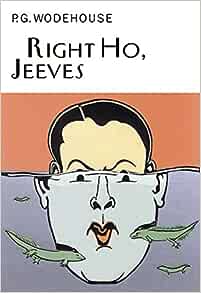
P. G. Wodehouse was masterful at dialogue.  Nothing sagged in his characters’ speeches, using language more colourful than quotidian conversation. Where a character from The Bean Trees would say something like ‘he thinks he’s the cat’s pyjamas,’ Wodehouse’s Aunt Dahlia huffs out ‘Your uncle Tom thinks he’s the cat’s nightwear.’ As for Jeeves, everyone’s favourite butler provides understated commentary and suggestions to his master that are loaded with subtext. In this example from Right Ho, Jeeves, the text leading up to this tells us that Bertie is confused about a woman’s intentions, and Jeeves offers, ‘Feminine psychology is admittedly odd, sir. The poet Pope…’

‘Never mind about the poet Pope, Jeeves.’

‘No, sir.’

‘There are times when one wants to hear all about the poet Pope and times when one doesn’t.’

‘Very true, sir.’

From this snippet, the reader knows that Bertie is irritable and won’t listen to considered advice, and that Jeeves, due to his station, is going to play along.

There are loads of other great prose writers who command the dialogue in their works, but on a Saturday afternoon in August, Wodehouse was the first to come to mind.

Writing with a Chatbot

‘I can see the value of AI as a useful tool for things like writing abstracts for scientific papers and the like.’ That was me on the topic of AI generated writing before I experimented with it myself.

As a total novice, I had no idea what I could ask of an AI bot or how I should ask it. I signed up for a free mini course offered by creativity guru Dave Birss on LinkedIn on how to get started with ChatGPT to ‘upskill as a researcher and a writer.’ Perfect.

I quickly learned that instructions had to be detailed and lengthy. It wasn’t just ‘write me an essay’ or ‘write me an article’ on a topic. Creating a prompt for the chatbot involved writing a meticulous paragraph about the style and scope of the output writing, along with the intended audience and purpose of the writing – for example, was it to sell a product, to persuade readers to act or to simply entertain.

This long-winded instruction had to cover some points that should not be included in the output. This sounded odd to me. Even though essays in literature tend to not have bullet points or numbering, if I wanted a literary essay, I had to specify no bullet points or numbering. In the prompt examples that Birss gave, he always used a phrase about the output piece being ‘jargon free.’ For that I’m assuming if you don’t point it out, the bot gives you jargon.

During the course, for practice, I asked ChatGPT to write an informative 500-word summary of an article that I referred to in last week’s blog. When I put in some of the things I did not want, I included that the summary should be ‘jargon free.’ Within seconds, I received a summary that adequately picked up the main points of the article. But it was flat. It lacked a sense of the critical tone, and there was mention of the provocative examples in the original text. The only comment it made on style noted that the article was ‘jargon free.’ I wonder where it picked up that idea. All these shortcomings made it hard to imagine where such a summary might be used.

To be fair, Birss does point out that AI cannot create ready-to-use copy. Some human editing would be involved.

My second outing with AI involved asking it to help me author an essay that I’m working on for The Journal of Open Learning, where I’m the Book Reviews Editor. We have a special issue coming up on capacity building in online and distance learning. I thought it would be useful to readers to have a short editorial piece on books in this specialised area of education. As I hadn’t had much joy finding specific books on this topic in the usual scholarly search engines, I thought I’d hand it over to ChatGPT. I wrote a long prompt, explaining to the bot that this essay was for an academic audience. I even specifically named the journal. I added that I wanted to advise academics and scholars about recent books in capacity building for online and distance learning. I forgot to mention no bullet points or numbering.

The bot spewed out 1000 words for a generalist audience – perhaps first year undergraduates – that was full of definitions of online and distance learning and of capacity building. It also contained a paragraph on the value of reading books (that part was for high school students). No actual books were mentioned. The style and formatting, complete with a numbered list of diverse ways to find valuable resources, was more suitable to a business report.

I responded to this by asking the bot for some examples of recent books to accompany the article and the books had to have capacity building and online learning in their chapter headings or indexes. There, bot, chew on that one. Within 30 seconds, I was given a list of six book titles with the names of their authors – no dates or publishers were mentioned. I checked each book to get a full reference and to make sure they addressed the topic. One of the books had different authors for the title than what I had been given, and it was generally about online learning – no capacity building. Another book was by a well-known author, and the title was similar to, but not the exact same as, a book written 25 years ago. Four of the six books were completely made up. They simply did not exist.

My second adventure with AI was like the first, missing the mark and not giving me anything I could work with. I take back what I said earlier this year about AI writing scientific abstracts. AI as a writer’s tool is in its infancy. In my experiments, it has misunderstood the nuances of writing and the rigour expected of academic research and prose. For the time being, AI appears to have a place in writing for generalist audiences and might produce working drafts for business reports, marketing content, articles for the popular press, blogs – hey, wait a minute…

Dave Birss, who offers a useful and entertaining beginner’s guide to AI for writers.