A Renaissance person and a polymath went into a bar…

People say Renaissance man – and my spellcheck has just scolded me for not being ‘inclusive,’ telling me that I should be using ‘person.’ Yet, if you search online for a renaissance person, all you get are Renaissance men. Even worse, if you look up Renaissance woman, images appear of women painted by men of the Renaissance, followed by various articles on the lifestyles of European women who lived during the 15th and 16th centuries. No surprise that the online definitions of Renaissance man are steeped in the ideals and sexist language of that time. From Encyclopaedia Britanica:

‘Renaissance man, an ideal that developed in Renaissance Italy from the notion expressed by one of its most-accomplished representatives, Leon Battista Alberti (1404–72), that “a man can do all things if he will.” The ideal embodied the basic tenets of Renaissance humanism, which considered man the centre of the universe, limitless in his capacities for development, and led to the notion that men should try to embrace all knowledge and develop their own capacities as fully as possible.’

In other definitions these capacities specify physical strength and artistic ability. I wonder if Renaissance man has been replaced by polymath – a fine word though it might lack the gravitas of the Renaissance person. The difference being that a polymath is a person of wide knowledge and learning who’s not required to excel in arts or sports. The word polymath didn’t come along until the early 17th century at a time of burgeoning sciences and an affinity for Latin and Greek. It’s derived from the Greek polys, meaning many, and mendh, meaning to learn.

What brought me to this subject of humans who excel is different fields was the recent discovery that the 19th century chemist Sir Humphry Davy was also secretly a prolific poet even though, unknown to most people, only a couple of his poems were published in his lifetime. It turns out his scientific journals were sprinkled with his verse. In the popular press, this idea that a scientist can also be literary seems to come as something of a shock. Is this the result of the specialist world we live in? Or is there some provincial side, a kind of lazy thinking going on? That is, it’s easier to put people into one box than the many boxes most of us inhabit whether we are accomplished or not.

The Observer quotes Sharon Ruston of Lancaster University commenting on Sir Humphry Davy’s journals: “He’s writing about nitrous oxide or galvanism. But then there are lines of poetry as well. These two things are happening simultaneously for him. He is trying to figure out what the world is and how to understand the world.” In this light, it’s not surprising that thoughts about chemistry and poetry were intertwined. So much of the sciences and technologies use the language of metaphors to explain how things work.

Incidentally, a search for women polymaths was more successful than that for Renaissance women. The obvious candidates included the composer, philosopher and abbess Hildegard of Bingen and Florence Nightingale (a statistician as well as a nurse). The not so obvious candidates from the pop-culturally biased world of algorithms were Michelle Obama and Taylor Swift.

What I’ve been reading…

Over the festive season, I read a couple of excellent novels that both revolve around a strong bond between a brother and sister. Ann Patchett’s The Dutch House is an entertaining and thoughtful family saga that questions the importance of the homestead and of family possessions. Yuri Herrera’s short novel, Signs Preceding the End of the World, is about a young Mexican woman who crosses the US border to bring her brother back home. While both books are well-written, Herrera’s lyrical style and Dantesque narrative journey left more of an impression.

Writing about and with our senses

In her book Sentient: What Animals Reveal About Our Senses, Jackie Higgins quotes from Leonardo Da Vinci who observed that the typical person ‘looks without seeing, listens without hearing, touches without feeling, eats without tasting . . . [and] inhales without awareness of odour or fragrance.’ When it comes to using our senses, Higgins concurs that ‘We are guilty of underappreciating – and underestimating.’

Higgins’ book is chocked with fascinating facts and anecdotes about animal and human senses, presented in accessible language that at the same time is not shy to use scientific terms. By senses, the author is not considering only the five senses delineated by Aristotle, but others that have since been examined, such as the senses of balance, pain, time and space.

I learned among other things that octopuses are covered with tactile sensors. Higgins cites studies showing how octopuses can use their heightened sense of touch to navigate mazes, dismantle Lego sets and even open childproof caps that leave us adults flummoxed. Other sea creatures can see colours that humans cannot, and some humans are so colour blind they experience the world in greyscale. The legendary speed of the cheetah is explained through recent studies of their acute sense of balance. This idea is explored further through experiments with athletes and dancers.

Along with these fun factoids, I also came away from this book thinking about the ways writers exploit the senses in creative writing. This is a well-worn topic in writers’ workshops and in those ubiquitous how-to books on writing. I won’t disagree with any of it. To transport the reader into an unknown place through words alone involves attention to all the senses and not just that of sight – visual description tends to be overdone and over-adjectived by novice writers.

This week I’ve been reading Black Dahlia and White Rose, a collection of short stories by Joyce Carol Oates. In ‘Spotted Hyenas: A Romance’ Oates employs the sense of smell in a few noteworthy ways. First, she uses smell to create fear and intrigue. A middle-aged woman, Mariana, thinks there’s a male intruder in her home and when he disappears all that is left is an animal scent. A few days later, the man reappears and seems to be half man, half animal. He enters a room filled with books. After he disappears for a second time, Mariana finds a book sticking out from a shelf – ‘The paperback Origin of Species was still warm, as if the furry man had been breathing on it. There was a smell—a distinct, acrid, animal smell…’. Mariana later realises (or strongly believes) that the man is someone she knew in her student days. The sense of smell becomes integral to the developing plot as the realisation triggers a flashback into an earlier life, full of dreams unfulfilled. This leads to a reunion at a pungent hyena habitat and this gem, when she first encounters her old classmate: ‘He stared bluntly at her and leaned close. Mariana could smell his breath—a meaty, earthy smell—a faint under-smell of decay like something overripe.’

If Da Vinci and Higgins are accurate about humans not appreciating their senses, perhaps writers and artists are needed to remind us of the copious world our senses can produce.

Joyce Carol Oates (again, I am a fan).

Sensitive, Intelligent Trees – how not to popularize science writing

I warned you, one of my themes this year is trees. Having completed an online course on trees and sylviculture, I’ve turned to books on the subject.

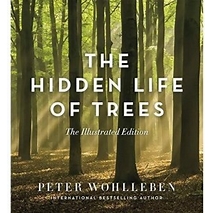
The Hidden Life of Trees by Peter Wohlleben was an international bestseller some five years ago that somehow past me by. On the back of this Wohlleben, a forester by training, has his own magazine, podcast and television show in his native Germany. Now he has a sequel volume that has been reviewed and piqued my interest. But given the rule for most film franchises – sequels are rarely as good as the original – I thought it right that I read the original first.

I’m afraid I struggled with the anthropomorphizing of trees throughout this popular book. Example: ‘The tough trees that grow on this slope are well versed in the practices of denial and can withstand far worse conditions than their colleagues who are spoiled for water.’ Denial is a complex human emotion, one that involves a great deal of reflection and conjuring of scenarios to discount one explanation over another more palpable idea. When I try to grow a new plant from a cutting and it doesn’t work, I don’t suspect the cutting of being in denial of its new situation or resisting the notion of creating new roots. It’s more likely the weather conditions weren’t ideal, the soil was too acidic, or my rooting powder was too cheap to work.

Discussing three oak trees that are next to each other, Wohlleben claims one is ‘behaving’ differently from the rest. ‘Clearly, each of the three trees decides differently. The tree on the right is a bit more anxious than the others, or to put it more positively, more sensible.’ My more prosaic explanation might involve exposure to wind or sunlight, or one of the trees being a favourite of the local canine population.

What got under my skin the most were the references to trees having the parental, often ‘motherly,’ sensibility to protect their young. This comes from an idealisation of parenthood and motherhood that doesn’t fit well with the reality of dysfunctional families or those families where love and nurturing exist, but the time and means to provide safety are lacking due to economic circumstances.

To the book’s credit, it includes fun facts about the ages of some trees – over 10,000 years old. And a few interesting factoids: Apparently, walnut trees emit a mosquito repellent; and ‘There are more life forms in a handful of forest soil than there are people on the planet.’

The book is also useful for its environment points. Bringing together the ideas of commercial forestry with industrial farming, Wohlleben notes that, ‘Thanks to selective breeding, our cultivated plants have, for the most part, lost their ability to communicate above or below ground. Isolated by their silence, they are easy prey for insect pests. That is one reason why modern agriculture uses so many pesticides.’

Reviews of the book show a divide between the professional reader-critics (e.g., The New Yorker and The Guardian) and the citizen-critics on the internet (e.g., Goodreads and Amazon). The latter praise the ‘accessibility’ and ‘delightful’ style and presentation of complex science. I’m with the professional readers who cringe to varying degrees over the simplifications, humanizing and questionable science being used to support the idea of trees having feelings and the capacity to learn. I prefer language about transmitting signals through electrons and the ways living organisms adapt to their environment. I’d like to think that with information and visual aids literally at our fingertips, science writing to generalist audiences no longer needs to rely upon fairytale scenarios or the registers of childhood language.

Paul Nash’s Cherry Orchard (1917)