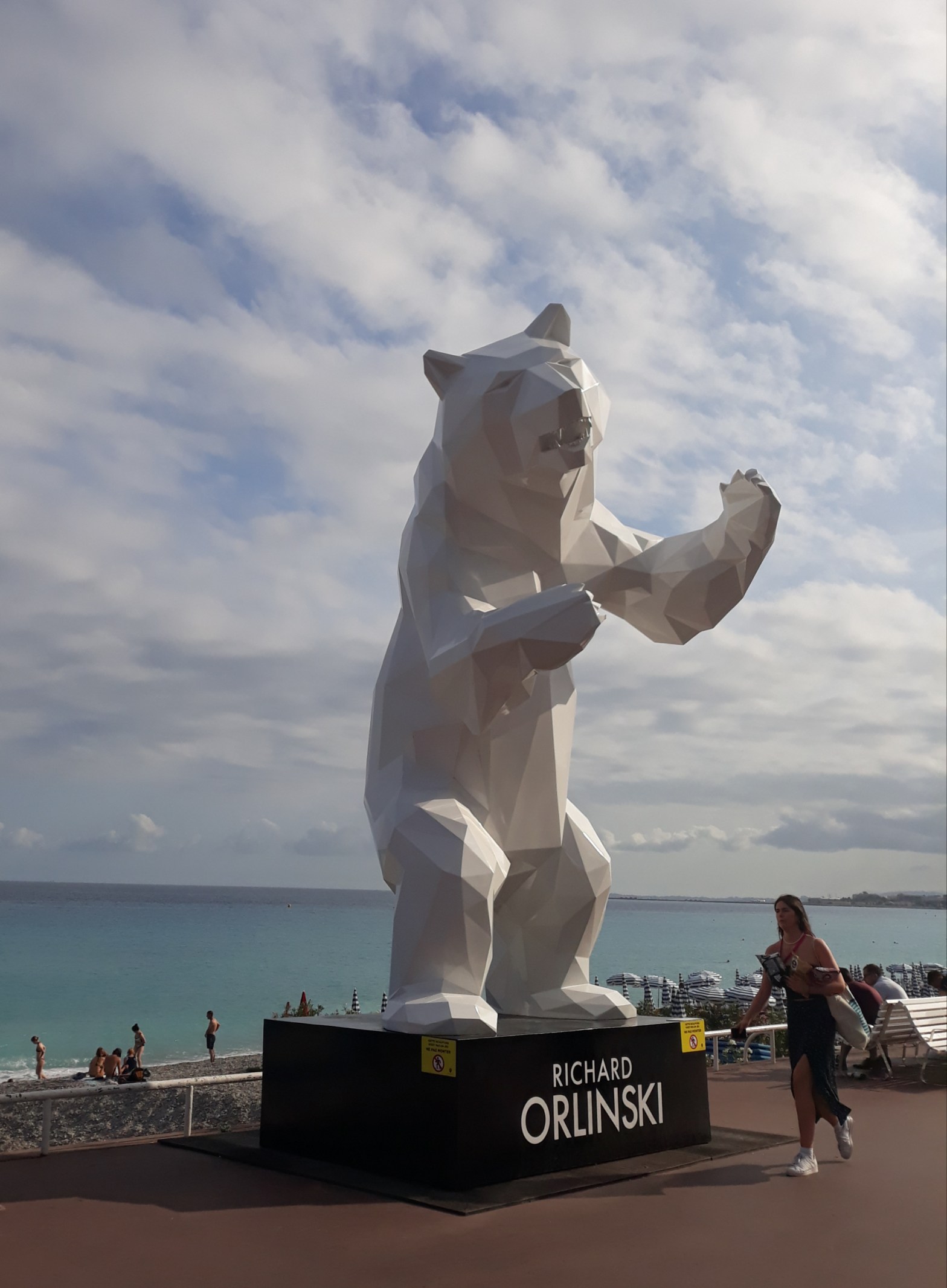
This trip to France has been decorated with some controversial street art. An installation by the French neo-pop artist Richard Orlinski of colossal animal sculptures has the French culturati polemicizing and passersby posing for selfies with the plasticine creatures. The monochrome structures use the bright colours of the original ten-pack of Crayola crayons and resemble children’s toys. These qualities and their placement in public squares, the famous promenade and even one at the airport give them a sense of fun.

Since the first sculpture I noticed in the installation was of a white polar bear, on its hind legs with a ferocious scowl, I thought there was an environment message or meaning. My other thoughts were to do with the bear as a symbol for Russia. As Nice has a sizable Russian community, I thought the creature was well placed and could have something to do with the war in Ukraine. All these ideas fell apart when I saw a huge black lion and a red tyrannosaurus rex in other parts of the city centre. Then there was Kong. A yellow King Kong wields a barrel over his head in Place Massena and a red version of Kong is amusing arrivals at the airport. I haven’t taken a picture of these Kongs as I feel some copyright issues should be taken into consideration. Kong might be iconic, but he was the creation of American filmmaker Merian C. Cooper, who deserves some credit and his estate some money for the use (or overuse) of the image.
Critics of Orlinski’s animal sculptures point out that they are simplistic and negate the complexities of art. I agree with that as I aimlessly search for meanings. Edgar Degas once said that ‘art is not what you see, but what you make others see.’ These sculptures, neither individually or as a collection, make me see or understand anything differently.
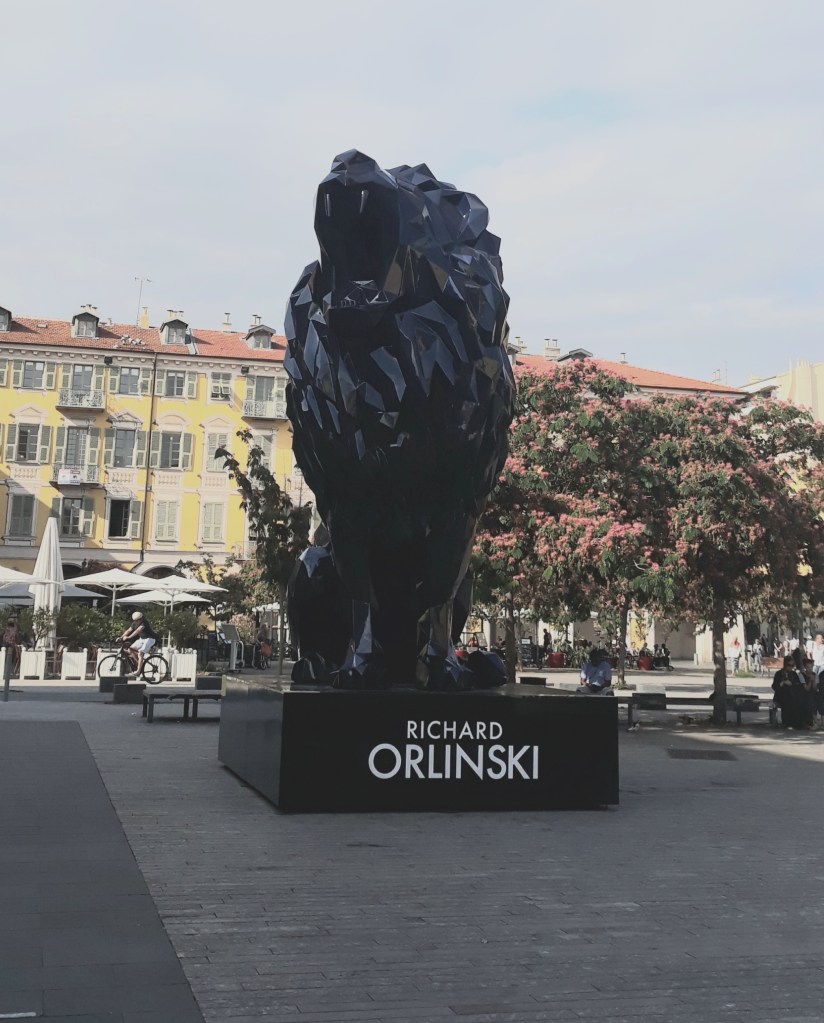
Orlinski is also unpopular with galleries as he draws costumers away from indoor installations and the more traditional paintings-on-walls exhibitions. The works have thus been reduced to ‘instagramable’ and ‘industrialised art.’ Orlinski’s own giant-sized replicas sell for 500,000€ and figurine versions for 2,000€. Being accessible to the public for me is a point in their favour. I can’t find fault in a sharing of creativity, even if their most creative feature lies in their enormity and placement in unlikely public spaces. They have at least been a source of gentle amusement during this working holiday.

 Paola Trimarco